
Dual Band 4G LTE Router
4.7Editor score
AC1200 dual-band Wi-Fi
32-device connection support
Six external antennas
Modem with SIM card slot choices compared for speed, coverage, failover, portability, and features to help you select the right router for home, travel, or
A modem with SIM card slot can replace a conventional cable connection with cellular service, creating a flexible Wi-Fi network for a home, office, vehicle, or temporary worksite. The best model depends on carrier compatibility, supported LTE or 5G bands, wired ports, antenna options, failover features, battery life, and how many devices need simultaneous access.
This guide compares ten unlocked cellular routers with physical SIM card slots, ranging from compact travel dongles to dual-SIM 5G models with multi-WAN controls. The comparison considers wireless generation, cellular category, network bands, Ethernet connectivity, VPN support, battery capability, antenna design, and practical coverage features rather than relying on marketing labels alone.
Each selection reflects where its design offers the strongest balance for a particular need, including budget networking, wired failover, portable operation, and premium 5G connectivity. Ratings and specifications can change as products evolve, and prices also fluctuate, so shoppers should confirm carrier support, SIM format, regional bands, and current availability before purchasing.
4.7Editor score

4.3Editor score

4.1Editor score
The table below compares the cellular standard, wireless generation, SIM approach, and standout connectivity features of all ten routers, making it easier to match a device to a particular home, travel, or backup requirement.




The Cudy 4G AC1200 combines a cellular modem, dual-band Wi-Fi 5 router, and four-port network switch in one enclosure. Its 4.3 rating reflects a balanced feature set, while the LT500 platform provides Cat 4 LTE connectivity with cellular download speeds stated up to 150 Mbps. That makes it a practical choice when cable service is inconvenient, unreliable, or completely unavailable.
We may earn a commission when you buy through this link, at no additional cost to you.
The strongest feature is its combination of four Fast Ethernet ports with automatic WAN failover. A home computer, network switch, security camera, or other wired terminal can be connected directly, while the router can switch from a primary broadband connection to cellular service if the fixed link drops. Built-in WireGuard, OpenVPN, and IPsec support gives it more utility for remote access than a basic hotspot and removes the need for a separate VPN appliance on many small networks.
Its dual-band Wi-Fi 5 is specified at 867 Mbps on the 5 GHz band and 300 Mbps on the 2.4 GHz band. External antennas improve the chances of stable LTE reception, and the compact enclosure is more suitable to a permanent desk or shelf than to handheld travel. The main limitation is that Cat 4 cellular hardware cannot deliver the higher theoretical throughput associated with newer LTE categories or 5G, and buyers must provide their own compatible nano SIM.
This is the strongest overall choice for a small office, rural residence, retail location, or home that wants cellular backup without complicated routing. It is less appropriate for a user who expects 5G performance or needs a large collection of advanced multi-WAN controls, but its mix of Ethernet ports, failover, dual-band Wi-Fi, VPN tools, and external antennas is unusually well rounded for a 4G router.
Automatic WAN failover turns the router into more than a cellular hotspot. A business can keep its primary broadband connection while using LTE as a secondary path, allowing online systems to remain reachable if the wired service becomes unavailable.
Four Fast Ethernet ports make the LT500 useful for desktop systems, IP cameras, and other equipment that benefits from a wired connection. Those ports also reduce the need for a separate switch in a compact installation.
We may earn a commission when you buy through this link, at no additional cost to you.
The VSVABEFV C910 is an unlocked 4G router aimed at users who want a straightforward cellular-to-Wi-Fi connection without the cost of a more advanced multi-WAN system. Its 3.9 rating places it in the middle of the group, but the specification set is useful for a home, small office, or temporary installation where multiple devices need to share a cellular connection.
We may earn a commission when you buy through this link, at no additional cost to you.
The router supports LTE FDD bands B2, B4, B5, B12, B13, B17, B18, B25, and B26, which makes it particularly relevant in the United States, Canada, and Mexico. It also supports WCDMA and 4G, with stated LTE download rates up to 150 Mbps and upload rates up to 50 Mbps. Its 300 Mbps Wi-Fi and capacity for 32 simultaneous devices are enough for browsing, streaming, IPTV, smart-home equipment, and routine household use.
Two LAN ports and one WAN port provide basic wired connectivity, while four non-detachable antennas are intended to help maintain cellular and Wi-Fi reception. Router, access point, and repeater modes give it some flexibility when it is used to extend an existing network rather than create the primary connection. A limitation is that the wireless side is single-band, so nearby 2.4 GHz traffic can compete more heavily than it would on a dual-band router.
The product is best for buyers who prioritize carrier and band compatibility, modest equipment cost, and simple operation. It is less appealing for crowded offices, users seeking Wi-Fi 6, and travelers who may need 5G. Buyers should also disable any SIM PIN code and verify the correct APN before use, while confirming that their SIM is compatible with the router and not restricted to another device.
The extensive listed LTE band selection is a major strength in the United States, Canada, and Mexico. Regional compatibility remains more important than a headline speed because a router cannot connect reliably to every carrier on every market.
Router, access point, and repeater modes let the C910 serve as a primary cellular router, share a wired network wirelessly, or extend an existing Wi-Fi signal. That makes it more adaptable than a conventional travel hotspot.
We may earn a commission when you buy through this link, at no additional cost to you.
The GL.iNet GL-X2000 Spitz Plus combines Cat 12 LTE, dual-SIM operation, Wi-Fi 6, and sophisticated multi-WAN controls. Its 4.3 rating matches the Cudy model, but this router appeals to technically capable users who want greater routing flexibility. It is designed for remote access, temporary offices, and small businesses that need cellular service to function as more than an emergency backup.
We may earn a commission when you buy through this link, at no additional cost to you.
Cat 12 LTE uses three-carrier aggregation to increase bandwidth availability and improve responsiveness when conditions permit. Inside, dual-band Wi-Fi 6 is specified at up to 574 Mbps on 2.4 GHz and 2402 Mbps on 5 GHz. Two SIM slots provide carrier selection and automatic network failover, while the multi-WAN system can combine Ethernet, cellular, repeater, and tethering connections with configurable failover priorities and proportional load balancing.
Security and remote-management tools are another strength. OpenVPN and WireGuard are preinstalled, with support for more than 30 VPN services, and the device can create an encrypted private network for remote users. Four SMA connectors allow external cellular antennas to be added where stronger or more directional reception is needed. The trade-off is complexity: this is a router for someone comfortable configuring WAN relationships, VPN clients, and advanced routing rather than a minimal device that only creates a hotspot.
The Spitz Plus is well suited to a home office, field deployment, temporary retail location, or backup network that needs multiple connection paths. Its North American designation and carrier certification make regional verification especially important. It does not offer 5G or an internal battery, so it works best near a mains outlet and with optional antennas, but it is one of the most capable dedicated 4G choices in this roundup.
The ability to use cellular, Ethernet, repeater, and tethering paths gives administrators more ways to preserve access. Custom priorities and proportional load balancing can keep traffic moving when one connection becomes slow or unavailable.
Four SMA connectors allow appropriate antennas to be positioned near a window or outside a cabinet. This can be valuable in metal enclosures, dense buildings, and remote locations where the router's internal reception is insufficient.
We may earn a commission when you buy through this link, at no additional cost to you.
The Hitron D60 is built around 5G cellular performance and is one of the few picks in the list capable of combining a physical nano SIM with eSIM-based failover. Its 4.0 rating reflects solid overall utility, while support for both standalone and non-standalone 5G makes it suitable for markets at different stages of 5G network deployment.
We may earn a commission when you buy through this link, at no additional cost to you.
The stated 5G download capability reaches up to 3.4 Gbps on non-standalone 5G, while the Wi-Fi 6 side uses 4×4 MIMO radios with capacity stated at up to 5.4 Gbps. It remains backward compatible with 4G LTE, so the router can continue operating on 4G when a 5G network is unavailable or the carrier has not enabled a particular 5G mode. The AX3000 designation also indicates a modern wireless standard intended to support several high-bandwidth clients.
Dual failover capability is the major practical feature. A physical nano SIM and eSIM can use separate carrier paths, giving a residential or small-office installation a cellular backup when the primary internet service fails. Certification with T-Mobile, AT&T, and US Cellular provides a clearer basis for compatibility, although users should still confirm that their plan, location, and SIM are supported.
The D60 makes the most sense for users who need fast 5G, expect heavy file transfers or high-resolution streaming, and want cellular continuity for critical work. Its emphasis on fixed installation means it is not the most convenient travel router in the group, and a suitable power source and continuous service are important. Even so, it delivers a rare combination of 5G, Wi-Fi 6, mesh support, and two cellular options.
Using nano SIM and eSIM capabilities together allows service from separate paths, reducing the chance that a carrier outage or local network problem will leave the installation disconnected.
The combination of high-capacity 5G cellular service and 4×4 Wi-Fi 6 radios is intended for modern homes and small offices where many devices may access media, cloud applications, and large files concurrently.
We may earn a commission when you buy through this link, at no additional cost to you.
The GL.iNet GL-XE3000 Puli AX is the most versatile premium model here, combining 5G, dual-SIM functionality, Wi-Fi 6, multi-WAN routing, and a substantial internal battery. Its 4.1 rating may be modest for such an advanced specification sheet, but the design serves a broad range of professional, travel, and event applications that simpler cellular routers cannot match.
We may earn a commission when you buy through this link, at no additional cost to you.
The router supports 5G NSA and SA, remains compatible with 4G LTE, and can select between two SIM-based carrier connections with automatic failover. Wi-Fi 6 is specified at up to 574 Mbps on 2.4 GHz and 2402 Mbps on 5 GHz, with MU-MIMO support for simultaneous connections. A 6400mAh battery is stated to provide up to eight hours of uninterrupted operation, which is particularly useful at construction sites, conferences, outdoor events, and temporary offices.
Multi-WAN support includes Ethernet, repeater, cellular, and tethering paths, along with load balancing, failover, DNS over TLS, and DNS over HTTPS. Preinstalled OpenVPN and WireGuard support more than 30 VPN services. For advanced users, the OpenWrt-based proprietary firmware opens a large selection of plugins and customization options, while a no-code interface provides a simpler path for less technical administrators.
The Puli AX is the best premium choice when portability, 5G, and advanced routing must coexist in one device. It is less convincing for a basic household that only needs an affordable LTE hotspot, and the physical eSIM feature requires a separately purchased card. Cellular performance also depends heavily on carrier coverage, signal conditions, and the availability of 5G bands in the chosen area.
The 6400mAh battery allows the Puli AX to remain online during short outages and makes the router practical for mobile or event use. It does not replace a full power system for prolonged outages, but it adds useful flexibility.
The firmware provides access to more than 5,000 ready-made plug-ins, giving experienced users a high degree of control. A separate no-code panel keeps basic administration approachable without discarding deeper configuration options.
We may earn a commission when you buy through this link, at no additional cost to you.
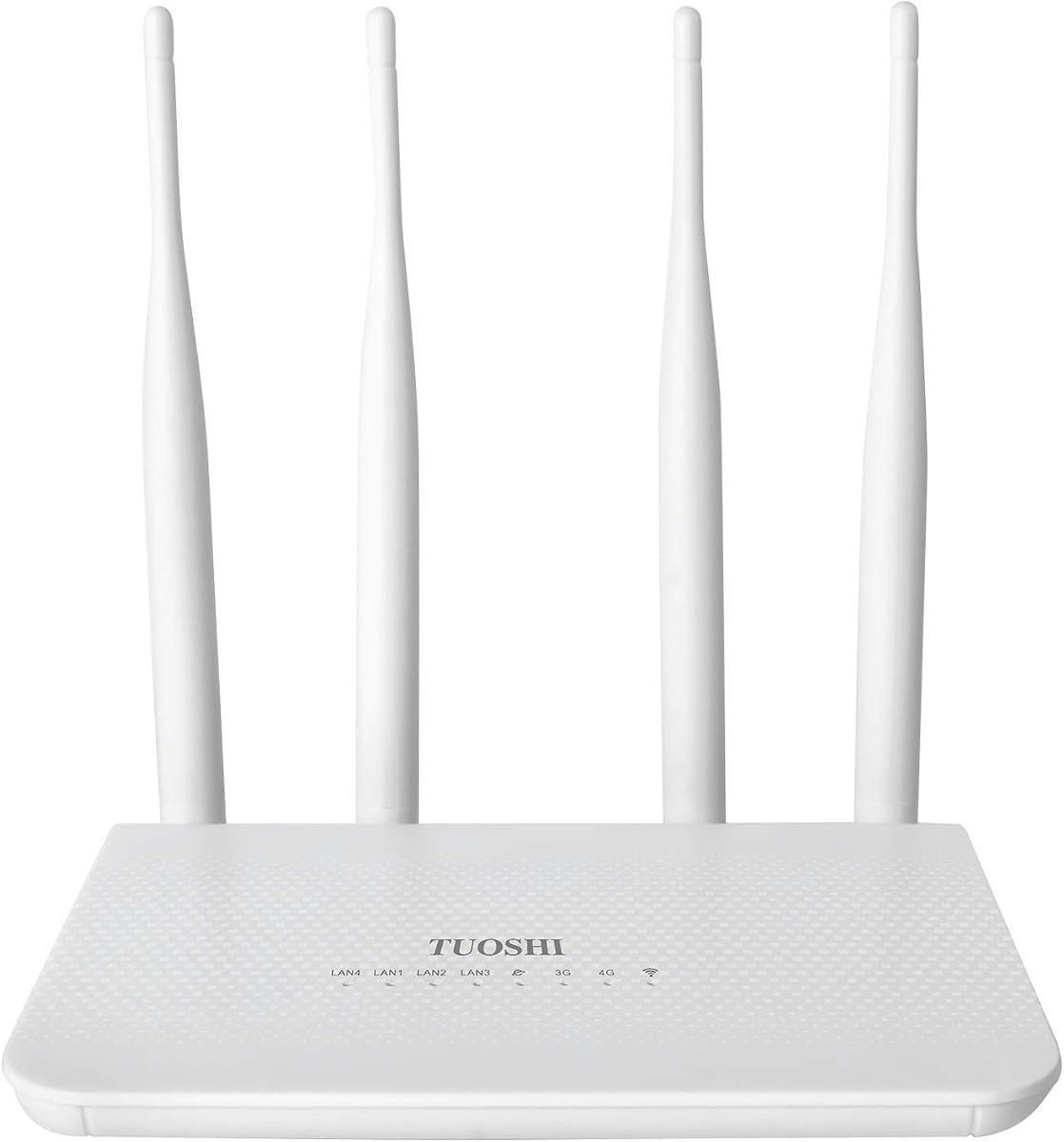
The unnamed Dual Band 4G LTE Router is a straightforward AC1200 cellular router with a 4.7 rating, the highest among the ten products considered. It combines Cat 4 LTE, dual-band Wi-Fi, automatic failover, and five RJ45 network ports, making it a compelling budget-oriented choice for buyers who need more networking flexibility than a basic travel hotspot.
We may earn a commission when you buy through this link, at no additional cost to you.
The wireless side is specified at 900 Mbps on the 5 GHz band and 300 Mbps on 2.4 GHz, allowing compatible clients to use the less crowded 5 GHz range for gaming and high-definition video. It can support 32 devices at the same time. Cellular performance reaches up to 150 Mbps for downloads and 50 Mbps for uploads, subject to the carrier, network conditions, and the user's data plan.
A single RJ45 WAN port accepts a wired broadband connection, while four additional RJ45 Ethernet ports support computers, switches, cameras, and other wired equipment. The router can automatically move to 4G service if the broadband connection fails. Six external antennas are included to strengthen both cellular reception and Wi-Fi coverage, and setup involves inserting a compatible SIM and entering the wireless password.
This is an attractive choice for a home or office that wants inexpensive cellular backup and a capable dual-band network without moving to a premium 5G platform. The important limitation is carrier support: the product is specified for AT&T and T-Mobile only and is not compatible with Verizon or Sprint. A standard SIM is also required, and users should confirm that their provider permits data-router use before purchasing.
Separating 2.4 GHz and 5 GHz traffic allows compatible devices to move demanding streaming and gaming activity away from the more crowded lower band. This is a meaningful benefit over single-band cellular hotspots.
The WAN and four LAN connections let the router replace a basic wired network switch in smaller spaces. They also make it easier to connect stationary equipment without depending entirely on Wi-Fi.
We may earn a commission when you buy through this link, at no additional cost to you.
The N300 Unlocked 4G LTE Modem Router is designed around broad carrier-band support and practical backup networking. Its 3.8 rating is among the lower scores in the group, but the long list of supported LTE and WCDMA bands, four Ethernet ports, and security features make it worth considering wherever compatibility is the priority.
We may earn a commission when you buy through this link, at no additional cost to you.
The listed LTE bands include B2, B3, B4, B5, B7, B8, B12, B13, B17, B25, B26, B66, and B41, while WCDMA support covers B2, B4, B5, and B8. Cat 4 cellular download speeds reach up to 150 Mbps, and the dual-band N300 wireless specification provides up to 300 Mbps. The router can support 32 devices and includes four fast Ethernet links for wired devices.
Four high-gain antennas are intended to improve reach throughout a house or similar space. Security options include L2TP, PPTP, OpenVPN, and WPA3, and mesh capability can extend roaming across rooms. The standard SIM slot and plug-and-play design reduce setup friction, while a web interface provides centralized management. Verizon use is possible only with the stated TTL configuration, depending on the data plan, so compatibility there needs careful attention.
The N300 is best for a holiday cabin, remote camera installation, mobile vehicle, temporary office, or home that needs a secondary cellular path. It offers fewer performance capabilities than the Cudy and budget dual-band models, particularly on the Wi-Fi side, but its extensive band list and four wired ports are meaningful advantages. Buyers should confirm carrier, band, and device-authorization requirements before installation.
The extensive frequency list can prevent the frustration of purchasing a router that cannot connect to a locally available network. It is particularly useful for travelers, rural users, and international deployments.
Mesh capability allows compatible units to provide seamless roaming across rooms. This can improve coverage in larger homes without forcing every client to remain associated with one access point.
We may earn a commission when you buy through this link, at no additional cost to you.
The GL.iNet GL-E750V2 Mudi is a portable 4G router built for travel, remote work, and secure access away from a fixed connection. Its 3.9 rating is modest, yet the combination of Cat 6 LTE, a 7000mAh battery, VPN support, and a compact enclosure gives it a clear purpose. It is designed to travel with the user rather than remain permanently installed in a home.
We may earn a commission when you buy through this link, at no additional cost to you.
The router combines 300 Mbps on 2.4 GHz with 433 Mbps on 5 GHz, and its preinstalled EM060K Cat 6 module supports faster LTE networking than most entry-level hotspots. OpenVPN and WireGuard are available, with stated local-network VPN speeds of up to 10 Mbps for OpenVPN and 50 Mbps for WireGuard. Customized DNS and support for more than 30 VPN servers help protect traffic when connecting through public networks.
Its 7000mAh battery is stated to deliver up to eight hours of use, while the 5.7-by-3.1-by-0.9-inch body weighs 285 grams. The package includes a USB-C-to-USB-A cable, USB-C-to-USB-C cable, USB-C port replicator, international power adapters, an Ethernet cable, and a two-year warranty. Storage can be expanded through microSD up to 1 TB, and a USB 2.0 port is included.
The Mudi is a strong match for travelers who need a private network rather than a public hotspot, especially if they carry laptops and require VPN access. It also supports GL.iNet's physical eSIM card, although that card must be purchased separately. The absence of 5G and lower Wi-Fi ceilings than newer models are reasonable compromises for a router designed around mobility and battery convenience.
The 7000mAh battery provides useful operation away from mains power, helping travelers maintain connectivity during outages, road trips, and outdoor work. Eight hours of stated use makes careful charging planning advisable for extended trips.
Built-in OpenVPN and WireGuard make it easier to protect devices connected to the Mudi on public or unfamiliar networks. The router can act as the central gateway, avoiding the need to configure a full VPN on every travel device.
We may earn a commission when you buy through this link, at no additional cost to you.
The HOSAYA HF26 is a tiny 4G dongle that can operate as either a portable Wi-Fi router or a direct USB modem. Its 4.2 rating is strong for such a specialized product, and the dual operating method gives it a useful role in vehicles, travel kits, and locations where a full-size router would be excessive.
We may earn a commission when you buy through this link, at no additional cost to you.
The American version supports LTE bands B2, B4, B5, B7, B12, B17, B28, and B66, along with 3G bands B2 and B5. It is described as working in most American countries, including the United States, Canada, Mexico, and several countries in Central and South America. The dongle draws power from a 5V 1A USB source and can run from a computer, vehicle connection, or power bank. Plug-and-play operation removes the need for a CD driver.
When used as a router, it can support 10 Wi-Fi users and is compatible with phones, computers, and Wi-Fi cameras. In USB modem mode, it can provide direct internet access to a Windows computer, although antivirus software or a firewall may need permission to install the necessary driver. It only accepts valid universal SIM cards; locked, contract, or device-restricted SIMs may not work, and manual APN entry may occasionally be necessary.
The HF26 is best for travelers who value size, flexibility, and low power consumption more than Ethernet ports or high client capacity. It is not ideal as the primary router for a busy household, and users should confirm both regional band support and their carrier's hotspot-device policy. For car travel or a backup connection stored in a bag, however, its tiny footprint and dual USB functions are compelling.
Using the HF26 as a Wi-Fi hotspot is convenient for several portable devices, while USB modem mode can provide a more direct connection to a single computer. This flexibility is valuable when a traveler needs different connection methods.
USB power makes the dongle easy to operate from a car or portable battery. Care should be taken with heat buildup and prolonged high-load use, especially inside a parked vehicle in direct sunlight.
We may earn a commission when you buy through this link, at no additional cost to you.
The Global Travel 4G Router is a small mobile hotspot intended primarily for international travel, camping, and vacation homes. Its 3.6 rating is the lowest in the roundup, and the explicit exclusion of the Americas narrows its audience. Nevertheless, it provides a simple way to create Wi-Fi from a local micro SIM while traveling abroad.
We may earn a commission when you buy through this link, at no additional cost to you.
The router supports 3G and 4G networks and is intended to work with the principal frequency bands used by operators in many countries. It supports up to 10 simultaneous users, including laptops, desktop computers, tablets, and phones. Windows 7, Windows 8, Windows 10, and Linux are listed as compatible systems, giving it a practical cross-platform foundation for older travel equipment.
A 2100mAh battery is stated to provide up to 10 hours of standby time. Its lightweight, thin design is appropriate for carrying in luggage, and an LED display provides basic operating feedback. The micro SIM slot accepts a local mobile card, with the SIM not included. Since the router is not applicable in the Americas, buyers should not choose it for a trip to the United States, Canada, or Mexico even if the listing refers generally to global use.
This is a niche choice for an international traveler who values a simple pocket hotspot over 5G speed, wired Ethernet, or sophisticated routing. It is less appropriate for users who expect a stable home connection, heavy media use, or extensive carrier support. Before buying, travelers should verify the exact local bands, carrier rules, roaming requirements, and whether a data-only SIM is permitted in a portable hotspot.
Using a local micro SIM can make data pricing and network access more predictable than relying on a costly international roaming plan. The SIM itself must be purchased separately and should match the router's supported network.
Ten users is adequate for a traveler with a phone, laptop, and perhaps one or two companion devices. It is not intended for a busy group, and the older 3G/4G design offers less headroom for modern streaming than newer cellular routers.
We may earn a commission when you buy through this link, at no additional cost to you.
A good cellular router must fit the intended location, carrier network, power source, and number of connected clients. The most important considerations are regional band compatibility, LTE or 5G performance, wired networking, failover behavior, and the difference between a portable hotspot and a fixed installation.
The router and SIM must both operate on the same cellular bands in the intended country. A device that works with AT&T and T-Mobile in the United States may not support every European, Asian, or Latin American operator. Some models in this roundup are certified for North American networks, one is intended for countries outside the Americas, and another lists a specific set of LTE and WCDMA bands. Check the router's full band list against the carrier and region rather than relying on an 'unlocked' label alone. Some carriers also permit a SIM in a hotspot or router only under particular data plans, and device-locked SIMs may be rejected even when the hardware itself is compatible.
The cellular modem category indicates the theoretical performance supported by the hardware. Cat 4 models offer a practical baseline for browsing, video calls, and moderate streaming, while Cat 6 and Cat 12 can provide greater throughput and carrier aggregation when local conditions permit. The Hitron D60 and GL.iNet Puli AX support 5G, offering considerably more capacity where 5G service and compatible SIM plans are available. A higher category cannot compensate for weak signal or an uncongested-versus-congested network, so availability in the actual location should determine whether an advanced modem is worthwhile.
The cellular connection becomes a local Wi-Fi network, so the router's wireless standard and antenna design influence the experience of every connected device. Dual-band routers separate 2.4 GHz and 5 GHz traffic, with 5 GHz generally offering more bandwidth and less congestion over shorter distances. Wi-Fi 6 models such as the Spitz Plus, Hitron D60, and Puli AX add MU-MIMO and other efficiency features for modern clients. Client limits also matter: the larger 4G routers support around 32 devices, while the tiny travel models commonly support 10. A modest router can look fast on a speed test but become congested when many devices stream, download, or make video calls.
RJ45 ports distinguish a real network router from a basic hotspot. The Cudy LT500, N300, and budget dual-band model include multiple LAN connections, allowing computers, cameras, and switches to be wired directly. A WAN port can accept fixed broadband for automatic cellular failover. More advanced models add multi-WAN relationships among cellular, Ethernet, repeater, and tethering paths, along with configurable priorities or load balancing. This is valuable for remote work and business continuity but introduces additional setup complexity. A simple failover router is usually more appropriate for a household, while a multi-WAN model is better suited to an administrator who understands routing policies.
Antenna quantity alone does not determine coverage, but external and detachable antennas can make a meaningful difference in weak-signal locations. The Cudy, C910, budget dual-band model, N300, and Spitz Plus feature several external antennas. The Spitz Plus uses four SMA connectors, allowing suitable cellular antennas to be positioned separately from the enclosure. The portable HOSAYA and travel models prioritize compact size, so their antennas are less adjustable. Placement matters greatly: a router near a window, away from metal cabinets and electronics, generally offers better reception than one hidden in a utility closet. For a weak rural signal, choosing a model with accessible antenna connectors may be more useful than upgrading only the Wi-Fi standard.
Battery-powered routers offer freedom from mains power and are convenient for travel, vehicles, events, and outages. The Mudi's 7000mAh battery is stated to provide up to eight hours of use, while the smaller global travel router offers a 2100mAh battery with up to 10 hours of standby. These figures are not directly equivalent because active use consumes more energy than standby. A fixed router may provide steadier performance with no charging routine, but it cannot readily move between locations. Consider size, weight, included power adapters, and USB power options as well as battery capacity, especially for international travel where different outlet standards may be encountered.
VPN support can protect traffic when the cellular network is public or untrusted, and it also enables secure access to a home or office network. WireGuard and OpenVPN appear repeatedly among the higher-capability models. Some routers also provide WPA3, DNS encryption, firewall controls, and browser-based administration. OpenWrt-based firmware adds deeper customization for advanced users, while simpler web interfaces are easier for households. A useful decision is whether the router only needs to create a private local network or must also support remote users, encrypted connections, custom services, and network segmentation. More control is beneficial in professional use but can create unnecessary setup complexity for a basic travel hotspot.
The physical SIM format must match the router's slot. This roundup includes full-size, standard, micro, and nano designs, so an incorrect choice may prevent the SIM from fitting or may require an adapter. Dual-SIM models can select between two carriers or fail over between them, but the Spitz Plus and Puli AX use single-standby dual-SIM arrangements, meaning one line is active at a time. The Hitron D60 combines a nano SIM with eSIM for dual-path cellular failover. The Puli AX and Mudi can also use GL.iNet's physical eSIM, although it must be purchased separately. Check whether the physical SIM, eSIM, and active line behavior fit your continuity requirements.
Begin by confirming that the router supports your carrier, regional bands, SIM format, and data plan. Insert the powered-off SIM, connect the appropriate antennas if the model uses external or SMA connectors, and restore power. Most units should then create a Wi-Fi network that can be selected using the default name and password printed on the label. A browser-based administration page can usually be used to confirm the APN, update firmware, set the Wi-Fi credentials, and configure any failover or multi-WAN behavior.
For the best cellular reception, place the router near a window and away from metal enclosures, dense shelving, microwaves, and other electronics. Raise external antennas and avoid enclosing the unit in a closed box. Wired devices should be connected to LAN ports when the router offers them, and bandwidth-intensive tasks can be separated between the 2.4 GHz and 5 GHz Wi-Fi bands. If a connection is unstable, compare signal readings with and without the antennas repositioned before changing carriers or firmware settings.
Use the router's web interface to install security updates, change default passwords, enable WPA3 or WPA2 encryption, and configure VPN or DNS privacy features when needed. Battery models should be kept in dry, ventilated conditions and charged periodically during long storage. Avoid leaving a small dongle in a hot vehicle or exposing any unit to water, excessive dust, or moisture. When using failover, test the cellular path periodically by temporarily disconnecting the primary WAN connection and confirming that essential devices can reconnect.
Yes, most cellular routers create a normal local Wi-Fi network and can also provide wired Ethernet connections. The primary difference is that internet access comes from a SIM and cellular network rather than a cable or fiber modem. Features such as parental controls, VPN support, guest networks, and failover vary by model, so buyers should confirm the administration options they need before purchasing.
An unlocked router is not automatically compatible with every carrier or SIM. The hardware must support the carrier's LTE or 5G frequency bands, and the carrier must permit the SIM to operate in a router or hotspot. Some locked, contract, or device-restricted cards will not work even if their physical shape fits the SIM slot.
A 5G router can be substantially faster where compatible 5G service is available, but it is not automatically the best choice everywhere. A good 4G model may provide more consistent reception, lower power consumption, or a lower cost in an area with limited 5G coverage. Users should compare local network availability, carrier support, signal conditions, and the types of tasks they expect to perform.
Yes, if it includes a WAN input and automatic failover configuration. The router detects that the fixed connection is unavailable and moves traffic to the cellular network. This works best with a carrier and plan that permit continuous routing, and the backup should be tested periodically to confirm that authentication, VPN, and critical services resume correctly.
Full-size, micro, and nano SIM cards differ in physical dimensions while storing similar subscriber information. A card must physically fit the router's slot and match its supported size. Adapters can sometimes help, but a router designed for a particular form factor is usually cleaner and more reliable, particularly for travel and portable use.
The listed models range from support for about 10 users on compact travel devices to as many as 32 on larger 4G routers. The maximum is only a theoretical connection limit; available performance still depends on cellular signal, carrier congestion, device activity, and the router's processing capacity. A family with several simultaneous video streams should choose a more capable dual-band or Wi-Fi 6 model.
External or detachable antennas can help when the router must be placed inside a cabinet, near metal equipment, or in an area with weak cellular reception. They do not guarantee better service if there is no usable network signal at the location, and incorrect antenna selection can also perform poorly. Buyers should match the connector and supported frequency bands and position the antenna where it has an unobstructed view of the relevant cell sites.
It depends on the router's regional bands and the intended destination. Several products in this guide focus on North America, one explicitly targets countries outside the Americas, and others support broad international band lists. A local SIM can be convenient, but roaming SIMs may also work. Confirm frequency support, carrier authorization, roaming fees, and whether the destination falls within any modem-based regional restriction.
The Cudy 4G AC1200 is the best overall option because it combines Cat 4 LTE, dual-band Wi-Fi, four Ethernet ports, VPN support, external antennas, and automatic WAN failover in a compact design. The budget dual-band 4G LTE Router stands out with its 4.7 rating, AC1200 wireless performance, five wired ports, and automatic 4G backup, while the GL.iNet Puli AX is the premium choice for buyers who want 5G, dual-SIM resilience, multi-WAN control, OpenWrt-based customization, and a built-in battery.
Before choosing, prioritize the factors that directly affect your service: local carrier compatibility, LTE bands, 5G availability, antenna placement, wired-port needs, and the number of simultaneous clients. A compact dongle is more appropriate for travel than a permanently installed office router, while a home with many active devices benefits more from dual-band Wi-Fi 6 and higher-capacity cellular hardware than from a basic hotspot.
Finally, verify the current product details, carrier certification, SIM requirements, firmware, and price directly on the listing before ordering. Cellular specifications provide only a ceiling: actual speed and reliability depend on the selected carrier, local coverage, signal conditions, network congestion, and the user's plan. Regular testing of both cellular and failover paths is the best way to ensure the router is ready when connectivity matters most.