
Trap a Pest Pantry Moth Traps – Pheromone Glue Lure – 8 Pack
4.3Editor score
Eight pantry moth traps
Simple peel-and-fold setup
Designed for food storage areas
Our Moth Traps guide compares the best pantry and clothing moth traps for placement, pheromone design, coverage, durability, and ease of use.
Moth traps can make the difference between a minor nuisance and a persistent infestation, but the right choice depends on whether you are targeting pantry moths, clothes moths, or both. Effective traps combine a targeted pheromone lure, dependable adhesive, discreet placement, and enough coverage for the rooms or storage areas involved.
We compared these ten moth trap options by examining their stated target species, lure design, trap quantity, placement guidance, replacement interval, and suitability for pantries, closets, carpets, and other fabric-storage spaces. The list includes specialized pantry traps, dedicated clothing moth traps, and versatile options designed for more than one category of moth.
Each review explains where the product stands out, where its scope is limited, and which households may find it most useful. Ratings reflect the supplied customer feedback, while practical recommendations also depend on the location and type of infestation. Product availability and current retailer listings can change, so verify the latest details before buying.
4.3Editor score

4.5Editor score

4.3Editor score
The table below compares all ten options by moth type, pack size, lure format, and stated use period, making it easier to separate dedicated pantry products from clothing moth solutions.




This six-pack combines a targeted pheromone lure with a sticky trap designed to interrupt the breeding cycle of Indian meal moths. Its 4.5 rating is among the highest in the group, while the concentrated center stripe and directed placement advice make it our strongest general recommendation for pantry and kitchen moth control.
We may earn a commission when you buy through this link, at no additional cost to you.
The product's standout feature is its Blue Stripe formula, which places a double-concentrated pheromone stripe in the center of each trap. Rather than relying on a vague glue surface alone, the design gives moths a focused attraction point. The manufacturer also recommends using three traps in a triangle, with one in the pantry and two around the kitchen.
The trade-off is specificity. These traps are not presented as clothing moth controls, and six units may require additional sets for a large home or several separated food-storage areas. Each trap is stated to last up to three months, and the product is intended for indoor use around food and people when directed, but it does not eliminate existing eggs or larvae on its own.
This is the best choice for a household that has identified pantry moths and wants a focused, low-fuss monitoring and prevention system. It combines a strong stated lure with safe, simple placement and a customer rating that supports confidence. For clothing moth problems, choose one of the dedicated fabric-storage options instead.
The centered pheromone stripe is intended to draw male Indian meal moths toward the adhesive, helping reduce mating opportunities. Multiple traps distributed around the pantry and kitchen can make that monitoring process more consistent.
The peel, fold, and position format requires no spraying or separate wafers. That makes these traps suitable for households seeking a quiet approach near stored food, provided the traps are placed as directed and kept away from direct contact with food.
We may earn a commission when you buy through this link, at no additional cost to you.
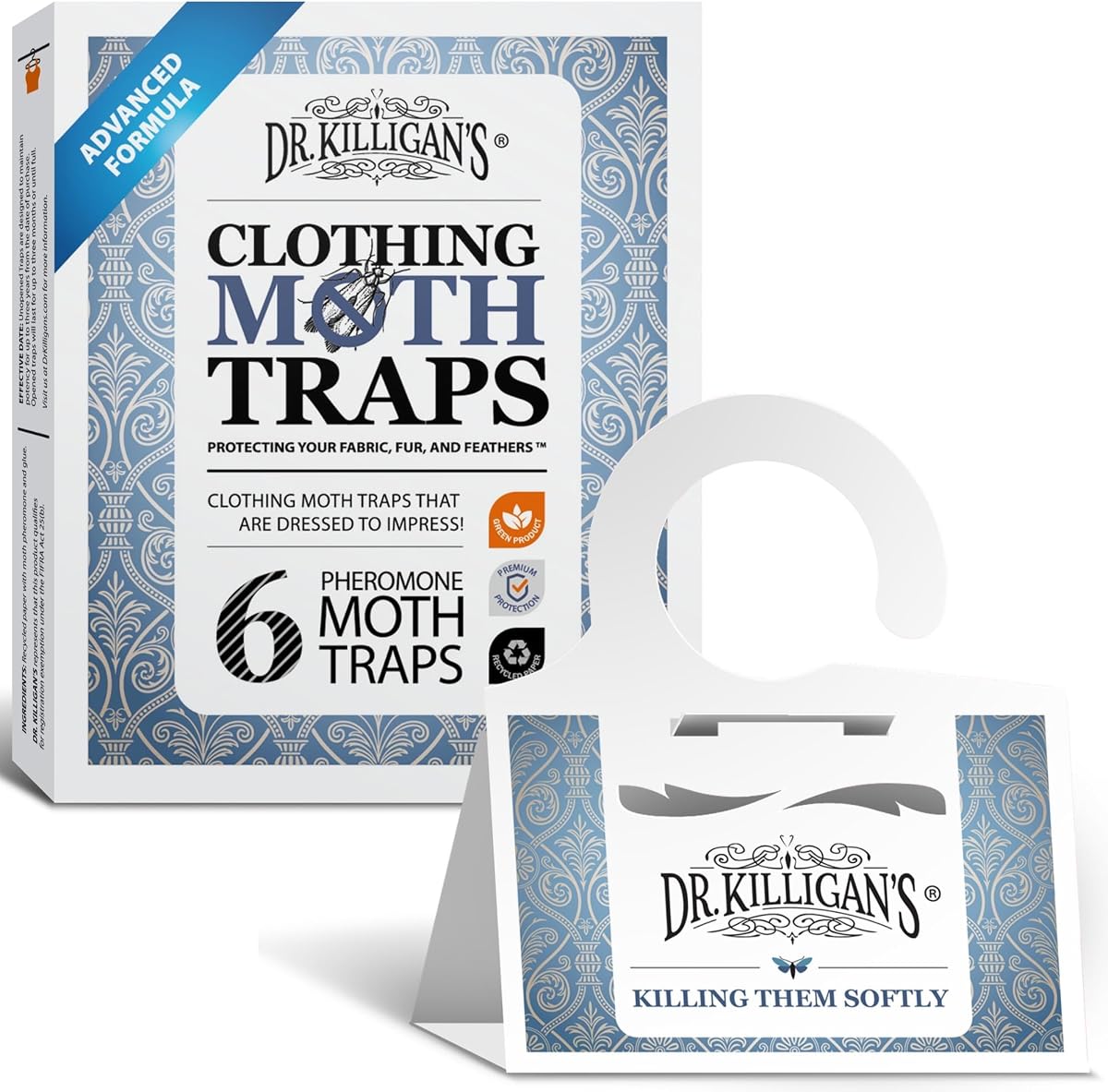
These premium clothing moth traps target the web-spinning and case-bearing clothes moths, two species associated with damage to wool, cashmere, carpet, fur, and feathers. The 4.3 rating reflects generally favorable customer feedback, and the understated appearance helps the traps blend into closets and storage spaces.
We may earn a commission when you buy through this link, at no additional cost to you.
Their design is as important as the lure. The manufacturer says the housing maximizes airflow, and the adhesive already contains the pheromone attractant, eliminating the need for separate wafers. This makes setup straightforward: open the trap, peel it, fold it, and place it near affected garments or other fabric-storage areas.
These traps are clearly limited to clothing moth applications. They should not be selected for pantry moths, food moths, or gypsy moths, and they do not replace treatment of an existing infestation's eggs or larvae. The manufacturer recommends adding Dr. Killigan's Six Feet Under spray when a more complete treatment approach is needed.
This product is a strong fit for closets containing valuable natural-fiber garments, particularly when appearance matters and the household wants a dedicated pheromone trap. Choose it instead of a pantry model when the evidence points to webbing or case-bearing clothes moths rather than food-storage pests.
The traps are expressly intended for wardrobes and storage areas holding wool, cashmere, fur, feathers, and carpet. Their focused pheromone and enclosed adhesive surface provide ongoing monitoring without spraying garments.
Unlike generic triangular glue cards, these traps are designed to be visible enough to remain in place while still looking acceptable in a finished closet. The three-step installation also makes them approachable for first-time moth-trap users.
We may earn a commission when you buy through this link, at no additional cost to you.
This fourteen-trap set is the most expansive dedicated clothes moth option in the group. It uses an extra-strength, timed-release female pheromone to attract males, while the 4.3 rating suggests broad customer approval. The generous count makes it especially useful for wardrobes, multiple rooms, or large fabric-storage areas.
We may earn a commission when you buy through this link, at no additional cost to you.
The adhesive is described as industrial grade, extra sticky, non-toxic, and odorless. Each trap is individually sealed to help preserve lure potency, and an opened trap can remain active for up to three months. Installation follows the familiar open, peel, fold, and place process, so no separate bait pieces are required.
As with other dedicated clothes moth traps, this one is not intended for pantry moths. The manufacturer also recommends a broader treatment plan when established damage is present, since trapping adult males cannot independently address every egg or larval population. Some users may also find that fourteen loose traps require deliberate distribution to maintain useful spacing.
This is our premium clothing moth recommendation for households that want substantial coverage from a single purchase. It is particularly compelling for large closets, multiple wardrobes, or homes storing several vulnerable materials. Those with a small, single-room problem can achieve the same target species with a smaller six-trap set.
Fourteen traps allow placement in several closets, storage containers, or carpeted areas rather than concentrating every card in one location. That flexibility is useful when a house contains more than one moth-prone fabric zone.
The product is promoted for use in the home with a non-toxic, odorless glue surface. It offers passive monitoring for people who prefer not to use foggers, insecticide sprays, or traditional moth-control products in occupied living spaces.
We may earn a commission when you buy through this link, at no additional cost to you.
This versatile ten-pack is intended to address pantry moths, Mediterranean flour moths, other food moths, and clothes moths. Its 4.2 rating is slightly below the leaders, but the ability to move the same basic trap between food-storage and fabric-storage areas makes it distinctive.
We may earn a commission when you buy through this link, at no additional cost to you.
The lure uses timed-release technology, and the manufacturer says it can attract male moths within 25 feet. It also recommends allowing 10 to 15 days for the pheromones to work and replacing traps every three months, although another section of the product information states that opened traps can remain effective for up to six months. Users should follow the instructions and packaging for the applicable replacement schedule.
The main compromise is specialization. A dedicated pantry trap may be preferable when Indian meal moths are confirmed, while a dedicated clothes moth model can state its target species more precisely. This versatile option also notes that a trap should be relocated if no results are observed after 15 days, which adds a monitoring step to the process.
This set is best for homeowners who are not fully certain which moth type is present or who want protection across both a pantry and a closet. Its ten-trap pack is easy to distribute, and the claimed chemical-free, non-toxic positioning suits households seeking a straightforward adhesive monitoring solution.
The ability to use these traps near stored food and around fabrics simplifies initial setup when the exact pest is uncertain. They can also be relocated between areas as signs of moth activity change.
The stated release system is designed to keep attracting male moths over time, supporting disruption of mating activity. Monitoring and periodic replacement remain important because trap performance depends on placement, airflow, and the level of nearby infestation.
We may earn a commission when you buy through this link, at no additional cost to you.
This blue six-pack shares many strengths with the leading pantry option while adding a more decorative presentation. It targets Indian meal moths, Mediterranean flour moths, and other food moths, and its 4.5 rating places it among the best-rated products in this guide.
We may earn a commission when you buy through this link, at no additional cost to you.
The patented Blue Stripe Formula is described as combining double-potent pheromones with industrial-grade glue. The manufacturer highlights precise temperature control during the mixing process to preserve the integrity of the delicate pheromone and adhesive components. The traps are also said to maintain effectiveness for up to six months, subject to proper placement and use.
Like the other dedicated pantry options, it should not be used for clothing moths or gypsy moths. A six-trap pack may also be insufficient for a large house with numerous food-storage zones, and the stated six-month duration should not be interpreted as permission to ignore a severe infestation indefinitely.
This is an attractive choice for visible kitchen cabinetry where a plain glue card would look out of place. It also suits households that want a dedicated food-moth trap and appreciate the stated breadth of target species. For larger homes, the 20-trap version provides easier whole-home distribution.
The blue housing is intended to blend into a finished kitchen rather than look purely utilitarian. That makes the traps more practical in open or visible cupboards where a basic folded card would be conspicuous.
The stated target list includes Indian meal moths, Mediterranean flour moths, and other food moths. That broader focus is useful in kitchens where the precise species has not been confirmed.
We may earn a commission when you buy through this link, at no additional cost to you.
This white six-pack is a light-colored alternative within Dr. Killigan's premium clothing moth line. It targets the web-spinning and case-bearing clothes moth, earns a 4.3 rating, and is designed for wardrobes containing fur, feathers, wool, carpet, or cashmere.
We may earn a commission when you buy through this link, at no additional cost to you.
The pheromones are already incorporated into the glue, eliminating separate wafers and simplifying setup. The manufacturer emphasizes the housing's airflow and decorative appearance, making the traps suitable for display in closets. This is particularly helpful for people who dislike leaving conspicuous glue cards among carefully stored garments.
The six-unit count is less suitable for extensive multi-room coverage, and the traps are not for food moths, pantry moths, or gypsy moths. As a trapping method, they focus on adult males and mating disruption rather than directly removing every egg or larva in an established infestation.
Choose this version when a pale housing better matches a light-colored closet and a six-trap quantity meets the property's needs. It provides the same core pheromone and adhesive format as the black option, with the primary difference being appearance.
The white housing is intended for closets and wardrobes where a darker trap would stand out. The decorative presentation helps owners keep monitoring devices in place without making storage areas look unfinished.
The stated pheromone targets both Tineola bisselliella, commonly described as the web-spinning clothes moth, and Tinea pellionella, the case-bearing clothes moth. This focus makes it more appropriate than a generic pantry trap for fabric damage.
We may earn a commission when you buy through this link, at no additional cost to you.
This eight-pack is the simplest pantry moth option in the guide. It uses a pheromone glue lure, receives a 4.3 rating, and focuses on the moths that affect grains, cereals, flour, pet food, and other dry goods.
We may earn a commission when you buy through this link, at no additional cost to you.
The setup is refreshingly direct: peel back the paper to expose the adhesive, fold the trap into position, and place it in a cupboard. Its understated design is intended to blend into cabinetry, making it practical for spaces where appearance matters or where numerous traps will be deployed.
The product is explicitly limited to food moths and does not work for clothes moths or gypsy moths. Its listing also provides less information about the precise lure strength and stated replacement interval than several competing products, so users should follow the package directions and judge results through regular trap inspection.
This is our budget recommendation for a focused pantry problem, particularly when the household wants a straightforward disposable-style trap without extra components. The eight-trap count gives enough units to distribute through a pantry and several dry-food cupboards without requiring a much larger dedicated setup.
The trap is ready to use after exposing the glue and folding it. There are no separate wafers to attach and no spraying stage, which simplifies routine placement and replacement.
Its understated appearance is well suited to cupboards and food-storage cabinets. Multiple traps can be spread around susceptible areas to improve the chance of detecting and capturing male pantry moths.
We may earn a commission when you buy through this link, at no additional cost to you.
This 20-trap set expands Dr. Killigan's premium clothing moth formula into a multi-room monitoring package. With a 4.3 rating and a target list covering web-spinning and case-bearing clothes moths, it is built for wardrobes, storage rooms, carpets, and homes containing several fabric-heavy areas.
We may earn a commission when you buy through this link, at no additional cost to you.
The pheromone is already present in the adhesive, and the open-peel-fold process keeps deployment simple. The decorative housing is designed to maximize airflow while remaining acceptable on display, which is an important consideration when traps need to remain deployed long enough to be useful.
A 20-trap quantity can be excessive for a small closet, and buyers should avoid clustering traps where their airflow and coverage would be limited. The traps are not intended for pantry, food, or gypsy moths, and trapping adult males does not replace inspection, sanitation, or separate treatment of larvae and eggs.
This is the better choice for homeowners who want to cover multiple wardrobes, storage cabinets, or carpeted areas in a coordinated deployment. The same lure and design are available in a smaller six-pack, but this larger quantity reduces the need to split coverage across several purchases.
Twenty units can be distributed through master bedrooms, guest rooms, dressing areas, and sealed storage spaces. This is advantageous when moth activity is suspected across several connected but distinct fabric-storage zones.
The adhesive carries the pheromone attractant and requires no ongoing bait handling. Periodic inspection and replacement according to the package instructions still matter, but the traps can serve as a consistent monitoring presence between checks.
We may earn a commission when you buy through this link, at no additional cost to you.
This 20-trap black pack is built for broad pantry and kitchen deployment. It carries a 4.5 rating and uses the same double-potent Blue Stripe Formula described for the smaller Dr. Killigan pantry options, targeting Indian meal moths, Mediterranean flour moths, and other food moths.
We may earn a commission when you buy through this link, at no additional cost to you.
Its larger count makes it practical for homes with multiple cupboards, pantries, pet-food storage areas, bird-seed bins, and other dry-goods locations. The traps require no spray or separate wafers, and their decorative design allows them to remain deployed in visible storage spaces.
The tradeoff is efficiency for small homes. Twenty traps may be more than necessary in a single compact pantry, and concentrated placement can reduce the useful distribution that pheromone traps need. It should not be selected for clothing moths, and it should not be relied upon as the sole response to a severe infestation with extensive webbing or larvae.
This product is an excellent fit for a household that wants comprehensive food-moth monitoring across a large kitchen or several storage zones. Its top-tier rating and substantial pack count provide a practical way to establish consistent coverage without mixing unrelated trap types.
The large quantity supports placement near several different food moth entry points rather than relying on a few cards in one cabinet. It is especially useful when dry goods are stored throughout the home or in a substantial pantry.
The manufacturer describes a double-potent pheromone and industrial-grade adhesive combination created through controlled mixing. The formula is intended to attract and capture pantry moths while interrupting reproduction.
We may earn a commission when you buy through this link, at no additional cost to you.
With 24 individually sealed traps, this is the largest pantry-focused set in the guide. It has a 4.4 rating and uses a time-released female pheromone designed to attract and capture male moths, with the stated aim of stopping the breeding cycle.
We may earn a commission when you buy through this link, at no additional cost to you.
The target list covers Indian meal moths, flour moths, grain moths, and seed moths. That range is well matched to kitchens, pantries, and storage areas containing whole grains, flour, almonds, bird seed, pet food, and other dry goods. The extra-sticky adhesive is described as non-toxic, odorless, and free of insecticide.
This product is not intended for clothing moths. Its opened-trap duration is stated at up to three months, so households should plan a regular replacement and inspection routine. As with every trap in this guide, it works best as part of an integrated approach that includes identifying the pest, cleaning affected areas, and limiting access to vulnerable food or materials.
Choose this option for extensive pantry monitoring or for a home that wants enough individually sealed traps to cover many storage points. The high count, broad food-moth focus, and odorless adhesive make it a strong all-around pantry solution for larger spaces.
Twenty-four traps make it easier to create a distributed monitoring network across several cupboards and pantry zones. Individual sealing also helps maintain attractant freshness until each unit is needed.
The product is positioned for use in food preparation and storage areas, with a non-toxic and odorless glue surface. Placement should still follow the package directions and avoid direct contact with food.
We may earn a commission when you buy through this link, at no additional cost to you.
The most useful moth trap is one whose lure, placement, and coverage match the pest and the affected part of your home. Start by confirming whether the problem involves food-storage moths, clothes moths, or both, then compare trap design and deployment needs.
Choose a trap specifically labeled for the moth type found in the affected area. Do not expect a pantry trap to control a wardrobe infestation, or a clothing trap to address moths in stored flour and pet food.
Prioritize a clearly described lure system and follow its replacement guidance. More lure is not a substitute for correct placement or regular inspection.
Count the separate pantries, closets, storage cabinets, and carpeted zones you want to monitor, then buy enough traps to distribute them across those spaces.
Choose a design you will be willing to leave in the target location, and follow its exact positioning instructions for the best chance of catching moths.
Set a regular inspection and replacement reminder based on the package directions. Do not leave expired or dirty traps in place indefinitely.
Look for clear placement and handling instructions. When a household includes young children or curious pets, choose an area where the trap can work without being touched.
Use traps as one layer of a broader pest-control strategy. Remove infested materials, clean storage areas, protect vulnerable foods and garments, and seek professional guidance for a severe infestation.
Use ratings as a supporting signal, not the only decision. The right product is the one that targets your pest, fits the area, and can be maintained consistently.
Begin by confirming the affected area and removing the source of the infestation. For pantry moths, inspect flour, cereal, grains, pet food, bird seed, nuts, and other dry goods for webbing, larvae, or damaged packaging. For clothes moths, inspect wool, cashmere, fur, feathers, carpets, and stored garments. Clean the area before deploying traps, and move vulnerable items into sealed containers when practical.
Prepare each trap according to its instructions. Most options use an open, peel, fold, and place process, while integrated pheromone products need no separate wafers. Place pantry traps in cupboards, pantries, and other dry-food storage locations; place clothing traps in closets, garment-storage areas, and suitable fabric-storage zones. Spread traps among separate activity areas rather than stacking them, and keep direct food contact off the trap surface.
Inspect traps regularly and look for captured moths or a decline in activity. Replace traps according to the stated use period and packaging instructions, dispose of used traps carefully, and wash your hands after handling. If activity continues, move traps to a different location, expand coverage, and strengthen sanitation and storage measures. Persistent or widespread infestations may require a pest professional and treatment directed at immature stages.
Many of the listed traps are described as non-toxic, odorless, insecticide-free, or safe around food when used as directed. Nevertheless, no trap should touch food or be placed where it could contact dishes, utensils, or food packaging. Follow the product label, keep traps in appropriate monitoring locations, and store the products themselves away from food.
A single trap is usually best for one defined area, such as a single pantry or cupboard. Moths are more effectively monitored by distributing several traps across separate food-storage and kitchen zones. The recommended number depends on the property's size, the number of storage locations, and the level of activity.
Most pheromone traps in this guide are designed to attract and capture adult male moths so mating and reproduction are interrupted. They may not directly control every egg or larva, which is why sanitation, inspection, sealed storage, and sometimes additional treatment remain important. A severe infestation may require a more comprehensive plan.
Generally, no. Dedicated pantry traps are formulated for food-associated moth species, while dedicated clothing traps target web-spinning and case-bearing clothes moths. A versatile product may address both categories, but its broader targeting does not replace a specialized trap when the moth type is known.
Place them in closets, wardrobes, garment-storage areas, and other spaces containing vulnerable fabrics such as wool, cashmere, fur, feathers, leather, or carpet. Position traps where moths are likely to travel and where they will remain undisturbed, while avoiding direct contact with garments when following the manufacturer's instructions.
The listed products generally state an opened use period of approximately three to six months, depending on the model. Actual lure performance can vary with airflow, temperature, humidity, placement, and infestation level. Inspect traps regularly and replace them according to the packaging guidance rather than assuming they remain fully effective indefinitely.
An empty trap does not necessarily mean there is no infestation. The moth may not have found the lure, the trap may be too far from activity, airflow may be weak, or a different moth species may be involved. Leave the trap in place for the recommended monitoring period, inspect nearby materials, and try relocating it if no activity is detected.
Glue traps offer passive, discreet monitoring and can interrupt breeding by capturing adult males, while sprays may be more appropriate for directly addressing certain immature stages when used according to their label. The best approach often combines trap monitoring with cleaning, storage controls, and other treatment steps rather than relying on one method alone.
The strongest overall choice is Dr. Killigan's six-pack black pantry traps because it combines a 4.5 rating, a concentrated pheromone stripe, discreet placement, and clear guidance for distributing traps around a pantry and kitchen. For a focused pantry problem with a simpler setup, the eight-pack Trap a Pest option is the budget-friendly alternative, while MaxGuard's 14-trap clothing set offers the strongest premium coverage for wardrobes and fabric storage.
Prioritize the target species, the number of separate areas that need monitoring, and whether the traps will actually be left in place. Dedicated products are preferable when you know whether the infestation involves food or fabrics. A larger pack is not automatically better if the traps are clustered in one location, so distribute them according to the manufacturer's guidance and inspect them regularly.
Moth traps work best as part of a wider prevention and sanitation plan that includes source inspection, cleaning, sealed storage, and attention to larvae or eggs. Before ordering, verify the current product listing, package instructions, target species, and retailer details, since formulations, packaging, availability, and other listing information can change over time.