
Pool Salt Tester 5-in-1
4.4Editor score
Five water parameters
PPM, PPT, percent display
Simple dip-probe operation
Our Soil Salinity Testers guide compares 10 digital and multifunction meters for gardening, farming, pools, aquariums, precision checks, and field use.
Soil salinity testers help reveal dissolved salts that can restrict plant growth, interfere with nutrient uptake, or indicate that an irrigation or fertilization strategy needs adjustment. A useful meter should provide a clear reading, suit the material being tested, and withstand regular handling in gardens, greenhouses, farms, pools, or aquariums.
This guide compares ten soil and water salinity meters based on their stated functions, measurement ranges, displays, probe designs, water resistance, portability, and intended applications. The list includes dedicated soil instruments, multifunction plant testers, saltwater pool meters, marine handheld colorimeters, and precision-oriented salinity kits.
Each review explains what distinguishes the selected model, where it is most useful, and which limitations to consider before buying. Ratings reflect the supplied marketplace feedback, while feature details come from the listed product information. Product availability and pricing can change, so confirm current details before ordering.
4.4Editor score

4.6Editor score
3.9Editor score
The table below provides a quick side-by-side view of each meter's primary purpose, measured parameters, probe format, and notable design features. It is a practical starting point for narrowing the field before reading the detailed reviews.


The 2 in 1 Digital Plants EC Meter combines soil electrical conductivity and temperature in a straightforward instrument rated 4.6 by marketplace users. Its appeal lies in a focused purpose: measuring two variables that are especially useful when checking how salts and root-zone conditions may be affecting plants. The wired probe and digital display make it considerably easier to interpret than a traditional dial gauge.
We may earn a commission when you buy through this link, at no additional cost to you.
The stated EC range is 0–4.00 mS/cm, with accuracy of plus or minus 2% of full scale. Temperature is measured at the same time, giving users context for their salinity result. The probe carries an IP67 rating, so it is designed to resist water and dust during outdoor use. A green backlit LCD also helps preserve readability in gardens, greenhouses, and low-light conditions.
Operation is straightforward: insert the probe into the soil and allow ten to fifteen seconds for the reading to stabilize. That is a useful improvement over guesswork, although the device does not provide the broader pH, moisture, light, or nutrient data offered by multifunction garden meters. Buyers seeking a full plant diagnostic toolkit should compare the more specialized options in this guide.
This is a strong general recommendation for gardeners, farmers, and indoor plant growers who want an uncomplicated salinity-and-temperature instrument without a large display full of unrelated functions. It is less appropriate for saltwater pool management or anyone requiring NPK analysis. For the core task of monitoring electrical conductivity in soil or growing media, its clear range, protective probe, and temperature context make it especially versatile.
The meter's direct EC reading is easier to act upon than a generic moisture scale. Pairing it with root-zone temperature gives growers a more complete view of conditions around the probe and can help guide when to investigate salt buildup or poor nutrient availability.
The IP67-rated electrode and backlit screen suit repeated checks in outdoor beds, pots, and greenhouses. Its two-function design also reduces the number of readings required when salinity and temperature are the only variables under investigation.
We may earn a commission when you buy through this link, at no additional cost to you.
The Pool Salt Tester 5-in-1 is built for water rather than soil, with the ability to measure salt levels, pH, TDS, EC, and temperature. It carries a 4.4 rating and is a useful budget-oriented option for anyone maintaining a swimming pool, hot tub, or aquarium. It can also serve as a general tool for checking salt in other liquid applications.
We may earn a commission when you buy through this link, at no additional cost to you.
One of its most useful features is the choice of display units. Pool readings are shown from 0–9999 ppm, seawater from 10–200 ppt, and food solutions from 0.01–25%. The unit automatically changes to ppt when a ppm reading exceeds 9999, making the meter adaptable to samples with different salt concentrations. A clear LCD and simple dip-probe operation reduce setup and interpretation time.
The product information emphasizes convenient operation without complicated setup or calibration. That makes it approachable for new pool owners, although users should still follow the included instructions and understand that reliable interpretation depends on a representative sample and proper probe handling. It does not offer the automatic calibration, automatic temperature compensation, or eight-parameter breadth of more advanced pool meters.
Choose this product if your primary goal is affordable salinity monitoring in water rather than direct soil testing. It is especially practical for routine checks around pools, aquariums, and hot tubs, where the same meter can provide salt, pH, TDS, EC, and temperature information. Gardeners seeking a root-zone instrument should look instead to a dedicated soil EC or multifunction soil tester.
The ability to read ppm, ppt, or percentage makes the meter useful beyond a single pool scenario. Users can select the unit that corresponds to their sample instead of mentally converting values during every check.
Dipping the probe into a sample and reading the LCD suits quick maintenance checks. The absence of a complex setup makes this a convenient option for beginners who want more information than a basic salt strip provides.
We may earn a commission when you buy through this link, at no additional cost to you.
The 7-in-1 Digital Soil Tester Kit is designed as an all-purpose plant care tool, measuring soil moisture, pH, temperature, light intensity, fertility-related information, EC, and TDS. It has a 4.3 rating and appeals to home growers who want several common diagnostics in one instrument. The inclusion of EC and TDS functions makes it more relevant to salinity monitoring than a standard moisture-only meter.
We may earn a commission when you buy through this link, at no additional cost to you.
Its large LCD uses a white backlight to present numerical parameters clearly in daylight or darkness. Four AAA batteries power the display, and a low-battery warning helps prevent readings from becoming unreliable near the end of the battery life. The stated measurement procedure calls for inserting the probe about 10 centimeters into the soil and waiting roughly ten seconds for the values to appear.
There are important operating restrictions. The tester is not intended for direct liquid measurement, and forcing it into extremely dry, hard soil may damage the probe. The instructions recommend lightly moistening the test area and waiting ten minutes before inserting it. Those safeguards are worth noticing because they distinguish this model from liquid EC meters that can be dipped directly into a solution.
This meter is a strong choice for indoor plant collections, garden beds, potted plants, and succulents where a broad set of readings can inform watering, acidity, temperature, and light decisions. It is less suitable for specialist NPK analysis or precise aquaculture work. For general gardeners who want salinity alongside moisture, pH, and environmental readings, its feature density and display make it a compelling option.
Seven functions allow users to compare moisture, pH, temperature, light, EC, TDS, and fertility-related readings without moving between separate basic instruments. The result is a more holistic view of routine plant conditions.
A large, white-backlit screen is especially useful in dim indoor spaces. Icons and numerical values make the display accessible to beginners, while the low-battery reminder helps users replace power before collecting questionable data.
We may earn a commission when you buy through this link, at no additional cost to you.
The 4-in-1 Digital Soil Meter measures soil moisture, pH, temperature, and sunlight intensity, earning a 4.2 rating from marketplace users. It is aimed primarily at plant care rather than specialist salinity analysis, but these measurements can still help gardeners understand why plant performance may be declining and whether salinity is even likely to be the primary concern.
We may earn a commission when you buy through this link, at no additional cost to you.
One of its most distinctive design elements is the rotating head, which can move through 45 degrees. That allows the display to be viewed without repeatedly bending over the soil. A large LCD with white backlighting improves visibility, and the unit uses four AAA batteries, which are not included. A low-battery alert is built into the interface.
Users insert the probe approximately 10 centimeters into the soil and wait about ten seconds. The manufacturer recommends reading at least five locations and averaging the results, which is sensible for a meter intended to represent an uneven planting bed. The probe should not be forced into dry, hard soil; the test area should be watered first and allowed to settle for ten minutes.
This is a useful general garden meter for checking whether watering, pH, temperature, or light deserves attention. It should not be selected by a buyer whose primary requirement is a documented salinity or EC reading. Users focused on salt management should choose a meter with explicit EC or salinity measurement, while those checking broader growing conditions will find the four-function format easy to use.
The adjustable head is a practical benefit during repeated garden checks. Instead of crouching or repositioning the entire probe, users can tilt the display into a more readable angle while keeping the probe in place.
A single insertion cannot describe every part of a bed, so the recommendation to test at least five locations is valuable. Averaging multiple readings produces a more representative result and reduces the chance of acting on an isolated pocket.
We may earn a commission when you buy through this link, at no additional cost to you.
The Hanna HI98319 Marine Salinity Tester is a compact handheld colorimeter designed for direct salinity measurement in marine environments. Its 3.9 rating reflects a niche but clearly defined purpose: taking salinity readings where portability and focused operation matter. The device is particularly relevant to aquariums and marine biology applications rather than general gardening.
We may earn a commission when you buy through this link, at no additional cost to you.
Unlike multifunction soil meters that fill a large display with moisture, pH, light, and fertility data, this instrument concentrates on the measurement it was designed to perform. The listed interface uses simple button operation, which can make the instrument approachable for users who do not need extensive configuration or interpretation of unrelated parameters.
Its portability is another meaningful advantage. The compact colorimeter can move between tanks, sample locations, and work areas without the bulk of a bench instrument. That said, the product listing does not provide a broad set of additional specifications, and the meter's aquatic specialization makes it a poor fit for anyone expecting to insert a probe directly into garden soil.
This model is best for aquarium keepers, marine researchers, and other users who need a dedicated portable salinity checker. It should be considered alongside water EC meters when selecting a tool for pools or general liquid samples, because it is not marketed as a multifunction water analyzer. For garden salinity management, a dedicated soil EC or conductivity meter remains the more logical purchase.
A dedicated colorimeter can be easier to deploy when every measurement is a salinity check. Its compact form suits moving between aquariums or collecting samples away from a fixed workstation.
The HI98319 fills a specific gap between general soil meters and multiparameter pool analyzers. Buyers should confirm that their samples and required output align with its direct marine measurement design before choosing it.
We may earn a commission when you buy through this link, at no additional cost to you.
The 8-in-1 Saltwater Pool Tester is the most feature-complete liquid analyzer in this group, with a supplied rating of 5.0. It measures pH, TDS, EC, salinity, ORP, specific gravity, free chlorine, and temperature. That breadth makes it suitable for swimming pools, hot tubs, aquariums, spas, and drinking-water checks where a single instrument can cover several maintenance variables.
We may earn a commission when you buy through this link, at no additional cost to you.
Automatic temperature compensation adjusts readings as water temperature changes, an important consideration in outdoor pools and aquariums. The meter also offers automatic calibration and a backlit LCD, while the listed accuracy reaches 0.01 pH. Its upgraded sensor is described as having a 0.05-second response time, allowing users to obtain numerical results without comparing color patches.
The many readings are the product's main attraction, but they also require more interpretation than a two- or three-function meter. Users should become familiar with what each parameter means and how it relates to their specific water system. It is also important to distinguish this instrument from a soil probe: its listed strengths and applications concern water analysis rather than root-zone insertion.
This is a strong recommendation for a pool or aquarium owner who wants salinity, pH, chlorine, ORP, and related water metrics in one portable device. It can also be useful for drinking-water spot checks when its supported parameters match the required task. Garden users should select a soil-specific model instead, while buyers who need only salt level may prefer a simpler and more focused meter.
Eight measurements reduce the need to juggle several single-purpose devices. Pool and aquarium users can monitor salinity alongside pH, chlorine, ORP, specific gravity, TDS, EC, and temperature in the same session.
Automatic temperature compensation helps maintain reading consistency as aquatic environments warm or cool. Combined with automatic calibration, this reduces routine configuration effort during regular maintenance.
We may earn a commission when you buy through this link, at no additional cost to you.
The 8-in-1 NPK Soil Analyzer is positioned as a more technically advanced soil instrument, providing temperature, humidity, EC, salinity, pH, and NPK readings. The title refers to eight functions, although the supplied feature description calls it a professional seven-in-one tester. No marketplace rating is provided, so the evaluation should focus on the stated ranges and construction rather than user feedback.
We may earn a commission when you buy through this link, at no additional cost to you.
Its measurement ranges are clearly listed: temperature from -40°C to 80°C, humidity from 0–100%, EC from 0–20,000 microS/cm, salinity from 0–20,000 mg/L, pH from 3–10, and NPK from 0–1999 mg/kg. These figures make the meter relevant to users who need more than a simple moisture or pH reading and want salinity considered alongside nutrient conditions.
The IP68 waterproof housing and sealed internal components are designed for rain, mud, and demanding outdoor environments. Two 7.6-inch stainless steel probes support insertion into garden soil, lawns, or crop fields. USB-C power eliminates disposable batteries, although users must have a suitable power source. The listed weight of 6.53 ounces also supports portable field use.
This is a compelling candidate for farmers, landscapers, and serious growers who want a broad digital soil assessment in a rugged enclosure. The instruction to wait three to five minutes for stabilized NPK results in sufficiently moist soil means it demands more patience than a basic moisture meter. Buyers should also verify that the listed electrical values and units align with the interpretation method used in their own soil-management program.
EC, salinity, pH, and NPK readings are more useful together than in isolation. A grower can compare salt conditions with broader soil characteristics, although meaningful interpretation still requires consistent sampling and suitable thresholds for the crop.
The IP68 enclosure, sealed components, stainless steel probes, and broad temperature tolerance are meaningful advantages for farm, greenhouse, and landscape use. USB-C power further reduces battery-related interruptions during extended field sessions.
We may earn a commission when you buy through this link, at no additional cost to you.
The Apera Instruments Value Series Salt20 is a dedicated salinity tester kit with a 4.0 marketplace rating. It uses a platinum black sensor to measure salinity across a stated range of 0–10.0 ppt. That makes it a focused option for users who need dependable salt-level information rather than a general soil meter with numerous gardening functions.
We may earn a commission when you buy through this link, at no additional cost to you.
Automatic calibration and automatic temperature compensation are two of the kit's most practical features. The large LCD displays temperature and ppt together, while reminders indicate when a calibration has been completed and when the reading is stable. Those prompts help users avoid acting on a number that has not settled or that was collected before calibration.
The complete package includes calibration solution, batteries, and a lanyard in a portable carrying case. This is a more self-contained approach than choosing a bare meter and sourcing accessories separately. The stated battery life is up to 1,000 hours, which supports regular use without frequent replacement.
This kit is best for aquariums, marine water, and other liquid samples where ppt is the appropriate unit and salinity is the main decision variable. It is less suitable for inserting directly into soil, and users wanting pH, temperature as a separate measurement, or broader soil diagnostics will need another instrument. For dedicated salinity work with a portable, organized package, the Salt20 offers a clear and mature feature set.
Automatic calibration helps simplify a process that can otherwise affect confidence in an instrument. On-screen reminders for completed calibration and stable readings also make it easier to follow a consistent measurement routine.
The included solution, batteries, and lanyard make the kit easier to organize and transport. A dedicated carrying case is particularly useful for aquarium maintenance, field sampling, or a mobile water-testing setup.
We may earn a commission when you buy through this link, at no additional cost to you.
The Long Probe Deep Soil Salinity EC Meter is designed for users who need to reach below the surface without repeatedly disturbing the upper layer of soil. It measures electrical conductivity in soil or hydroponic nutrient solution and is marketed for both indoor and outdoor gardening. No marketplace rating is supplied, so its appeal should be evaluated from its long-probe design and listed features.
We may earn a commission when you buy through this link, at no additional cost to you.
The stainless steel probe is a notable choice for a tool that will repeatedly contact soil and moisture. Its extended length makes it more suitable than a shallow probe for checking conditions near a root zone or beneath a dense surface layer. The meter is also described as practical for greenhouse soil and solution media, allowing the same conductivity-focused instrument to serve both solid and liquid growing samples.
A digital screen with backlight improves reading visibility and helps users move away from ambiguous dial indications. The meter is compact and lightweight, which supports portable use in gardens, farms, and greenhouses. However, the supplied information does not list a detailed measurement range, accuracy specification, water-resistance rating, or battery configuration, so buyers should verify those specifications when a particular precision level matters.
The long-probe format makes this a practical option for gardeners and farmers who specifically want deeper or more representative EC sampling. It is less attractive for users who also require pH, moisture, temperature, light, or nutrient readings, because those functions are not listed. For a simple salinity-focused tool, however, the deep stainless steel probe, backlit display, and dual soil-and-solution use are its strongest points.
A longer probe can reach farther into the root zone, which is useful when the top layer appears dry but moisture and salts may occur deeper. It can also reduce disturbance to small, densely planted areas compared with a short, broad insertion.
The ability to check soil and hydroponic nutrient solution broadens its use beyond outdoor beds. Growers can monitor both growing media and the solution feeding it, although the probe should be cleaned between samples to avoid cross-contamination.
We may earn a commission when you buy through this link, at no additional cost to you.
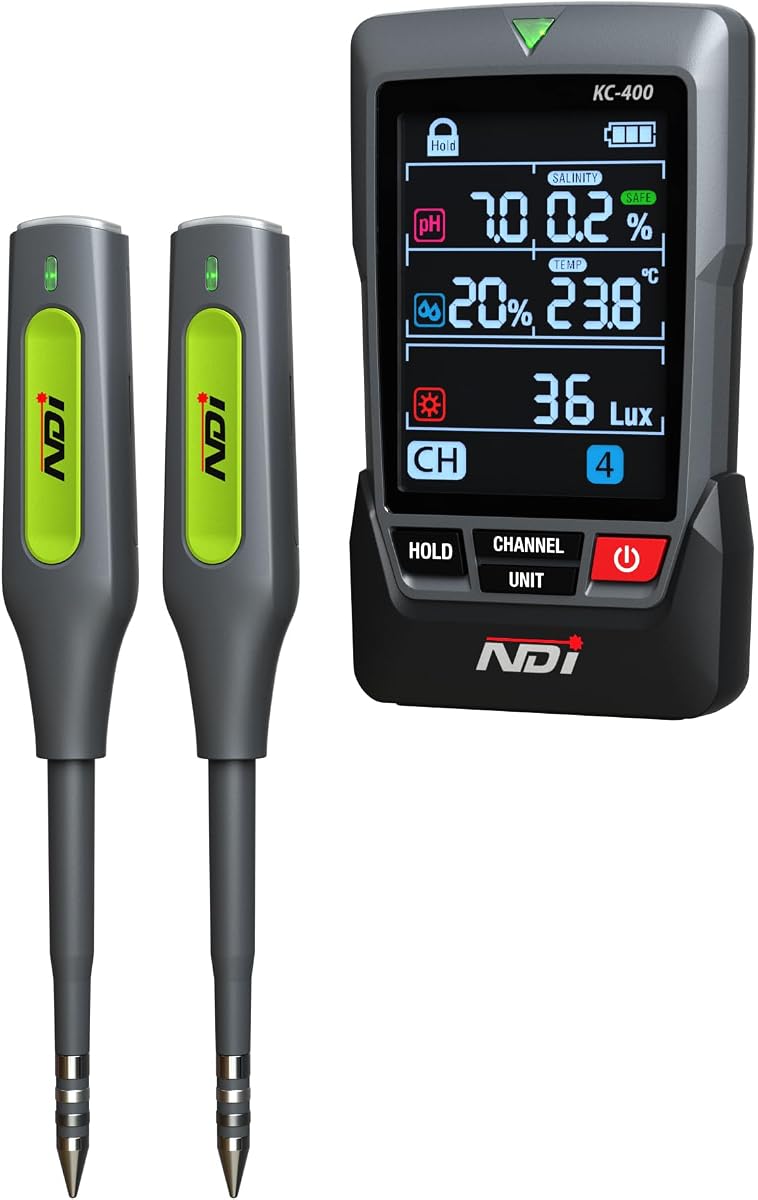
The NDI Multifunctional Soil Meter distinguishes itself through support for up to five probes and wireless data transmission. It measures pH, salinity, temperature, and light intensity, with acoustic wave growth assistance also named in the product title. The concept is especially relevant to landscapers, greenhouse operators, and growers who want readings from several locations rather than a single spot check.
We may earn a commission when you buy through this link, at no additional cost to you.
Wireless transmission could reduce the need to physically carry the display between probes, depending on the included system configuration. Multi-probe capability also enables a more representative view of a garden or growing area, particularly where irrigation, soil composition, or exposure to sunlight varies. These are meaningful advantages over a single-probe meter when managing larger spaces.
The product data is limited to the headline functions, however, and does not provide detailed ranges, accuracy figures, probe lengths, ingress-protection ratings, battery details, or wireless distance. Its 3.9 rating also suggests that potential buyers should examine current customer feedback carefully. The inclusion of pH and salinity does make it relevant to this guide, but buyers should verify that the salinity output matches the units and interpretation method they need.
This meter makes the most sense for users who value networked or distributed measurements over a simple single-location reading. It can support salinity monitoring alongside pH, temperature, and light data, while the multi-probe approach may reduce the time required to survey large or variable areas. For a straightforward garden meter, simpler alternatives provide more transparent specifications; for coordinated monitoring across several points, this model's wireless multi-probe concept is the key attraction.
Several probes allow a user to compare separate beds or planted zones without treating one insertion as representative of the entire property. That approach is useful where salinity may accumulate unevenly or where water management differs across an area.
Wireless transmission can streamline collection and recording by reducing the need to move physically between each probe. The actual benefit depends on the supplied range and system configuration, which should be confirmed before purchase for large outdoor sites.
We may earn a commission when you buy through this link, at no additional cost to you.
The right salinity tester depends on what you will actually measure. Start with the sample type, required units, depth of the root zone, and need for complementary readings, then consider display quality, weather resistance, calibration, and field portability.
Match the instrument to the sample before comparing features. Choose a soil probe for beds, pots, lawns, and fields; choose a liquid meter for pools, tanks, and nutrient solutions.
Verify the measurement range, displayed unit, and conversion method. A number is useful only when it matches the concentration scale used in your application.
Choose breadth when several variables affect your routine; choose focus when one dependable salinity reading is the goal. Avoid paying for functions you will not interpret.
Match probe depth to the root zone and soil condition. A longer probe is useful below the surface, while careful insertion is essential in dry or compacted soil.
For frequent outdoor use, prioritize a documented water-resistance rating and durable shaft material. Indoor-only models may be sufficient for a controlled plant shelf.
Prefer automatic calibration and temperature compensation for frequent water testing. Follow the stated calibration routine consistently to maintain confidence in results.
Prioritize a readable illuminated screen and a power method that suits your location. Make sure required batteries or charging equipment are included or easy to obtain.
Use multiple locations and stable readings for reliable results. Good technique often improves data quality more than adding another meter feature.
Begin by reading the manufacturer's instructions, identifying the correct measurement mode, and checking the battery or USB-C power level. Clean the probe according to the manual, then take a reading only after the display indicates a stable value. For soil instruments, insert the probe to the recommended depth without forcing it. For liquid meters, immerse the sensing area as directed and remove the probe before handling the display.
Consistent sampling improves the usefulness of every measurement. In a garden, move to several representative locations and record the results rather than relying on a single favorable spot. Rinse the probe between samples so residue does not affect later readings, and avoid inserting a soil probe into dry, hard ground. If the instructions call for moistening a test area first, allow the water to settle before taking the reading.
Care and storage matter as much as the initial reading. Wipe away loose soil, wipe the probe clean, and dry the instrument as directed before putting it in its case. Remove batteries from a meter that will be stored for a long period if the manufacturer recommends it, and keep calibration solution or accessories together. Store the device in a dry place within its stated temperature limits, and recalibrate when prompted or after samples that could leave residue on the sensor.
Most soil salinity testers measure electrical conductivity, or EC, which indicates the concentration of dissolved ions in soil moisture. Some devices convert or present that information as salinity, TDS, ppm, or ppt. A useful reading should be interpreted alongside soil moisture, temperature, crop type, and the unit specified by the manufacturer. It is a relative diagnostic tool rather than a complete laboratory analysis.
EC is related to the amount of dissolved salt in a sample, but the two are not always identical measurements. Conductivity changes with the concentration and composition of ions, while reported salt content may use a conversion or calibration specific to the instrument. Check whether the meter reports EC, ppm, ppt, mg/L, or a calculated salinity value before comparing it with a target.
Only if the manufacturer explicitly says the device can measure liquids. Some multiparameter soil meters can damage their probes if dipped directly into a solution, while dedicated EC or salinity meters are designed for immersion. The long-probe model in this guide is stated to work with both soil and hydroponic nutrient media. Follow the stated restrictions and cleaning instructions for the exact model you own.
Watering dilutes salts and changes the amount of moisture surrounding the probe, both of which can affect a conductivity reading. It is usually more meaningful to take samples at a consistent time and at a similar moisture condition. If you are tracking a trend rather than a single result, use the same depth and a consistent watering schedule so the changes reflect the soil rather than the sampling method.
At least five locations is a sensible minimum when a bed varies in soil type, irrigation, or plant health. Include areas near different plants, edges, low spots, and visibly dry or wet zones. Record each result and consider the average along with the range. The 4-in-1 Digital Soil Meter specifically recommends testing at least five locations for its pH and moisture readings.
It is especially useful for liquid measurements in pools, aquariums, and hydroponic systems where temperature may change throughout the day. Temperature compensation adjusts the measurement to improve consistency across different conditions. Soil meters that also report temperature can provide useful context even when they do not automatically compensate. For repeatable results, always allow the reading to stabilize and document the temperature.
Some conductivity-focused models support both media, but many garden meters are restricted to soil insertion and must never be dipped directly into liquids. Water-focused meters generally cannot be used as soil probes. Check the product instructions for the permitted sample type before testing, because using the instrument outside its design can produce poor results or damage the sensing area.
Calibration frequency depends on the instrument, sample type, and how often it is used. Automatic-calibration meters should still be checked with the appropriate solution when prompted. Dedicated meters that include calibration solution benefit from a routine verification schedule, especially after heavy use or exposure to residue. Following the manufacturer's calibration reminders is the safest way to maintain reliable readings.
The Digital Plants EC Meter stands out for balanced soil use, combining EC and temperature in a focused design with a water-resistant probe. The Pool Salt Tester 5-in-1 is the more economical choice for pools and aquariums, while the NDI Multifunctional Soil Meter offers the most distinctive connected approach through support for up to five probes and wireless transmission.
Prioritize the sample type before any other feature. Choose a soil instrument for root-zone work, a dedicated liquid tester for pools or aquariums, and a broader analyzer when pH, moisture, temperature, light, or NPK readings will influence your decisions. Also consider the measurement range, unit, probe depth, water resistance, calibration process, and display before making a final choice.
Current product details, ratings, and pricing can change, so confirm the latest listing before purchasing. Use the review as a starting point, then check whether the meter includes the functions and construction required for your specific plants, soil, water system, and working environment.