
GOKKO GK-32 SpanishFly
4.8Editor score
Anti-feedback footswitch and control
Independent treble boost
True bypass operation
Best preamps for acoustic guitar compared for tone shaping, feedback control, outputs, effects, and stage or recording versatility in this expert guide.
An acoustic guitar preamp can transform a plain pickup signal into a balanced, stage-ready sound. The right model gives players clearer tone, practical feedback control, flexible outputs, and enough shaping tools to suit different rooms, microphones, amplifiers, and recording systems.
We compared the listed preamps by examining their tonal controls, feedback-management features, connectivity, effects, bypass options, power requirements, and intended applications. The guide covers floor pedals, compact stompboxes, instrument-mounted units, and portable preamplifiers for practice, performance, or recording.
Each pick reveals what its controls and design can contribute to an acoustic signal, with particular attention to ease of live use and compatibility with common backline. Product availability, features, and pricing can change, so readers should verify current details before purchasing.
4.8Editor score
4.6Editor score

4.7Editor score
The table below compares all ten preamps by their principal tone controls, feedback-management tools, output options, and practical operating features.


The SONICAKE A Factory is a multi-effect acoustic pedal built around an analog preamp, and it carries a 4.0 rating. Its appeal comes from combining conventional signal shaping with digital reverb, an adjustable notch filter, mute, and multiple output choices in one compact unit.
We may earn a commission when you buy through this link, at no additional cost to you.
Control over gain and frequency range makes the preamp section useful for adapting a pickup's output before it reaches an amplifier or console. The high-impedance input is intended to preserve the character of the source, while the XLR balanced output offers a direct route to a PA, mixer, or audio interface.
The adjustable notch filter is particularly valuable when a piezo pickup generates troublesome frequencies. A buffer bypass helps maintain a consistent signal when the pedal is disengaged, although players should still compare the bypassed and engaged sounds because buffered and true bypass approaches can feel different.
This model is best for performers who want acoustic preamp and ambience functions in a single pedal without relying on a larger amplifier. It is less suited to someone seeking only the simplest DI box, but for a flexible setup it offers a compelling mix of utility and portability.
The gain and frequency-range adjustments provide meaningful control over the pickup signal, while the notch filter targets unwanted resonant peaks. Together, these controls make the pedal more adaptable than a minimal transparent preamp.
The balanced XLR output is useful for direct stage or recording use, while the compact enclosure is easy to add to a pedalboard. The included reverb also provides a practical option for players who want more ambience than the destination device supplies.
We may earn a commission when you buy through this link, at no additional cost to you.
The SONICAKE Sonic Wood is an acoustic multi-effects pedal with a 4.5 rating and a clear focus on preparing an instrument for a stage. It combines an analog preamp, two-band EQ, chorus, delay, reverb, and an XLR output in a single unit.
We may earn a commission when you buy through this link, at no additional cost to you.
The preamp and EQ section is designed to reproduce a familiar acoustic amplifier character, offering a warm, natural starting point. Around it, chorus, delay, and reverb broaden the range of textures available without requiring separate effects pedals or a complicated amplifier menu.
Tap tempo and a tail on/off function make the time-based effects easier to organize, particularly when switching between songs. The tradeoff is that the Sonic Wood does more than a conventional preamp, so players seeking a straightforward transparent signal path may prefer a more focused design.
It is a strong fit for solo performers, singer-songwriters, and players who need a dependable acoustic signal plus performance effects. The XLR output is especially useful for feeding a mixer or PA directly, making the pedal more of a complete stage toolbox than a simple preamp.
Chorus, delay, and reverb cover several common acoustic treatments without expanding the pedalboard. Tap tempo and tail control make transitions more predictable, although preset planning is still important for live use.
The analog preamp and two-band EQ provide a familiar acoustic foundation before the effects are applied. This makes the pedal approachable for players who want a quick way to approach a fuller acoustic sound.
We may earn a commission when you buy through this link, at no additional cost to you.
The L.R. Baggs Venue DI is a full-featured acoustic preamp and DI with a 4.7 rating. It is built for players who want careful control over pickup tone, dependable feedback management, and stage-oriented conveniences such as a tuner and footswitchable mute.
We may earn a commission when you buy through this link, at no additional cost to you.
Its five-band equalizer provides adjustable bass, low-mid, high-mid, presence, and treble response, with tunable mid bands for more detailed sculpting. A Garrett Null notch filter adds a targeted way to address problematic resonances, while adjustable gain supports both passive and active pickup systems.
The full chromatic tuner and dedicated tune/mute footswitch make the unit convenient in rehearsals and performances. An adjustable volume boost can add presence for solos or cut through a dense mix, although its level and tonal interaction should be adjusted carefully near feedback-prone equipment.
The Venue DI is the strongest recommendation here for serious stage and recording players who need broad control rather than a minimal signal path. It costs more in complexity and physical presence than the smaller alternatives, but that complexity is exactly what makes it adaptable across different instruments and environments.
Five dedicated EQ bands give players a much broader vocabulary than the two- and three-band alternatives. Tunable low-mid and high-mid ranges are particularly useful for fitting a guitar to a room, band, or recording chain.
The integrated tuner, mute function, and adjustable boost reduce the need for separate floor devices. These features help a player move between tuning, silent setup, and a louder solo without changing the main signal path.
We may earn a commission when you buy through this link, at no additional cost to you.
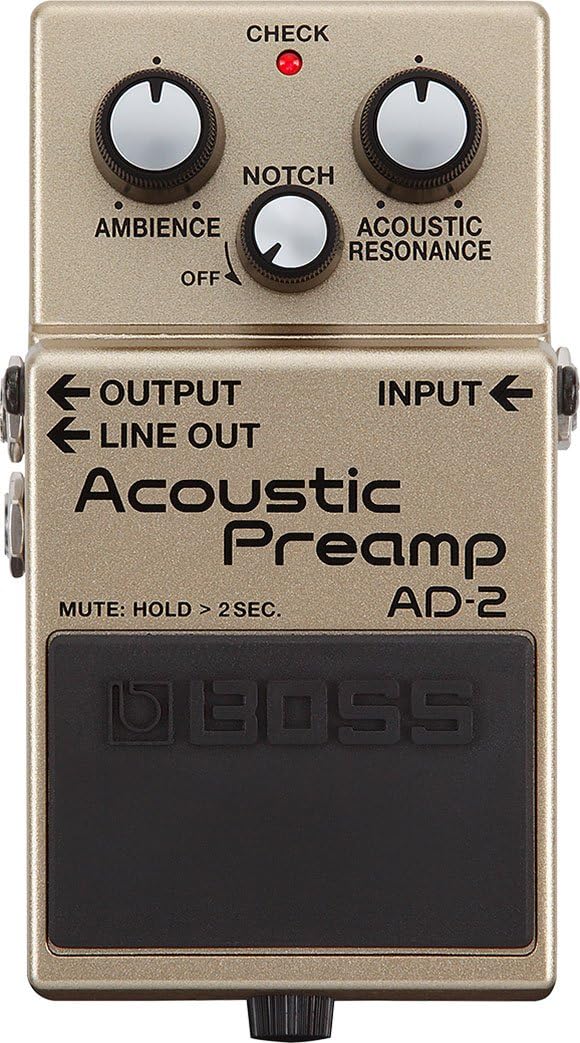
The BOSS AD-2 is a purpose-built acoustic preamp with a 4.6 rating and a strong reputation for a natural presentation. Rather than trying to replicate a full amplifier menu, it uses a focused set of processing controls designed to address familiar acoustic-guitar problems.
We may earn a commission when you buy through this link, at no additional cost to you.
Acoustic resonance processing reproduces the complex resonance associated with an unplugged instrument, helping a pickup signal sound less thin or overly compressed. The dedicated ambience control adds acoustic-focused reverb, while the notch filter provides immediate feedback reduction without requiring a deep menu dive.
A normal output can feed an acoustic amplifier, and the balanced DI output can connect directly to a PA or mixer. The mute function is helpful when switching guitars or tuning, though players who require multiple independent EQ bands may find the control set less granular than that of a full preamp and DI.
The AD-2 is an excellent option for performers who want a simple, dependable acoustic processor with a balanced direct option. Its five-year warranty also adds reassurance, and the straightforward control layout makes it accessible to newer players while remaining useful to experienced performers.
The acoustic resonance function is the model's defining feature. It is intended to restore an open, organic character to a pickup signal without requiring the player to recreate that response with several separate EQ adjustments.
Switching between a normal amplifier output and a balanced direct output lets the same pedal serve rehearsal rooms and formal stages. The sound mute adds another layer of practical control for setup and instrument changes.
We may earn a commission when you buy through this link, at no additional cost to you.
The Fishman AFX Pro EQ Mini is a compact acoustic EQ and preamp with a 4.1 rating. Its distinguishing feature is flexibility: a five-band equalizer, multiple bypass modes, phase control, and dual path routing allow the player to adapt the signal to different amplification setups.
We may earn a commission when you buy through this link, at no additional cost to you.
The EQ is voiced specifically for acoustic instruments, which offers a more useful starting point than a generic bass-and-treble control. The phase control is intended to help fight feedback, providing another option when a room, monitor, or nearby acoustic instrument makes a piezo signal difficult to control.
True bypass, buffered bypass, and mute options let users decide how the pedal interacts with the rest of the chain. The compact design is easy to fit on a crowded board, but the need for a separately sold external 9V supply is an inconvenience that should be considered when planning the rig.
This Fishman model suits players who want a focused equalizer and routing tool without the larger footprint of a traditional preamp. It does not offer the broad effects selection of some competitors, but that restraint makes it a potentially cleaner and more predictable platform.
True bypass, buffered bypass, and mute give the player meaningful control over the pedal's relationship with downstream equipment. This flexibility is useful when comparing clarity, signal consistency, and silent setup options in a particular chain.
Dual path routing and phase control make the unit more adaptable than a basic tone stomp. It can serve as a direct acoustic shaping tool while offering choices for different amplifier, mixer, or interface arrangements.
We may earn a commission when you buy through this link, at no additional cost to you.
The GOKKO GK-32 SpanishFly stands out with a 4.8 rating and a straightforward set of acoustic-oriented controls. It is designed to prepare a pickup signal for an amplifier, mixer, or pedalboard while making feedback management and tonal presence easy to adjust.
We may earn a commission when you buy through this link, at no additional cost to you.
An anti-feedback footswitch and associated control provide a direct response to the most common acoustic-stage problem. A separate treble-boost footswitch adds brightness and presence without requiring the player to hunt through EQ settings, while input, bass, and treble controls handle basic level and tonal shaping.
True bypass preserves the uninvolved signal, and the 9V center-negative power requirement is conventional for a pedal of this type. The limitations are the lack of a more granular EQ, tuner, or broader effects system, but those omissions help preserve the unit's straightforward design.
The GK-32 is a strong recommendation for a player who wants more feedback protection and tonal control without navigating a complex preamp. It is particularly suitable for acoustic soloists, duo performances, and anyone building a compact live signal chain.
The dedicated anti-feedback footswitch is especially useful when volume, positioning, or room acoustics change. Players can engage it when needed and return to a true-bypass signal without navigating a preset.
The independent treble boost makes it easy to increase clarity for a solo or a busy mix. Bass and treble controls provide enough range for basic correction, while the input control handles the overall level.
We may earn a commission when you buy through this link, at no additional cost to you.
The Fishman Platinum Pro EQ/DI is a 4.5-rated analog preamp pedal aimed at players who want studio-style control in a live or recording setup. Its feature set includes balanced XLR output, onboard compression, phase control, and a switch between pre-EQ and post-EQ signal paths.
We may earn a commission when you buy through this link, at no additional cost to you.
The pre and post EQ option is significant because it determines whether the equalizer is applied before or after the onboard dynamics. This allows the player to compare how compression and EQ interact, a useful distinction when preparing a signal for a mixer, interface, or larger acoustic amplifier.
A footswitchable boost with level control can add volume for solos, while the phase switch assists with feedback management and tone matching. Compression can also change the perceived attack and sustain of a note, so it should be adjusted conservatively when the aim is a natural acoustic response.
The Platinum Pro is a strong fit for a serious pedalboard, session player, or live performer who values routing and signal control. A player searching for a simple pedal with only volume and tone may find this model unnecessarily elaborate.
The routing switch changes how the equalizer interacts with the rest of the signal chain. It gives the player a practical way to compare tonal correction before dynamics with post-EQ shaping.
The balanced XLR output suits direct connection to a PA, mixer, or recording interface. Compression and phase control add useful finishing tools for creating a stable, mix-ready acoustic source.
We may earn a commission when you buy through this link, at no additional cost to you.
The Plastic 301 Acoustic Preamp is an instrument-mounted control unit with a 4.4 rating. It combines a preamp, pickup tuner, and several tone controls in one package, offering a different approach from the pedalboard-focused models elsewhere in this guide.
We may earn a commission when you buy through this link, at no additional cost to you.
Volume, bass, midrange, treble, brilliance, notch filter, and phase controls provide a surprisingly broad set of adjustments. The integrated tuner helps players establish a reference pitch, while the phase switch and notch filter provide tools for reducing feedback and refining the pickup response.
Solder-free installation and an easy-access battery compartment make this model appealing to players who want onboard control without adding equipment to a pedalboard. The trade-off is installation: it is not a portable floor device, and the controls are only available when the preamp is mounted on the instrument.
The Plastic 301 is a good option for a guitarist who wants a permanently integrated pickup system. It may be less convenient for switching instruments or using a highly mobile setup, but it brings useful tone shaping and tuning directly to the guitar.
Separate bass, midrange, treble, and brilliance controls allow more detailed adjustment than a standard two-knob preamp. The notch filter and phase switch help manage common feedback problems.
Solder-free installation and accessible battery placement simplify ownership once the unit is fitted to the guitar. This approach avoids pedalboard space and keeps frequently used controls close at hand.
We may earn a commission when you buy through this link, at no additional cost to you.
The Palmer POCKET AMP ACOUSTIC is a portable preamp for acoustic string instruments with a 4.5 rating. It is intended for practice, small gigs, and recording situations where a full acoustic amplifier would be unnecessary or inconvenient.
We may earn a commission when you buy through this link, at no additional cost to you.
Its three-band equalizer includes a semi-parametric midrange control specifically tuned for acoustic instruments. That focused voicing is important because a generic instrument preamp may not offer the same support for the frequency ranges most likely to cause harshness, muddiness, or feedback in an acoustic source.
The input accommodates both piezo and magnetic pickups, giving the device broader compatibility than a unit designed around one pickup type. Bass guitar compatibility broadens its practical use, although it remains a preamp rather than a full amplifier or effects processor.
The POCKET AMP ACOUSTIC is a strong choice for home practice, rehearsals, and direct recording. Players who need a balanced stage output, tuner, or extensive onboard effects should look elsewhere, but those who value portable analog-style tone shaping will find the format highly convenient.
The three-band layout and semi-parametric mid control focus on the tonal problems acoustic players encounter most often. It provides more targeted shaping than a simple tone control while remaining easy to operate.
Support for piezo and magnetic pickups means the preamp can work with different instrument electronics. Its portable format is especially useful for players who practice or record away from a full amplifier.
We may earn a commission when you buy through this link, at no additional cost to you.
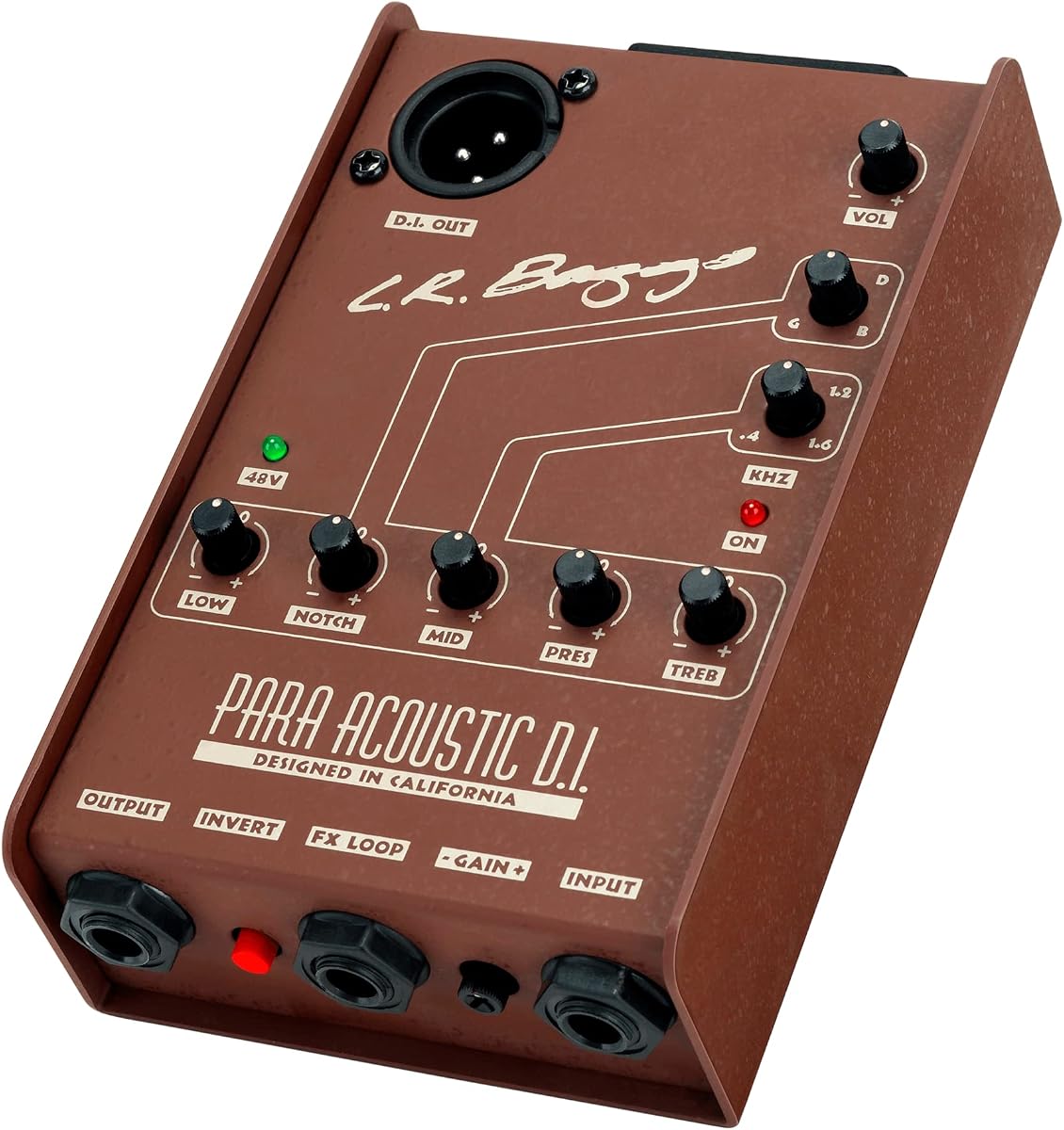
The LR Baggs Para Acoustic D.I. is a direct acoustic interface with a 4.7 rating and a reputation for straightforward signal quality. It provides adjustable gain, five-band equalization, phase inversion, and both XLR and quarter-inch outputs in a focused package.
We may earn a commission when you buy through this link, at no additional cost to you.
The five-band EQ is more detailed than the compact models with only bass and treble controls, allowing the player to address several parts of the spectrum. The adjustable gain accepts both passive and active pickups, while phase inversion provides another tool for finding the best response and reducing feedback.
Its dual output connectors make it easy to connect to a PA, mixer, or audio interface without requiring an additional box. The lack of effects, tuner, boost, and footswitch controls keeps the signal path simple, but it also means there is less onboard flexibility than the full preamp-DI models.
The Para Acoustic D.I. is best for a player who wants reliable equalization and direct-output flexibility without distracting extras. It is especially suitable for a permanent setup where the preamp and DI remain together, and it can also serve as a focused recording front end.
The equalizer offers enough range to correct common acoustic issues without the complexity of a fully featured stage preamp. Tunable notch and midrange bands add useful focus for challenging rooms and pickup systems.
Operation from a 9V battery or 48V phantom power makes the unit practical in both mobile and installed environments. XLR and quarter-inch outputs support balanced and common instrument-level connections.
We may earn a commission when you buy through this link, at no additional cost to you.
The right acoustic preamp depends on the player's pickup, venue, amplification path, and desired level of control. The most useful model matches those needs without adding features that complicate setup or transport.
A floor pedal is ideal when the signal chain changes between venues or when the player wants tone shaping, effects, and feedback control beside other stompboxes. An instrument-mounted preamp is more convenient for a permanent setup because its controls and tuner travel with the guitar. A portable preamp is useful for practice and recording away from a full amplifier, while a dedicated DI-style unit suits players who want a stable signal without elaborate footswitch operation.
Piezo and magnetic pickups present different challenges. Piezo sensors often produce more high-frequency content and can trigger feedback more readily, while magnetic pickups may have a different output level and tonal profile. An adjustable input or gain control gives the player room to accommodate either type and prevents the signal from being too weak or overwhelming the next device. Active electronics may also require a different gain range than a passive pickup.
Bass and treble controls are useful for broad corrections, but a multi-band EQ provides much more precise control over the spaces between them. Low and high mids can address muddiness, nasal frequencies, harshness, or dullness without disturbing unrelated parts of the spectrum. A semi-parametric mid control is valuable because it lets the player choose both a center frequency and a width of adjustment, making it easier to isolate a problem frequency. More bands are not automatically better, but greater resolution is valuable in crowded or imperfect rooms.
Feedback can ruin an acoustic performance, so notch filters, phase controls, and anti-feedback circuits deserve careful attention. A notch filter is most effective against a specific resonant frequency, while phase adjustment can improve compatibility between microphones, monitors, and nearby instruments. A dedicated anti-feedback control may be easier to engage during uncertain conditions. No feature eliminates feedback entirely, and proper volume, positioning, monitor placement, and pickup selection remain essential.
The destination determines which outputs matter. A quarter-inch output works with many amplifiers and instrument inputs, while a balanced XLR output is often preferable for long cable runs, direct PA connections, mixers, and audio interfaces. Some preamps provide both, allowing one unit to serve rehearsal and stage configurations. Players should also confirm whether the unit is intended to connect directly to a full-range acoustic amplifier or to serve as the preamp for another system.
A transparent preamp and EQ leaves most creative decisions to the amplifier, PA, or recording software. A multi-effects acoustic pedal adds convenience by providing chorus, delay, reverb, and other performance treatments in one enclosure. Those effects can make a solo sound more dimensional, but they also increase the number of controls and may not suit players who want a completely natural acoustic response. It is best to select a processor according to the sound you need rather than the number of features displayed.
True bypass provides the most direct connection between the guitar and amplifier, while buffered bypass can produce a more consistent signal through a chain of pedals. Some models also provide a mute, which is useful during instrument changes and tuning. An integrated chromatic tuner is convenient but not universal. Players who change guitars often or perform without reliable access to a tuner may place greater value on these features than users with a dedicated tuner and a fully controlled signal chain.
Battery operation offers freedom from cables but requires regular power management, while a 9V pedal supply adds another item to carry. Phantom power can suit a permanent installation near a mixer or interface, and some devices support more than one power method. Portability includes size, weight, control access, and the number of connections needed. A complex preamp can still be practical if it is mounted near the floor, while a compact unit is more valuable to a traveling musician than a feature-rich model that remains on a stand at home.
Begin with the preamp bypassed or fully muted, connect the guitar, and set the amplifier or recording input to a conservative level. Engage the preamp, raise the input gain only until the signal sits comfortably in the meter, and then make small EQ adjustments. Cut a problem frequency before boosting broad areas, and compare every change against the original sound to avoid correcting the same issue twice.
Set up feedback controls before the rehearsal is complete. Use the notch filter only when the unwanted frequency is reasonably consistent, experiment with phase when microphones or monitors are involved, and engage a dedicated anti-feedback circuit when conditions become unstable. Lowering the instrument volume or moving away from a problematic monitor often helps more than increasing tone-shaping controls. For direct recording, confirm the output connection and select the matching input on the interface or mixer before making creative changes.
Protect the unit from moisture, impact, and unstable power. Install fresh batteries when a signal becomes intermittent, keep external power connections clean, and avoid using power supplies with incorrect voltage or polarity. For onboard models, follow the manufacturer's installation instructions and avoid opening the battery compartment while the instrument is connected to amplification. Clean control surfaces gently, store cables without sharp bends, and periodically inspect footswitches, connectors, and strain relief.
It depends on what the built-in preamp does and where the signal is going. A guitar preamp usually provides basic volume and tone adjustment, while a separate acoustic preamp may add a fuller EQ, feedback control, phase adjustment, tuner, boost, effects, and balanced output. Players using a simple amplifier can often get by with onboard controls, while direct PA and recording setups often benefit from a more capable unit.
Yes. Piezo pickups often produce a bright, dynamic signal with frequencies that can cause harshness or feedback, so acoustic preamps commonly include notches, phase controls, acoustic-specific EQ, and resonance processing. Electric guitar preamps are generally designed around magnetic pickups, amplifier-like voicing, and distortion or lead tones. The preamp should be compatible with the installed pickup rather than simply with the instrument type.
A basic DI box routes an instrument signal and may provide impedance matching, while an acoustic preamp typically includes tone shaping, gain control, and feedback-management features. Some acoustic preamps also act as DI units and offer XLR outputs, but their control set is more extensive. Players who only need a clean direct connection may not need the extra controls of a full preamp.
The most valuable live features are usually a dependable balanced output, accessible EQ, a mute, and a way to manage feedback. A tuner is also convenient, while a footswitchable boost can help a guitar cut through a band without changing instruments. Effects such as delay and reverb are useful when the player wants them, but they should be set before the performance and checked for interaction with other sound sources.
Yes, particularly if it offers a balanced output, adjustable gain, phase control, and a detailed EQ. These features help create a clean source before adding compression, reverb, or other processing in an audio interface, mixer, or recording application. Players should check output type, signal level, and power requirements to ensure the preamp integrates properly with the recording chain.
True bypass is useful when a completely direct signal is desired and the guitar or amplifier handles the signal well. Buffered bypass may create a more consistent signal through a large pedalboard and can help preserve the instrument's character in some setups. Neither is universally better, so the best choice depends on the guitar, other pedals, amplifier, and whether output consistency or minimal circuit involvement matters more.
Start with moderate volume and correct instrument position before relying on electronic controls. A notch filter can target a fixed resonant peak, phase controls can improve compatibility with other sources, and an anti-feedback circuit can help in changing conditions. Turning down the wrong frequency, using a high-quality cable, and moving the guitar away from the monitor or other acoustic source are equally important parts of feedback control.
It depends on the player. A built-in tuner is convenient because it is always near the instrument and may include a mute for silent tuning. A separate tuner can offer a larger display, faster readings, or easier placement. Players who already have a reliable clip-on or pedal tuner may not need the onboard feature, while those who want fewer accessories may prefer a preamp with an integrated chromatic tuner.
The BOSS AD-2 stands out for focused acoustic processing, balanced direct output, and straightforward operation. The GOKKO GK-32 SpanishFly offers dedicated anti-feedback control, independent treble boost, and true bypass, while the L.R. Baggs Venue DI provides the deepest combination of EQ, tuner, boost, and feedback-management features.
The right choice depends less on feature count than on the player's signal path. Choose a detailed preamp for stage control, a multi-effect pedal for built-in ambience and modulation, a portable unit for practice and travel, or an onboard system for permanent guitar control. Always verify pickup compatibility, output connectors, power requirements, and bypass behavior before purchasing.
Features, model availability, and pricing can change over time, so readers should confirm the latest specifications and current product details before making a final decision. It is also wise to compare the preamp with the amplifier, PA, or interface in the intended setup, because the best sound usually comes from a compatible combination rather than one isolated product.