
ALFA AOA-2458-59-TF
4.2Editor score
Dual-band 2.4 and 5 GHz
Nine dBi advertised gain
Integrated N-Female connector
This Marine WiFi Antenna guide compares 10 options for range, dual-band support, marine durability, gain, connectors, and installation flexibility.
A marine WiFi antenna can make a substantial difference to internet reliability aboard a boat, yacht, RV, or remote waterside installation. Salt, spray, vibration, changing weather, and obstructions can weaken ordinary indoor equipment, so the most useful antenna combines suitable frequency coverage with rugged construction and a practical mounting system.
This guide compares ten antenna options by examining supported bands, gain, radiation pattern, connector type, environmental resistance, dimensions, and included hardware. It includes dedicated marine dual-band models, outdoor WiFi antennas, combination cellular antennas, and a VHF radio antenna to clarify where each product does—and does not—fit.
The selections show how antenna design changes with the installation. Purpose-built marine models offer the strongest case for exposed saltwater use, while compact and multipurpose options may suit specific routers or temporary setups. Ratings and product configurations can change, and current prices should always be checked before purchasing.
4.2Editor score

5.0Editor score
The table below compares the ten included antennas across their intended roles, radio coverage, gain, physical design, and key practical limitations. It is a technical buying comparison rather than a laboratory test report.


The Poynting Omni-496 Dual Band is the most complete marine-focused option in this guide. It carries a 5.0 rating and combines an 8 dBi maximum-gain specification with support across 2.4 GHz and 4.9 to 7.2 GHz. That broad coverage makes it appropriate for WiFi, WiFi 6E, and WiFi 7 systems, subject to the transmitting device and connector configuration.
We may earn a commission when you buy through this link, at no additional cost to you.
Marine durability is a defining strength. The antenna is protected against ultraviolet exposure, salt spray, and weather, with an IP68 water-ingress rating and compliance with MIL-STD 810F and ASTM B117 salt-spray testing. Its 560 mm length and 75 mm diameter place it in the full-length radome category, which can support more deliberate mast placement than a small puck antenna.
Installation hardware is unusually practical. The package includes a marine adapter with 1-inch, 14-thread-per-inch mounting and an L-bracket for a 30 to 50 mm pole. The N-Type female connector provides a conventional high-quality connection point, although a suitable low-loss cable and matching router interface are still required for a complete installation.
This is the strongest recommendation for a boat owner who wants a purpose-built dual-band antenna, accepts the full-length mounting footprint, and can match the connector system. It is less suitable for a compact roof installation or a router with no compatible external antenna ports, but within its marine specialty, the package is unusually well specified.
Salt spray, ultraviolet exposure, and persistent weather are tougher on an exposed antenna than ordinary household conditions. This model's stated UV and saltwater resistance, IP68 rating, and documented salt-spray standards make it a more convincing choice for a permanent position on a vessel or coastal structure.
The included marine adapter and pole L-bracket allow installers to choose a standard threaded deck or mast position or a conventional pole arrangement. A higher, unobstructed position can improve the useful radio horizon, although the final result also depends on the router, cable run, nearby structures, and local coverage.
We may earn a commission when you buy through this link, at no additional cost to you.
The Pro-Gain is a feature-rich premium option aimed at owners of cellular gateways, enterprise routers, and remote installations. It has no published Amazon rating, so its evaluation here relies on the supplied product specifications. It offers 2.4 GHz and 5.8 GHz coverage, an advertised 8 dBi gain, a dual N-female MIMO arrangement, and an omnidirectional radiation pattern.
We may earn a commission when you buy through this link, at no additional cost to you.
Its strongest technical feature is the pair of N-female connectors. That arrangement is useful with enterprise and industrial routers from Cradlepoint, Peplink, Cisco, Digi, and Sierra Wireless, as well as compatible mobile broadband gateways. The stated VSWR of 1.8 or less indicates an effort to reduce reflected power and improve transmission efficiency.
The fiberglass construction and stated operating range from -40°F to 150°F support outdoor use, while the 360-degree pattern avoids the need to rotate the antenna when wind or vessel movement changes its direction. U-bolts, screws, an installation guide, and a recommendation for low-loss KMR240 cable make it a more involved but potentially complete installation kit.
Choose this antenna when your marine internet setup uses a MIMO-capable external antenna interface and the router is valuable enough to justify careful cabling. Buyers should verify connector gender, supported gateway bands, and radio capabilities before ordering, since its 8 dBi figure is described as a 2.4 GHz maximum gain and should not be interpreted as 8 dBi on every supported band.
Dual connectors allow separate 2.4 and 5.8 GHz paths to compatible MIMO equipment. This can be valuable where the goal is a stable connection for conferencing, telemetry, or multiple connected devices rather than simply extending a single legacy WiFi radio.
The stated gain cannot create a signal where none exists, and poor cable connections or lengthy lossy runs can erode the benefit. The manufacturer recommends high-quality low-loss KMR240 cable, correct N-male termination, surge protection, and sealing exposed connections with self-fusing silicone tape for demanding outdoor installations.
We may earn a commission when you buy through this link, at no additional cost to you.
The Poynting OMNI-496 Coastal is another purpose-built marine antenna, distinguished by a stated operating span from 2400 through 6000 MHz and a maximum gain of 7.5 dBi. It supports WiFi and WiMAX/LTE-related frequencies in the 3.3 to 3.8 GHz region, as well as IEEE 802.11a, b, g, n, and ac standards.
We may earn a commission when you buy through this link, at no additional cost to you.
The construction information directly addresses the marine environment. The antenna has an IP68 rating, protection against ultraviolet rays and saltwater, and an all-weather enclosure. Its omnidirectional pattern allows continuous reception and transmission in every horizontal direction without the need to point a narrow beam toward a shoreline tower.
The included marine adapter uses a 1-inch, 14-thread-per-inch standard, and the L-bracket accepts a 30 to 50 mm pole. These options make the antenna adaptable to a standard marine fitting or an existing mast. The N-Type female connector is suitable for conventional coaxial cable, but the listed package does not include a cable, and the pole is also excluded.
This is a sensible alternative for mariners who want a coastal-grade antenna but do not need the broader maximum-gain claim and newer WiFi support highlighted by the first-ranked model. Confirm the router's antenna ports and the required cable length, then use quality coax and weatherproof connectors to obtain the best practical result.
An omnidirectional antenna is useful when the relevant cellular or WiFi coverage can arrive from more than one direction. It is particularly sensible around harbors and coastal routes where the strongest transmitter may not remain in one fixed direction relative to a moving vessel.
A high-quality N-type connection is only one part of the system. Long cable runs should use appropriately low-loss, outdoor-rated coax, with connectors protected from moisture and strain. Keeping unnecessary slack out of the route and avoiding sharp bends helps protect the installation.
We may earn a commission when you buy through this link, at no additional cost to you.
The 4G/WiFi/GPS 3-in-1 Combination Antenna is a compact puck-style option intended for outdoor, weatherproof, and marine use. It has a 4.2 rating and distinguishes itself from ordinary WiFi antennas by combining cellular, WiFi, and GPS functions behind a through-hole mounting design.
We may earn a commission when you buy through this link, at no additional cost to you.
That combination can simplify a crowded antenna position when the navigation equipment, cellular modem, and WiFi router can all be placed near one another. The 24-inch leads provide some positioning flexibility, but they are not long enough to reach a distant router compartment on a larger vessel without additional cable or a different routing plan.
The supplied information is concise, so the important installation details are limited. Buyers should confirm the connector type and gender on each lead, the supported cellular bands, the WiFi frequencies, and whether the GPS element is passive or active. The through-hole format also requires a clean, sealed mounting surface rather than a simple screw or adhesive pad installation.
This antenna makes the most sense for a boat with a centralized electronics location and a need for multiple radio functions in one location. It is less attractive for a user who only needs high-gain dual-band WiFi, because the supplied data does not state a gain figure, frequency range, or IP rating for this specific model.
A combined antenna can reduce the number of separate roof or mast penetrations when each device uses a compatible lead. This is useful on vessels where deck space is limited and every additional hole creates another potential point for water ingress.
A three-function antenna is convenient only when the router, modem, and GPS receiver accept its connectors and frequency assignments. Verify lead lengths and interface types before drilling or committing to the mounting position, and follow the device makers' grounding and surge-protection guidance.
We may earn a commission when you buy through this link, at no additional cost to you.
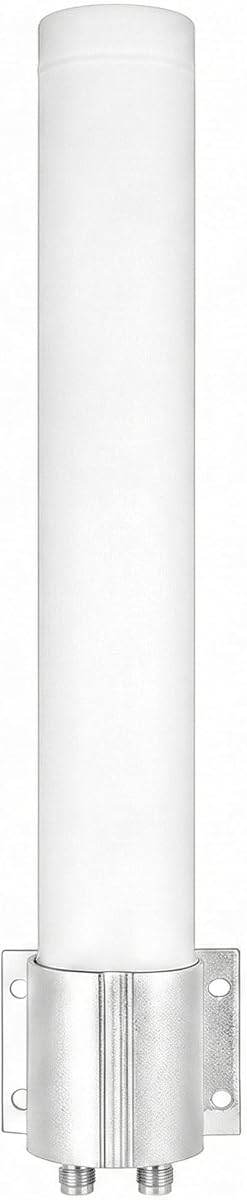
The ALFA AOA-2458-59-TF is a straightforward dual-band outdoor WiFi antenna with an advertised 9 dBi gain and a 4.2 customer rating. It operates across 2.4 and 5 GHz and is aimed at extending or improving WiFi coverage where an existing device has a compatible external antenna connection.
We may earn a commission when you buy through this link, at no additional cost to you.
Its fiberglass construction keeps the antenna relatively light and easier to handle than a larger marine radome. The integrated N-female connector avoids a permanently attached cable, giving the installer freedom to select the cable length and route for the vessel or outdoor system. The product is described as weatherproof, making it a plausible option for a protected exterior position.
The main concern is marine-specific qualification. Unlike the dedicated Poynting models in this list, the supplied specifications do not mention an IP rating, salt-spray testing, or a marine mounting adapter. It may still work well in a sheltered location, but exposed saltwater service calls for careful connector sealing, corrosion monitoring, and periodic inspection.
This is the best budget-style choice for a boat owner who already has compatible N-male cabling and a router with suitable ports. It provides a substantial claimed gain and a simple integrated connector without requiring a dedicated marine mount. Confirm the router's interface and use low-loss outdoor-rated coax for the best result.
A higher-gain external antenna can help when a router's stock antenna is obstructed by a cabin, deck, or equipment enclosure. The improvement is most useful when the radio's own antenna ports support the selected band and the installation provides a genuinely clearer radio path.
Weatherproof construction does not necessarily mean every exposed connector is permanently sealed. Use compatible N-male coax or a weather-sealed adapter, protect the connection with the appropriate marine-grade materials, and inspect it periodically for corrosion or water ingress.
We may earn a commission when you buy through this link, at no additional cost to you.
The M19B 2-Lead MIMO is a cellular antenna rather than a conventional WiFi antenna. It carries a 5.0 rating and supports 4G LTE, CBRS 5G NR, multi-carrier, and multi-technology applications. The supplied description specifically names marine, M2M, IoT, public safety, mobile, and stationary installations.
We may earn a commission when you buy through this link, at no additional cost to you.
Its heavy-duty high-density injection-molded ABS housing is 8.6 inches high and intended for demanding conditions in all climates. The antenna-only package includes two one-foot leads with N-female connectors, plus an L-bracket mounting arrangement. Those short leads are useful for nearby equipment but may require extensions or a different routing approach.
The M19B does not list WiFi frequency support. A cellular antenna can carry data supplied by a cellular router, but it should not be treated as an interchangeable external WiFi antenna unless the connected device explicitly supports the radio bands and connector arrangement. The distinction is important when selecting an internet antenna for a boat.
Choose this model when the primary requirement is cellular coverage through a compatible 4G LTE or 5G modem, particularly in a marine or industrial installation. Verify the modem's supported cellular bands, the two N-female leads, and whether the included lead length suits the available mounting space.
The housing and all-climate construction language point toward demanding mobile and fixed applications. A robust enclosure is valuable where vibration, temperature changes, and weather are routine, although connector protection and correct grounding remain part of the overall installation.
A boat may use both a cellular modem and local WiFi equipment, but they operate in different frequency bands. Match the antenna to the radio that must transmit and receive, and do not select a cellular model simply because the word MIMO appears in its description.
We may earn a commission when you buy through this link, at no additional cost to you.
The Bingfu Dual Band WiFi set is a two-pack of compact 3 dBi omnidirectional antennas with a 4.6 rating. It supports 2.4 GHz and the 5 to 5.8 GHz range through RP-SMA male connectors and is intended for routers, access points, USB adapters, wireless cards, IP cameras, DVR systems, and other compatible wireless equipment.
We may earn a commission when you buy through this link, at no additional cost to you.
The pair is especially relevant to MIMO equipment that uses two antenna connections. Because both antennas share the same gain and connector format, they can provide a matched physical arrangement for a compatible receiver. The product's compatibility list also includes vehicle cameras, FPV equipment, extenders, industrial routers, IoT gateways, and M2M terminals.
This is not a specialized marine radome. The supplied information gives no IP rating, salt-spray standard, marine mount, or UV-specific construction detail. Its 3 dBi gain is also lower than the full-length models above, although the real result depends on the radio system, antenna height, cable losses, obstructions, and local coverage.
For an enclosed cabin electronics setup or a compact marine network, the two-pack can be a useful way to improve a MIMO-capable router. It is less suitable for a mast-mounted, all-weather coastal deployment unless the antenna and connector are suitably protected. The critical purchase check is connector gender: the center must have a hole and no pin.
MIMO systems can use separate antennas to support simultaneous radio paths. A matched two-pack reduces the need to source two differing units, although the router manual must confirm that two external antennas are supported and should specify which ports form the MIMO pair.
RP-SMA male and RP-SMA female are not interchangeable. The listed connector has a hollow center, while an RP-SMA female connection has a central pin. Check the router or device marking carefully, and avoid force-fitting the wrong connector.
We may earn a commission when you buy through this link, at no additional cost to you.
The LINOVISION 4G LTE MIMO 3-in-1 combines two cellular MIMO elements and one dual-band WiFi element in a single roof-mounted package. It has a 3.2 rating, an IP67 waterproof rating, and an operating range of -40°C to +85°C. The supplied information identifies RVs, marine vehicles, remote IoT devices, surveillance systems, and industrial environments as target uses.
We may earn a commission when you buy through this link, at no additional cost to you.
Its cellular elements cover 698 to 960 MHz and 1710 to 2690 MHz, while the WiFi element covers 2400 to 2483.5 MHz and 4900 to 5825 MHz. The two cellular connections use SMA male, and the WiFi connection uses RP-SMA male. Each RG174 lead is 40 centimeters, or 15.75 inches, long.
The combination reduces the number of separate roof-mounted antennas, and the IP67 rating provides useful outdoor protection. However, RG174 is a relatively thin coaxial cable, and short runs of small-diameter cable can matter in a marginal coverage area. The product also has the lowest customer rating among the rated products in the guide.
Choose the LINOVISION when a single compact roof position and separate cellular and WiFi elements are priorities. Confirm that the router provides the necessary antenna ports and that its cellular modem supports the required frequencies. For a long mast run, plan the cable route carefully or select a model with longer, lower-loss leads.
Combining cellular and WiFi functions can make deck or roof installation tidier. It also concentrates the radio position, which can make placement easier to repeat and can reduce the number of separate housings exposed to weather.
The included 40-centimeter RG174 leads are convenient for nearby equipment but cannot create extra signal strength. When the router is farther away, compare the route length with the cable's loss characteristics and avoid unnecessarily long or poorly supported runs that could undermine the antenna's stated benefit.
We may earn a commission when you buy through this link, at no additional cost to you.
The Eifagur 9 dBi Long Range antenna is a compact dual-band outdoor WiFi antenna with a 4.7 rating. It supports 2.4 GHz and 5 to 5.8 GHz and is advertised for routers, access points, security cameras, RV cameras, and other wireless devices. The design is presented as a simple replacement that can improve an existing installation.
We may earn a commission when you buy through this link, at no additional cost to you.
Its principal attraction is the claimed 9 dBi gain in a relatively small format. That makes it appealing for an outdoor camera, RV network, or boat cabin system where a full-size marine radome is unnecessary. Omnidirectional operation also avoids the need to aim the antenna toward a single access point or base station.
The supplied specifications do not identify the connector, antenna dimensions, mounting hardware, ingress-protection rating, or marine salt-spray resistance. Those omissions matter more in a vessel environment than in a protected outdoor location. The product may serve as a convenient directional-free WiFi upgrade, but the buyer must verify the physical interface before ordering.
This is a good lightweight option for improving WiFi reception around an RV, exterior camera, or protected marine location, especially where a 4.7 customer rating inspires reasonable confidence. For a permanently exposed mast or coastal installation, a model with documented IP and corrosion protection is the safer long-term choice.
Higher gain can improve the link margin in suitable conditions, but it does not bypass distance limits or create internet access without a usable upstream signal. A smaller antenna also makes placement easier where deck space, wind loading, or the appearance of a full-length radome is a concern.
Because the listed information does not confirm an IP rating, salt resistance, or connector type, use this product in a sheltered location unless its documentation establishes otherwise. A proper sealed adapter, strain relief, and corrosion-resistant mounting hardware are necessary in any exposed saltwater installation.
We may earn a commission when you buy through this link, at no additional cost to you.
The HYS VHF Marine Antenna is included as a marine communications complement, not as a WiFi antenna. It operates from 156 to 163 MHz with 3 dBi gain and is designed for VHF marine radio, NOAA weather reception, and compatible 156 to 163 MHz equipment. It has a 4.7 rating but cannot be connected to a WiFi router for internet service.
We may earn a commission when you buy through this link, at no additional cost to you.
Its marine engineering is extensive. The 43.3-inch fiberglass radome has an anti-corrosion finish, while stainless-steel hardware is intended to resist galvanic corrosion. The included 22.9-foot, or seven-meter, low-loss RG-58 cable terminates in PL259 and is designed to connect to a radio with a standard SO239 socket.
The built-in 180-degree nylon ratchet mount permits installation on a deck, side, or rail and can fold for storage or low-clearance travel. The antenna also covers marine Channel 16 and NOAA weather frequencies, with stated VSWR performance across the band. Proper coax shield grounding at the radio remains essential.
Do not buy this model to improve boat WiFi. Purchase it when the need is a VHF marine radio, NOAA weather receiver, or compatible communications system. A vessel may need both this antenna and a dedicated WiFi or cellular antenna, but they serve different radio systems and cannot substitute for each other.
Marine voice communication and internet access may both be essential aboard a boat, yet they occupy entirely different frequency ranges. A VHF antenna improves radio communication and NOAA reception; it has no effect on a router's 2.4 or 5 GHz WiFi link.
The coax shield must be properly grounded to the radio chassis ground to reduce electromagnetic interference and help protect transmitter components. Follow the radio manufacturer's instructions, inspect the PL259 connection for corrosion, and keep the joint suitably protected from salt spray.
We may earn a commission when you buy through this link, at no additional cost to you.
The right marine WiFi antenna depends on the radio system, placement, exposure, and available connector infrastructure. Review the technical requirements before focusing on gain, because compatibility and durability determine whether an antenna can be installed successfully at all.
Start by identifying whether the antenna must support local WiFi, cellular data, GPS, or some combination of those services. WiFi antennas cover the 2.4 GHz and 5 GHz regions, while cellular antennas may need low-band and high-band LTE coverage, and the listed M19B also targets CBRS 5G NR. A product that is excellent for one service can be completely ineffective for another.
The connector on the antenna must physically and electrically match the router or gateway. The list includes N-female, N-male, RP-SMA male, SMA male, and PL259 interfaces, and these are not interchangeable. Check whether the router uses one antenna port, two MIMO ports, or proprietary cable leads, and confirm whether an adapter can be used without introducing unacceptable loss or a poor weather seal.
Gain describes how efficiently an antenna concentrates energy in a given direction, not how much internet service the provider supplies. An omnidirectional antenna spreads energy around the horizon and is usually easier to use on a moving boat, while directional antennas can concentrate energy toward a known shoreline tower but demand careful aiming. A higher figure such as 9 dBi is meaningful only when the band, pattern, cable, and placement are appropriate.
Saltwater, ultraviolet radiation, standing water, and constant vibration are more aggressive than a typical indoor environment. Look first for an explicit IP68 or IP67 rating, followed by evidence of UV and saltwater protection. Standards such as MIL-STD 810F and ASTM B117 salt-spray testing add useful confidence, but a rating applies to the antenna housing and does not automatically protect every cable connector.
A full-length antenna can benefit from a mast position that is above cabin structures, but it needs secure brackets and strain-free support. Puck antennas are easier to place and combine, while L-bracket and marine-thread adapters suit different installations. Plan the complete path from radio to antenna, keeping cable runs as short as practical, avoiding sharp bends, and allowing the coax to be supported without loading the connector.
Dual-band support does not mean every band receives the same gain or behaves identically. The 5 GHz band generally has shorter propagation characteristics than 2.4 GHz, while 2.4 GHz can be less crowded but may be more susceptible to some obstructions. A product advertised as 8 dBi may apply that maximum only to its lower band. Review the supplied frequency ranges and the manufacturer's band-specific diagrams before setting expectations.
MIMO equipment may use two antenna leads, and connecting the wrong ports can prevent the expected performance gain. Cable also matters: thin RG174, long runs, unnecessary adapters, and poorly seated connectors can all reduce an otherwise effective installation. For longer routes, select suitable low-loss coax such as the KMR240 recommendation included with the Pro-Gain product, and terminate connectors correctly.
A marine antenna should be inspected periodically, particularly after severe weather. Check connectors for corrosion, clean salt deposits with appropriate methods, verify that brackets remain tight, and look for cracked radomes or water ingress. A surge-protection strategy and correct equipment grounding can also reduce damage from electrical transients. Record cable, connector, and mounting details so the installation can be serviced consistently.
Begin by disconnecting power to the router, modem, or radio and confirming the antenna connector type against the equipment manual. Mount the antenna in the intended location, connect the specified low-loss outdoor-rated cable, and route it without tight bends, sharp abrasion, or strain on the connector. For a combination antenna, attach each lead to the correct cellular, WiFi, or GPS interface before securing the housing.
After installation, weatherproof every connection that is not explicitly designed as a sealed permanent interface. Keep the coax entry and any N, SMA, or RP-SMA joint above standing water, use compatible sealing materials, and secure the cable to the mast or deck separately from the antenna connector. Then restore power, check signal readings on the connected router, and compare performance before and after the upgrade where possible.
Inspect the installation at regular intervals and after severe weather. Look for salt residue, loosened fasteners, damaged insulation, chafed coax, water inside a connector, or corrosion around dissimilar metals. Clean with methods approved for the antenna and connector materials, replace damaged hardware promptly, and avoid painting over vents, seals, or labels. If performance declines, compare the router readings and inspect the cable before changing the antenna.
A dual-band omnidirectional antenna with documented saltwater, UV, and ingress protection is generally the most practical choice for a moving vessel. It avoids constant realignment and can serve multiple compatible radios. The best installation still depends on router ports, available mast space, local coverage, and a low-loss cable route.
No. Higher gain can improve the link within the antenna's intended pattern, but it cannot create upstream coverage or overcome an absent signal. Cable losses, interference, obstructions, band congestion, and the router's radio quality also matter. A well-positioned antenna with moderate gain can outperform a higher-gain unit installed poorly.
Only when the cellular gateway converts cellular data into WiFi and the antenna supports the gateway's required bands and connectors. A pure cellular antenna does not replace the local WiFi antenna for a router operating in the 2.4 or 5 GHz bands. Check both the modem and any external WiFi interfaces before installation.
Place it as high as practical and away from metal structures, wiring, and other antennas that may interfere. A mast location often provides a clearer horizon, but a full-length radome requires a secure bracket and careful cable support. A compact combination antenna may be more convenient near the router when long coax runs and signal loss are concerns.
IP68 indicates protection against dust and water ingress under the conditions defined by the rating system. It is a strong reason to favor a purpose-built marine model, but it does not guarantee that every cable connector is permanently sealed. Exposed joints still need compatible weatherproofing, strain relief, and regular inspection.
Only if the router or gateway uses a matching N-male connection or a suitable adapter. Several options in this guide use N-female, while others use RP-SMA or SMA. Connector gender is easy to confuse, so inspect the device port and verify whether the center contains a pin or a hole before purchasing.
Not by ordinary frequency selection alone. VHF marine radio and NOAA reception use roughly 156 to 163 MHz, while WiFi uses much higher 2.4 and 5 GHz bands. A boat may need separate antennas for both functions, each matched to its own radio and installed with the appropriate cable and grounding.
Inspect it at least periodically and after storms, heavy salt exposure, or maintenance near the mast. Look for corrosion, loose brackets, damaged cable jackets, water at connectors, and physical cracks. Reseal or replace compromised parts promptly, because connector corrosion and moisture ingress can create unstable performance even when the radome appears undamaged.
The Poynting Omni-496 Dual Band is the leading all-around choice because it combines broad WiFi support, 8 dBi maximum gain, IP68 protection, salt-spray and UV considerations, and versatile marine mounting hardware. The Pro-Gain MIMO model is the premium option for compatible enterprise or cellular gateways, while the ALFA AOA-2458-59-TF provides the most approachable dedicated WiFi upgrade for a budget-conscious installation.
Prioritize radio compatibility, environmental protection, connector type, and mounting before treating advertised gain as the deciding feature. A purpose-built coastal antenna is preferable for an exposed permanent position, while compact dual-band or combination antennas can work well in protected areas. Cable quality, surge protection, and correct grounding remain essential parts of the system.
Product ratings, configurations, and prices can change over time, so check the current listing and compatibility documentation before ordering. Compare the antenna's bands with the router, verify the connector gender, measure the available mounting space, and plan the full cable route. Those checks prevent a technically capable antenna from becoming an expensive installation mistake.