
Holikme 35Ft Dryer Vent Cleaner Kit
4.4Editor score
Thirty-five-foot flexible rod
Four-inch vent brush
Drill attachment included
Protective gloves included
Explore the best HVAC duct cleaning tools for 2026, comparing reach, attachment systems, airflow, brush design, ratings, versatility, durability, and ease of
HVAC duct cleaning tools range from rotating lint brushes designed for dryer vents to air-powered whips and vacuum attachments for larger supply ducts. The right tool depends on duct diameter, accessible openings, debris type, and whether you prefer brush, airflow, or suction-based cleaning.
We compared all ten products by considering their cleaning method, reach, included accessories, attachment compatibility, construction, and suitability for dryer vents or household air ducts. The list covers dedicated vent brushes, professional air-whip systems, flexible whip attachments, and a shop-vacuum duct nozzle.
Each review highlights the product's most useful features, practical limitations, and ideal application. Ratings reflect the supplied product information, while feature availability and current pricing can change, so shoppers should confirm compatibility and the latest listing details before buying.
4.4Editor score


4.2Editor score
This side-by-side comparison organizes each tool by cleaning method, reach, included components, and compatibility, making it easier to distinguish dryer-vent brushes from air-powered duct-cleaning systems and vacuum attachments.




This is the most versatile air-powered system in the group, combining five five-foot flexible rods, forward and reverse skipper balls, eight-tentacle whips, and an air-controlled blowgun. No customer rating was supplied for it, but its equipment list distinguishes it from simpler brush-only kits and makes it a compelling option for users who clean multiple sizes of ductwork.
We may earn a commission when you buy through this link, at no additional cost to you.
The rods use memory-style flexible construction and quick-connecting one-eighth-inch ends, allowing several sections to be assembled into a longer working line. Multiple air attachments add useful flexibility because a skipper ball can travel along duct walls while a whip can reach around corners. Forward and reverse configurations also allow the operator to choose how debris is moved through the system.
The trade-off is that this is an equipment-based approach rather than a simple manual brush. The forward air whip with skipper ball works best with a compressor producing at least 125 PSI, and the blowgun includes a one-eighth-inch quick connector plus a one-quarter-inch plug. Buyers without compatible air equipment may find a conventional vent brush easier to use.
It is best for homeowners or cleaning professionals who want one package for dryer vents and general air ducts. Choose it when the goal is a versatile air-cleaning setup rather than the lightest or simplest tool. Confirm compressor compatibility, connector sizes, and the dimensions of your accessible openings before assembling the kit.
Five separately connectable rods allow the working length to be adjusted as the route changes. Their flexible construction is particularly useful for navigating bends while keeping the cleaning attachment moving through the duct.
Forward and reverse skipper balls and eight-tentacle whips offer different ways to move debris. This makes the kit useful across main trunks, smaller branches, dryer vents, and tight corners when paired with suitable airflow.
We may earn a commission when you buy through this link, at no additional cost to you.
The supplied product record for this ASIN contains no title, rating, image, price, or description, which prevents a meaningful feature comparison. It is included to preserve the requested ten-product lineup, but there is not enough verified information to recommend it for a particular HVAC cleaning task.
We may earn a commission when you buy through this link, at no additional cost to you.
In practical terms, buyers cannot determine whether this listing represents a rotating brush, vacuum attachment, air-powered whip, or another device. Reach, connector type, cleaning mechanism, accessories, and material construction are also unknown. Reviewing the live Amazon listing is therefore essential before purchasing.
Because the available evidence is limited, the absence of visible drawbacks should not be interpreted as a strength. A product with limited documentation may also carry compatibility risks, such as an unsuitable connector, inadequate reach, or an attachment that does not match the homeowner's dryer-vent or HVAC opening.
This option is best treated as a conditional purchase. Open the direct listing, verify the actual product name, included components, dimensions, rating history, and return terms, and confirm that it addresses the intended cleaning job. If those details do not clearly exceed the documented alternatives in this guide, choose one of the better-specified options instead.
The direct product page is the only source for meaningful details in this record. Check that it is the intended tool rather than an unavailable or redirected listing.
Match the verified cleaning method to the duct type, opening size, and available power source. Missing specifications make that compatibility check especially important.
We may earn a commission when you buy through this link, at no additional cost to you.
This Holikme kit carries a 4.4 rating and brings together two synthetic brush heads with flexible rods extending as far as 30 feet. It is designed for dryer vents, exhaust ports, ducts, and fireplace chimneys, making it more broadly useful than a kit marketed only for one cleaning task.
We may earn a commission when you buy through this link, at no additional cost to you.
Its main advantage is simple mechanical agitation. The brush can be pushed manually or attached to a drill for rotation, and the manufacturer advises keeping the rod moving slowly in and out. Selecting the brush head that corresponds to the duct diameter helps the bristles contact the vent wall instead of leaving substantial gaps.
A potential drawback is the physical effort involved in pushing and turning a long rod through bends. The connection points also need attention because the instructions recommend sealing them with tape to reduce the chance of separation. Users must slow down around corners and stubborn lint deposits rather than forcing the shaft.
This is a good selection for households that want to maintain both dryer vents and a fireplace chimney without relying on an air compressor. Select the appropriate head, inspect the connections before starting, and use slow, consistent strokes. It is less suited to large HVAC supply ducts than the air-powered or vacuum-based products in the guide.
Different head diameters help users match the brush to narrow exhaust ports and larger duct sections. Correct sizing improves wall contact and makes each pass more purposeful.
Using a drill adds rotational agitation for compacted lint, while manual operation offers finer control in delicate areas. Either method benefits from slow, steady movement.
We may earn a commission when you buy through this link, at no additional cost to you.
This product is a compact air-powered whip designed for smaller flexible and insulated ductwork. It has eight flexible tentacles, a 14-inch cleaning section, a forward-flow configuration, and a one-eighth-inch connector. Its supplied rating is 3.3, making it more suitable for targeted work than as a complete stand-alone cleaning system.
We may earn a commission when you buy through this link, at no additional cost to you.
The flexible tentacles are intended to conform around obstacles and reach into corners where a rigid brush may remain on the duct surface. Forward-directed airflow pushes air away from the technician and carries loosened debris farther into the run. The connector allows the whip to be incorporated into a larger equipment setup.
Because it is an attachment rather than a full kit, it requires a compatible hose, blower, or other air source. Its low-pressure operating design is intended to clean while protecting duct surfaces, so it may not provide the aggressive agitation some users expect from rotating brushes.
Buy this whip if you already own compatible air-cleaning equipment and need a flexible attachment for branches, bends, or narrow sections. It is less appropriate for someone seeking an all-in-one dryer-vent solution. Check connector size and available airflow before ordering, particularly if a different whip is already included with another kit.
Each flexible strand can bend around obstructions, helping the tool reach areas that a straight brush may skim. That makes the whip useful for corners and irregular duct routes.
Directing airflow away from the operator reduces the chance of drawing dust toward the person working in a confined area while helping move debris down the duct.
We may earn a commission when you buy through this link, at no additional cost to you.
This Holikme dryer-vent kit has a 4.4 rating and combines a 40-foot flexible rod with two brush heads measuring four inches and one-and-a-half inches. That combination is well suited to dryer exhaust runs that pass through longer wall or roof routes and contain different cross-sectional sections.
We may earn a commission when you buy through this link, at no additional cost to you.
The smaller brush can travel through a narrow pipe while the larger head addresses wider duct areas. A drill attachment lets users rotate the shaft and loosen accumulated lint, while manual turning remains possible. The instructions emphasize turning clockwise and moving the rod slowly, with extra care around bends and stubborn deposits.
The 40-foot length is a clear strength for deep residential vent lines, but it also makes the kit less convenient for small jobs. Users must coil or carefully guide the flexible sections, and the joins should be checked before insertion because a loose connection could leave a brush head inside the vent.
This is a strong choice for homeowners with long dryer vents who want flexible reach and two brush sizes in one package. It also works for exhaust ports and other accessible ductwork. Confirm the route and brush dimensions beforehand, and advance the rod gradually rather than applying force around obstructions.
Forty feet of flexible extension can traverse substantial wall, attic, or roof-mounted runs. This reduces the need to split a long route into several shorter passes.
The included four-inch and one-and-a-half-inch brushes accommodate different passage widths. Starting with the smaller head and progressing to a larger one can reduce the risk of forcing a bulky brush through a tight section.
We may earn a commission when you buy through this link, at no additional cost to you.
This 35-foot Holikme kit is a practical all-in-one option for routine dryer-vent maintenance. It includes a heavy-duty brush for four-inch pipes, flexible nylon rods, a separate lint brush, a drill attachment, and protective gloves. Its 4.4 rating indicates generally favorable customer feedback.
We may earn a commission when you buy through this link, at no additional cost to you.
The kit offers two useful cleaning configurations. The larger four-inch brush is intended to contact the walls of common dryer ducts, while the dedicated lint brush can handle narrower gaps or focused areas. Connecting the handle to a standard household drill adds rotational force for packed debris and can shorten the work involved.
Its primary limitation is that powered rotation requires steady control, especially at elbows. The product guidance recommends slowing down around corners and then increasing speed gradually. This is less convenient than a fully manual tool, but it offers more cleaning force than pushing a brush by hand alone.
The bundle is well suited to homeowners who want useful accessories without assembling a collection of separate tools. It covers the main requirements for accessible dryer lines and reaches far enough for many residential installations. Inspect the rod connections, begin slowly, and avoid forcing the rotating head through a sharp bend.
The larger vent brush, dedicated lint brush, drill connector, and gloves cover the basic workflow from insertion through debris handling. That makes the kit practical for first-time dryer-vent maintenance.
At 35 feet, the flexible rod is long enough for many common household vent routes without the storage bulk of the longest kit in the guide.
We may earn a commission when you buy through this link, at no additional cost to you.
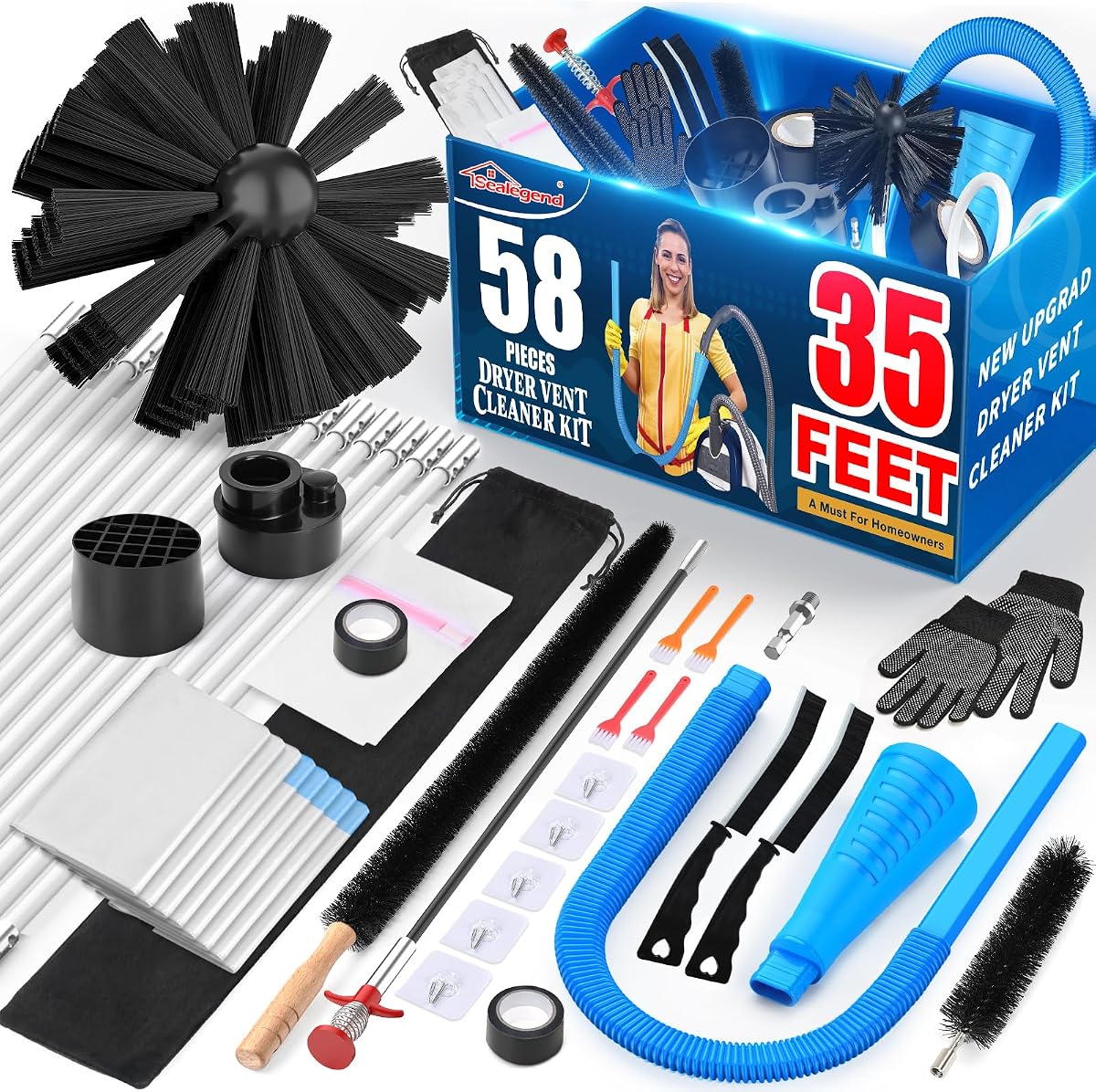
The Sealegend kit has the highest supplied rating in this roundup at 4.5. Its 58-piece collection includes a 35-foot dryer vent brush, lint vacuum attachment, long lint-trap brush, vacuum and dryer adapters, a drill bit, several specialty brushes, gloves, tape, hooks, and 33 lint collection bags.
We may earn a commission when you buy through this link, at no additional cost to you.
This range of components supports a more complete cleaning workflow than a basic brush-only set. The vent brush can rotate with a drill, while the included adapters permit suction from a shop vacuum or electric blower and can use airflow from the clothes dryer. Multiple brushes address gaps, coils, and lint-trap areas that one implement might miss.
The drawback is organization. With so many pieces, users must sort the kit before and after use to avoid losing small attachments. The vacuum attachment is also not universally compatible; the product information specifically notes exceptions for some Dyson and Shark models. Buyers should confirm their vacuum's connection before expecting suction operation.
This kit is ideal for a household that wants one box to handle dryer cleaning and related lint tasks. It is particularly useful for users who value collection bags and several cleanup methods. Start with the components relevant to the actual job rather than attempting to use every piece at once.
Rotating brush action, vacuum suction, and blower-assisted airflow can each address different debris conditions. Having the correct adapters lets the user change methods without buying separate equipment.
The included lint bags and laundry bag provide convenient destinations for removed material. That helps contain lint during cleaning and disposal.
We may earn a commission when you buy through this link, at no additional cost to you.
This 17-foot one-piece kit is designed around durability rather than a large accessory count. Its supplied rating is 4.2, and the package includes a solid-core shaft, a custom double-lock brush head, and a universal hex adapter. The integrated construction avoids the fragile snap points found in many segmented nylon vent cleaners.
We may earn a commission when you buy through this link, at no additional cost to you.
A positioning hole in the shaft is intended to limit reverse rotation, helping the brush remain attached when it encounters resistance. The double-lock head adds another layer of retention. These details are particularly relevant in clogged lines, where a conventional brush can slow, reverse, or separate from the shaft.
The shaft is designed to balance stiffness for forward push with enough flexibility for 90-degree elbows. That makes it a focused tool for deep residential systems, although its 17-foot length is shorter than the 30-, 35-, 40-, and 60-foot brush kits included in the comparison. It also lacks the broader accessory assortment offered by the Sealegend bundle.
Choose this kit when reliability during powered rotation matters more than having many attachments. It is a sensible option for owners of medium-depth dryer vents who want a simple, durable setup. Verify that 17 feet is sufficient for the route and keep the brush moving steadily through resistance.
A continuous shaft removes the weakest links found in multi-piece rods. That design is especially helpful when powered rotation places considerable torque on the tool.
The positioning hole and double-lock head work together to reduce reverse rotation and separation. More consistent brush engagement improves control in heavy lint.
We may earn a commission when you buy through this link, at no additional cost to you.
This shop-vacuum attachment takes a different approach from the brush and whip kits. Rather than pushing a cleaning head through a duct, it creates a seal over an accessible furnace supply opening and uses vacuum suction to collect debris. It carries a supplied rating of 2.6, so buyers should give compatibility and fit extra attention.
We may earn a commission when you buy through this link, at no additional cost to you.
Its standard two-and-a-half-inch port is designed to connect to most shop vacuums through a tapered inlet. The three-by-nine-inch nozzle is intended to fit common floor or wall vent covers after the grille is removed. If the opening does not match closely, the flange can be filed or sanded to customize the seal.
The main limitation is that it is an attachment, not a standalone cleaning system, and suction performance depends on the vacuum and the airtightness of the seal. It also cannot push a brush deep into a concealed run. A poor fit may reduce airflow and leave debris in the duct rather than removing it.
This tool suits users with an accessible supply register and a compatible shop vacuum who want to capture dust directly at the opening. Confirm the port size, vent dimensions, and ability to remove the grille before purchasing. Carefully form the seal and monitor the vacuum's performance during use.
A close-fitting seal is essential for effective suction at the duct opening. The adjustable flange allows limited fitting adjustments when a standard size does not align perfectly.
Vacuum suction captures debris as it is drawn toward the nozzle. This approach is particularly useful for accessible supply registers where a full brush-and-rod system would be excessive.
We may earn a commission when you buy through this link, at no additional cost to you.
The Holikme 60-foot kit offers the greatest reach among the listed brush-oriented products. Its 4.4 rating reflects favorable customer feedback, and the package combines flexible nylon rods, a heavy-duty brush for four-inch pipes, a dedicated lint brush, a drill attachment, and protective gloves.
We may earn a commission when you buy through this link, at no additional cost to you.
The long extension is valuable for routes that include extensive wall, attic, roof, or crawlspace sections. The four-inch brush targets common large-diameter dryer ducts, while the smaller lint brush can reach narrow gaps or provide focused cleaning. A standard household drill can add rotation to speed up removal of accumulated debris.
Maximum reach also creates a handling tradeoff. Sixty feet of flexible rod is more involved to coil, feed, and keep under control, particularly around tight bends. The user must advance sections methodically and avoid leaving a joint poorly secured. This makes the kit less convenient for occasional, short cleaning jobs than a more compact option.
Choose it for unusually long or complex dryer-vent routes and owners who prioritize reach. Check the entire path before use, ensure the rod joins are secure, and begin at lower drill speed. If the vent is short and straight, one of the shorter or more specialized kits will be easier to manage.
Sixty feet allows one kit to cover many extended residential vent runs. It is particularly useful when accessing a distant exterior vent through multiple bends.
The main four-inch brush works against larger duct walls, while the dedicated lint brush supports narrower or more focused cleaning tasks. Using the right head improves control.
We may earn a commission when you buy through this link, at no additional cost to you.
The most useful tool is one that matches the duct route, debris, opening size, and available equipment. Comparing cleaning method, reach, connectors, and included accessories prevents an expensive mismatch and makes routine maintenance more practical.
Rotating brushes are effective at agitating lint and dust from dryer-vent walls. Air-powered whips can move loose debris through branching ducts and reach around obstacles, while vacuum attachments collect material directly at accessible openings. Consider whether the job involves compacted lint, fine household dust, or a long network of narrow branches.
Longer is not always better, because an extended rod can be difficult to maneuver through corners and awkward working positions. Measure the likely path from the appliance or register to its exhaust point, then add a modest allowance for bends. The guide includes options ranging from 14-inch whip attachments to 60-foot brush kits.
A brush that is too narrow may leave much of the wall untouched, while one that is too large may not fit or may damage the duct. Kits with multiple head sizes offer more flexibility. Select the largest head that can move comfortably through the narrowest part of the route.
Air whips may require a one-eighth-inch connector, blower, hose, or compressor, while drill-powered brushes require a compatible hex adapter or drill connection. Shop-vacuum tools must match the vacuum port and create a reliable seal. Verify every connection before beginning, since a mismatched fitting can prevent the tool from working as intended.
Flexible rods, one-piece shafts, and soft tentacles each handle corners differently. Segmented rods can separate under torque, rigid tools may not negotiate tight bends, and long powered shafts can reverse or buckle if pushed too forcefully. Look for flexible construction, secure joints, and a brush design intended to resist reversing.
A complete kit may include a drill attachment, lint brush, vacuum adapter, blower adapter, gloves, tape, or collection bags. These extras can streamline the job, but they should serve a real part of the cleaning process. A focused two-piece kit may be easier to store and use than a large collection of seldom-needed attachments.
Long flexible rods need enough room to coil without kinking, while compact whips are convenient for occasional use. A light tool with a simple handle may be preferable for people working in confined spaces. Also consider how the tool will be dried and stored after pulling moisture or debris from the duct.
Disconnect power to the dryer or HVAC equipment before inserting tools, and work slowly to avoid damaging ducts or dislodging connections. Avoid forcing a rotating brush through an elbow. If the duct is damaged, unusually hot, leaking, or blocked by something other than ordinary lint, have the system evaluated before continuing.
Begin by identifying the cleaning route, measuring the openings, and selecting a head that fits the narrowest section. Disconnect the dryer or power to the HVAC equipment before inserting anything. Inspect rod connections, brush locks, adapters, and hoses, and clear the work area so the flexible shaft can be advanced without kinking.
For a brush kit, begin at low drill speed and move the shaft slowly. Increase speed gradually when the brush is working through compacted lint, and reduce it near elbows or fragile sections. For an air tool, connect the specified blower or compressor and start with controlled airflow. For a vacuum attachment, form the best possible seal at the opening and keep the nozzle moving while suction is active.
After the pass, withdraw the tool slowly and wipe away visible debris before it dries. Clean the brush and shaft according to the manufacturer's instructions, allow wet components to dry fully, and inspect connectors for wear. Coil long rods loosely and store attachments in a dry place. Replace a damaged brush or cracked connector rather than using compromised equipment.
A dryer vent brush physically contacts and agitates duct walls to loosen lint, while an HVAC duct whip uses flexible tentacles and moving air to reach around obstacles. Brushes are especially useful for compacted lint in long dryer lines, whereas whips are more versatile for branching air ducts and corners. The best choice depends on the duct route and the type of debris.
Home cleaning tools are useful for routine maintenance of accessible dryer vents and light debris in household ducts. They may not address damaged ductwork, deeply embedded contamination, mold, complex commercial systems, or inaccessible sections. Professional inspection remains sensible when the system has unusual symptoms, recurring blockage, or duct damage.
Choose a reach that covers the full vent route with a small allowance for bends. Most residential kits in this guide range from 17 to 60 feet, while air whips can be much shorter. Measure the path or observe where the exterior vent terminates rather than estimating only from the appliance location.
Many brush kits can be used manually, but a compatible drill adds rotation and makes compacted lint easier to loosen. Air whips require compatible airflow equipment, and shop-vacuum attachments require a compatible vacuum. Check whether the supplied connector matches your drill, blower, compressor, or vacuum before purchasing.
Some versatile kits can handle both applications, particularly those with long rods and multiple brush or air attachments. However, the brush diameter and airflow requirements must match each opening. A dryer vent brush may fit a four-inch line without being suitable for a much larger supply trunk, so confirm dimensions and clearances.
Cleaning frequency depends on laundry volume, pet hair, dryer design, and how quickly lint accumulates. Inspect the exterior flap and interior vent path regularly and clean when lint is visible or airflow seems restricted. Visible buildup, excessive heat, or unusually long drying times warrant inspection rather than waiting for a fixed schedule.
Stop the drill immediately and avoid forcing the tool forward. Back it out slowly, check whether the brush is tightly packed, whether the shaft buckled, or whether a connection loosened. The one-piece double-lock design is intended to resist this problem, but any brush kit still benefits from slow movement and careful joint inspection.
Yes, because a loose connection can allow air to bypass the nozzle and reduce suction at the duct opening. Shop-vacuum attachments may include an adjustable flange for improving the fit. If a seal cannot be formed, the vacuum may perform poorly, so confirm port compatibility and opening dimensions before use.
The Professional Air Duct & Dryer Vent Cleaning Tool Kit is the broadest choice for users who want flexible rods, several air attachments, and a blowgun in one system. The Holikme 35-foot dryer-vent kit is the strongest budget-oriented all-in-one option, while the 17-foot one-piece shaft kit stands out for durable construction and brush retention.
Prioritize the tool that matches the actual job rather than choosing by reach alone. Long routes favor extended rods, tight turns favor flexible one-piece shafts or tentacles, stubborn lint favors rotating brushes, and accessible supply registers may be best served by a well-sealed vacuum attachment. Confirm connector sizes, brush diameter, available equipment, and storage needs.
Current pricing and listing contents can change, so review the latest Amazon page before purchasing. Verify that all advertised components are included, that required accessories are available, and that the product is suitable for the duct dimensions and cleaning method you intend to use.