
Donner MAMP2
4.0Editor score
Built-in phono input
Broad source connectivity
Automatic setting memory
This Amplifier for Turntable guide compares 10 top models for phono support, power, connectivity, speaker matching, and easy home audio setup at any level.
A good amplifier for a turntable must do more than produce ample volume. It should provide compatible phono-stage support, clean gain, useful tone controls, and enough power for your chosen speakers. The right model can also turn a simple record player into a flexible centerpiece for a modern home audio system.
We compared these 10 amplifiers and preamplifiers using the specifications and features supplied for each product. Our evaluation covers phono compatibility, power output, connectivity, speaker limitations, control options, physical design, and the extra components needed to connect a turntable and speakers.
The list includes dedicated turntable preamps, compact Class D amplifiers, versatile home receivers, and higher-end integrated models. Each review identifies the product's strongest use case and relevant limitations, while current prices and availability can change independently of the recommendations.
4.0Editor score

4.5Editor score
4.7Editor score
The comparison below highlights the most important distinctions among the 10 products, including their turntable readiness, amplifier configuration, source connections, output capability, and intended role within a home listening system.



The Sony STRDH190 is our most versatile all-around choice for a turntable-centered home system. It earns a 4.5 rating and combines a built-in phono input with 100 watts per channel, Bluetooth, radio, multiple analog inputs, and flexible speaker switching. It is particularly appealing when you want a traditional receiver rather than another dedicated mini amplifier.
We may earn a commission when you buy through this link, at no additional cost to you.
Its combination of four stereo RCA audio inputs, a phono connection, a 3.5mm input, Bluetooth, and an FM receiver means the amplifier can serve records alongside phones, computers, and other home sources. The A/B arrangement can connect up to four speakers, allowing two pairs to play together or independently. Its stated speaker-impedance range of 6 to 16 ohms should be checked against every speaker you intend to connect.
The receiver's low-profile enclosure measures 5.25 inches tall, making it more practical for a conventional AV cabinet than many full-size components. High-Resolution Audio support and a large-capacity power transformer emphasize the music-focused design. On the other hand, the lack of HDMI, optical, or coaxial connections means it is not the natural centerpiece for a television-centered entertainment system.
Choose the STRDH190 when you want one approachable component for vinyl, passive speakers, Bluetooth, FM radio, and a possible second listening zone. It is our Editor's Choice because it balances useful power, turntable readiness, and familiar home-audio features without requiring a separate preamplifier. This is a particularly strong fit for a two-speaker living-room or listening-room setup.
The dedicated phono input removes the need for a separate preamp in a conventional magnetic-cartridge setup, while the four-speaker A/B arrangement expands the listening options. Verify cartridge compatibility, grounding, and speaker impedance before completing the installation.
Its familiar layout and broad source selection make the Sony easy to incorporate into an existing home system. Bluetooth, radio, headphones, and multiple analog inputs add convenience without changing the central role of the record player.
We may earn a commission when you buy through this link, at no additional cost to you.
The Donner MAMP2 delivers one of the broadest feature sets in this guide and stands out as a budget-conscious option for turntable owners. It has a 4.0 rating, two independently controlled channels, a phono input, and compatibility with Bluetooth 5.3, USB, RCA, AUX, FM, optical, and coaxial sources. It can also serve karaoke or event duties through two quarter-inch microphone inputs.
We may earn a commission when you buy through this link, at no additional cost to you.
The stated output is 60 watts per channel RMS, with a total peak-power figure of 600 watts. The continuous rating is the more useful figure when assessing speaker compatibility, although the product also supports up to two groups of four 4- to 16-ohm speakers and one subwoofer. Users should still plan connections carefully rather than assuming every arrangement is equally appropriate.
Its remote can control treble, midrange, bass, echo, and Talkover functions in any input mode. The amplifier can remember the selected mode, volume, and equalizer settings after startup, which is convenient for a system used regularly with records. The broad input list is another major strength, although the lack of HDMI makes it less attractive as an all-purpose modern TV receiver.
The MAMP2 is our Best Budget pick for buyers who want a phono stage, ample connectivity, karaoke functions, and speaker flexibility in one enclosure. It is less conventional than the Sony and may include more features than a minimalist system requires, but those extras make it adaptable to records, computers, smart televisions, and hosted events.
Bluetooth 5.3, USB, optical, coaxial, AUX, RCA, and FM provide unusually broad source support for the category. Digital inputs can also simplify connecting a television or streamer, while the microphones broaden the amplifier beyond dedicated music use.
Independent treble, midrange, and bass adjustments are available from the amplifier and remote. Storing the mode, volume, and EQ choices reduces repeated setup work and makes the receiver easier to use for regular vinyl listening.
We may earn a commission when you buy through this link, at no additional cost to you.
The Nobsound NS-13G MAX is a compact Class D amplifier aimed at turntable users who want substantial stated output and detailed component specifications. It carries a 4.1 rating, uses a Texas Instruments TPA3255 chip, and is specified at 300 watts per channel into 4 ohms. Its 0.005% total harmonic distortion and 107dB signal-to-noise ratio are among the more detailed figures in this comparison.
We may earn a commission when you buy through this link, at no additional cost to you.
The amplifier provides an MM phono input for turntables, RCA inputs for other line-level sources, banana-plug speaker outputs, and a volume-synchronized 3.5mm AUX passthrough. That passthrough can be useful for adding a subwoofer or extending a multi-room setup. Separate bass and treble controls offer ±6dB of adjustment, and the compact dimensions make the unit easy to place on a desk, shelf, or AV rack.
The included 48-volt, 5-amp adapter supports the headline power configuration, but the external supply adds another box to the installation. The enclosure uses precision-cut aluminum and twin cooling vents for passive thermal management, which avoids adding a fan to the signal path. As with any high-output compact amplifier, speaker sensitivity, impedance, and room size will have a major effect on perceived performance.
This is a good choice for a dedicated two-channel vinyl system, a small home theater, or a compact studio-monitor setup. It may be excessive for modest bookshelf speakers in a small room, but its compact footprint, phono stage, and high stated output give it unusual flexibility for a mini amplifier.
The TPA3255-based design delivers a high stated output rating in a small aluminum chassis. That makes it useful where shelf space is limited but the system still needs enough power for larger passive speakers or a multi-speaker layout.
A CNC-milled aluminum body and side ventilation create a passive cooling path. The result avoids a continuously running cooling fan, which can be beneficial in quiet listening rooms and home offices.
We may earn a commission when you buy through this link, at no additional cost to you.
The Pyle PP999 is a dedicated turntable preamplifier rather than a receiver or speaker amplifier, making it useful when another component already handles power and volume. It has a 4.3 rating and performs the essential job of converting a low-level magnetic-phono signal into a line-level signal suitable for modern amplifiers, computers, and active speakers.
We may earn a commission when you buy through this link, at no additional cost to you.
Its stereo RCA input accepts the turntable, while stereo RCA outputs pass the amplified line-level signal onward. The specification lists a 3mV input sensitivity at 50k ohms and a maximum output of 2V peak-to-peak at 10k ohms. The product also includes low-noise operational amplifiers and is powered by a 12-volt DC adapter.
One of the most useful placement tips is to position the preamp close to the turntable, because a longer run of exposed cable can attract unwanted noise and interference. Its dedicated format avoids competing with a full receiver for shelf space. However, there are no user-adjustable gain or tone controls, so matching it to different cartridges and correcting records must be handled elsewhere in the system.
Choose the PP999 when your existing amplifier has RCA line inputs but no phono stage, or when you want to keep a modern system separate from a turntable. It is a focused solution rather than an all-in-one. Pairing it with a suitable power amplifier creates a flexible vinyl setup without buying a large receiver.
The PP999 provides a straightforward path from the turntable's RCA outputs to another system's line-level inputs. This makes it especially useful for modern amplifiers that omit dedicated phono support.
Placing the preamplifier near the turntable can reduce unwanted noise pickup along the low-level connection. The included 12-volt supply and simple RCA layout keep setup manageable.
We may earn a commission when you buy through this link, at no additional cost to you.
The Fosi Audio MC331 combines a DAC, preamplifier, power amplifier, and headphone amplifier in a visually distinctive package. It earns a 4.4 rating, reaches a stated maximum of 105 watts per channel into 4 ohms, and includes a VU meter, visible tubes, and a replaceable-tube design for listeners who enjoy a traditional audio-component aesthetic.
We may earn a commission when you buy through this link, at no additional cost to you.
Connectivity includes Bluetooth, USB, coaxial, optical, and RCA, giving the unit flexibility with computers, phones, disc players, streaming devices, and other sources. A pre-out permits connection to another power stage, while the 3.5mm headphone output adds another listening option. The remote handles source selection, volume, bass, and treble from a listening position.
The key turntable consideration is that the MC331 accepts turntables with a built-in phono preamp through its RCA inputs; it does not list a dedicated phono stage. That limitation is easily solved with a turntable that includes one or by adding a separate phono preamplifier. It also means the model is less direct for owners of a basic magnetic-cartridge turntable with no built-in stage.
The MC331 is ideal for a stylish desktop or bookshelf system that mixes vinyl with digital and wireless sources. It is our top choice among models with replaceable tubes, while its power and output options give it broader utility than a typical preamp-only product. Just confirm cartridge-stage requirements before purchasing.
The built-in DAC and broad input selection reduce the need for separate source components. A turntable with its own phono stage can sit alongside computers, phones, and digital sources in the same system.
Visible tubes, a VU meter, and a compact metal enclosure give the MC331 more personality than a conventional black mini amplifier. Replaceable tubes also let owners change the component's operating character when desired.
We may earn a commission when you buy through this link, at no additional cost to you.
The Fosi Audio BT20A is a straightforward compact amplifier for passive speakers, and it carries a 4.5 rating. Its maximum output is listed at 100 watts per channel, with Bluetooth and RCA inputs, physical bass and treble controls, and a simple one-touch power switch. It can serve a bedroom, office, living room, garage, patio, or small venue.
We may earn a commission when you buy through this link, at no additional cost to you.
The unit's main convenience is wireless streaming from a phone, making it useful for casual listening beyond the record-player setup. When used with a turntable, however, owners need a turntable with a built-in phono preamp or a separate phono preamplifier. Once the source is converted to line level, the RCA input provides a familiar connection to the amplifier.
Its compact Class D design and all-black finish help it blend into shelving or an entertainment area. The simple controls avoid menu-driven operation, and the smooth bass and treble adjustments allow basic tonal matching. Its stated maximum power is not the same as continuous power under every speaker impedance, so buyers should consider their speakers' requirements and manufacturer guidance.
The BT20A is best for a straightforward two-speaker system where Bluetooth and simple analog input matter more than a full receiver. It can be an excellent second-zone or casual-listening amplifier, while vinyl enthusiasts should plan on adding a phono stage. For its clean design and ease of use, it remains one of the strongest compact choices in the guide.
A one-touch power switch and direct bass and treble controls make the BT20A approachable. Its uncomplicated layout suits a system that is played regularly without extensive menu adjustments.
Bluetooth provides a convenient way to stream from a phone, while the stereo RCA input accepts line-level equipment. The absence of a phono stage is the main limitation for direct turntable use.
We may earn a commission when you buy through this link, at no additional cost to you.
The Qlearsoul HiCore H2 has the highest rating in this guide at 5.0 and combines clean stated performance with a distinctive anti-hijack Bluetooth feature. It uses a Texas Instruments TPA3255 Class D chip, delivers 100 watts per channel into 4 ohms, and specifies a signal-to-noise ratio of at least 95dB with total harmonic distortion plus noise no greater than 0.1%.
We may earn a commission when you buy through this link, at no additional cost to you.
Its three-input hub supports Bluetooth 5.4, RCA, and 3.5mm AUX. Switching physically from Bluetooth to RCA or AUX cuts the Bluetooth signal, preventing unwanted devices from pairing and taking over the music. A two-second long press in Bluetooth mode clears pairing history. The main volume knob rotates for level, short-presses to cycle inputs, and also handles the pairing reset.
The included 30-volt, 5-amp supply is intended for stable everyday listening, while the amplifier accepts a wider 24–51V DC input range. A more capable supply may unlock the chip's higher peak potential, though actual maximum output depends on voltage and current. The 17-by-13-by-10-centimeter CNC aluminum body uses side vents for passive cooling and includes non-slip feet.
The H2 is a strong choice for a small modern audio hub with passive speakers, although it still needs a phono stage for a conventional turntable. Its dedicated bass and treble controls, easy input switching, and anti-hijack behavior make it especially appealing in shared homes or multi-source systems where source priority matters.
The anti-hijack mode physically disconnects Bluetooth when an analog input is selected. This makes it easier to keep a turntable or other wired source in control when another nearby device attempts to pair.
The H2 accepts a broad range of DC input voltages, giving users some flexibility beyond the included 30V supply. Buyers should still match a replacement power source carefully to the amplifier's current and voltage requirements.
We may earn a commission when you buy through this link, at no additional cost to you.
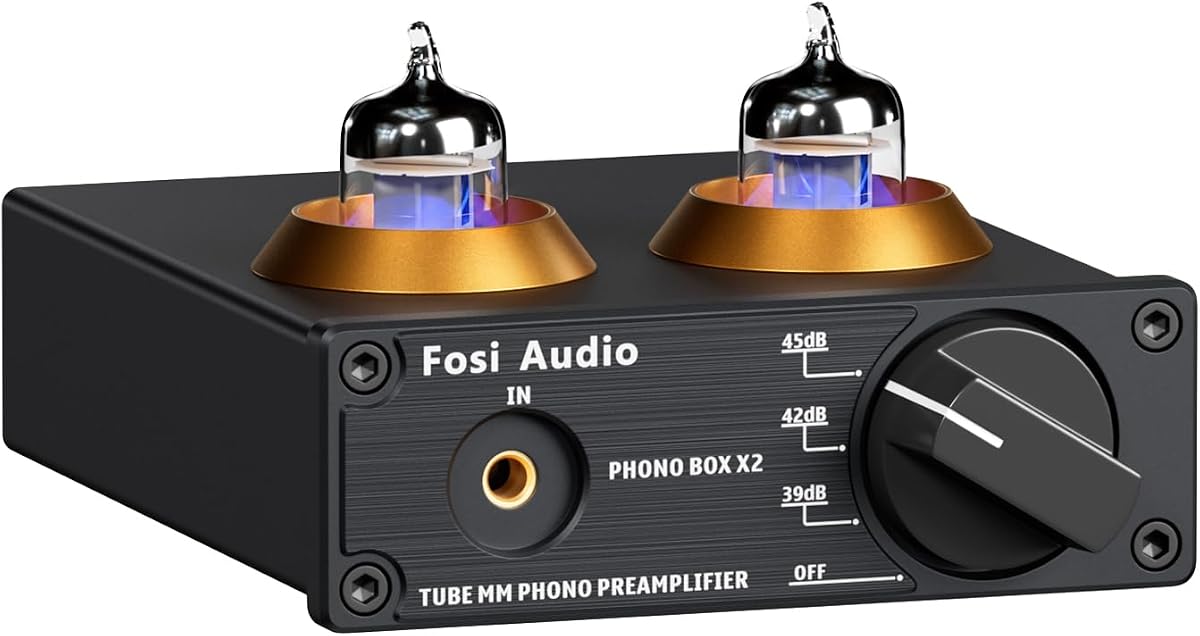
The Fosi Audio Box X2 is a dedicated MM phono preamplifier for turntables that do not already include a phono stage. It has a 4.5 rating and offers three switchable gain settings—39, 42, and 45dB—so listeners can match amplification more closely to the cartridge and system. It uses low-noise integrated circuitry and replaceable vacuum tubes.
We may earn a commission when you buy through this link, at no additional cost to you.
The preamp converts phono-level signals to line level and includes a grounding post for turntable connection. Its stereo RCA output can feed any power amplifier or active speaker system with line-level inputs. A 3.5mm AUX input also allows the Box X2 to function as a general tube preamp, broadening its usefulness beyond records.
Compatible vacuum-tube models listed for the product include 6K4, 6J1, 6J4, GE5654, 6AK5, and 66. The ability to substitute tubes lets owners explore different sound characteristics, although component matching and tube handling require care. The package includes the preamp, two vacuum tubes, an RCA cable, a power adapter, and a user manual.
Choose the Box X2 when you already own a capable power amplifier but want a dedicated, adjustable vinyl stage. It is less convenient than an all-in-one receiver because it cannot drive passive speakers directly. In return, it offers a focused analog design, multiple gain choices, and tube flexibility for listeners who enjoy modifying their audio chain.
The three-position gain control gives listeners a more useful starting point than a fixed preamp. It is particularly helpful when comparing different moving-magnet cartridges or when one system component has a quieter line-level stage.
Replaceable tubes provide a direct way to change the character of the preamplifier. Listed compatible models can be mixed for experimentation, making the Box X2 appealing to hobbyists who enjoy component-level changes.
We may earn a commission when you buy through this link, at no additional cost to you.
The Fosi Audio BT20A Pro is an upgraded version of a compact Class D design, with a 4.4 rating and a stated maximum output of 300 watts per channel. It uses the Texas Instruments TPA3255 chip, specifies a signal-to-noise ratio of at least 108dB and total harmonic distortion no greater than 0.005%, and includes a 32-volt, 5-amp power adapter.
We may earn a commission when you buy through this link, at no additional cost to you.
The most unusual feature is its replaceable operational amplifiers. The two plug-in NE5532 chips can be exchanged for options including LME49720HA, MUSES02, OPA2604AP, OPA2134PA, LM4562, and NJM4556AD. This gives technically inclined users a way to alter the preamp section while retaining the compact Class D power platform.
Bluetooth 5.0 provides familiar wireless streaming, and separate bass and treble controls allow basic tonal adjustments. Holding the volume control for five seconds removes the current Bluetooth pairing, while a memory function simplifies subsequent connections. As with the standard BT20A, the amplifier does not include a phono stage, so a turntable needs a built-in preamp or a separate preamplifier.
The Pro is a good fit for a listener who wants more output and component-level flexibility in a compact unit. It is especially compelling for experiments involving the operational amplifiers. If that customization is unnecessary, the extra complexity may not provide a practical advantage over a simpler amplifier, but it gives this model a distinctive hobbyist appeal.
The replaceable NE5532 operational amplifiers can be exchanged with several listed alternatives. This is unusual at this size and gives users a direct way to experiment with preamp sound without replacing the complete amplifier.
The TPA3255 platform and 32-volt supply provide a high stated maximum output in a compact enclosure. Bass and treble controls and Bluetooth keep it practical for everyday listening with passive speakers.
We may earn a commission when you buy through this link, at no additional cost to you.
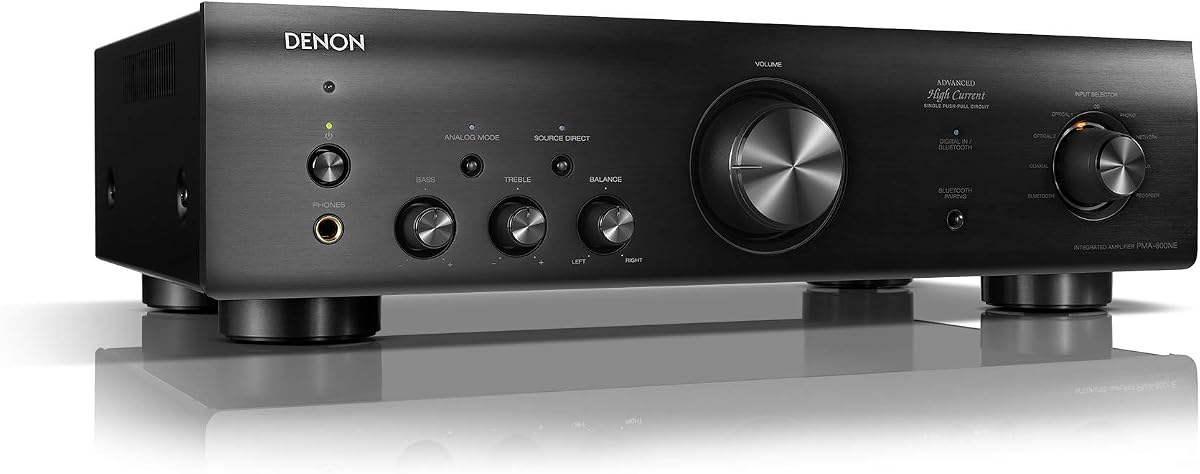
The Denon PMA-600NE is our Best Premium pick and the highest-rated model in the guide at 4.7. It is a two-channel integrated amplifier with 70 watts of output at 4 ohms, a dedicated phono input, Bluetooth, two optical inputs, one coaxial input, and a design intended to combine digital convenience with a strong analog listening path.
We may earn a commission when you buy through this link, at no additional cost to you.
Its divided circuitry can disengage the digital circuits and turn off Bluetooth for an analog-focused experience. That makes the PMA-600NE attractive for owners who want a versatile component but may prefer to keep the signal chain free of active digital sections during critical record listening. The slim, vibration-resistant enclosure also helps it fit naturally into a dedicated audio setup.
The amplifier uses Denon's Advanced High Current push-pull circuit, reflecting the brand's emphasis on driving a range of passive speakers. The 70-watt figure is less dramatic than the maximum or peak numbers used by some Class D competitors, but it is a more conventional amplifier output specification and may be easier to interpret when matching speakers.
Choose the PMA-600NE for a refined home system that mixes vinyl with television, disc players, computers, and wireless sources. It is especially compelling when analog purity and a polished receiver design matter. Compared with the Sony STRDH190, it offers digital inputs and a refined integrated design, making it the stronger premium centerpiece for a mixed-source system.
The PMA-600NE accepts several digital and wireless sources while allowing its digital circuitry to be switched off. Owners can use that analog mode for focused listening without giving up the amplifier's broader connectivity.
The slim, vibration-resistant enclosure and integrated construction make this model visually and functionally suited to a dedicated listening space. The dedicated phono stage also allows a straightforward turntable connection.
We may earn a commission when you buy through this link, at no additional cost to you.
The right amplifier depends on your cartridge, speakers, listening room, and other sources. Use the following factors to narrow the choices before comparing features or ratings.
In short, buy direct phono support when your turntable lacks a built-in stage. If the turntable already includes one, any clean line-level RCA input may be sufficient.
In short, prioritize compatible impedance, continuous output, and speaker sensitivity over the largest headline power claim.
In short, confirm impedance, safe parallel speaker arrangements, and connector type before buying. Speaker suitability matters more than owning the highest-output model.
In short, choose an integrated amplifier for a complete setup or a dedicated preamp when you already own a suitable power stage.
In short, size the system to the room and speakers rather than assuming a larger number is always better. Efficient speakers and sensible placement can be more important than maximum power.
In short, prioritize the sources and controls you will use regularly. A simple, reliable connection is often better than unused advanced features.
In short, measure the shelf and plan for the power adapter, ventilation, and cable reach. Good placement protects both convenience and thermal performance.
In short, use ratings as context rather than a verdict. System matching and correct setup remain central to a satisfying result.
Begin by placing the amplifier on a stable, ventilated surface and checking its power requirements before connecting anything. Identify the turntable's output type, attach the grounding wire when required, and confirm whether the cartridge has a built-in phono stage. Use the appropriate phono input for a stage-equipped amplifier or place a compatible preamp between the turntable and a line-level input. Connect passive speakers only when their impedance and channel arrangement are permitted by the amplifier's specifications.
Power the system on from the source side where practical, keep the amplifier volume low during connection changes, and select the correct input. Begin with tone controls centered, then make small adjustments after listening to familiar recordings. Equalization is best used sparingly because a record's original character should not be heavily reshaped. For Bluetooth models, pair the intended device and confirm that the amplifier is not connecting to an unwanted phone. For models with source memory or adjustable gain, save settings only after the speakers and cartridge have been matched.
Care for the components by unplugging the amplifier before changing cables and by avoiding blocked ventilation. Keep dust away from vents and control surfaces, and use a soft dry cloth rather than harsh chemical cleaners. Protect the turntable's stylus, store records upright, and avoid long cables between the cartridge and phono stage when practical. Leave extra room around heat-producing power supplies, and periodically check connectors for corrosion. If output becomes unstable, the correct input no longer works, or the amplifier smells unusual, disconnect power and seek service.
Only if your turntable does not already have a built-in phono preamp. A turntable with a built-in stage produces a line-level signal that can connect to standard RCA inputs. A conventional magnetic-cartridge turntable without a built-in stage needs a compatible phono preamp, either inside the amplifier or as a separate box. Check the documentation for both devices before connecting them.
No, not without checking compatibility. The speakers' nominal impedance must fall within the amplifier's supported range, and the amplifier must have enough clean power and sensitivity for the intended room. Also verify the number of speakers that can be connected simultaneously and the correct left and right channels. Connecting too many low-impedance speakers or exceeding the manufacturer's limits can cause protection issues or overheating.
A phono preamp boosts the very low signal from a cartridge and raises it to line level. A power amplifier accepts a line-level signal and drives passive speakers. Some integrated amplifiers include both functions, which creates a simpler one-box system. Dedicated preamps are useful when another amplifier or pair of active speakers already handles the power stage.
Not necessarily, because wattage figures may describe different conditions. Some compact amplifiers advertise maximum or peak output, while receiver ratings may represent continuous output at a specified impedance. Actual loudness also depends on speaker sensitivity, room size, amplifier design, and how close the speakers are. Compare like-for-like specifications and consider the speakers' requirements instead of choosing solely by the largest number.
Bluetooth is useful for adding music from a phone, but it is not normally used to carry the turntable's analog signal. The turntable should connect through an appropriate phono or RCA input, while Bluetooth serves as an additional source. Some models include a mode that disconnects Bluetooth when an analog source is selected, which can prevent an unintended nearby device from taking over playback.
They generally need a phono stage with sufficient gain and appropriate loading for the cartridge. The products in this guide that explicitly identify MM compatibility are primarily intended for moving-magnet cartridges. A moving-coil model may work with a high-gain phono input, but compatibility should be confirmed with the turntable, cartridge, and amplifier manufacturers rather than assumed.
A DAC does not improve the analog turntable signal by itself. It is useful when the system includes digital sources, because it converts those digital signals into analog audio for an analog amplifier. For records, the important path is the cartridge, phono stage, amplifier, and speakers. Models such as the Donner MAMP2 and Fosi Audio MC331 are most compelling when vinyl and digital sources are used together.
Unplug the unit before cleaning it or changing connections, and use a soft dry cloth to remove dust from the enclosure and controls. Keep ventilation openings clear, and do not place the amplifier in a closed cabinet without adequate airflow. Avoid moisture and chemical cleaners. For turntable-specific maintenance, keep the stylus clean, handle records by their edges, and store them upright in a stable environment.
The Sony STRDH190 is the strongest overall choice because it combines a dedicated phono input, useful power, a familiar receiver layout, and flexible speaker switching. The Donner MAMP2 is the best budget option for buyers who value broad connectivity, while the Denon PMA-600NE stands out as the premium selection with switchable analog circuitry and refined home-audio design. Each serves a different style of listener rather than a single universal setup.
Prioritize phono-stage compatibility first, followed by speaker impedance, continuous output, and the other sources you expect to connect. Dedicated preamps such as the Pyle PP999 and Fosi Audio Box X2 are sensible when another power amplifier is already available. Compact Class D models excel in space-constrained systems, while the MC331 appeals to listeners who want tubes, digital inputs, and a distinctive centerpiece.
Finally, confirm every connection and manual requirement before ordering, especially the cartridge type, grounding arrangement, speaker impedance, and included power supply. Product ratings, features, and current prices can change, so review the latest listing information and retailer policies at the time of purchase. A carefully matched amplifier, turntable, speakers, and room will provide a more satisfying result than headline specifications alone.