
Sainlogic Automatic Plant Waterer for 15 Potted Plants
4.4Editor score
Large moisture status display
Humidity and schedule modes
IP64 water-resistant housing
Fifteen root-directed drippers
Complete tubing and filter kit
Compare the best indoor automatic plant watering systems, including smart sensors, timers, app control, capacity, and setup for up to 30 pots for home use.
An indoor automatic plant watering system can keep pots consistently hydrated while reducing the daily effort required to care for houseplants. The strongest options combine drip irrigation, adjustable scheduling, dependable pumps, and flexible tubing layouts. Important differences include smart humidity sensing, Wi-Fi control, battery life, and the number of plants each system can support.
The systems in this guide were compared using their stated specifications, including plant capacity, timer controls, sensor functions, water delivery, power options, included accessories, and installation considerations. The list covers simple timer-based units, rechargeable battery models, sensor-responsive systems, and app-connected products designed for indoor plant collections.
Each review explains where a system stands out, which plant collections it suits, and what setup compromises buyers should consider. The top three picks cover a balanced smart-sensor option, a straightforward watering kit, and a premium app-controlled system. Product availability, features, and prices can change, so confirm current listing details before purchasing.
4.4Editor score

4.3Editor score

4.2Editor score
This side-by-side comparison highlights plant capacity, scheduling options, smart features, power design, and the practical trade-offs of each indoor automatic watering system.



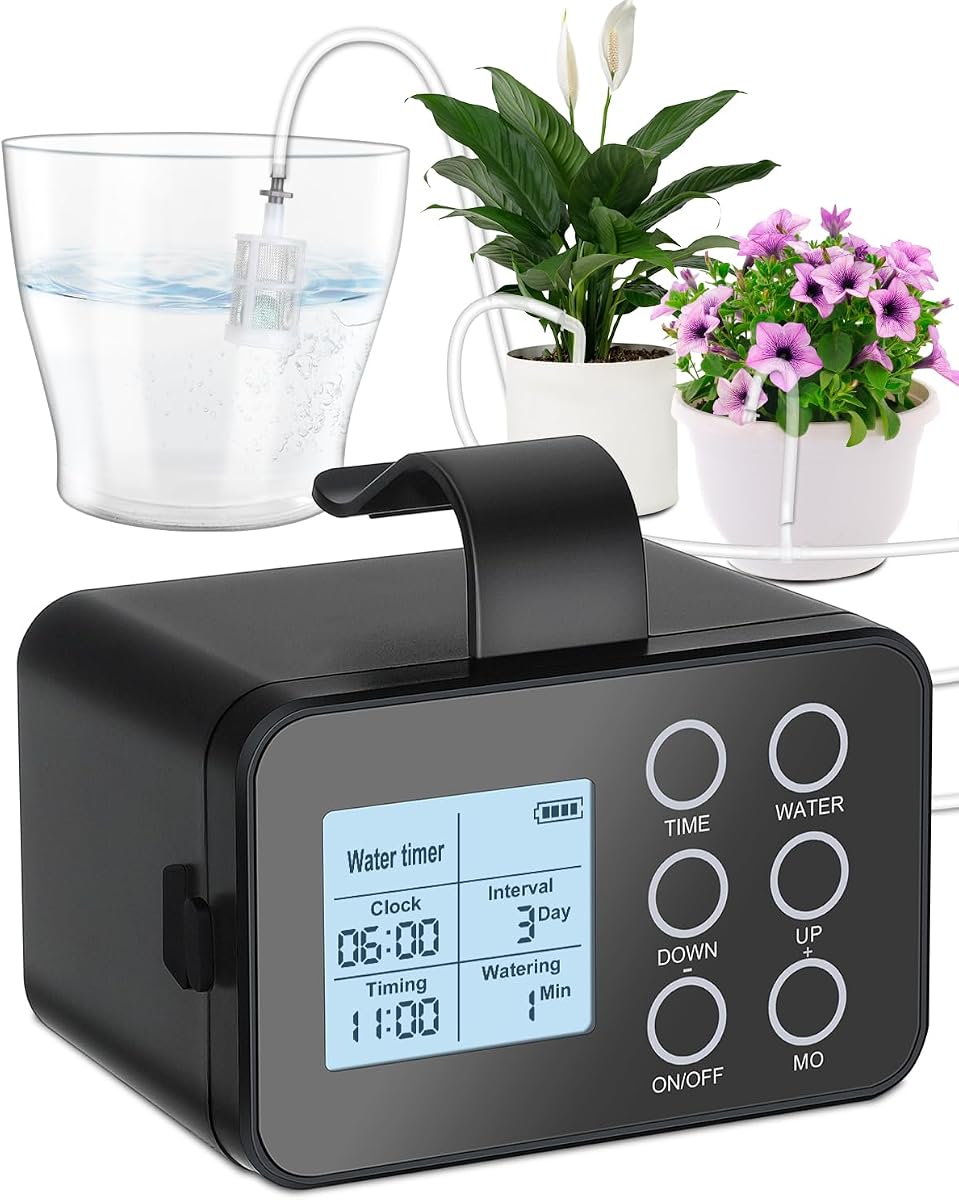

The Moistenland Automatic Plant Waterer is a practical, timer-driven indoor system with a 4.3 rating. Its strongest qualities are uncomplicated scheduling, direct-to-root drip delivery, and the freedom to arrange the included tubing around different shelves, stands, and pot groups. It avoids unnecessary app complexity while still automating the repetitive part of plant care.
We may earn a commission when you buy through this link, at no additional cost to you.
Its internal clock lets users decide when watering begins, while the drip system releases water gradually so soil can absorb it without the surface runoff associated with a quick pour. The product information emphasizes water savings of up to 70% compared with traditional watering methods. The tubing, emitters, and connections can be adjusted to create a layout suited to the user's collection rather than forcing every plant into a fixed arrangement.
The main limitation is the lack of a humidity sensor, so watering continues according to the programmed schedule rather than responding directly to current soil moisture. Another important consideration is siphon behavior: the internal pump does not provide anti-siphon protection. The water source should remain below all pots, or the first dripper should be positioned above the source level. Buyers willing to follow that placement rule gain a capable and economical system.
This is a strong recommendation for plant owners who want dependable automatic watering without a phone, Wi-Fi account, or complex learning process. It is especially suitable for indoor shelves with several similarly grouped plants that follow comparable moisture needs. For mixed collections requiring individualized moisture responses, a smart sensor model would be a better fit.
The internal clock is the system's main convenience. Once the start time and watering behavior are configured, the unit can continue tending pots on a recurring basis, making it a straightforward option for anyone who prefers physical controls and dependable scheduled delivery.
Drip placement near the root zone reduces runoff and allows moisture to soak into soil more gradually. Adjustable drip lines and emitters make it possible to fit plants distributed across multiple indoor shelves rather than limiting the setup to one tightly grouped row.
We may earn a commission when you buy through this link, at no additional cost to you.
This 15-pot automatic watering system has a 4.2 rating and combines scheduled drip irrigation with smart humidity detection. It is designed for indoor plant owners who want an automated setup capable of serving a meaningful collection while also offering a mode that responds more closely to the growing environment.
We may earn a commission when you buy through this link, at no additional cost to you.
The package includes a controller, 33 feet of tubing, a Type-C cable, 15 T-joints, 15 drippers, a filter, anti-siphon components, and a user manual. Its robust pump and water pressure are intended to reach pots positioned farther from the source, which helps when plants occupy several shelves or a wider room. Buyers can also arrange the tubing and connectors into a custom layout.
Humidity mode is the most interesting feature for uncertain plant owners, but it should be treated as a useful automation tool rather than an absolute substitute for checking the soil. The sensor responds to the environment, while individual species, pot size, drainage, and growing medium can still affect how quickly moisture disappears. Scheduled mode remains available for users who want more predictable timing.
This system is a good fit for households seeking humidity-aware care without committing to a full app ecosystem. It is particularly suitable for mixed indoor collections large enough to justify 15 drippers. Buyers should check the included power arrangement and confirm that the room layout allows the tubing to reach every intended pot without creating trip hazards or awkward runs.
Humidity mode offers a more responsive alternative to watering blindly by the calendar. It is especially helpful for new owners who are still learning how quickly their particular pots and mixes become dry.
Fifteen drippers, matching connectors, 33 feet of tubing, a filter, and anti-siphon components provide a broad foundation. This is enough hardware to build a coherent system for a sizable indoor collection rather than a minimal two-pot arrangement.
We may earn a commission when you buy through this link, at no additional cost to you.
The Automatic Plant Waterer, 15 Pots, 770 Watering Combinations, Smart Sensor is one of the most balanced systems in the guide. Its 4.3 rating reflects a capable combination of humidity sensing, programmable timing, flexible tubing, adjustable drip emitters, and cordless operation. It is especially convincing for owners who want control without depending on a phone or cloud connection.
We may earn a commission when you buy through this link, at no additional cost to you.
The large LED display and control knob make watering duration and interval settings easy to adjust. Durations can range from 20 seconds to 30 minutes, while intervals span one hour to 15 days. In Intelligent Humidity Mode, the included soil sensor helps the system respond to moisture conditions rather than watering strictly by schedule. The stated 770 combinations create substantial room to match different pot sizes and plant types.
A 2200mAh rechargeable battery allows cordless placement, which is useful when the nearest outlet is inconvenient. The kit includes 49 feet of flexible tubing, 15 adjustable drip emitters, a humidity sensor, filter, anti-siphon device, 15 three-way connectors, screws, and a USB-C cable. That is a thorough setup for a collection spread across shelves, hanging baskets, and nearby plant stands. The main trade-off is that the number of settings can feel elaborate at first.
This is our leading recommendation for users who want responsive watering, meaningful scheduling flexibility, and freedom from a permanent outlet connection. It works especially well for plant owners who understand that no single schedule suits every species and want the option to use sensor feedback. It remains necessary to monitor the reservoir and inspect emitter placement as conditions change.
Twenty-second minimum watering periods make the system relevant to both thirsty houseplants and more compact containers. Intervals extending to 15 days provide a useful alternative for owners who travel or maintain plants in seasonal conditions.
The rechargeable battery eliminates the need to place the controller beside a wall outlet, while humidity sensing helps reduce unnecessary watering. Together, these features make the system more adaptable to rooms where tubing and power access are limited.
We may earn a commission when you buy through this link, at no additional cost to you.
The Sainlogic Automatic Plant Waterer for 15 Potted Plants has a 4.4 rating and offers one of the clearest approaches to routine indoor irrigation. Its oversized 3.07-inch display, scheduled mode, and humidity mode make it easy to understand what the system is doing without navigating an app.
We may earn a commission when you buy through this link, at no additional cost to you.
The soil moisture sensor supports a responsive mode in which drip watering runs when soil becomes dry and pauses once the display indicates that it is wet. A programmable schedule remains available for users who prefer routine watering or for plants in consistent indoor environments. Fifteen drippers deliver water close to the roots, helping reduce surface runoff and wasted moisture.
Its IP64 waterproof construction and built-in backflow prevention offer useful resilience around indoor plants and outdoor-adjacent areas such as balconies or patios. The complete kit includes a Type-C cable, 33 feet of tubing, 15 T-connectors, 15 drippers, a filter, anti-siphon valve, moisture sensor, and manual. One limitation is that the emitters are not individually adjustable, so duration and interval are set for the system as a whole.
This is a strong budget recommendation for owners who value a readable display and dependable physical controls. It works best when plants have broadly similar watering needs or when the schedule can be changed periodically. Buyers with sharply different moisture requirements may need more granular flow control or separate zones.
The large display is more informative than a simple indicator light. It shows moisture status and schedule information, helping users confirm whether the system is watering and when the soil last reached the configured condition.
IP64 protection and built-in backflow prevention make the unit suitable for locations where splashes may occur. These features add confidence when pots are grouped on a balcony, patio, or near an open window.
We may earn a commission when you buy through this link, at no additional cost to you.
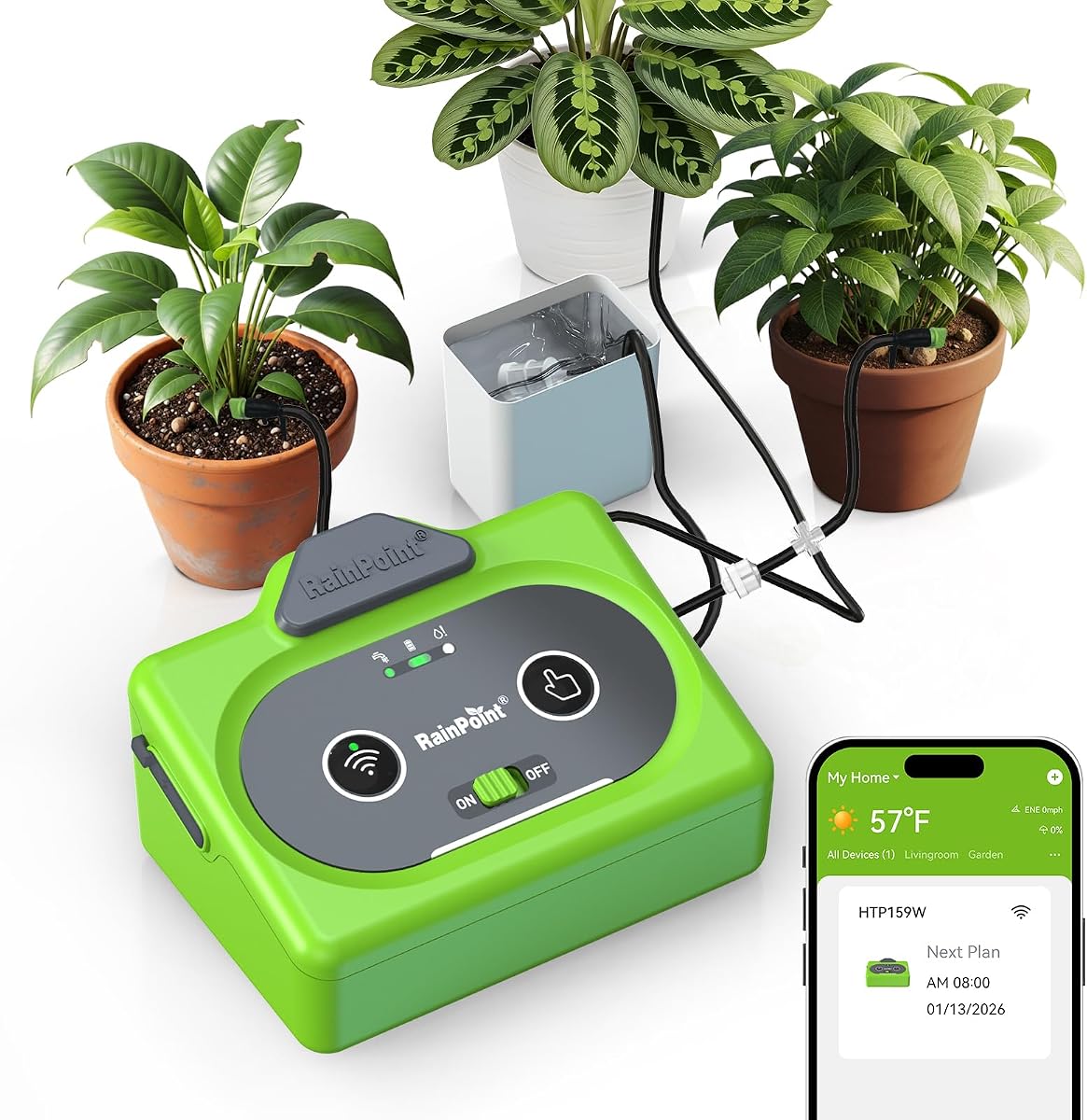
The RAINPOINT Direct WiFi Connection Smart Auto Plant Waterer has a 4.3 rating and focuses on convenient remote management. It connects directly to home Wi-Fi through the RainPoint Home app, allowing schedules, watering status, and family access to be managed from a smartphone.
We may earn a commission when you buy through this link, at no additional cost to you.
A particularly useful feature is local storage memory. Preset schedules continue running even if the internet becomes unavailable, reducing the chance that a temporary connection problem suspends plant care. USB-C power and a built-in rechargeable battery likewise allow operation during unexpected power outages. The system supports standard and seasonal adjustment options within the app, helping owners modify watering as conditions change.
The water-shortage protection system shuts off the pump when the source runs dry, and a low-water indicator provides a visual warning. Push and email notifications add remote awareness, while adjustable emitters let users vary flow for different pot sizes. The package includes a 32.81-foot length of one-sixth-inch tubing, 10 adjustable drip emitters, a T cross fitting, 10 T-barb fittings, an anti-siphon valve, filter, end plugs, stakes, and a USB cable.
This model is a compelling choice for households that want shared remote visibility and online scheduling without tying routine operation to live internet access. It is best suited to users with compatible Wi-Fi who are comfortable configuring an app. Since the included emitter kit is intended for 10 plants, larger collections should verify the required accessories before installation.
The app allows family members to view watering status and receive alerts, which is useful when plant care is shared across a household. Remote visibility also makes it easier to notice a low reservoir while away from home.
Local storage preserves preset watering programs during an internet outage. Combined with battery backup, this design is intended to maintain plant care through temporary connectivity or power disruptions.
We may earn a commission when you buy through this link, at no additional cost to you.
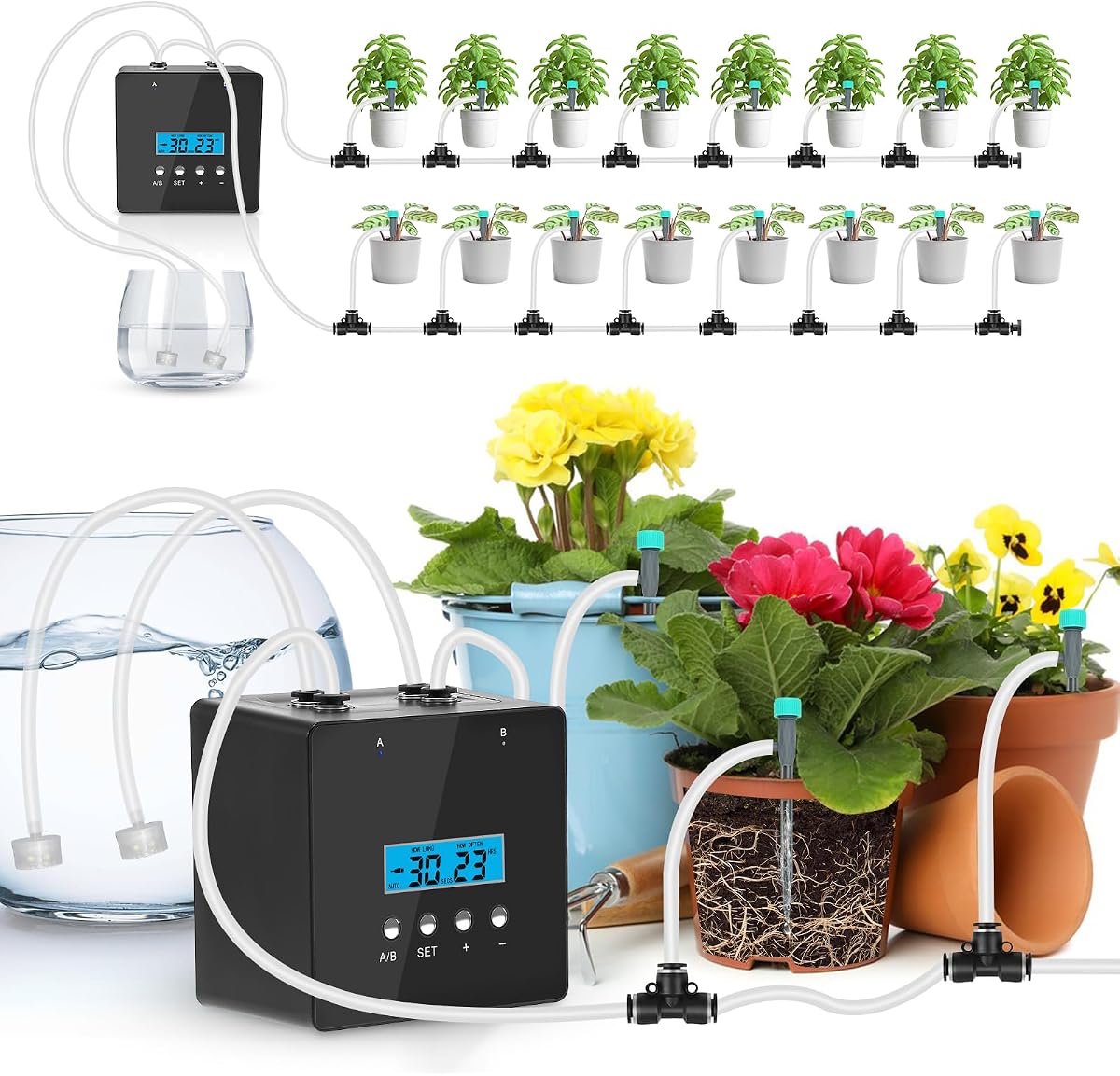
The Two-Zone Automatic Plant Waterer has a 4.2 rating and brings an important advantage to larger indoor collections: two independently managed watering zones. Its stated capacity reaches 30 plants, although the included kit directly supports up to 15 and requires additional accessory kits for expansion.
We may earn a commission when you buy through this link, at no additional cost to you.
Zone control lets users separate plants with different needs into distinct groups. Watering duration can be adjusted from five seconds to 30 minutes, while frequency can range from every one to 23 hours or every one to 15 days. Manual mode provides immediate watering without disrupting the programmed schedule, and adjustable flow controls allow more precise delivery for individual plants within a zone.
The automatic water-cutoff detection stops the system if the tank is empty, helping protect the pump and reducing the risk of continued dry operation. A large LED display presents watering status, and the rechargeable controller enters an energy-saving sleep mode while unplugged. The package contains 32.81 feet of one-quarter-inch tubing, two filters, two check valves, 15 adjustable emitters, 15 barbed tee connectors, five cross connectors, and five end caps.
This system is a strong option for a large collection organized into two moisture groups. Its lack of soil sensing means it relies on scheduling rather than real-time moisture feedback, so buyers should assign plants carefully. For more than 15 pots, the expansion hardware and total tubing requirements should be considered before installation.
Separate zones make it easier to serve thirsty foliage plants and more restrained succulents without forcing both groups onto one schedule. This is especially valuable in collections large enough that individual watering becomes inconvenient.
The system can be expanded toward a 30-plant configuration through additional accessories. That flexibility allows buyers to begin with the included 15-plant setup and add capacity as the collection grows.
We may earn a commission when you buy through this link, at no additional cost to you.
The LetPot Automatic Watering System is the most app-focused option in this guide, with a 4.2 rating and a feature set aimed at dedicated plant keepers. It supports Wi-Fi and mobile remote control, customizable schedules, low-water alerts, adjustable drip modes, and up to five simultaneous watering tasks.
We may earn a commission when you buy through this link, at no additional cost to you.
The dedicated app lets users set frequency, duration, and recurring plans while away from home. Adjustable drippers and customizable plans allow intermittent or continuous delivery, giving owners a way to accommodate plants with different uptake rates. The upgraded chip is designed for stable connectivity, and the spiral lock helps maintain consistent water pressure within the tubing system.
Its IP66 waterproof rating broadens the potential use of the system beyond indoor rooms, including balconies and suitable outdoor areas. A German-imported silent pump is another thoughtful detail for living spaces where noise would be disruptive. The kit includes a 10-meter pipe, 10 adjustable drippers, 10 connectors, 10 brackets, a filter, and an adapter plug, with stated support for 10 to 20 pots depending on the layout.
This is our premium recommendation for users who want detailed remote scheduling and multiple programmable tasks. The main trade-off is that connectivity and app management add complexity compared with a simple timer. For a large, varied indoor collection or a plant enthusiast who enjoys tuning watering programs, those features justify the more advanced design.
Up to five watering tasks allow separate programs for different plant groups or seasonal routines. Remote changes and low-water alerts are particularly helpful for owners who travel or maintain plants in several locations around the home.
Intermittent and continuous modes can better reflect how a particular soil mix absorbs water. The silent pump also makes the system more suitable to bedrooms and living areas where operating noise would otherwise be distracting.
We may earn a commission when you buy through this link, at no additional cost to you.
The Dual-Pump 20-Plant Waterer has a 4.1 rating and stands out for its two independent self-priming pumps. Each pump can follow a separate schedule and adjustable flow, helping one controller serve plants with noticeably different watering requirements.
We may earn a commission when you buy through this link, at no additional cost to you.
The system can water up to 20 plants using tubing, drip emitters, T-connectors, and locking connections. Adjustable emitters range from low to high output, giving users more control than a fixed-flow drip arrangement. The programmable timer automates the process for busy periods and short trips without requiring a faucet connection.
Power can come from USB-C or four AA batteries, although batteries are not included. The intake hose fits into buckets, bottles, or water jugs, and larger containers can reduce refill frequency. A key placement note is to keep the water container below the pots to prevent unwanted dripping, especially when the pumps are not operating.
This is a good choice for owners with 20 plants or a need for two distinct watering groups but no desire for app-based control. Its practical strengths are dual scheduling, container compatibility, and adjustable delivery. The absence of humidity sensing means it is best for users who understand their plants and can choose reliable schedules.
Independent pumps let one group receive short, frequent watering while another receives a different schedule or flow level. This is more nuanced than simply increasing or decreasing the duration for every connected plant.
The intake works with common household containers, so the system does not need a permanent faucet connection. This makes it convenient for renters, balcony collections, and movable indoor arrangements.
We may earn a commission when you buy through this link, at no additional cost to you.
The Tipkook Automatic Plant Waterer Indoor with Timer has a 4.5 rating, the highest among the systems compared. It combines a large LCD, easy physical programming, a 2600mAh rechargeable battery, and support for up to 15 planters with no requirement for Wi-Fi or an app.
We may earn a commission when you buy through this link, at no additional cost to you.
Watering durations can be set from one to 300 seconds. The unit offers time-based intervals from one to 23 hours and day-based intervals from one to 30 days, giving users both fine control for regular indoor watering and longer gaps for travel. The display keeps scheduling details visible, reducing the need to memorize settings or repeatedly open controls.
Its claimed battery life of more than 30 days in energy-saving mode provides useful operating endurance. A manual button starts an immediate watering cycle without erasing the stored program. The system includes 33 feet of clear PVC tubing, 15 three-way T-connectors, 15 drip emitters, a filter, Type-C cable, blue anti-siphon valve, and straight connector. The blue valve should be installed above the water source as directed.
This is an excellent recommendation for plant owners who prioritize straightforward scheduling and long battery life over remote access. It suits offices, bedrooms, or living spaces where a phone-based controller would add little value. Because there is no soil sensor, users should verify the schedule during the first few weeks and adjust it as seasonal conditions change.
The LCD and control interface provide direct access to every setting. Avoiding an app also removes Wi-Fi compatibility concerns and makes the system approachable for beginners or anyone who prefers a self-contained appliance.
The 2600mAh rechargeable battery and stated 30-plus-day endurance in energy-saving mode support use during vacations or long work periods. Long scheduling intervals further reduce the need for frequent interaction.
We may earn a commission when you buy through this link, at no additional cost to you.
The RAINPOINT WiFi Automatic Plant Waterer has a 4.0 rating and offers a compact app-controlled solution for vacations and busy periods. It can serve 10 to 15 potted plants and combines a 2400mAh rechargeable battery with Wi-Fi scheduling and monitoring.
We may earn a commission when you buy through this link, at no additional cost to you.
The smartphone app allows users to schedule and observe watering routines and provides real-time notifications. The battery is stated to operate cordlessly for up to 60 days on a single charge, making the unit suitable for extended trips. It supports only 2.4GHz Wi-Fi, an important compatibility consideration for homes or routers configured exclusively for newer bands.
The included anti-siphon valve cuts off flow when the pump stops, helping prevent continuous dripping and overwatering after a cycle ends. A pump, durable tubing, and drip stakes support flexible placement across 10 to 15 pots. The water inlet can be placed in a bucket, and the stated setup time is about 15 minutes, with no plumbing or professional tools required.
This is a practical choice for travelers who want to monitor a plant collection from a phone without relying on a wall outlet. Its tradeoff is that it offers fewer advanced controls than the larger app-focused options and has the lowest rating in this comparison. Buyers should verify 2.4GHz Wi-Fi support and plan for reservoir capacity before a long absence.
Cordless operation and a stated battery life of up to 60 days make the system appropriate for extended travel. A bucket-fed reservoir also keeps the setup flexible when the plant area is far from a faucet.
The valve stops water flow when the pump turns off, reducing the risk of continued leaking from drip lines. That protection is especially helpful during automated operation when the owner cannot inspect every emitter.
We may earn a commission when you buy through this link, at no additional cost to you.
The right indoor automatic plant watering system depends on plant count, collection diversity, travel frequency, power access, and how much control you want over each watering cycle. Review capacity, scheduling, power, and placement before choosing a model.
Start with the number of pots that need regular water rather than the total number of plants in the home. Most systems in this guide support around 15 plants, while the dual-pump model reaches 20 and the two-zone design can expand toward 30. Check not only the stated plant count but also the amount of tubing included, because a large collection spread across several rooms may require longer runs than a compact shelf arrangement.
Watering duration and frequency determine how useful a timer will be across different plant types. Very short minimum durations help with small pots and delicate herbs, while longer maximum durations suit larger planters and thirsty foliage plants. Systems offering intervals from one hour to multiple days accommodate both routine indoor care and extended travel. Look for a manual mode as well, because an immediate watering button is useful for checking a newly installed system or responding to an unexpectedly dry pot.
A soil humidity sensor can make automation more responsive by pausing or starting a cycle according to current moisture. It is particularly useful for owners who do not yet know how quickly each plant dries out. However, one sensor generally represents a limited area rather than every pot, so a mixed collection may still require grouped schedules. Timer-only systems are simpler, but they depend more heavily on accurate programming and periodic checking.
App control is valuable when you want to change a schedule, check status, or receive low-water alerts while away. It also adds setup requirements and dependence on compatible Wi-Fi. Local schedule memory is an important advantage because it allows preset watering to continue during an internet interruption. Confirm whether the unit supports only 2.4GHz Wi-Fi, and consider whether app-based convenience justifies the additional complexity for your routine.
Rechargeable battery operation allows the controller to be placed near the plant collection instead of near an outlet. This can simplify tubing routes and reduce visual clutter. USB-C charging is convenient, while AA battery backup offers a different way to maintain operation if mains power fails. Check the claimed battery endurance, particularly if you plan to travel, and remember that a low-water reservoir can interrupt care regardless of battery strength.
A strong pump helps water reach pots positioned farther from the source, but delivery also depends on tubing, connectors, and emitter placement. Adjustable drip emitters are useful for mixing pots of different sizes because they allow flow to be tailored to each plant. Fixed-flow drippers may be simpler and more uniform when every plant shares similar requirements. Ensure the setup can deliver adequate water without requiring repeated cycles that saturate the closest pots.
Anti-siphon components help stop residual pressure from causing drippers to leak after the pump switches off. This feature matters most in automatic systems that cannot be monitored continuously. Placement remains important even with a valve: keep the reservoir below pot level, or position the first dripper above the source as directed. Locking connectors and properly seated tubing also reduce the chance of leaks at junctions, especially in long layouts.
A complete kit should include the tubing, connectors, drippers, filter, and power cable needed to create a functional layout. Filters help keep debris from reducing flow, while anti-siphon parts protect the system from residual draining. Smart systems may provide more automation but also require initial app configuration and occasional troubleshooting. Simpler timer units are easier to maintain and often better for beginners who want reliable watering without software management.
Begin by grouping plants according to similar watering needs and identifying a stable location for the water source. Place the reservoir or intake below the pots whenever possible. Connect the tubing, filters, anti-siphon components, and drip emitters, then position each emitter near the root zone rather than against a pot rim. Before activating the pump, inspect every junction and run a short manual cycle to confirm that all intended pots receive water.
Program the system conservatively at first. Select a short duration and observe how the soil changes after a complete cycle, especially for clay-heavy mixes, succulents, and plants in containers without drainage. If a humidity sensor is included, place it in a representative pot and make sure it is inserted as directed. For app-connected models, establish the schedule before leaving home and verify that notifications, low-water alerts, and offline memory are configured correctly.
Ongoing care includes checking the reservoir before each extended trip, cleaning the filter as needed, and inspecting emitters for sediment or kinks. Rotate or confirm the sensor position if plants are rearranged, and review the schedule as seasons change. Keep the controller and electrical connections away from standing water, follow the anti-siphon placement instructions, and always place the water source below the pots unless the manufacturer expressly directs otherwise.
No single schedule suits every plant because succulents, ferns, herbs, tropical foliage plants, and flowering specimens dry out at different rates. Group plants with comparable needs and use adjustable flow or separate zones where possible. Even sensor-equipped systems should be checked periodically because drainage, pot size, substrate, and room conditions all affect moisture loss.
Install the included anti-siphon valve in the recommended location and keep the water source below the pots. Where the manufacturer specifies that the first dripper should sit above the source, follow that instruction exactly. Check that tubing is firmly seated in every connector, because a loose fitting can leak independently of the anti-siphon mechanism.
Timer-based models such as the Moistenland, Sainlogic, and Tipkook systems do not require Wi-Fi. App-controlled products need a compatible network for remote access, although the RAINPOINT Direct WiFi model stores schedules locally so programmed watering can continue during an internet outage. Its Wi-Fi requirements should still be checked before setup.
The right reservoir size depends on plant count, pot volume, watering duration, frequency, temperature, and how often the system runs. The reviewed products use different intake arrangements, including household containers, so buyers should estimate total demand and select a vessel with enough capacity for the entire absence. A low-water alert is helpful, but it cannot help if nobody is available to refill the source.
They reduce repetitive work but do not eliminate plant inspection. Check the soil, plant condition, reservoir level, filter, tubing, and emitter placement at least periodically, and more often when seasons change. New installations should be monitored during several cycles because every pot, mix, and room has a different drying pattern.
Scheduled mode waters according to a programmed duration and interval, while humidity mode uses a soil sensor to determine when moisture conditions warrant watering. Humidity mode can reduce unnecessary cycles, yet it is only as accurate as the sensor and the area it represents. Scheduled mode remains useful for consistent routines, travel, and groups whose needs are well understood.
Yes, because most reviewed systems do not require plumbing or permanent wall modification. Tubing can run along shelves or plant stands, and the controller can operate on battery or USB power. Check the property rules, avoid creating trip hazards, and protect floors from any moisture that could occur during setup or refilling.
Clean them whenever you notice reduced flow, uneven watering, or visible debris, and inspect them at least whenever the reservoir is refilled. The frequency depends on the water source and whether particles are present. Replacing a clogged emitter or cleaning the filter is usually simpler and safer than compensating with longer watering cycles.
The 15-Pot Smart Sensor Waterer is the most balanced overall option because it combines humidity monitoring, broad scheduling choices, adjustable emitters, rechargeable cordless operation, and an extensive tubing package. The Sainlogic 15-Plant Waterer is an appealing budget selection with a clear moisture display and easy-to-read controls, while the LetPot Automatic Watering System stands out as the premium app-controlled option.
Prioritize the features that solve your actual routine. A simple timer is often sufficient for a small, stable collection, while a humidity sensor becomes more valuable when plant types vary. Larger collections benefit from individual flow controls or multiple zones, and frequent travelers should examine battery life, anti-siphon protection, low-water alerts, and offline schedule behavior.
Before buying, confirm the plant capacity, power method, Wi-Fi requirements, included tubing, reservoir arrangement, and installation space. Product features and availability can change, and prices fluctuate over time, so check the current listing and manufacturer instructions before making a final purchase.

