
Reatan X8 Mini PC
4.3Editor score
Ryzen AI processor
48GB upgradeable DDR5
OCuLink external GPU support
Explore the best mini PC for data analysis with 10 expert-reviewed options compared for processing power, memory, storage, displays, networking, and expansion.
A mini PC for data analysis must balance processor speed, usable memory, fast storage, and dependable networking while fitting neatly into a compact workspace. The strongest systems can handle spreadsheets, databases, notebooks, dashboards, and multiple analytical applications without occupying an entire desk.
We compared all 10 systems using the supplied specifications, focusing on core count, memory capacity and expansion, storage, display support, connectivity, form factor, operating system, and warranty or support details. The list covers new, renewed, business-focused, gaming-oriented, and AI-capable mini PCs.
Each recommendation highlights the workload it suits most and any meaningful limitations. The first three entries receive the guide's top-pick distinctions, while the remaining reviews explain where their particular hardware configuration makes sense. Product availability and pricing can change, so confirm current details before buying.
4.3Editor score

4.8Editor score

4.7Editor score
The comparison highlights processor architecture, memory, storage, display capability, networking, expansion, operating system, and support so buyers can match a compact system to the demands of their data workflow.
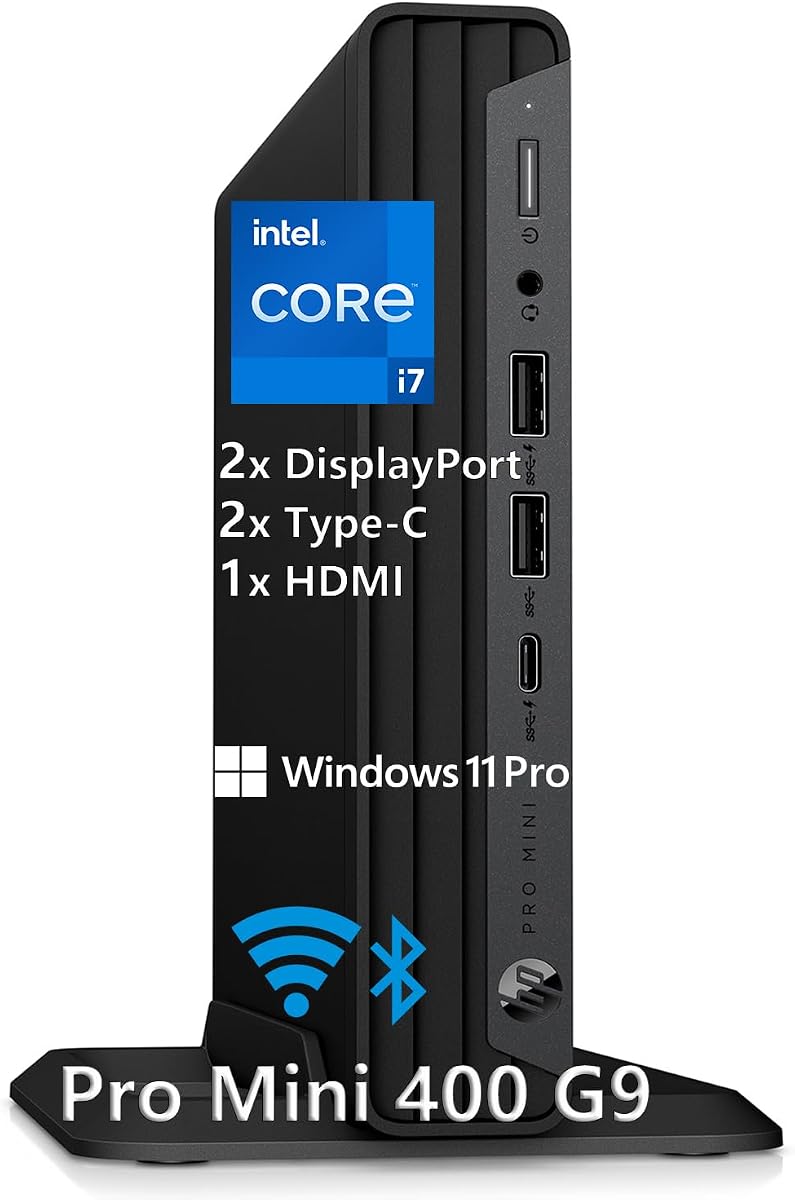


The HP Mini Desktop PC combines a 12th-generation Intel Core i7-12700T processor with 16GB of DDR4 memory and a 512GB NVMe solid-state drive. It holds a 4.7 rating and stands out for its twelve-core design, three-monitor support, and broad collection of ports. That combination makes it a convincing general-purpose system for spreadsheet analysis, business intelligence work, database exploration, and concurrent research.
We may earn a commission when you buy through this link, at no additional cost to you.
Processor capability is the model's main strength. The i7-12700T offers 12 cores with boost speeds reaching 4.7GHz, giving data workflows more room to operate across multiple applications. The NVMe drive supports quick boot and application access, while 16GB of RAM is sufficient for many mainstream analytical tasks, including large spreadsheets, browser-based tools, SQL clients, and data visualization applications.
Display flexibility also deserves attention. Dual DisplayPort 1.4 and HDMI 2.1 connections support three 4K monitors at 60Hz, allowing users to separate raw data, analysis tools, and reports across separate screens. Seven high-speed USB ports, including two 20Gbps USB-C connections, Gigabit Ethernet, Wi-Fi 5, and Bluetooth reduce reliance on adapters and simplify transfers from external storage or laboratory instruments.
The trade-offs are practical rather than dramatic. Sixteen gigabytes of memory can become restrictive for large in-memory datasets, intensive virtual machines, or memory-hungry machine-learning tools, and the supplied storage is modest for extensive local archives. Nevertheless, the HP is well suited to users who want capable, expandable desktop-class performance in a 6.97-inch enclosure. It is our top overall recommendation for a balanced data-analysis workstation.
The twelve-core processor gives spreadsheet calculations, database queries, data cleaning, and report generation more room to run concurrently. This is particularly helpful when a second monitor contains documentation or a visualization dashboard.
Supporting three 4K displays makes it easier to build a dedicated workflow with source data, a Python or SQL workspace, and a separate results view. The output configuration is one of the strongest features in this guide.
We may earn a commission when you buy through this link, at no additional cost to you.
The HP Elitedesk 800 is a compact business desktop with a six-core, 12-thread Intel Core i5 processor, 32GB of DDR4 RAM, and a 1TB PCIe NVMe drive. Its 4.8 rating is the highest in this comparison, and the emphasis on memory, storage, connectivity, and business-oriented features makes it a strong all-round analytical workstation.
We may earn a commission when you buy through this link, at no additional cost to you.
The 32GB memory advantage is particularly relevant to data work. It gives browser sessions, spreadsheets, Python environments, SQL clients, and visualization applications more room to coexist without forcing users to rely on virtual memory as frequently. The NVMe drive also provides ample capacity for local datasets, project files, model outputs, and application installations, while supporting responsive startup and file access.
Connectivity is another major strength. The front panel includes USB-C and USB-A ports, the rear adds six USB-A connections, a 100W USB-C port, Gigabit Ethernet, and audio connections, and Wi-Fi 6 AX201 with Bluetooth supports wireless use. Intel UHD Graphics 630 provides dual 4K monitor support through two DisplayPort outputs, with rear USB-C DisplayPort Alt Mode offering a possible third-display option subject to configuration.
The main limitation is that its standard display arrangement is less expansive than the three- and four-monitor alternatives here. Integrated graphics also mean it is not intended for GPU-intensive modeling. Even so, the combination of 32GB RAM, 1TB NVMe storage, business networking, and a tiny 6.97-inch footprint is unusually practical. It is our premium pick for business users who value a ready-to-use, balanced configuration.
Thirty-two gigabytes offers a comfortable working margin for moderate-sized tabular data, repeated API queries, and several open analytical applications. It is also a more future-resistant starting point than many 8GB or 16GB alternatives.
Stable Gigabit Ethernet, abundant USB connectivity, Windows capability, and included keyboard and mouse make the unit practical for an office or shared analytical workstation. Its business design also suits fleet deployment.
We may earn a commission when you buy through this link, at no additional cost to you.
The Reatan X8 is the most technically advanced option in the list, combining the Ryzen AI 9 HX 470 processor, 48GB of Crucial DDR5 memory, a 1TB Crucial PCIe 4.0 NVMe drive, and OCuLink expansion. Its 4.3 rating is lower than those of many alternatives, but the supplied specifications indicate exceptional capability for intensive data analysis and AI-assisted experimentation.
We may earn a commission when you buy through this link, at no additional cost to you.
The processor has 12 cores and 24 threads, reaches up to 5.2GHz, and includes Radeon 890M graphics with an integrated NPU capable of up to 86 TOPS of AI performance. That makes it relevant to local language models, AI assistants, data preprocessing, and mixed analytical workloads. Its 48GB of memory is especially useful for large working sets, virtual machines, and projects that do not fit comfortably within a standard 16GB configuration.
Expansion is the X8's defining feature. Two DDR5 SODIMM slots support up to 96GB of memory, while dual M.2 slots support up to 8TB of storage. Its PCIe 4.0 x4 OCuLink interface provides 64Gbps of theoretical bandwidth and can connect an external desktop graphics card. That is valuable when a notebook, visualization, or machine-learning workflow eventually needs more graphics capability than integrated graphics can provide.
The system also supports four displays through HDMI 2.1, DisplayPort 2.0, and dual USB4 connections, including output up to 8K at 60Hz. Wi-Fi 7, Bluetooth 5.4, and 2.5Gbps Ethernet serve demanding data-transfer and network workflows. The honest drawback is that this specification level makes the X8 less practical for a modest budget, while its 4.3 rating suggests not every buyer will be equally satisfied. For users planning serious growth, however, it offers the most future-proof foundation in this roundup.
The integrated NPU and high core count make the X8 relevant for local model experimentation, AI-assisted coding, and analysis pipelines that mix conventional computation with AI inference. Software compatibility should still be checked for the exact tools in your workflow.
Removable memory, multiple M.2 positions, and OCuLink graphics expansion let users add capacity as datasets and models evolve. This is more future-facing than choosing a fixed configuration and replacing the entire system later.
We may earn a commission when you buy through this link, at no additional cost to you.
The Glorlin Ryzen 7 Mini PC pairs an AMD Ryzen 7 8845HS processor with 16GB of DDR5 memory and a 500GB NVMe drive. It carries a 4.7 rating and stands out as a capable, quad-display compact system with unusually flexible networking and storage options for a general-purpose data-analysis platform.
We may earn a commission when you buy through this link, at no additional cost to you.
The eight-core, 16-thread Ryzen 7 8845HS boosts to 5.1GHz, giving it ample throughput for spreadsheet calculations, code execution, database work, and document-heavy multitasking. Its integrated NPU offers up to 38 TOPS for compatible AI-assisted applications, while Radeon 780M graphics handle 4K playback, media tasks, and light graphics work. The supplied 16GB of DDR5 4800MHz memory is a usable starting point for moderately sized projects.
Upgrading is one of the system's most attractive qualities. Memory can be expanded as high as 256GB, and dual M.2 slots support up to 4TB of storage. For analytical work, that means a user can begin with a moderate configuration and add RAM for larger working sets or SSDs for datasets and project archives. The machine also supports up to four 4K displays through HDMI, DisplayPort, and dual USB-C connections.
Networking includes dual 2.5G Ethernet, Wi-Fi 6, and Bluetooth 5.3, giving this mini PC an advantage in environments with multiple wired connections. The trade-offs are the relatively modest base memory and storage, and the recommendation to add memory for especially AI-intensive work. It is a strong choice for users who want a flexible four-screen analysis desk and anticipate modest expansion later.
The four-display configuration can divide a workspace among raw data, a scripting environment, dashboards, and documentation. It reduces constant window switching and helps visual analysts compare several views at once.
Dual 2.5G Ethernet is useful when transferring sizable files from a local server or connecting to another workstation. Wi-Fi 6 and Bluetooth 5.3 provide flexible alternatives for everyday setups.
We may earn a commission when you buy through this link, at no additional cost to you.
The ACEMAGICIAN S3A combines an eight-core, 16-thread Ryzen 7 H 255 processor with Radeon 780M graphics, 16GB of LPDDR5 memory, and a 512GB PCIe 4.0 NVMe drive. Its 4.6 rating reflects a versatile compact system whose adjustable power modes, quiet cooling, and triple-display support make it suitable for both analytical and creative work.
We may earn a commission when you buy through this link, at no additional cost to you.
The processor boosts to 4.9GHz and provides enough parallel capability for programming, data cleaning, spreadsheet automation, application development, and media editing. The laptop-class Ryzen 7 H processor is efficient enough for a compact desk and offers useful integrated graphics without requiring a separate full-size tower. A 512GB PCIe 4.0 drive supports quick application launches and access to working files.
One particularly relevant feature is the choice of three power modes. Silent mode operates within a stated 20–35W range, auto mode uses 30–45W, and performance mode reaches 40–54W. Data analysts can reduce power and fan noise during routine spreadsheet work, then increase the available processing envelope for Python jobs, simulations, or batch processing. The dual-fan cooling system is designed to preserve stable performance during extended sessions.
The S3A supports three 4K displays through HDMI 2.0, DisplayPort 2.0, and USB4 Type-C, making it useful for a multi-view analytical desk. Full-function USB-C, USB 3.2, and LAN connections support common peripherals. The main limitation is that its 16GB LPDDR5 memory is less upgradeable than conventional SODIMM configurations, while the base 512GB drive may fill quickly with large datasets. It is best for a power-conscious user who values flexible performance and quiet operation.
Silent mode suits sustained office analysis, while performance mode provides additional processor headroom for code compilation, simulations, and batch tasks. This makes the system more adaptable than a fixed-power mini PC.
The cooling system and adjustable modes are particularly helpful in a shared office, where constant fan noise can be distracting. Three-display support adds valuable workspace without requiring a larger desktop.
We may earn a commission when you buy through this link, at no additional cost to you.
The Lenovo ThinkCentre M75Q G2 is a renewed business micro PC built around the Ryzen 5 PRO 5650GE processor, 16GB of RAM, and a 256GB NVMe drive. Its perfect 5.0 rating is notable, although the listing contains only a single visible review, so that score should be considered in the context of a limited feedback history.
We may earn a commission when you buy through this link, at no additional cost to you.
The six-core Ryzen 5 PRO 5650GE is well suited to routine enterprise analysis, including spreadsheet reporting, database access, document workflows, and multiple browser-based applications. Sixteen gigabytes of DDR4 memory is enough for many standard analytical tasks, while the PRO designation aligns the system with business-oriented use. Windows 11 Pro is preinstalled, removing the need to arrange a separate operating-system license during initial setup.
The renewed status is central to this recommendation. The product is renewed by a Microsoft Authorized Refurbisher and includes free U.S.-based technical support. This can be appealing for a dependable office system or a secondary analysis station, especially when a full-size desktop is unnecessary. Users should still review the condition, included accessories, warranty terms, and return provisions before purchase.
The clear limitation is storage. A 256GB NVMe drive provides fast access but little room for local copies of large datasets, model files, or virtual machine images. External storage or a network drive would be necessary for bigger archives. Despite that constraint, the strong processor, professional operating system, support, and excellent listed rating make the M75Q G2 a compelling choice for everyday business analysis on a renewed system.
Windows 11 Pro and the Ryzen PRO platform create a sensible foundation for office applications and managed business environments. A user can focus on analysis rather than beginning with an unlicensed operating system.
A refurbished business micro PC can provide a useful combination of capability and value, but its warranty and cosmetic condition deserve careful review. The supplied support commitment adds reassurance for buyers who want assistance after setup.
We may earn a commission when you buy through this link, at no additional cost to you.
The Dell OptiPlex 3080 Mini is a renewed office micro PC with a 10th-generation Intel Core i5-10500T processor, 16GB of RAM, a 512GB SSD, Windows 11 Pro, and Wi-Fi and Bluetooth. It holds a 3.7 rating, the lowest in this list, so buyers should weigh the compact design and established office platform against less enthusiastic customer feedback.
We may earn a commission when you buy through this link, at no additional cost to you.
The six-core i5-10500T is a familiar processor for business productivity. For spreadsheet analysis, database tools, report generation, email, and browser-based analytics, it provides adequate parallelism for common workflows. The 16GB memory configuration supports moderate multitasking, while the 512GB SSD offers a better balance of local storage than smaller business configurations, provided it has sufficient room for the operating system and applications.
The OptiPlex form factor is designed for deployment in offices, reception areas, and space-conscious workspaces. Its inclusion of Windows 11 Pro is useful for business users, and wireless connectivity means it can be deployed without a direct Ethernet connection. Renewal by a Microsoft Authorized Refurbisher, along with free U.S.-based technical support, adds a layer of service to the purchase.
The older processor and lower rating are the central drawbacks. Heavy local modeling, large virtual environments, and CPU-intensive data preparation may benefit from a newer platform. The 512GB drive is also limited for users retaining many historical datasets. Even so, the Dell serves as a practical secondary workstation for standard business analytics, particularly for buyers comfortable with a renewed device and seeking a compact, recognizable office design.
The system is well suited to routine reporting, data entry, dashboards, and document-based analysis. A primary workstation can handle heavy computation while this compact unit handles lighter recurring tasks.
Refurbishment by a Microsoft Authorized Refurbisher and access to U.S.-based technical support are meaningful benefits. Reviewing the return policy remains important, as with any renewed computer.
We may earn a commission when you buy through this link, at no additional cost to you.
The BOSGAME P6 uses a Ryzen 9 6900HX processor with 8 cores and 16 threads, 24GB of LPDDR5X memory, and a 1TB PCIe 4.0 NVMe drive. Its 4.6 rating reflects a capable compact system that stands apart for its high memory capacity, dual Gigabit Ethernet, and potential to function as a networking or server-adjacent analysis node.
We may earn a commission when you buy through this link, at no additional cost to you.
The Ryzen 9 processor boosts to 4.9GHz and handles demanding tasks such as 1080p video editing, several lightweight virtual machines, and intensive multitasking. For data analysis, 24GB of RAM offers a useful middle ground between standard 16GB systems and much larger memory configurations. The 1TB PCIe 4.0 drive provides generous room for datasets, notebooks, virtual environments, and project files while maintaining fast access.
The dual 1Gbps Ethernet ports are especially relevant to analytical infrastructure. They can support advanced setups such as soft routers, home servers, hardware firewalls, and high-speed network switching. A full-function USB-C port supports data, PD 3.0, and DisplayPort, while Wi-Fi 6E and Bluetooth 5.3 provide modern wireless connectivity. Three 4K displays can be driven through HDMI, DisplayPort, and USB-C.
The system is also designed to operate quietly, with a stated noise level below 36dB, making it suitable for an office or home analysis area. Its limitation is that the 24GB LPDDR5X memory is onboard and therefore less accessible for expansion than SODIMM memory. The older Ryzen 9 platform also cannot match the newest processors in specialized workloads. For network-heavy users who want more than 16GB without moving to a high-end expandable platform, the P6 is an interesting middle ground.
Two wired network interfaces provide unusual flexibility for a compact analysis computer. They can simplify communication with local storage, servers, or network appliances in a dedicated technical workspace.
Twenty-four gigabytes of RAM and a 1TB NVMe drive create a comfortable environment for medium-scale projects. The system is better suited to active analysis than a basic office configuration.
We may earn a commission when you buy through this link, at no additional cost to you.
The Lenovo ThinkCentre neo 50q Gen 5 is a one-liter business mini desktop powered by an eight-core, 12-thread Intel Core 5 210H processor. It includes 8GB of DDR5 memory, a 512GB PCIe 4.0 NVMe drive, and Windows 11 Pro. Its 4.4 rating reflects a current-generation, security-focused design that is particularly appropriate for managed professional environments.
We may earn a commission when you buy through this link, at no additional cost to you.
The hybrid processor uses four performance cores and four efficiency cores, with performance-core speeds reaching 4.8GHz and a 12MB Intel Smart Cache. This design supports responsive office applications, virtual meetings, data preparation, and analytical software while allowing the platform to manage routine background work efficiently. Its PCIe 4.0 storage provides quick startup and application loading.
Security is a distinguishing feature. A discrete TPM 2.0 is TCG certified and FIPS 140-2 certified, offering hardware-based protection for data and encryption. Windows 11 Professional adds management and security capabilities, while a Kensington Security Slot supports physical protection. The system also includes a keyboard and mouse for immediate use, and VESA compatibility allows it to be mounted behind a monitor or beneath a desk.
Eight gigabytes of memory is the most important limitation. It is adequate for light analysis and office productivity, but a data analyst would benefit from adding RAM if the machine supports larger SODIMM modules. Dual 4K display support is useful, though not as expansive as the top multi-screen alternatives. Overall, the neo 50q is a strong compact and secure office analysis computer for users who prioritize manageability over maximum memory.
The discrete TPM 2.0 provides a hardware root for supported encryption and authentication workflows. Windows 11 Pro and the Kensington slot further align the machine with professional deployment.
The 7.05 by 7.2 by 1.44-inch chassis can sit on a desk or mount out of the way. VESA support is especially useful where visual workspace matters in a multi-monitor analysis setup.
We may earn a commission when you buy through this link, at no additional cost to you.
The BOSGAME E5 combines an AMD Ryzen 5 5300U processor with 16GB of DDR4 RAM and a 1TB M.2 2280 PCIe NVMe drive. Its 4.3 rating and configuration position it as a value-oriented mini PC for spreadsheet analysis, business reporting, database work, and other productivity tasks that do not demand a top-tier processor.
We may earn a commission when you buy through this link, at no additional cost to you.
The 5300U offers four cores and eight threads with speeds reaching 3.8GHz, along with Radeon graphics operating at a maximum frequency of 1500MHz. That is sufficient for everyday analytical software, web-based tools, multiple document workflows, and occasional media work. The larger practical strength is the combination of 16GB memory and a full 1TB SSD, providing more local capacity than several higher-ranked compact alternatives.
Storage can be expanded to 4TB, and the system supports three 4K displays at 60Hz through HDMI 2.0, DisplayPort, and a Type-C output. Two 1Gbps RJ45 LAN ports offer another networking option for a data-transfer environment, while three USB 3.2 Type-A ports, one USB 2.0 Type-A port, and a CTIA-compatible combo jack cover standard peripheral needs.
The trade-off is processor depth. Four cores and eight threads are less suitable than higher-ranked options for parallel simulations, heavy virtual machines, intensive machine-learning development, or large simultaneous workloads. The E5 also uses an older Ryzen 5000-series platform. Even so, it is a useful low-power system for users who prioritize storage capacity, familiar productivity tools, and multi-monitor capability over maximum compute performance.
A 1TB NVMe drive gives the system room for a productive project library, application installations, and local copies of common datasets. Expansion up to 4TB extends that flexibility.
The E5 is best aligned with spreadsheets, reporting, database clients, and browser-based analytical tools. It delivers the core requirements without the power demand and complexity of a more specialized workstation.
We may earn a commission when you buy through this link, at no additional cost to you.
The right data-analysis mini PC depends on dataset size, software, display habits, networking, and the need for future upgrades. The most important factors are processor capability, memory, storage throughput, and enough connectivity for the devices and screens in your workflow.
A processor with more cores and threads can divide data cleaning, calculations, queries, and visualization tasks across more parallel resources. Modern Ryzen 5, Ryzen 7, Ryzen 9, Core i5, Core i7, and Core 5 platforms can handle business analytics, but larger simulations and machine-learning workflows benefit from the 8-core or 12-core options in this guide. Clock speed also matters for shorter tasks, while the processor architecture should support the instructions required by specialized analytical software.
Prioritize enough cores for multitasking without paying for unnecessary power, and include performance cores and memory capacity in the overall upgrade plan.
RAM determines how much data can remain immediately available to applications. An 8GB machine is best limited to light office analysis, 16GB handles many common spreadsheet and database workflows, and 24GB to 32GB provides a better margin for browser-heavy sessions, virtual environments, and moderately large datasets. The Reatan X8 goes further with 48GB and upgradeability to 96GB, which is especially attractive for advanced local AI or memory-intensive projects.
Choose at least 16GB for regular analytical work, and favor conventional SODIMM or removable memory when future expansion matters.
An NVMe SSD reduces delays when loading large project files, refreshing dashboards, and starting data tools. Capacity matters as much as speed: a 256GB drive quickly becomes restrictive after installing an operating system, analytical tools, virtual environments, and several working sets. Models with 500GB, 512GB, or 1TB drives provide a better starting point, while dual M.2 positions permit later additions without replacing the primary drive.
Select at least 512GB for serious daily use, or 1TB when keeping datasets and results locally, and verify available M.2 expansion.
Data analysts often benefit from separating source data, code, charts, and documentation. Dual 4K support is sufficient for many two-screen arrangements, while three- and four-display systems can reduce window switching. Resolution support should be evaluated alongside connector types, since USB-C DisplayPort Alt Mode and full-function USB4 provide more flexibility than video-only USB ports. Integrated graphics are appropriate for tables and dashboards but may not satisfy demanding 3D or GPU-accelerated modeling.
Choose two displays for a focused setup or three or more for heavy comparison work, and verify outputs, refresh rates, and docking requirements.
Network speed can affect access to shared datasets, remote compute, APIs, and local servers. Gigabit Ethernet is the common baseline, while 2.5G networking provides more headroom for large transfers and busy local environments. Wireless standards such as Wi-Fi 6, Wi-Fi 6E, and Wi-Fi 7 offer convenience, although a stable wired connection remains preferable for sustained transfers. Dual network interfaces can also support advanced routing, firewall, and server functions.
Match the ports to your data sources, choosing faster Ethernet for local storage and high-volume transfers and checking whether server or routing use justifies multiple interfaces.
USB-A remains essential for legacy storage, keyboards, mice, and specialist equipment, while full-function USB-C can support data, charging, and display output. Look for a mix of USB 2.0, USB 3.2, and USB 4 or USB-C ports rather than judging by connector count alone. Thunderbolt or OCuLink can provide a path to an external graphics card, while audio jacks and wired networking complete a professional desk setup.
Inventory the peripherals and adapters you already own, then prioritize the specific port types and bandwidth they require.
Windows 11 Pro provides broad compatibility with business applications, data tools, and management features, while Linux may suit development and server workflows. Renewed systems can be attractive when they include an authorized refurbishment program and technical support, although visible review counts may be limited. Warranty duration, return terms, and the availability of included peripherals should be compared alongside raw hardware specifications.
Verify the installed operating system, support provider, warranty coverage, and return policy before treating a renewed or compact unit as your main workstation.
Compact systems generate heat in a smaller space, making cooling quality and power limits important for sustained performance. Adjustable performance modes let a user balance quiet operation with greater processing headroom. Dual-fan cooling can be useful under prolonged analytical workloads, while low-power efficiency can reduce noise and electricity use. A system that throttles or becomes noisy quickly may be less productive than one with a more stable thermal design.
Check fan modes, cooling claims, and noise specifications, especially when the computer will run calculations or virtual environments for extended periods.
Begin by placing the mini PC on a hard, stable surface with adequate airflow around its vents, or mounting it behind a monitor or beneath a desk if the chassis supports VESA installation. Connect the display, keyboard, mouse, and network before powering on, then complete the operating-system setup and install the analytical applications, drivers, and security updates required for your workflow.
Create a clear folder structure for source data, cleaned datasets, scripts, notebooks, visualizations, and final reports. Keep large working files on fast NVMe storage, archive inactive material to secondary storage, and back up irreplaceable datasets to separate media or a trusted network location. Confirm that your analysis software can access the intended folders and that external connections use encrypted transfer methods when data is sensitive.
For long sessions, check thermal behavior and available storage, enable appropriate system updates, and schedule regular backups. Clean dust from vents carefully while the system is shut down, avoid placing the unit on soft surfaces, and use surge protection or a properly specified UPS where appropriate. When expanding memory or storage, power the system down, consult the model documentation, and use components compatible with the specified generation, capacity, and slot format.
Sixteen gigabytes is a practical minimum for regular spreadsheet, database, and browser-based analysis. Twenty-four or 32GB is preferable for large working sets, virtual environments, and several analytical applications running together. A 48GB configuration provides additional room for memory-intensive experimentation, while upgradeable memory is valuable when the project requirements will grow over time.
A mini PC can handle Python data preparation, visualization, and many conventional machine-learning workflows when it has sufficient processor cores, RAM, and storage. More demanding training tasks benefit from newer processors and a dedicated GPU. The Reatan X8's OCuLink support is especially relevant because it can accept an external desktop graphics card when integrated graphics are not enough.
Yes, and multiple screens can make a substantial difference when comparing tables, code, charts, and documentation. Most systems support at least two displays, while the Glorlin, Reatan, and several other models support three or four. Confirm the maximum resolution, refresh rate, connector type, and whether an adapter or docking station is required.
A renewed unit can be a sensible choice for standard office analysis, reporting, database access, and secondary workstation duties. The Lenovo ThinkCentre M75Q G2 and Dell OptiPlex 3080 include Windows 11 Pro and refurbisher support, but buyers should review warranty terms, cosmetic condition, included accessories, and return policies carefully.
An SSD substantially improves application startup, file access, and responsiveness when working with large project directories. NVMe models are preferable because they use the high-speed storage interface supported by these mini PCs. Capacity remains important too, so choose at least 512GB for regular work and consider additional M.2 storage for larger datasets.
It depends on how data reaches the computer. A standard Gigabit connection is sufficient for many cloud-based and modest local workflows, while 2.5G Ethernet reduces transfer delays when moving large files between a local server, NAS, or another workstation. The main analysis workload still depends on processor, RAM, software, and storage speed rather than network speed alone.
Windows 11 Pro is broadly compatible with spreadsheet applications, SQL clients, Python, R, business intelligence tools, and many visualization programs. It also adds management and security features useful in a professional environment. Linux may be preferable for certain development or server workflows, so check the operating-system requirements of every tool you intend to use.
Upgradeability varies considerably by model. Some offer removable SODIMM memory and multiple M.2 storage slots, while others use onboard LPDDR memory with less accessible expansion. Graphics expansion is most flexible on systems with OCuLink, while USB4 or USB-C can support compatible docks and external devices. Verify the exact model's internal layout before planning an upgrade.
The HP Elitedesk 800 leads the guide for its balanced business configuration, offering 32GB of DDR4 memory, a 1TB NVMe drive, strong connectivity, and an excellent 4.8 rating. The Reatan X8 is the premium choice for users who need 48GB of memory, exceptional expansion, local AI capability, and OCuLink graphics support, while the Glorlin Ryzen 7 stands out as the best-value four-display option.
For most analysts, prioritize processor parallelism and at least 16GB of memory, then match storage and displays to the size of the datasets and the number of views you need. Renewed business systems can be practical for routine reporting, but the Reatan X8, HP Elitedesk 800, and other expandable configurations provide more room for projects that will grow over time.
Before purchasing, verify the current product listing, exact component configuration, warranty, ports, and operating-system details, since specifications and availability can change. Current prices should also be compared, as the best system for one analyst may be unnecessarily advanced for another or fall short of a heavier computational workload.