
GQ GMC-300S
4.6Editor score
Internal second-by-second logging
Computer data downloads
Rechargeable battery design
Three measurement modes
Our Nuclear Radiation Detector guide compares meters for radiation types, alerts, logging, portability, and professional use, helping you choose the model.
A nuclear radiation detector can make unfamiliar environments easier to assess by identifying ionizing radiation and showing changes in dose rate over time. The most useful model balances accurate measurements, understandable alerts, reliable battery life, and a display that remains clear in the places where you intend to use it.
We compared all ten products in this guide by examining the radiation types each device is designed to detect, supported measurement modes, alarm behavior, data storage, power options, display quality, and intended applications. The list includes Geiger counters, a scintillator-based personal monitor, a compact field detector, a data recorder, and an electromagnetic field meter included for comparison.
Each review explains what the product is best suited for, the capabilities that distinguish it, and any limitations that shoppers should understand before buying. Ratings and specifications reflect the supplied product information, while prices and availability can change, so compare the current listing with the priorities outlined in the buying guide.
4.6Editor score

4.2Editor score

4.5Editor score
The comparison covers sensing technology, supported radiation, alarm capabilities, data features, and practical portability, while clearly identifying the final product as an EMF meter rather than an ionizing-radiation instrument.




The GQ GMC-300S is a digital Geiger counter and radiation dosimeter with a 4.6 rating, making it a practical entry point for people who want more than a momentary reading. Its combination of real-time logging, downloadable history, and a rechargeable battery distinguishes it from simple pocket meters while keeping the focus on straightforward monitoring.
We may earn a commission when you buy through this link, at no additional cost to you.
The device records data every second in internal memory, allowing a later download to a computer through the supplied data-viewing software. Users can work in dosimeter mode, CPM count mode, or graph mode, so the same instrument can support a dose-rate check, a raw count view, and a visual representation of changing conditions.
Its main tradeoff is that the supplied specifications do not describe a particularly elaborate alarm system, sensor type, or large display. Buyers who only need a reliable meter for occasional checks, documentation, or moderate monitoring will find those omissions less important, while specialists may want a model with more explicit threshold controls and sensor specifications.
This is our best budget choice for homeowners, hobbyists, and users who want downloadable records without moving to a professional instrument. It is especially appealing when a compact detector, internal memory, and computer compatibility matter more than advanced surface-contamination analysis.
One-second internal logging creates a useful history without requiring the user to watch the display continuously. Downloadable records can support comparisons across rooms, materials, or different times of day.
Dosimeter, CPM, and graph modes offer different ways to interpret the same monitoring session. This flexibility is useful for both quick inspections and more structured environmental checks.
We may earn a commission when you buy through this link, at no additional cost to you.
The FNIRSI GC-01 combines a built-in Geiger-Müller sensor with gamma, beta, and X-ray detection, giving users a broad set of measurement capabilities in one handheld device. Its 4.2 rating is the lowest among the listed products, but the available specifications show a well-developed instrument with particular attention to alarm configuration and curve-based monitoring.
We may earn a commission when you buy through this link, at no additional cost to you.
Both current-dose and cumulative-dose alarm thresholds can be set, while light, vibration, and sound modes let the user choose how the device communicates a threshold breach. The meter also includes a curve display, bilingual English and Chinese operation, and a claimed cumulative-dose-equivalent range from 0.00 microsievert to 500.0 millisievert.
The most important limitation is that the supplied listing does not describe downloadable logging, a storage case, a telescopic probe, or advanced contamination analysis. It is therefore a strong general-purpose monitor rather than the obvious choice for a data-recording installation or a specialized surface-contamination survey.
We recommend the GC-01 for users who prioritize clear warnings and flexible alert behavior. It suits home inspections, educational activities, radiological environments, geological work, and vehicle or industrial checks where having audible, visual, and haptic notification options adds practical value.
Light, vibration, and sound alerts can be used independently or according to the setting. A silent visual mode may be better at work, while vibration is useful when noise or sleeping conditions make an audible alert inconvenient.
Separate current and cumulative dose thresholds let the device respond to both a sudden increase and an accumulating exposure. The curve display adds context by showing how the measured level changes over the active monitoring period.
We may earn a commission when you buy through this link, at no additional cost to you.
The HFS-50-CsI is a personal radiation monitor built around a cesium iodide scintillator sensor rather than a conventional Geiger-Müller tube. Its 4.6 rating and broad measurement interface make it a strong choice for sustained monitoring, especially where low power consumption, readable trends, and stored records are important.
We may earn a commission when you buy through this link, at no additional cost to you.
The listed measurement range extends from 0.01 microsievert per hour to 20 millisievert per hour, with a stated error of plus or minus 10 percent. A 200-second dynamic waveform, dose-rate indicator bar, and support for total, staged, average, and maximum dose readings give users several ways to interpret the results.
Data refreshes once per second, and the device can retain up to 100 recent records. Total dose and cumulative time remain after power-off, while timed measurements add another layer of control for users who need a defined monitoring window.
This monitor is best for people checking hospital X-ray or CT areas, working in laboratories, or conducting longer environmental observations. Its claimed 1,700 hours of continuous measurement in screen-sleep mode is a major advantage, although actual runtime depends on the selected screen behavior and operating mode.
The CsI sensor is designed for gamma and X-ray measurement and includes an energy-compensation mechanism for more stable operation. This makes the model relevant to medical imaging environments and other areas where source energy can vary.
Saving recent readings and preserving total dose and cumulative time makes the detector easier to use for periodic inspections. The timed-measurement function also helps define consistent intervals for comparing separate locations.
We may earn a commission when you buy through this link, at no additional cost to you.
The ND01 is a compact Geiger-Müller radiation detector designed around quick environmental checks. Its 3.7 rating is the lowest in this group, but the supplied specifications present a clear set of measurement modes, color-coded alert levels, and a pocket-friendly form factor.
We may earn a commission when you buy through this link, at no additional cost to you.
The detector supports real-time, average, and accurate-value readings, allowing users to balance immediacy with a filtered result. Its three-color status system identifies green as safe, yellow as a reminder condition, and red as danger, using the listed boundaries of 0.00 to 0.52, 0.52 to 2.28, and above 2.28 microsievert per hour.
Its 0.00 to 50,000 microsievert-per-hour equivalent rate range and stated energy range of 48 keV to 1.5 MeV make it broad enough for common beta, gamma, and X-ray checks. On the other hand, the listed intrinsic-error range of minus 17 to plus 25 percent is less precise than the HFS-50-CsI's stated plus or minus 10 percent measurement error.
This model is most appealing to buyers who prioritize portability, an immediately understandable display, and simple AAA battery replacement. It is a convenient option for checking objects, home materials, antiques, seafood, or general surroundings, but it may be less suitable when traceable records or laboratory-grade documentation are required.
Green, yellow, and red give the user an immediate visual hierarchy. This is helpful in public spaces or when the detector is being used as a supplementary awareness tool rather than for formal analysis.
Real-time, average, and accurate-value modes let the user choose between rapid feedback and a filtered result. The pocket-sized body and AAA power make the device easy to carry, although batteries may need replacing during extended use.
We may earn a commission when you buy through this link, at no additional cost to you.
The Radar-9989 is the most specialized ionizing-radiation instrument in the list, with a 4.5 rating and a U.S.-made LND7311 mica-window sensor. It is designed to detect alpha, beta, gamma, and X-ray radiation and adds dedicated surface-contamination measurements for industrial, laboratory, and professional monitoring.
We may earn a commission when you buy through this link, at no additional cost to you.
The large sensor is paired with a 3.5-inch color LCD, real-time readings, six unit options, and a 270-second dose-rate waveform graph. Supported units include microsievert per hour, microroentgen per hour, counts per second, counts per minute, microsievert, and becquerels per square centimeter.
An energy-compensation sliding cap is intended to improve measurement accuracy, while visible and audible alarms can react to a customized threshold even when the screen is asleep. The included storage box, telescopic rod, Type-C cable, lanyard, and manual make it a more complete field package than several compact competitors.
The Radar-9989 is best for users who need multiple radiation types, flexible units, contamination checks, and a readable trend display. Its larger sensor, color screen, and broad feature set justify a premium approach, although the supplied information does not provide a battery runtime figure or full accuracy specification.
The LND7311 mica-window sensor is intended to support alpha, beta, gamma, and X-ray measurements. This makes the detector useful when the source type is uncertain or when a single survey must cover several forms of ionizing radiation.
The 3.5-inch color screen, selectable units, adjustable alarm threshold, and 270-second graph support more deliberate field work. A telescopic rod helps maintain separation from a source, while the storage case improves transport and organization.
We may earn a commission when you buy through this link, at no additional cost to you.
The Beta Gamma X-ray Tester is a portable Geiger counter with a 4.0 rating and a broad set of monitoring functions. It detects gamma rays, beta particles, and X-rays, displays readings immediately, and offers current-dose, cumulative-dose, real-time, and timed measurement capabilities.
We may earn a commission when you buy through this link, at no additional cost to you.
Its alarm system offers light, vibration, and sound, with separate thresholds for instantaneous and cumulative readings. A replaceable rechargeable battery and included Type-C cable make power management more flexible than a sealed disposable-battery design, while the clear display is intended to remain readable in direct sunlight.
The listing describes the device as slim, lightweight, and drop-resistant, and its supported functions include point checks, personal exposure tracking, and long-term monitoring of a designated location. However, the supplied information does not identify the sensor model, quantify measurement accuracy, or state the internal log capacity.
This is a good general-purpose choice for home renovation checks, geological exploration, vehicle inspection, industrial production, radiology departments, and laboratories. It is best for users who need flexible alarms and rechargeable power more than a particular sensor platform or a guaranteed downloadable data workflow.
Three alert styles make it possible to receive immediate notification in different settings. Separate instantaneous and cumulative thresholds support both a sudden rise and a longer-term exposure concern.
Real-time, timed, dosimeter, and radiation-monitoring functions cover brief inspections and longer sessions. The rechargeable battery can be replaced, which is useful for field work where charging access may be inconsistent.
We may earn a commission when you buy through this link, at no additional cost to you.
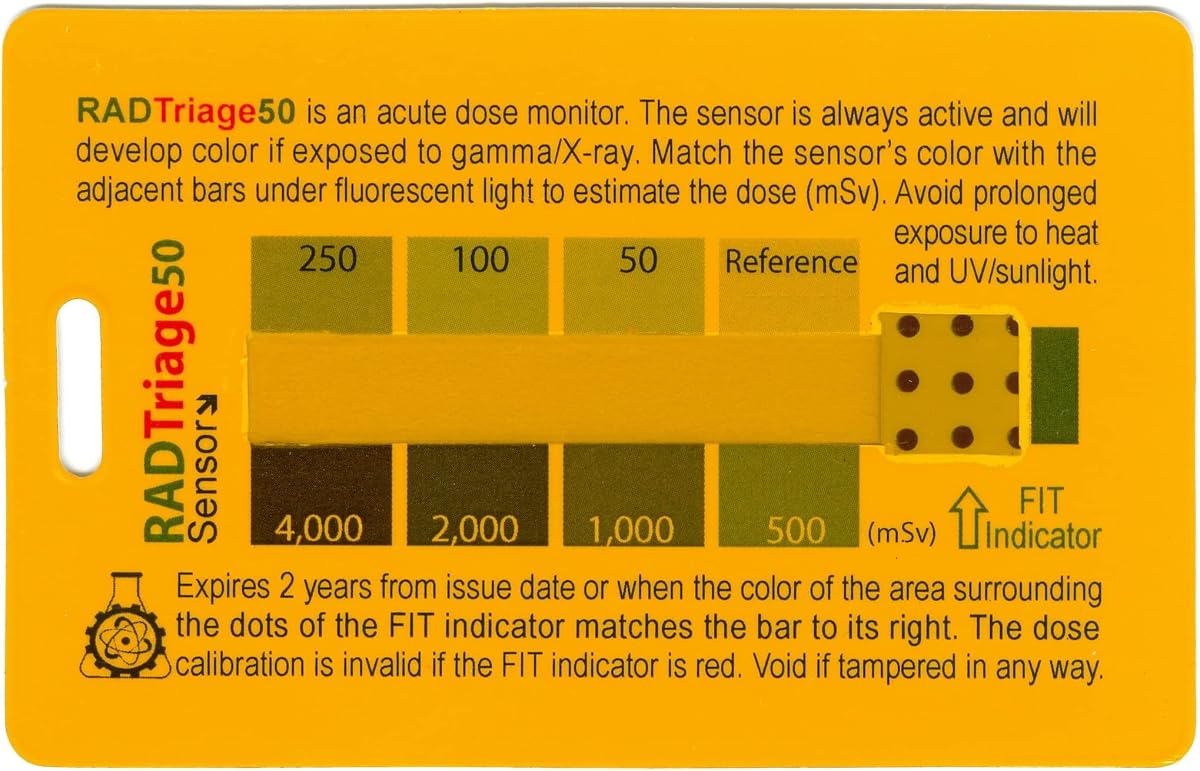
The Rad Triage 50 is a personal radiation detector designed to fit in a wallet, pocket, or badge holder. Its 4.4 rating reflects a focused purpose: quickly indicating beta, gamma, and X-ray radiation without the battery and calibration requirements associated with many electronic meters.
We may earn a commission when you buy through this link, at no additional cost to you.
The supplied description highlights that it is made in the United States, field tested, and approved by the U.S. Department of Homeland Security. It can provide instant detection around sources such as reactors, fallout, and dirty bombs, making it a personal awareness and triage device rather than a full-featured data logger.
The major advantage is simplicity. It requires no batteries and no calibration, while the stated shelf life can potentially be extended through cold storage and the listing claims a usable life of at least two years after removal. Its listed imperviousness to an electromagnetic pulse bomb also distinguishes it from ordinary consumer electronics.
This detector is best for travelers, emergency personnel, or anyone wanting a small personal warning device. It is less appropriate for users who need dose-rate graphs, downloadable records, adjustable thresholds, or detailed unit conversion.
The absence of batteries makes the Rad Triage 50 easier to keep on hand and removes one common failure point. It can remain in a wallet or pocket without routine charging or battery replacement.
The product focuses on quickly indicating the presence of ionizing radiation. That simplicity makes it useful as a compact preparedness tool, although it offers less analytical detail than a full Geiger counter.
We may earn a commission when you buy through this link, at no additional cost to you.
The GQ GMC-320 Plus is a digital Geiger counter and data recorder with a 4.6 rating. Its defining feature is not simply a live reading but the ability to record radiation data, replay it later on a computer, and integrate the instrument into a wider radiation-monitoring network.
We may earn a commission when you buy through this link, at no additional cost to you.
Automatic recording reduces the need to watch the device throughout a survey or exposure period. The open communication protocol is intended to make network support easier, which is valuable for users who want measurements collected over time rather than isolated spot checks.
Technical support is available through the GQ Electronics forum, and the product includes a 30-day money-back warranty plus a one-year factory warranty. The supplied information does not describe the sensor, measurement range, alarm system, display size, or battery runtime, so buyers should verify those specifications for their intended application.
The GMC-320 Plus makes most sense for institutions, technical users, or serious collectors who need recorded and replayable data. It is a better fit than a basic pocket meter when documentation, later analysis, and possible network support are central to the purchase.
Automatic data recording captures changes that may be missed during a brief visual inspection. Downloading the history for computer playback allows a user to examine the measurement session after leaving the monitored area.
The open communication protocol can help buyers connect the detector to broader monitoring arrangements. That makes the unit more relevant to organized radiation-monitoring setups than a standalone consumer meter.
We may earn a commission when you buy through this link, at no additional cost to you.
The GQ 320S is a digital nuclear radiation detector, monitor meter, Geiger counter, and dosimeter with a 4.5 rating. Its swivel display distinguishes it from basic handheld units, allowing the screen to be repositioned for different viewing angles and working positions.
We may earn a commission when you buy through this link, at no additional cost to you.
The device logs real-time data every second in internal memory and permits history downloads to a computer through free viewer software. Dosimeter mode, CPM count mode, and graph mode provide complementary ways to inspect radiation, while the rechargeable battery supports extended portable use.
The supplied information is concise and does not state the sensor model, measurement range, alarm behavior, or exact battery duration. Consequently, buyers should compare those details with their own requirements rather than assuming that the 320S has the same contamination or energy-response capabilities as the Radar-9989.
The GQ 320S is best for users who spend time monitoring from different positions or want a more flexible display than a fixed-screen meter. It is also a logical choice for anyone who values internal logs and PC software over advanced radiation-type analysis.
The swivel display can be oriented to suit the user and the meter, improving readability in different settings. This is a practical distinction for extended monitoring or handheld work where a fixed viewing angle may be inconvenient.
One-second logging and downloadable history support repeat measurements and later review. A long-lasting rechargeable battery further improves the meter as a portable tool for surveys around a home, workplace, or collection of materials.
We may earn a commission when you buy through this link, at no additional cost to you.
The ERICKHILL EMF Meter is the only non-ionizing product in the list, and it has a 4.4 rating. It detects low-frequency electric and magnetic fields from household electronics and wiring, making it useful for environmental awareness rather than nuclear radiation measurement.
We may earn a commission when you buy through this link, at no additional cost to you.
Its LCD presents processed values in volts per meter, microtesla, or milligauss. The electric-field range is listed as 1 to 1,999 volts per meter, while the magnetic-field range is 0.01 to 99.99 microtesla. Sound and light alarms trigger above the stated thresholds of 40 volts per meter and 0.4 microtesla.
Data hold freezes the displayed value for recording, and a five-minute automatic power-off helps conserve the rechargeable battery. A mute mode supports quiet environments, while the sensor should be placed close to powered appliances to improve the likelihood of obtaining a useful magnetic-field reading.
This meter is best for checking electromagnetic hotspots around televisions, computers, induction cookers, refrigerators, and other powered devices. It is not a substitute for a Geiger counter, scintillation detector, or other instrument designed to measure ionizing radiation.
The meter can help identify where electric or magnetic fields are strongest around common household equipment. Users can compare readings before and after introducing a shielding product, although such comparisons do not measure ionizing radiation.
The screen changes to red, the indicator flashes, and a buzzer sounds when a selected threshold is exceeded. Data hold keeps the current reading visible, making it easier to record a position or compare different locations.
We may earn a commission when you buy through this link, at no additional cost to you.
The right nuclear radiation detector depends on the radiation type, required precision, monitoring duration, recording needs, and working environment. Start by separating true ionizing-radiation instruments from EMF meters, then compare sensors, alerts, displays, power, and accessories.
A detector must be designed for the radiation present in the intended environment. The FNIRSI GC-01, ND01, Beta Gamma X-ray Tester, Rad Triage 50, and GQ models are described as detecting combinations of beta, gamma, and X-ray radiation, while the Radar-9989 adds alpha detection and a mica-window sensor. The HFS-50-CsI focuses on gamma and X-ray measurements with a cesium iodide scintillator. By contrast, the ERICKHILL device measures low-frequency electric and magnetic fields and should never be treated as a nuclear radiation detector.
Geiger-Müller counters ionize gas to create countable electrical pulses, while scintillator systems use a crystal sensor that produces light when radiation deposits energy. Within this list, the FNIRSI GC-01 and ND01 use Geiger-Müller sensing, the HFS-50-CsI uses CsI scintillation, and the Radar-9989 uses an LND7311 mica-window sensor. These technologies are not interchangeable: compare the stated energy response, measurement range, and error rather than assuming that a higher price always means a universally superior detector.
A basic presence check, a live dose-rate display, and a documented professional survey serve different purposes. The Rad Triage 50 favors portability and immediate personal triage, the HFS-50-CsI provides detailed curves and records, and the Radar-9989 adds multiple units, contamination measurements, and broad radiation-type coverage. Look for the specific values and modes you actually need rather than paying attention to the number of buttons or features advertised.
Alerts should be noticeable in the environment where the meter will be used. The FNIRSI GC-01 and Beta Gamma X-ray Tester support light, vibration, and sound, while the HFS-50-CsI combines audible sound, flashing lights, and on-screen alerts. The Radar-9989 uses visual and audible warnings with an adjustable threshold, and the ND01 translates its three status levels into green, yellow, and red. Consider whether background noise, sleeping, hearing protection, or the need for a discreet alert affects your choice.
Data records turn a spot check into a reviewable monitoring session. The GQ GMC-300S and GQ 320S log every second, support history downloads, and include PC viewer software, while the GQ GMC-320 Plus emphasizes automatic recording, later playback, and network support. The HFS-50-CsI stores up to 100 recent records and preserves total-dose information after shutdown. The Beta Gamma X-ray Tester also offers logging functions, but the supplied information does not state its export capacity.
Power specifications can shape the practical usefulness of a detector. Rechargeable models, including the GQ GMC-300S, GQ 320S, HFS-50-CsI, Radar-9989, Beta Gamma X-ray Tester, and ERICKHILL meter, are convenient for recurring use, although exact runtimes vary or are not provided. The ND01 uses two AAA batteries, and the Rad Triage 50 requires neither batteries nor calibration. Consider charging access, replacement logistics, automatic shutdown, low-battery warnings, and whether the device must work far from an outlet.
A large color screen can make trends easier to read, while a pocket format is more likely to remain with the user during a quick inspection. The HFS-50-CsI uses a color display and a telescopic rod, the Radar-9989 includes a 3.5-inch screen, storage case, telescopic rod, cable, and lanyard, and the GQ 320S uses a swivel display. The ND01 and Rad Triage 50 emphasize compact carry. Choose the balance of display quality, pocketability, and included accessories that fits the intended work.
Application lists are helpful, but a detector should be selected for its actual measurement design. The Radar-9989 is positioned for industrial safety, laboratories, professional monitoring, and surface-contamination work, while the GQ models emphasize data recording and network-capable setups. The HFS-50-CsI is relevant to hospital X-ray and CT environments, and several Geiger counters are listed for home renovation, geology, vehicles, radiology, and nuclear facilities. Verify radiation type, range, and accessories before applying a general-purpose meter to a specialist task.
Before using any ionizing-radiation detector, read the included manual and learn how the unit should be positioned relative to a source. For the ND01, the supplied instructions specify keeping the screen toward the user, placing the sensor on the back side toward the radiation source, holding the product parallel to the measurement target, and maintaining the position for 15 seconds. The Radar-9989 and HFS-50-CsI include telescopic rods that can help maintain separation.
Choose a mode that matches the task. Use a live or real-time display for a quick reading, average or accurate-value modes when a more filtered result is useful, and timed or logging functions for longer observations. Set current and cumulative alarm thresholds before entering an unfamiliar environment, then allow the meter to stabilize and compare readings from several positions rather than relying on a single point measurement.
Care for the device according to its power and storage instructions. Keep rechargeable batteries charged as directed, replace disposable batteries promptly after low-power warnings, download stored data before resetting or disposing of a unit, and keep the sensor face free of dust and damage. Store the detector in its case, away from extreme heat, moisture, and impact, and never expose an instrument beyond the environmental limits stated in its manual.
A Geiger counter uses a Geiger-Müller tube that counts ionization events as electrical pulses, while a scintillation detector uses a crystal sensor that produces light when radiation deposits energy. The supplied HFS-50-CsI uses a cesium iodide scintillator and lists a measurement error of plus or minus 10 percent, while several other products in the guide use Geiger-Müller sensing. The best choice depends on the required radiation types, response, and use environment.
No. A detector must use a sensor and energy response appropriate to the radiation being measured. The Radar-9989 is described as detecting alpha, beta, gamma, and X-ray radiation, while the HFS-50-CsI is listed for gamma and X-ray monitoring. Always check the radiation type, energy range, and intended application before relying on a meter for a specific material or environment.
No. The ERICKHILL ERICKHILL product measures low-frequency electric and magnetic fields, not ionizing radiation. It can identify EMF patterns around powered appliances, but it cannot replace a Geiger counter, scintillation monitor, or qualified radiation instrument. It is included in the list to clarify an important distinction that shoppers may encounter while researching radiation-related products.
The Rad Triage 50 is explicitly designed to fit in a wallet, pocket, or badge holder, while the ND01 is also described as compact enough for a pocket or backpack. The Rad Triage 50 requires no batteries or calibration, whereas the ND01 uses two AAA batteries. For longer sessions, the larger HFS-50-CsI and Radar-9989 may be easier to view but less convenient to carry.
Downloadable data is valuable when you need a permanent record, need to compare readings over time, or want to analyze a session away from the device. The GQ GMC-300S, GQ 320S, and GQ GMC-320 Plus are built around logging and computer viewing or playback. For a simple occasional presence check, those capabilities may be more than necessary, making portability and battery life more important priorities.
A current-dose alarm reacts to the radiation level at that moment, which is useful for identifying a sudden rise or entering a hazardous area. A cumulative-dose alarm considers accumulated exposure over the monitoring session. The FNIRSI GC-01 and Beta Gamma X-ray Tester support separate settings for both, allowing users to respond to immediate and longer-term concerns.
Several products in the guide list home renovation as an intended application, including the FNIRSI GC-01 and the Beta Gamma X-ray Tester. A detector can help identify changing radiation levels in suspect materials, but it does not by itself establish whether a substance is safe or legally handled. If a potentially significant source is found, step away from the area and seek appropriate professional guidance.
Follow the manual for the exact model, because sensor placement and warm-up behavior can affect readings. The ND01 instructions call for the screen facing the user, the sensor facing the source, the detector held parallel to the target, and a 15-second reading period. For stronger sources, use the supplied telescopic rod where available and never place a body directly in the beam path.
The GQ GMC-300S stands out as the best budget all-rounder because it combines second-by-second logging, downloadable history, a rechargeable battery, and several display modes. The FNIRSI GC-01 is the editor's choice for flexible warnings, with light, vibration, and sound alarms plus separate current and cumulative thresholds. The Radar-9989 takes the premium role because its LND7311 sensor, broad radiation coverage, contamination measurements, color display, and extensive accessory set suit more demanding work.
For long-duration personal monitoring, the HFS-50-CsI offers a color waveform, substantial record storage, multiple alarm methods, and a claimed long battery life. The Rad Triage 50 is the simplest carry option, the ND01 emphasizes color-coded status and pocket portability, and the GQ GMC-320 Plus and GQ 320S prioritize logged data for later review.
Before purchasing, verify the current listing, sensor specifications, range, radiation types, alarm options, and included accessories. Prices and availability can change, so the right moment to buy depends on both the detector's capabilities and the deal available when you are ready.