
RackChoice 8-Bay Chassis
4.0Editor score
Eight hot-swap drive bays
Eight full-height slots
Triple 120mm PWM fans
Flexible ATX PSU support
A 4U rackmount GPU server chassis provides the space, airflow, and rack integration needed for accelerators, AI systems, and storage-heavy servers. The right model balances GPU clearance, cooling capacity, drive bays, expansion slots, motherboard support, and dependable power delivery without wasting rack space.
We compared all ten listed chassis and barebone systems using their published specifications, including GPU accommodation, radiators and fans, storage options, slot counts, processor platforms, and power configurations. The list covers empty enclosures as well as complete server barebones designed for demanding accelerator workloads.
Each review explains who benefits most from the platform and where compromises may arise. Ratings, availability, and pricing can change, so shoppers should confirm current component support and listings before making a final purchase decision.
4.0Editor score

4.3Editor score

5.0Editor score
As an Amazon Associate we earn from qualifying purchases.
The comparison below organizes the ten systems by chassis type, GPU capacity, cooling provisions, storage support, expansion room, and power architecture, making it easier to identify the platform that matches a particular rack and workload.


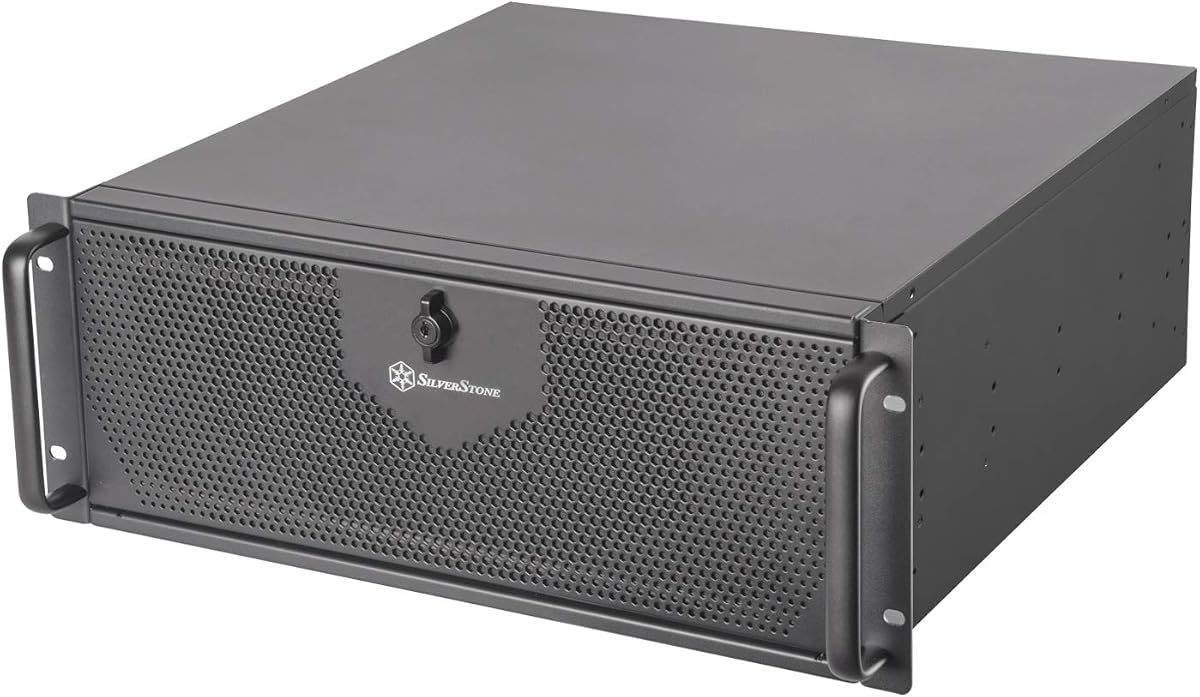
The SilverStone RM44 is a 4U rackmount server enclosure designed for builders who need substantial expansion room and serious liquid-cooling headroom. Its 4.3 rating is supported by a focused specification list that includes support for radiators as large as 360mm, SSI-EEB and extended ATX motherboards, eight PCIe or PCI expansion slots, sliding rail mounting holes, and a front-facing USB Type-C connection. It is not a turnkey server or a preconfigured GPU platform, so it works best for technically confident users assembling a workstation, rendering node, or compact inference server.
We may earn a commission when you buy through this link, at no additional cost to you.
Its principal advantage is the unusually generous cooling allowance for a 4U enclosure. A 360mm radiator can provide a substantial liquid-cooling surface, which is valuable when the chassis carries power-hungry accelerators, a high-core-count processor, or both. The eight expansion slots make it possible to consider multiple single-slot cards or a smaller collection of wider accelerators, although GPU physical dimensions and power requirements still need to be checked against the installed hardware. SSI-EEB support is another differentiator for enterprise boards with numerous memory slots and multiple power connections.
There are trade-offs to consider. The supplied specifications focus on cooling, motherboard format, and expansion rather than detailed drive-bay configurations, so buyers should confirm storage needs against the manufacturer’s manual and component drawings. Only one USB Type-C interface is listed, and there is no indication of hot-swap drive support. The enclosure also requires the user to source compatible server components, including any GPU, cooling hardware, motherboard, storage, and power supplies. These limitations make it less convenient than a complete barebone system.
The RM44 is the strongest general recommendation for buyers who want a flexible chassis rather than a fixed platform. It is particularly appropriate for a four-GPU build involving single-width cards, a high-airflow air-cooled design, or a custom liquid loop that benefits from a large radiator. Buyers who need hot-swap storage, integrated management features, or a ready-made server may prefer one of the more purpose-built systems. Within the empty-chassis category, however, the RM44 offers one of the strongest combinations of cooling capacity, board compatibility, and expansion potential.
Support for a 360mm radiator gives builders meaningful flexibility when tuning airflow around CPUs and accelerators. The enclosure can also accommodate conventional server fans, making it suitable for custom cooling layouts rather than a single prescribed thermal design.
SSI-EEB and extended ATX support accommodates enterprise-class boards, while eight expansion slots create room for several accelerators or other PCI devices. Physical slot width, length, and power requirements still require confirmation before assembly.
We may earn a commission when you buy through this link, at no additional cost to you.
The SilverStone RM4A is a configurable 4U server chassis with a 3.6 rating. Its listed capabilities include support for SSI-EEB motherboards, 360mm radiators with two 80mm fans, hard-drive mounting on the expansion-card retainer, eight PCI expansion slots, and a USB Type-C interface. It appeals to builders seeking a rack enclosure with more ambitious cooling and storage options than a basic office-style case, while remaining a component-level system rather than a ready-to-run server.
We may earn a commission when you buy through this link, at no additional cost to you.
The cooling provision is the RM4A’s main attraction. Accommodating a 360mm radiator allows a custom loop to use a large heatsink and quieter fans than a compact air-cooled arrangement, provided the radiator, tubing, pump, and mounting hardware are selected correctly. The enclosure also retains eight PCI expansion slots, which is a useful foundation for a multi-GPU system. Mounting a hard drive on the expansion-card retainer may make better use of space in a system that does not need a large front disk array.
The lower rating and limited published detail warrant more careful validation than the SilverStone RM44 offers. The product information does not provide a full drive-backplane list, detailed cooling layout, or an explicit statement about supported PSU form factors. It also does not confirm how many GPUs can physically fit, whether they must be single-width, or how much power may be supplied. These details are essential for accelerator builds and should be verified in the technical documentation before ordering any high-heat components.
The RM4A is best suited to a builder who values cooling flexibility and wants to place storage on the expansion-card retainer. It may work well for a compact GPU server, visualization system, or custom liquid-cooled compute node. It is less attractive for buyers seeking enterprise hot-swap arrays, comprehensive management, or a validated complete platform. The recommendation is therefore conditional: the core chassis specification is promising, but buyers should treat the published list as a starting point and verify fitment for their exact motherboard, GPU, and cooling hardware.
A 360mm radiator allowance provides ample space for a custom cooling loop, and the listed two 80mm fans offer a starting point for radiator airflow. Fan count and orientation may vary with the final internal configuration.
The expansion-card retainer can carry a hard drive, helping preserve other internal areas for accelerators, power distribution, or cooling. This is useful for compact builds but is not a substitute for a multi-bay hot-swap backplane.
We may earn a commission when you buy through this link, at no additional cost to you.
The Generic ZhenLoong X412 is a highly specified 4U server case aimed at four-GPU systems and storage-heavy deployments. Its feature set includes twelve 3.5-inch hot-swap positions, support for U.2, SAS, and SATA drives, E-ATX through ITX motherboard compatibility, eleven full-height PCI slots, a 1.0mm medium-carbon steel chassis, three 12038 PWM fans, and a MiniSAS-style backplane. It also includes guide rails and two 2000W CRPS power modules, making it more complete than a conventional empty enclosure.
We may earn a commission when you buy through this link, at no additional cost to you.
Storage is the standout advantage. The drive layout can support twelve 3.5-inch or 2.5-inch SAS or SATA drives, or a mixed arrangement of four SAS or SATA drives and eight U.2 SSDs. Tool-less caddies and an eight-bay section with orange release buttons suit frequent maintenance, while the backplane includes SFF8643 and SFF8654 connections. This makes the X412 relevant to virtualization hosts, data-processing systems, and storage nodes that need substantial local capacity without relying entirely on external storage.
The power configuration is similarly serious. Two included 2000W CRPS modules can operate in redundant or stacked modes, and the power board supports up to 3000W output. For high-end accelerators, that headroom is meaningful, but buyers must still coordinate PSU redundancy, GPU power connectors, motherboard requirements, and the server’s total load. The enclosure targets four GPUs but does not publish every dimensional constraint, so card length, slot width, cooling clearance, and power-cable routing should be checked before buying multiple expensive accelerators.
The X412 is a compelling choice for buyers who want storage density and a preincluded power architecture. Its drawbacks are the lack of a customer rating and an approximate 30-to-40-day transportation cycle stated in the supplied information. It also appears less familiar than chassis from established server brands, making written confirmation of backplane, fan, and accessory compatibility especially important. For a planned four-GPU or mixed-storage system, the X412 offers an unusually complete foundation, provided buyers account for procurement time and verify technical details before ordering.
The chassis supports twelve hot-swap bays and can combine conventional SAS or SATA drives with U.2 SSDs. That flexibility is valuable where a system needs both high-capacity disks and high-performance solid-state storage.
Two included 2000W CRPS modules provide a strong starting point for a four-GPU configuration. Their ability to switch between redundant and stacked operation also allows the server to adapt to changing workload demands.
We may earn a commission when you buy through this link, at no additional cost to you.
The RackChoice 4U chassis combines an eight-bay hot-swappable storage layout with eight full-height expansion slots, making it a practical value-oriented foundation for a GPU server. Its 4.0 rating reflects a broadly useful specification set: E-ATX, ATX, MicroATX, and Mini-ITX motherboard support; eight hot-swap 3.5-inch SAS or SATA positions that also accept 2.5-inch drives; three 120mm PWM ball-bearing fans; and support for either a standard ATX power supply or a redundant CRPS unit.
We may earn a commission when you buy through this link, at no additional cost to you.
Its storage design is especially useful for small data centers and business servers. The MiniSAS backplane and included reversed SFF-8643 male-to-four-SATA female cables simplify the connection of conventional SATA devices, while the hot-swap bays reduce maintenance time. Buyers can use the eighth bay as a fixed position when eight hot-swap bays are not required. Three cooling fans provide a reasonable foundation for a multi-card system, although the specifications do not mention liquid-cooling radiator support.
The main limitation is the nature of the bundled cabling. A backplane designed around MiniSAS and distributed SATA leads may not suit a build that uses a different controller, NVMe arrangement, or several very high-power GPUs. The chassis also leaves the final number of accelerators dependent on card thickness, physical dimensions, cooling, and power distribution. Redundant CRPS support is helpful, but no redundant power modules are identified as included. Users should therefore treat this as a flexible enclosure with strong storage basics rather than a prevalidated GPU platform.
For a home lab, small business, or cost-conscious cluster builder, the RackChoice offers an attractive balance of storage, expansion, and chassis flexibility. It is particularly useful when GPUs will be single-width or moderately sized and when a MiniSAS-backed disk array is part of the design. The included rails and installation guidance help simplify deployment in a standard rack. Buyers prioritizing liquid cooling, eight dual-width accelerators, or turnkey redundancy should choose a more specialized platform.
Eight hot-swap SAS or SATA positions make the chassis useful for virtualization and clustered workloads where drive maintenance should not require shutting down the entire system. The included MiniSAS-to-SATA leads support conventional disk arrangements.
The documented three-step rail procedure uses screwless inner rails and rack-mounted outer rails. This reduces the amount of assembly work required before installing internal components.
We may earn a commission when you buy through this link, at no additional cost to you.
The Rosewill RSV-AI01 is explicitly designed for AI and machine-learning systems that may require as many as four GPUs. It includes eight hot-swappable 3.5-inch or 2.5-inch SATA/SAS drive positions with 12Gbps capability, SGPIO, and temperature control. Cooling is handled by three 12038 hot-swap PWM fans and two rear 8038 fans, while the enclosure accepts E-ATX motherboards and includes a rail kit for standard rack deployment. Its 3.0 rating makes it one of the less proven choices in this group.
We may earn a commission when you buy through this link, at no additional cost to you.
The most attractive feature is the combination of a four-GPU target and serviceable cooling. Hot-swappable fans can simplify replacement of a failed fan, and the mix of three larger middle fans with two rear fans suggests a deliberate effort to move air through a dense accelerator configuration. The drive system is also more mature than a simple internal-disk enclosure, with status and management features aimed at operators rather than casual desktop users.
Users should nevertheless consider the lower rating and the limited published power information. A four-GPU AI server can impose a substantial combined load, yet the supplied specifications do not describe a redundant PSU option, maximum supported output, or the number and type of GPU power connectors. There is also no listed liquid-cooling radiator compatibility, making cooling design dependent on the supplied air-cooling arrangement. Verify accelerator dimensions, slot widths, cable clearance, and power requirements in advance.
The RSV-AI01 is most appropriate for a builder assembling a four-accelerator system with hot-swap storage and a preference for serviceable air cooling. Its preinstalled rails and modern USB connectivity make deployment convenient once the core compatibility checks are complete. However, it is not the first choice for a mission-critical deployment where a redundant power architecture or long-established vendor support ecosystem is essential. The best purchase is one that has been matched carefully to a known motherboard, GPU set, and cooling configuration.
Three 12038 PWM hot-swap fans and two rear 8038 fans create a service-oriented airflow layout. The replaceable fan design is helpful in dense systems where quick maintenance can reduce disruption.
The eight 12Gbps hot-swap bays support SATA and SAS devices while adding SGPIO and temperature monitoring. These features help operators track drive state and manage replacement tasks more effectively.
We may earn a commission when you buy through this link, at no additional cost to you.
The Supermicro CSE-747BTQ-R2K04B is a feature-rich 4U chassis with a 5.0 rating, the highest listed score among the ten products. It supports eight hot-swappable 3.5-inch SAS or SATA drives with SES2, eleven full-height and full-length expansion slots, and a layout optimized for four double-width GPUs. It accepts E-ATX boards measuring 15.2 by 13.2 inches as well as ATX and MicroATX form factors, making it a credible foundation for a compact enterprise or rendering server.
We may earn a commission when you buy through this link, at no additional cost to you.
The expansion layout is its standout feature. Eleven full-height, full-length slots offer room for multiple accelerator cards, network interfaces, storage controllers, and other PCI devices. Crucially, the chassis is optimized for four double-width GPU solutions, addressing a common obstacle in 4U systems where a large accelerator consumes two or more expansion positions. The storage side is equally operational, with an eight-bay hot-swap backplane and SES2 support for drive enclosure management.
Security and thermal provisions distinguish it from simpler cases. A front hard-drive door lock and a side-panel intrusion switch add physical monitoring and access control, while two rear 80mm PWM fans and four lower-middle 92mm PWM fans provide a defined airflow layout. The published information does not spell out liquid-cooling support, detailed PSU requirements, or every compatible Supermicro motherboard, so a system integrator should confirm the exact board, GPU, cable, and power configuration before ordering.
For an organization willing to perform careful platform validation, the CSE-747BTQ is the premium recommendation in this roundup. It offers a clearer enterprise feature set, a well-established chassis ecosystem, and a credible four-double-width-GPU arrangement. It is particularly suitable for virtualization, rendering, inference, or storage workloads that need more expansion capability than a compact office enclosure can provide. Buyers seeking the simplest possible build should instead consider a more integrated barebone, while those prioritizing maximum GPU density will need to compare the denser ASRock systems.
The chassis is optimized for four double-width accelerators, reducing uncertainty compared with generic cases where card width may consume most of the available slots. Eleven full-length slots also leave room for supporting controllers and network hardware.
The front door lock reduces casual access to the hot-swap drives, while the side-panel intrusion switch can report unauthorized opening. These are meaningful operational additions for a server stored in a shared equipment area.
We may earn a commission when you buy through this link, at no additional cost to you.
The ASRock Rack 4U8G-GNR2/RF is a high-density GPU barebone capable of supporting eight full-height, full-length PCIe 5.0 x16 accelerators. It includes a dual-socket platform, 32 DDR5 DIMM positions, enhanced airflow designed for 600W GPUs and accelerator cards, and a 3+1 redundant 2700W CRPS power configuration. Four hot-swappable 2.5-inch PCIe 5.0 NVMe bays or 24 hot-swappable SATA/SAS positions are listed, with an additional RAID or HBA card required for some configurations.
We may earn a commission when you buy through this link, at no additional cost to you.
Eight GPU support is the defining feature. This level of accelerator density suits large-scale training, inference clusters, rendering farms, and other parallel-computing systems where consolidating accelerators into fewer chassis simplifies networking and administration. The full-height, full-length PCIe 5.0 slots are designed for modern cards, while the airflow provisions specifically mention high-power 600W accelerators. Thirty-two memory slots also give the platform substantial capacity for large data sets and high-concurrency workloads.
Because this is a barebone, buyers must add processors, memory, accelerators, storage, and potentially an additional RAID or HBA card. The supplied title identifies an Intel Xeon 6700/6500 family system, while the listed platform details refer to dual E2 LGA 4710 sockets, Xeon 6700P, 6500P, and 6700E processors, and support for DDR5 RDIMM and MRDIMM. This makes exact processor and memory validation essential, particularly because the product naming and platform details should be confirmed together.
This server is the logical selection for buyers whose workload justifies maximum GPU count and enterprise memory capacity. The 2700W redundant CRPS architecture and 3+1 power design provide a strong foundation for eight high-power cards. It is not ideal for a small workstation, a modest home lab, or anyone who wants a ready-to-run system without sourcing numerous components. With careful compatibility checks and a suitable accelerator budget, it offers exceptional density for large-scale compute.
Eight full-height, full-length PCIe 5.0 slots allow a large number of accelerators to operate within one 4U enclosure. This density can simplify high-speed network topology and reduce the number of chassis requiring power, cooling, and administration.
Thirty-two DDR5 DIMM slots serve large-memory workloads, while the 3+1 2700W CRPS arrangement provides substantial power redundancy. Every accelerator and power cable must still be validated against the final system load.
We may earn a commission when you buy through this link, at no additional cost to you.
This ASRock Rack 4U8G-GNR2/RF listing describes an exceptionally dense server platform with eight full-height, full-length PCIe 5.0 x16 GPU slots, dual-socket processing, DDR5 memory, and a 3+1 redundant 3200W CRPS power design. Its supplied platform details identify SP5 LGA 6096 sockets, support for AMD EPYC 9005 and 9004 processors including specified 3D V-Cache models, 12+12 DIMM slots, and either 16 hot-swap 2.5-inch NVMe or 24 hot-swap SATA/SAS positions. An additional RAID or HBA card may be required.
We may earn a commission when you buy through this link, at no additional cost to you.
The 3200W power modules are the most distinctive feature in this group. Combined with airflow engineered around 600W GPUs and accelerator cards, the platform is oriented toward installations that need both high GPU density and considerable electrical headroom. Sixteen NVMe positions create a fast local storage tier for training data, model files, and high-volume inference inputs, while the optional larger SATA/SAS layout favors capacity-oriented configurations.
The product title refers to Intel Xeon 6700 and 6500 families, whereas the detailed feature list identifies an AMD SP5 platform supporting EPYC 9005 and 9004 processors. Buyers should not infer compatibility from the marketplace title alone. They should confirm the exact processor sockets, board revision, supported accelerator power limits, drive controller options, and backplane selection with the seller or manufacturer. This discrepancy is precisely why a barebone with eight high-power GPUs requires component-level validation before procurement.
This system is suited to organizations pursuing high-performance, multi-accelerator computing with large local storage and extensive power requirements. The SP5 dual-socket platform offers substantial memory bandwidth and capacity, while 24 DIMM positions support large workloads without forcing a move to a larger chassis. It is unnecessary for small deployments and demands a professional assembly process, but for a properly qualified eight-GPU build it represents one of the most ambitious options in the comparison.
The 3+1 redundant 3200W CRPS design supplies exceptional headroom for multiple 600W accelerators. System planners should still account for processor memory, storage, fans, and peak-efficiency requirements when validating the power budget.
Sixteen hot-swappable PCIe 5.0 NVMe bays can provide high-throughput local storage close to the accelerators. This reduces storage latency for data-intensive training and inference tasks compared with relying solely on a distant shared array.
We may earn a commission when you buy through this link, at no additional cost to you.
The ASRock Rack 4U8G-TURIN2/RF is a dual-socket AMD EPYC barebone built around eight full-height, full-length, dual-slot PCIe 5.0 x16 GPU positions. It supports EPYC 9005 and 9004 processors, including listed 3D V-Cache models, and provides 12+12 DDR5 RDIMM slots for 24 memory modules total. Its 3+1 2700W 80-Plus Titanium CRPS configuration and airflow intended for 600W accelerators make it a purpose-built platform for high-density, high-efficiency compute.
We may earn a commission when you buy through this link, at no additional cost to you.
Its storage flexibility distinguishes it from some similarly dense systems. The specification lists four hot-swappable 2.5-inch PCIe 5.0 NVMe bays alongside 20 hot-swappable 2.5-inch SATA bays, allowing a balanced arrangement of fast boot, cache, or application storage and larger conventional drives. Dual-socket AMD processing, 24 DIMM slots, and eight dual-slot accelerators give the platform substantial scaling potential for large models, virtualization clusters, and scientific workloads.
As a barebone, the system requires a careful bill of materials. Processor selection, exact memory population rules, operating system support, GPU cooling, cable routing, and drive controller requirements must be coordinated. Although the 2700W power architecture is substantial, eight 600W GPUs can consume more power than the nominal GPU rating alone suggests when processor, memory, fans, and power-conversion losses are included. Expansion and backplane options should also be confirmed for the intended storage configuration.
The 4U8G-TURIN2 is a strong fit for integrators that want maximum accelerator count on a well-specified AMD platform without moving to an even denser 3U or 4U system. It offers a useful balance of compute, memory, storage, and efficiency, and the Titanium power certification is a meaningful detail for operators watching energy consumption. It remains a specialist platform rather than a casual upgrade, so the best results come from validated enterprise integration and careful component planning.
Eight dual-slot PCIe 5.0 positions and airflow provisions for accelerators up to 600W TDP create a strong foundation for parallel compute. Card dimensions and thermal clearance still need to match the final chassis configuration.
Four hot-swap NVMe positions can serve fast-access data, while 20 SATA bays provide capacity. Combining both allows a system to separate performance-critical datasets from larger archival or working storage.
We may earn a commission when you buy through this link, at no additional cost to you.
The SilverStone RM42-502 combines a strong 4.7 rating with a traditional 4U server-chassis feature set. It supports SSI-EEB motherboards, 240mm liquid-cooling radiators, and two 5.25-inch drive bays that can directly hold 3.5-inch or 2.5-inch drives. The front panel includes an anti-theft lock, the exterior has sliding rail mounting holes, and the chassis may be positioned upright or horizontally. One USB Type-C interface adds modern peripheral connectivity.
We may earn a commission when you buy through this link, at no additional cost to you.
The orientation flexibility is especially useful. A server that can be installed upright or horizontally makes it easier to adapt the same enclosure to different rack layouts, workbench arrangements, or cooling plans. Liquid-cooling compatibility up to 240mm offers more flexibility than a purely air-cooled case, although it is less ambitious than the 360mm provision in the SilverStone RM44. The two drive bays are suitable for a basic boot-and-data configuration but are not designed for the high-density storage arrays offered by the X412, RackChoice, or Supermicro models.
The RM42-502 also provides less explicit information about expansion slots and cooling fans than the other SilverStone enclosure. Since the keyword centers on GPU servers, a prospective buyer should obtain the technical drawings or manual and confirm the number of full-height slots, maximum card length, maximum power-supply output, and clearance for multi-slot accelerators. The lack of a detailed drive-backplane and hot-swap specification also makes it more suitable for a carefully assembled system than a high-maintenance enterprise storage node.
This chassis is a good fit for a high-performance custom build that values liquid cooling, server motherboards, and a strong customer rating without needing a large hot-swap disk array. It can suit a compact GPU rendering workstation or inference server when only a small number of drives are required. It is less compelling for eight-GPU density or storage-heavy virtualization. The final recommendation depends on confirming the physical details that the concise product listing does not provide.
A 240mm radiator can provide a meaningful thermal advantage for a CPU and moderately loaded accelerators. The smaller radiator size also leaves more chassis flexibility than a 360mm design may require.
The ability to place the enclosure upright or horizontally lets integrators adapt it to available rack space and preferred airflow paths. Sliding rail mounting holes further streamline installation when sliding the chassis into position.
We may earn a commission when you buy through this link, at no additional cost to you.
The right GPU server chassis depends on accelerator size, thermal output, storage architecture, motherboard format, power design, and maintenance model. Reviewing these factors before purchasing helps prevent expensive compatibility problems after the server is assembled.
Start with the number and physical dimensions of accelerators, not just the number of PCIe slots. A standard GPU may consume one slot, while many data-center accelerators occupy two or more positions and require substantial airflow around their heatsinks. The Supermicro CSE-747BTQ is optimized for four double-width GPUs, the Rosewill RSV-AI01 and ZhenLoong X412 target four-GPU configurations, and the ASRock barebones are designed around eight full-height, full-length cards. Confirm card length, height, width, connector position, and the clearance of the rear panel before ordering.
Choose a chassis with explicit accelerator support whenever possible, and leave expansion space for networking, storage controllers, or capture cards.
GPU servers produce concentrated heat, so cooling design can be more important than raw slot count. The SilverStone RM44 supports radiators up to 360mm, the RM4A also lists 360mm compatibility, and the RM42-502 supports up to 240mm. The X412, Rosewill, Supermicro, and ASRock platforms emphasize fan-based airflow, with the ASRock systems specifically mentioning enhanced airflow for 600W accelerators. Review the complete airflow path, including intake restrictions, fan direction, rear exhaust, and the effect of a populated expansion-card area.
Prioritize a cooling design validated for the intended accelerator power level, and confirm radiator dimensions only for models that expressly support liquid cooling.
Empty SilverStone and RackChoice enclosures support enterprise or general-purpose motherboards to varying degrees, while the ASRock products are complete dual-socket barebones with processor compatibility already tied to a specific platform. SSI-EEB support is useful for boards with many memory slots, while E-ATX offers a more compact enterprise footprint. The ASRock listings mention Xeon or EPYC processor families depending on the specific platform, so the exact processor socket, board revision, and supported memory must be verified.
Match the chassis to the board’s form factor, socket, memory type, power connectors, and expansion layout before selecting any other components.
Storage requirements can determine whether a basic chassis is sufficient. The ZhenLoong X412 offers twelve drive positions and mixed U.2, SAS, and SATA support; the RackChoice and Rosewill each provide eight hot-swap bays; the Supermicro includes eight SAS or SATA positions with SES2. The ASRock platforms support as many as 24 drive positions depending on the selected configuration. A system with only two bays, such as the RM42-502, may be adequate for a compact compute node but unsuitable for a storage-intensive virtualization host.
Consider bay count, drive interface, hot-swap behavior, backplane requirements, and the availability of suitable controller cables.
A multi-GPU server needs more power than a conventional ATX desktop and may benefit from redundant or hot-swap CRPS modules. The X412 includes two 2000W units, the ASRock systems use 3+1 redundant CRPS configurations of 2700W or 3200W, and the RackChoice supports either ATX or redundant CRPS supplies. Supermicro and SilverStone listings do not state their complete power details in the supplied information. A larger power platform is not automatically necessary, but total draw, redundancy behavior, connector type, and drive power must be reconciled.
Select redundancy and capacity for the workload rather than power alone, and ensure the PSU modules and motherboard are a validated combination.
GPU slots and general expansion slots are not interchangeable in every chassis. The Supermicro provides eleven full-height, full-length slots, the X412 lists eleven full-height PCI positions, and the SilverStone RM44 and RM4A each list eight PCIe or PCI slots. Additional slots may be needed for dual-port network adapters, Fibre Channel or Ethernet controllers, RAID cards, and accelerators. Ensure there is space behind the rear panel for network connectors and enough lane bandwidth in the selected motherboard.
List every controller, NIC, and accelerator before choosing the chassis so expansion requirements are considered together.
A genuine rackmount chassis should fit a standard 19-inch rack and include an appropriate rail system. The RackChoice includes installation guidance, the X412 includes a dedicated guide rail, and the Rosewill arrives with a preinstalled rail kit. The SilverStone RM44 and RM42-502 feature sliding rail mounting holes. For shared data centers or remote installations, the Supermicro’s front door lock and side-panel intrusion switch add operational security that many generic chassis do not provide.
Check whether inner and outer rails are included, whether assembly is required, and whether the chosen server area requires locks or intrusion monitoring.
Begin by inventorying the motherboard, processors, memory, accelerators, storage, power supplies, and cooling hardware against the chassis manual. Confirm slot widths, maximum card dimensions, drive interfaces, backplane connectors, PSU form factors, and radiator size before installation. Assemble the motherboard and internal power distribution outside the rack when possible, but keep heavy or fragile expansion cards protected until the chassis is securely mounted.
Install the chassis in the rack, secure the rails, and verify that the front and rear panels do not obstruct airflow. Connect storage and expansion cables with the system powered down, observing the backplane orientation and any independent SAS or SATA power requirements. Route cables away from fans and accelerator intake areas, then confirm every module is fully seated before adding graphics cards or other high-heat equipment.
Bring the server up in stages when possible. First test the motherboard, processor, memory, and storage; then add power supplies and fans; then install one accelerator and validate thermals before populating remaining slots. After deployment, monitor temperatures, fan speeds, drive status, and power redundancy through the applicable management tools. Keep intake filters clean, leave adequate clearance around the rack, and schedule periodic inspection of fans, disks, cables, and physical security features.
A 4U chassis is designed to occupy four vertical units of standard 19-inch rack space. That height provides more room for full-length cards, larger cooling hardware, additional storage, and multiple power supplies than a 1U or 2U enclosure. It is a practical middle ground between compact rack servers and larger 5U or 6U systems.
Capacity varies considerably by chassis and card design. Some general-purpose 4U cases provide eight expansion slots, while specialized systems may support four double-width GPUs or eight full-height, full-length accelerators. The number of slots alone does not determine capacity, because power, cooling, physical dimensions, and slot spacing can all restrict the final configuration.
An empty chassis offers flexibility because the buyer can select every component and potentially reuse compatible parts. A barebone arrives with a validated platform and many of the essential server components, which can simplify assembly and reduce compatibility risk. It is usually better for operators who need a dependable predefined architecture, while an empty case is often more attractive to experienced builders.
Not necessarily. The Supermicro, X412, Rosewill, and ASRock platforms rely on substantial fan-based airflow for dense accelerator configurations. Liquid cooling can help when a 360mm or 240mm radiator is supported, especially with high-TDP processors and GPUs, but it adds pump, tubing, leak, maintenance, and installation considerations. Air cooling remains a valid choice when the chassis is designed and validated for the selected hardware.
Hot-swap bays allow a drive to be removed and replaced without powering down the entire server, which is valuable in clustered or high-uptime environments. Fixed bays are simpler and less expensive but usually require the system to be shut down for disk replacement. The X412, RackChoice, Rosewill, Supermicro, and certain ASRock configurations provide hot-swap options.
Redundant CRPS modules can keep the server operating if one power supply fails and can simplify maintenance because a module may be replaced without fully powering down the system. The benefit is greatest in data centers and other uptime-sensitive environments. Capacity, efficiency, and redundancy mode must still be matched to the number of accelerators and their peak power requirements.
Check the card’s physical length, height, slot width, connector position, and power requirements against the chassis dimensions and supported component list. Also verify that the motherboard has enough PCIe lanes and that the cooling path can handle the card’s thermal output. A vendor support confirmation or technical manual is preferable when the product listing does not provide complete clearance data.
Routine maintenance includes monitoring temperatures, fan operation, drive health, and power redundancy, along with checking that intake airflow is not blocked. Hot-swap fans and drives make service faster, while physical locks and intrusion sensors improve security in shared environments. Components should also be inspected periodically for dust, vibration damage, cable strain, and unusual operating temperatures.
The SilverStone RM44 stands out as the strongest all-around empty chassis because it combines 360mm radiator support, SSI-EEB and extended ATX motherboard compatibility, eight expansion slots, and convenient rail features. The RackChoice 8-Bay is the best budget-oriented enclosure for buyers who prioritize hot-swap storage and flexible motherboard support, while the Supermicro CSE-747BTQ is the premium choice for a clearly organized four-double-width-GPU layout and enterprise security features.
For maximum accelerator density, the ASRock barebones are more appropriate. They support eight full-height, full-length GPUs, extensive DDR5 memory, high-capacity redundant power, and fast NVMe storage, but they require exact platform validation and substantial component procurement. The ZhenLoong X412 offers a particularly complete foundation for mixed SAS, SATA, and U.2 storage, while the Rosewill RSV-AI01 serves buyers seeking four GPUs, serviceable fans, and hot-swap disks in a simpler AI-oriented package.
Before purchasing, compare every intended card and motherboard with the manufacturer’s dimensional and electrical specifications, then confirm the current listing. Component availability, ratings, configurations, and prices change, and the same chassis name may appear with different backplanes, power supplies, or included accessories. A current compatibility check is the final and most important step in selecting a reliable GPU server platform.