
MAXDONE Solar Trail Camera WiFi Bluetooth
4.2Editor score
Built-in rechargeable battery
Solar charging support
Local WiFi app control
Explore the best Battery Life Trail Camera options, comparing power setups, trigger speed, night vision, resolution, connectivity, and field reliability.
A trail camera with strong battery life should be dependable from the first week of hunting season through the final cold snap. The most useful models balance low-power operation, fast motion detection, effective night vision, and power options suited to remote locations, while connectivity remains a separate consideration.
This guide compares ten trail cameras using their stated resolution, trigger speed, infrared performance, weather resistance, recording modes, and available power configurations. It covers non-cellular models, local WiFi control, and cellular delivery, allowing readers to compare cameras designed for different monitoring priorities.
Each review explains where a camera stands out and where compromises may apply. The selections emphasize practical battery-life considerations rather than a single specification, and availability, included accessories, promotions, and prices can change, so shoppers should confirm current product details before purchasing.
4.2Editor score

4.4Editor score

4.3Editor score
The comparison below organizes all ten cameras by their most important operating characteristics, including power strategy, trigger speed, nighttime illumination, and connectivity. It highlights meaningful differences among solar-equipped, battery-powered, local-app, and cellular designs.




The WOSPORTS Trail Camera combines a non-cellular, non-WiFi design with flexible power options and detailed daytime capture. Its stated 4.3 rating reflects a generally capable package, while adjustable photo settings, 4K video, a 0.2-second trigger, and 940nm infrared illumination make it well suited to wildlife scouting and property monitoring.
We may earn a commission when you buy through this link, at no additional cost to you.
Power management is one of the model's strongest features. It accepts eight AA batteries, compatible WOSPORTS rechargeable lithium batteries, or a compatible solar panel, allowing the user to select the setup that best fits the location. Its 2-inch color LCD also supports on-device preview, reducing the need to remove the memory card during routine checks.
The camera offers a 120-degree detection angle, one-to-three-shot burst modes, and 32 infrared LEDs for dark conditions. These are meaningful features for users who want broad coverage without cellular service. The tradeoff is that it does not provide app-based viewing, so content must be accessed locally, and optional rechargeable and solar accessories require separate purchases.
This is a strong choice for hunters and landowners who value power flexibility and image quality more than remote notifications. It also suits people establishing a first camera without committing to a cellular subscription. For dependable long-term monitoring, the choice between disposable batteries, rechargeable cells, and solar assistance can be made according to access to the installation site and expected maintenance.
The three supported power approaches offer meaningful flexibility. AA batteries simplify initial setup, rechargeable lithium batteries can simplify repeated maintenance, and a compatible solar panel can extend operation in locations where the camera receives consistent sunlight.
A 0.2-second trigger, 120-degree viewing area, and selectable burst shots help preserve movement sequences. These features are especially valuable for deer activity, although the broad angle still requires careful aiming to avoid recording excessive empty space.
We may earn a commission when you buy through this link, at no additional cost to you.
The Moultrie Edge 3 is the most connectivity-focused camera in this guide, offering automatic cellular delivery, AI buck detection, GPS mapping, and remote access to compatible feeders. Its 4.3 rating and two-camera bundle are appealing to hunters who want organized intelligence from multiple remote locations rather than only locally stored files.
We may earn a commission when you buy through this link, at no additional cost to you.
The camera connects automatically to the strongest of four major U.S. networks, avoiding the need for a physical SIM card or manual network selection. It can send 40MP photos and HD video when activity is detected, while the app allows users to review a live aim view, monitor battery status, check feed levels, and adjust settings without visiting the property.
For battery life, the Edge 3 supports compatible Edge Series lithium battery packs and solar panels, which are practical choices for reducing visits to remote cameras. Its 0.5-second trigger is less rapid than the 0.1-second figures offered by several non-cellular models, but the cellular radio, GPS, and app functions create a more demanding operating environment. Users must also accept the cost of a cellular plan.
This bundle is best for serious hunters who prioritize immediate delivery, buck-specific alerts, and remote property management. It is less suitable for a buyer who wants a simple offline camera or wishes to avoid recurring service costs. The two-year warranty from app activation adds useful support, and the included pair offers a practical way to monitor two separate areas.
Four-network auto-connect removes much of the setup associated with cellular trail cameras. The camera is intended to choose a strong available network, making it especially helpful where coverage quality can vary across a hunting property.
AI buck identification, GPS location records, live aiming, and feeder controls turn the camera into a broader scouting tool. These capabilities are most valuable to hunters who already manage cameras, feeders, and multiple remote sites.
We may earn a commission when you buy through this link, at no additional cost to you.
The MAXDONE Solar Trail Camera is a compelling choice for users who want renewable charging and phone-based control without a cellular subscription. It combines a built-in 6000mAh rechargeable lithium battery, solar charging, WiFi and Bluetooth, 64MP photos, 4K video, and a stated 4.2 rating in a single housing.
We may earn a commission when you buy through this link, at no additional cost to you.
Its local WiFi hotspot extends up to 55 feet, and the free app allows users to view, download, and share captured media. The camera stores data locally rather than relying on a cloud service. The first-time setup process calls for placing the phone very close to the camera, while later access remains limited to the camera's own hotspot rather than a home WiFi or cellular network.
Performance specifications include a 0.1-second trigger, 100-degree detection angle, five-shot burst mode, and 65-foot low-glow infrared night vision. The IP66 housing is designed to withstand rain, snow, heat, and dust, while a preinstalled 32GB TF card and support for cards up to 256GB simplify recording and expansion.
This model is well matched to hunters, farmers, and backyard users who want reduced battery maintenance and convenient nearby access. It is not appropriate for viewing content from a remote cabin or monitoring a property while traveling, since the phone must remain within the local connection range. For local app control and integrated solar charging, it offers an unusually complete balance.
The combination of a 6000mAh rechargeable battery and integrated solar panel is central to the model's low-maintenance appeal. It reduces the need for routine disposable-battery changes while retaining a conventional trail camera form for outdoor placement.
The built-in hotspot and free app make local viewing straightforward without cellular service or a recurring plan. The limited 55-foot range is less convenient at a distant property, but it keeps transfers local and provides direct access near the camera.
We may earn a commission when you buy through this link, at no additional cost to you.
The Meidase P70 is a high-rated non-cellular model built around quick detection, 64MP still images, and 1296p video. Its 4.4 rating is among the highest in this comparison, and the 0.1-second trigger, side sensors, and 100-foot no-glow night range place it among the strongest choices for fast-moving animals.
We may earn a commission when you buy through this link, at no additional cost to you.
The camera uses eight AA batteries as backup and can be paired with a separately sold Meidase SP350 solar panel. That arrangement offers a clear upgrade path for a remote installation without requiring a cellular radio or frequent manual downloads. Its infrared system uses 940nm LEDs intended to produce nighttime images without the visible glow associated with some lower-wavelength systems.
H.264 compression reduces file size and supports faster playback, while a 2.4-inch color display and accessible controls allow immediate review. The primary compromise is connectivity: media must be managed locally, and the solar accessory is not included. The camera also uses AA batteries, which remain easy to obtain but require periodic replacement unless the solar option is added.
The P70 is a strong recommendation for users who prioritize fast triggering and nighttime detail without a service plan. It suits deer scouting, property observation, and general wildlife monitoring, particularly when a local SD-card workflow is acceptable. Adding the compatible panel can improve long-term battery management for installations with reliable sunlight.
The 0.1-second trigger and side sensors are central to the P70's performance. They reduce the chance that a fast-moving deer or small animal will cross the frame before the camera begins recording.
H.264 video compression makes stored clips easier to manage, and the color screen allows immediate playback. This is a practical offline workflow for owners who do not need alerts while away from the property.
We may earn a commission when you buy through this link, at no additional cost to you.
The WOSPORTS Mini Trail Camera is designed for portability, straightforward setup, and low-power operation. It weighs only 0.73 pounds, measures 4.25 by 4.21 by 3.43 inches, and runs on four AA batteries. Its 4.2 rating reflects a capable entry into compact wildlife monitoring with 30MP photos and 1080p video.
We may earn a commission when you buy through this link, at no additional cost to you.
A sensitive PIR sensor supports rapid motion activation, while 850nm infrared LEDs provide black-and-white nighttime images. The design is suitable for deer scouting, bird watching, garden observation, farm monitoring, and property surveillance. An adjustable strap makes it easy to attach to trees, posts, or fences, and the camouflage appearance helps reduce visual prominence.
Its low-power approach is important for battery life, although the four AA batteries and a maximum 32GB card mean the camera needs regular maintenance and offers less storage flexibility than larger models. The memory card is not included, so buyers must account for that additional requirement when setting up the camera.
This mini camera is best for users who value a small, lightweight unit over high-resolution 4K capture or remote connectivity. It works well for temporary placement, portable field observation, and locations where a full-size housing would be inconvenient. For more demanding monitoring, a model with larger storage support or a built-in rechargeable battery may be easier to maintain.
The compact, lightweight housing can be moved between trees, fences, and posts with little effort. That makes the camera practical for changing observation goals or temporary placement during a scouting trip.
Four AA batteries simplify power planning, and the stated low-power design extends standby performance. The 32GB storage ceiling is comparatively limited, so regular card checks and file management are important during active monitoring periods.
We may earn a commission when you buy through this link, at no additional cost to you.
The GardePro E5S combines a high 4.4 rating with one of the most efficient operating concepts in this guide: non-cellular, non-WiFi monitoring. The camera provides 64MP photos, 1296p HD video, a 0.1-second trigger, and three PIR sensors without adding the continuous demands of a cellular radio.
We may earn a commission when you buy through this link, at no additional cost to you.
Its eight-AA power configuration uses familiar batteries, while compatibility with a separately sold GardePro SP350 solar panel creates a path toward longer remote operation. A 1/4-inch-20 mounting thread makes placement on trees, posts, and fences convenient, and the IP66 housing is rated for demanding outdoor conditions.
The main benefit is operational simplicity. There is no subscription, no cellular plan, and no need to maintain a network connection. Instead, the user retrieves the SD card to review activity. The tradeoffs are that batteries and the optional solar panel are not included, and the camera does not offer the immediate notifications available from the Moultrie Edge 3.
This E5S is an editor's choice because it offers an effective balance of image quality, fast detection, weather resistance, and power flexibility. It is particularly well suited to hunters, farmers, and property owners who want dependable recordings without cellular expenses. It also makes a sensible foundation for a solar-assisted installation when remote access is limited.
Removing cellular and WiFi components can reduce power demands and simplify long-term deployment. The E5S concentrates on motion detection, local recording, and dependable field endurance rather than remote communication.
Three PIR sensors and a 0.1-second trigger help the camera react quickly to movement. The result is especially useful for deer and other wildlife that may pass through the monitored area without lingering.
We may earn a commission when you buy through this link, at no additional cost to you.
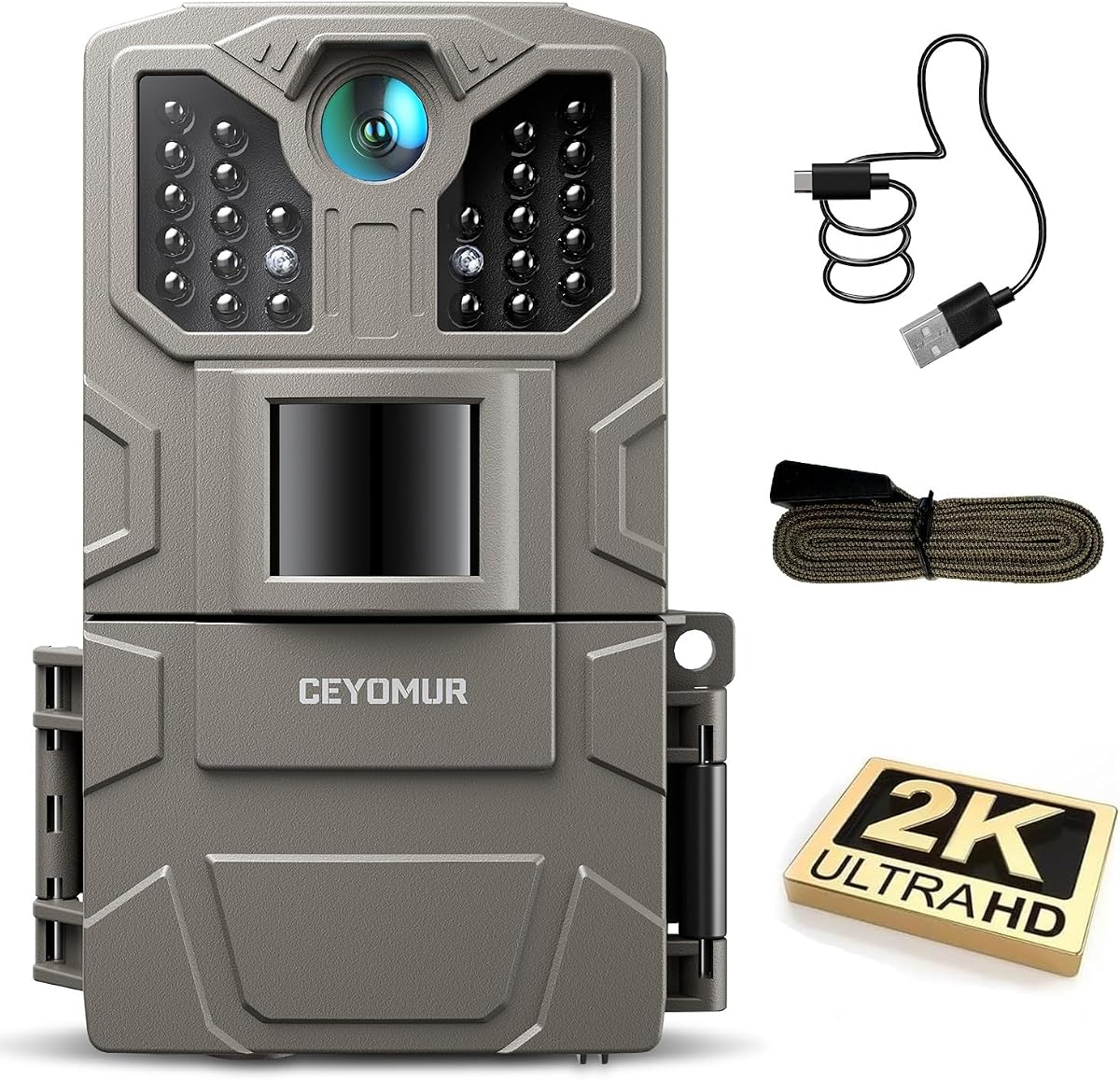
The CEYOMUR Trail Camera emphasizes ease of use and familiar features, making it suitable for first-time trail camera owners. It carries a 4.0 rating, captures 36MP photos and 2K video, and uses a brown housing intended to blend into outdoor environments. Its controls, screen, and lens are arranged on one side for simpler field setup.
We may earn a commission when you buy through this link, at no additional cost to you.
Twenty-four 850nm infrared LEDs provide nighttime illumination, and the automatic IR filter supports black-and-white night images. The listed trigger is described as fast, while features such as time-lapse, motion detection, audio recording, timestamps, and password protection provide a broad control set without requiring app-based setup.
For battery life, the camera uses eight AA batteries, which are not included. The IP66 housing is designed to withstand rain, dust, heat, and cold, while the integrated design helps users check angles and preview shots during installation. A memory card is also not included, so the complete field kit requires additional planning.
This model is a practical choice for beginners, backyard observers, and users who want straightforward controls and nighttime visibility. Its 4.0 rating is the lowest among the ten cameras, and the stated 2K recording format is less detailed than 4K alternatives. Nevertheless, the feature set and field-oriented design provide useful capability for general monitoring.
Putting the lens, screen, and controls on one side makes initial positioning easier than on a traditional split or flip-open housing. Users can adjust the angle and inspect the intended view before leaving the camera unattended.
The 24 850nm infrared LEDs support detailed black-and-white nighttime recordings, while the straightforward menu system reduces configuration barriers. The eight-battery format is easy to source, though it does require planned maintenance.
We may earn a commission when you buy through this link, at no additional cost to you.
The WOSPORTS Mini Trail Camera 2 Pack is aimed at buyers who want to monitor two locations with compact, low-power cameras. Each unit captures 30MP photos and 1080p video, reacts with a stated 0.3-second trigger, and includes a 16GB memory card. The pair has a 4.2 rating and shares the brand's familiar camouflage styling.
We may earn a commission when you buy through this link, at no additional cost to you.
Both cameras use four AA batteries for low-power operation, and 850nm infrared LEDs provide black-and-white night images. The compact bodies are easy to conceal and carry, while adjustable mounting straps support installation on trees, posts, and fences. The included cards make the bundle more immediately useful for buyers who otherwise need to source storage for each camera.
The tradeoff is that there is no phone or internet connection, and all four AA batteries must be supplied separately. Users retrieve files by removing the memory card. The 0.3-second trigger is responsive but slower than the best 0.1-second models, and 1080p video is less detailed than 4K alternatives.
This two-pack is best for hunters, farmers, and backyard observers who want parallel coverage without investing in two full-size systems. A trail, feeding site, and garden entrance are examples of locations that can benefit from simultaneous monitoring. It is a particularly convenient choice for beginners because two compatible memory cards are already part of the kit.
The two-camera format allows one purchase to cover separate travel routes or viewing areas. A 4.2 rating and shared feature set make it easier to expand a monitoring setup without managing different camera systems.
Each camera comes with a 16GB card, reducing the number of accessories required at installation. Batteries remain separate, and the offline workflow still requires regular visits to retrieve footage and maintain power.
We may earn a commission when you buy through this link, at no additional cost to you.
The WOSODA Mini Trail Camera 4 Pack is built for broad, multi-location monitoring. It includes four compact cameras, four 16GB memory cards, and 16 AA batteries. Each camera produces 30MP color or black-and-white photos and 1080p video, with a stated 0.3-second trigger and a 4.3 rating for the bundle.
We may earn a commission when you buy through this link, at no additional cost to you.
The cameras use a sensitive PIR sensor for motion activation and infrared night vision, while their camouflage housings help them blend into outdoor environments. Each unit runs on four AA batteries, and the low-power design is intended to extend standby time. Because the four cameras cannot connect to a phone, media is retrieved by removing each memory card.
The main benefit is deployment efficiency. Buyers can place four units around a property or across several travel corridors without separately purchasing cards and initial batteries. The tradeoffs are 1080p rather than 4K video, no cellular notifications, and the need to visit every camera for file transfer and battery maintenance.
This pack is best for a farmer, hunter, or property owner who wants consistent coverage across multiple points. It may be less appropriate for someone who needs immediate remote alerts or ultra-high-resolution footage. Its included accessories and compact design nevertheless make it a straightforward way to establish a multi-camera network.
The four-pack structure supports wider property coverage than a single-camera setup. Uniform cameras also simplify maintenance because the same accessories, settings, and operating procedures apply to each unit.
Four 16GB cards and 16 AA batteries are included, allowing a more immediate setup than cameras sold with bare essentials. Users still need to handle ongoing battery changes and physical retrieval of recorded media.
We may earn a commission when you buy through this link, at no additional cost to you.
The GardePro E5S 2 Pack extends the capable non-cellular E5S design across two monitoring locations. It has a 4.4 rating, captures 64MP photos and 1296p HD video, and uses three PIR sensors with a 0.1-second trigger. Both cameras can operate on eight AA batteries and support a separately sold GardePro SP350 solar panel.
We may earn a commission when you buy through this link, at no additional cost to you.
Its recording flexibility is a notable addition. Users can choose motion detection, time-lapse, or hybrid mode according to the activity being monitored. Cards up to 512GB are supported, and in-camera playback and loop recording make local management more convenient than systems with small capacity limits.
The IP66 housings and standard 1/4-inch-20 mounting threads suit outdoor installation on trees, posts, and fences. Because the cameras have no cellular or WiFi functionality, there are no remote alerts. Batteries and storage cards are also separate purchases, which should be considered when comparing the complete setup requirements.
This pack is a strong option for owners of a larger property who want high-resolution offline monitoring in two areas. It is especially useful when one camera covers a trail and another watches a feeding or property access point. Buyers who prioritize fast triggers, large card support, and recording-mode choice will find more flexibility here than the compact multi-camera bundles.
Motion detection, time-lapse, and hybrid modes allow each camera to be adapted to different monitoring goals. These options are useful for wildlife movement, changing outdoor scenes, or a mixture of both.
Support for cards up to 512GB reduces the frequency of file transfers compared with smaller-capacity systems. The capacity is especially helpful in a two-camera pack where motion-heavy locations may generate substantial recordings.
We may earn a commission when you buy through this link, at no additional cost to you.
Battery life depends on more than the battery label. Trigger behavior, infrared illumination, network activity, recording schedules, storage demands, weather, and sunlight all affect how often a camera needs attention, so the best choice depends on location and monitoring style.
A camera's power architecture determines both convenience and long-term operating potential. Disposable AA batteries are familiar and widely available, but they require regular replacement in frequently active locations. Rechargeable lithium packs can reduce recurring purchases, while integrated solar charging can maintain a built-in battery when the installation receives adequate sunlight.
Some models support a backup combination: eight AA batteries provide reserve capacity while a separately sold solar panel keeps the system topped up. Solar readiness is not the same as a complete solar kit, so shoppers should verify whether the panel, rechargeable battery, and required cable are included.
Choose a power setup that matches sunlight, access, and monitoring frequency. For remote or long-term installations, rechargeable or solar-assisted options usually demand less hands-on maintenance than disposable batteries alone.
A fast trigger reduces the chance that an animal will pass before recording begins. The list includes models ranging from 0.1 to 0.5 seconds. Very fast activation is useful for deer and quick-moving animals, but high trigger sensitivity can also record more irrelevant movement, producing more files and additional battery consumption.
Burst modes capture several images in succession and help preserve a movement sequence. Continuous video or time-lapse functions can use still more power than standard motion clips. A camera that fits the activity without recording every empty interval may require fewer battery changes over a full season.
Prioritize a quick trigger for difficult wildlife, but balance it with sensible sensitivity and recording duration. The lowest trigger figure is not automatically the most efficient choice in every environment.
Infrared illumination determines whether a camera can identify animals after dark. The 850nm systems in this guide generally provide bright black-and-white images, while 940nm systems are designed to reduce visible glow. A no-glow approach may be preferable where highly visible light could disturb wildlife or reveal the camera.
Range alone does not describe the entire image. Consider the stated distance, field of view, image clarity, and the amount of infrared light available at the target. A broad daytime detection angle can still produce darker distant footage at night if the animal is near the edge of the scene.
For sensitive wildlife, low-glow illumination may be the priority. For general property monitoring, brightness and recognition detail may matter more. Check the night specifications alongside the camera's low-light image claims rather than relying on maximum range alone.
Non-cellular and non-WiFi cameras use fewer communication components and offer a simple, low-maintenance workflow. Media remains on a local card, which can reduce power demands but requires physical visits. Local WiFi adds nearby phone access without a cellular subscription, but its effective range is limited.
Cellular cameras deliver photos, videos, and alerts from a distance. They are valuable for hunters who need immediate buck notifications or property owners supervising remote cabins and equipment. That convenience comes with service-plan requirements and a greater electrical demand than an offline camera.
Choose local-only operation for the simplest energy profile, nearby WiFi for close-range convenience, or cellular service when remote awareness justifies the added requirement. Do not buy a cellular model expecting it to function without an active plan.
Storage capacity determines how often files must be transferred and deleted. Compact cameras in this guide support smaller cards, while the GardePro E5S 2 Pack supports cards up to 512GB. A high-resolution camera with a small card can fill it quickly during busy seasons, especially when burst mode, video, or time-lapse is active.
The bundle formats include cameras with preinstalled or included memory cards, while others require separate purchases. Loop recording can preserve recent activity but may overwrite older files. Users who need long-term evidence should transfer files regularly and verify how the camera behaves when the card reaches capacity.
Select a capacity that matches activity volume and visit frequency. More storage is convenient, but it does not replace regular maintenance, and a larger card should always be supported by the camera's stated maximum.
A trail camera must withstand rain, dust, snow, heat, and cold in an exposed location. An IP66 rating indicates a sealed housing designed to resist dust and powerful water jets. This is valuable for tree-mounted cameras that cannot be sheltered and for farms or yards where changing weather is likely.
Consider the housing size as well. Compact units are easier to carry and conceal, while full-size models may be easier to handle and more suitable for larger batteries or panels. Mounting details matter too: straps are convenient for temporary placement, while a threaded mounting point provides a more permanent connection.
Choose weather resistance appropriate to the exposure and mounting method. Also consider access for battery and card changes, because a sealed location that is difficult to service can undermine otherwise strong battery endurance.
Photo and video resolution can improve visible detail, but higher resolution is not automatically better for every application. The list ranges from 30MP and 36MP cameras to 64MP models, with video formats including 1080p, 1296p, 2K, and 4K. These differences matter most when identifying animals, facial markings, or distant movement.
A fast trigger should be evaluated alongside image quality and storage. Detailed 64MP stills are useful for close identification, while 4K video can preserve more motion detail. Compression also influences file size and playback speed, with H.264 highlighted as a way to reduce the space consumed by recordings.
Match the imaging format to the purpose and storage plan. A compact 30MP camera may be sufficient for basic activity monitoring, while higher-resolution models are preferable when fine detail is a priority and the user can manage the resulting files.
A camera that is simple to configure can spend more time collecting useful footage. Look for intuitive menus, an on-camera screen, clear mounting hardware, and straightforward media transfer. These features are especially important for beginners, but experienced users also benefit from quick battery changes and local playback.
Check what is actually included. Some bundles provide memory cards and batteries, while individual cameras list batteries, cards, rechargeable packs, or solar panels as separate accessories. Warranty support and manufacturer guidance can also be useful when configuration questions arise.
Build the complete setup cost mentally without relying on the purchase price alone. A camera with fewer included essentials may be perfectly suitable for a buyer who already has compatible batteries and storage, while a complete bundle may suit someone starting from scratch.
Before deployment, read the product manual, insert batteries in the required orientation, and install a compatible memory card. For a WiFi camera, follow the close-range setup guidance before attempting to connect from a greater distance. Set the date, recording schedule, sensitivity, photo or video mode, and password before mounting the unit.
Place the camera at the recommended height and angle, usually with the target area in view rather than directly overhead. Check the lens and infrared window for dirt, confirm that the strap or threaded mount is secure, and position the housing where rain and direct environmental exposure are appropriate. A test walk or short delay can confirm that motion triggers recording as intended.
For battery longevity, use the specified battery chemistry, avoid mixing incompatible cells, and clean contacts when changing power. Solar-assisted models need an unobstructed charging position. Check cards and batteries on a regular schedule, transfer important files before loop recording overwrites them, and keep the housing closed and seals intact to preserve weather resistance.
A non-cellular, non-WiFi camera often has the lowest power demand because it does not operate a cellular radio or maintain a wireless connection. Solar-assisted models can extend that advantage further, but actual runtime depends on sunlight, trigger frequency, night illumination, recording mode, temperature, and battery quality. No single model is guaranteed to last an entire season in every location.
Not always. Solar charging is most useful where the camera receives dependable sunlight and the panel has a clear view of the sky. Heavy shade, frequent heavy recordings, and long winter periods can reduce the benefit. Many models still include AA batteries as backup, while others rely on an internal rechargeable battery, so the complete power design should be reviewed before installation.
The Moultrie Edge 3 uses cellular data and requires an appropriate service plan for remote delivery. Its automatic connection removes the need for a physical SIM card, but it does not remove the recurring service requirement. Non-cellular and local WiFi cameras offer alternatives for buyers who do not want a subscription or need to view content only near the camera.
A 0.1-second trigger is among the quickest figures in this guide and is well suited to deer, small animals, or anything crossing the frame quickly. Slower triggers can still work, particularly when the animal approaches slowly, but burst mode and careful placement can help. Very high sensitivity may also capture more irrelevant movement, increasing storage use and battery consumption.
The two systems emphasize different goals. A 940nm camera is designed to reduce visible glow, which can help avoid disturbing wildlife or revealing the unit at night. An 850nm camera generally produces brighter infrared illumination and clearer black-and-white images, but it may be more noticeable. The best choice depends on whether stealth, nighttime brightness, or distant identification is the priority.
Storage needs grow with resolution, video length, burst mode, and the amount of movement. The cameras here support different card limits, ranging from 32GB on the WOSPORTS Mini to 512GB on the GardePro E5S 2 Pack. Active locations and high-resolution video can fill smaller cards quickly, so frequent transfer and deletion may be necessary even when capacity is available.
The correct interval depends on activity, temperature, infrared use, recording mode, and power type. Active sites with frequent motion or night recording generally require more frequent checks, especially in cold weather. Solar-assisted units still benefit from periodic inspection because shade, panel alignment, dirty contacts, or heavy recording can reduce effective charging.
Continuous or time-lapse recording is possible on models that support it, but it records whether or not useful wildlife enters the frame. That creates more files and generally increases power consumption compared with PIR-triggered capture. Motion-triggered settings, a sensible detection zone, and short recording durations usually offer a better balance for battery longevity.
The MAXDONE Solar WiFi Camera is a practical top pick for buyers prioritizing renewable charging and nearby app access, while the GardePro E5S stands out for efficient offline monitoring, fast triggering, and solar readiness. The Moultrie Edge 3 2-Pack serves hunters who value cellular delivery, AI buck detection, and remote feeder control despite requiring a service plan.
Before choosing, prioritize the power design that matches the installation, the trigger speed needed for local wildlife, and the amount of physical maintenance you can perform. A simple offline model may be the best energy choice, while local WiFi or cellular service becomes worthwhile when accessibility and immediate awareness outweigh added complexity.
Finally, verify the current product listing, included accessories, battery requirements, storage limits, and service terms before ordering. Product bundles, promotions, and availability can change, and those details directly affect both the setup process and the battery-maintenance routine.