
Tasco 12MP Trail Camera
4.2Editor score
12MP still photographs
720p HD video
70-foot motion detection
Low-glow infrared flash
Long AA battery life
Cheap trail camera guide comparing ten affordable models for image quality, night vision, trigger speed, power, storage, and outdoor reliability.
A trail camera offers an affordable way to monitor wildlife, scout property boundaries, watch farm areas, or keep an eye on remote outdoor spaces. The best model balances a fast trigger, dependable night imaging, useful recording modes, simple controls, and enough battery life to remain unattended for long stretches.
This guide compares ten non-premium and cellular-capable trail cameras using the specifications and customer feedback available for each product. The list covers resolution, detection range, infrared illumination, recording flexibility, power options, storage limits, weather resistance, and connectivity, helping readers find the right balance for their monitoring needs.
Each review explains who the camera best suits, along with its strongest features and practical trade-offs. The top recommendations include a capable general-purpose model, a feature-rich value option, and a cellular camera for remote viewing. Product availability and prices change, so readers should verify current listings and accessories before purchasing.
4.2Editor score

4.3Editor score

4.3Editor score
The comparison below highlights the main differences in image quality, motion response, night illumination, power support, connectivity, and storage. It is designed to make the core trade-offs among these ten trail cameras easier to understand before choosing the right model.




The WOSPORTS Trail Camera stands out as the most complete general-purpose option in this guide, earning a 4.3 customer rating. It combines adjustable 64MP photographs with 4K or 1440P video, while its advertised 0.2-second trigger and 120-degree detection field make it well suited to deer, backyard wildlife, and property monitoring. The 2-inch color LCD also allows immediate playback without removing the memory card.
We may earn a commission when you buy through this link, at no additional cost to you.
Its stand-out strength is the balance between daytime image detail and nighttime performance. The optical lens is paired with 32 940nm infrared LEDs, creating the no-glow illumination commonly sought by hunters who want less visible disruption to wildlife. Burst shooting, sound capture, timestamps, time-switch functions, and password protection broaden its usefulness beyond basic still photography. Users can operate it with eight AA batteries, compatible rechargeable batteries, or a compatible solar panel.
There are some compromises for buyers seeking constant remote access. It is explicitly non-cellular and non-Wi-Fi, so photos must be retrieved by visiting the camera and removing the SD card. Batteries, the card, rechargeable packs, and solar equipment are not included with the core package. It also offers 4K recording, but storage consumption can be significant, making a suitable card and sensible recording settings important.
This is the best overall choice for a hunter, homeowner, or serious wildlife observer who wants high resolution, fast detection, and stealthy night vision without paying for a cellular subscription. The WOSPORTS model provides more features than a basic budget camera while remaining straightforward to operate. Buyers should confirm that their chosen memory card is supported and bring suitable batteries or an external power solution before deployment.
Adjustable photo settings let users balance detail against storage consumption, while the 120-degree detection field covers a broad area around the camera. The 0.2-second trigger is especially helpful when monitoring animals that move quickly through the frame.
The 32 940nm no-glow LEDs support dark-night recording while reducing the visible flash that can disturb sensitive wildlife. Compatibility with AA batteries, rechargeable packs, and compatible solar panels makes the camera adaptable to both short visits and extended monitoring.
We may earn a commission when you buy through this link, at no additional cost to you.
The GardePro E5S is a rugged, non-cellular trail camera with a 4.3 rating and an emphasis on reliable motion capture. It records 64MP photographs and 1296P HD video, while three PIR sensors support an advertised trigger speed of 0.1 seconds. Those characteristics make it particularly effective for fast-moving deer and for users who cannot regularly visit a camera to retrieve files.
We may earn a commission when you buy through this link, at no additional cost to you.
The E5S is unusually flexible for a non-connected model. Motion Detection, Time-Lapse, and Hybrid modes cover different monitoring needs, and in-camera playback with loop recording simplifies everyday operation. It accepts standard SD cards up to 512GB, offering more capacity than several competing products. An IP66 waterproof rating and a standard 1/4-20 mounting thread also help it fit into established outdoor monitoring setups.
Its main limitation is that it remains a traditional trail camera. Users cannot view activity from a phone or receive alerts while away, and they must physically retrieve the card. Eight AA batteries are required but not included, while the SP350 solar panel is sold separately. As with any high-resolution camera, continuous video modes can fill a card quickly, so storage planning and sensible sensitivity settings matter.
Choose the E5S when fast triggering, rugged construction, and multiple recording options are the priorities. It is especially attractive to hunters, farmers, and landowners who want broad storage support and a standard mounting interface without recurring connectivity costs. For anyone who needs immediate phone access, a cellular or Wi-Fi model would be more suitable.
Three PIR sensors and the advertised 0.1-second response are designed to detect movement rapidly. That makes the E5S appealing for locations where deer or other fast-moving animals cross the frame briefly.
Motion, time-lapse, and hybrid recording provide useful choices for different environments. Support for cards up to 512GB provides ample room, although video-heavy users should still monitor storage consumption.
We may earn a commission when you buy through this link, at no additional cost to you.
The WOSODA Two-Pack is designed for buyers who want to monitor more than one location at a time, and it holds a 4.3 rating. Each camera captures 48MP photographs and 1080P HD video with a 0.3-second trigger and detection range of up to 60 feet. The matching pair makes it practical for covering separate trails, entrances, or sections of a property.
We may earn a commission when you buy through this link, at no additional cost to you.
Night images are handled by upgraded 850nm low-glow infrared technology, producing black-and-white footage in darkness while avoiding the more visible flash associated with some standard infrared systems. The mimetic housing is designed to blend into outdoor environments, and included mounting straps and a stand support make positioning the cameras straightforward. Additional functions include time switching, timers, timestamps, and multiple recording modes.
The package does not overcome every limitation of a non-cellular camera. The 0.3-second response is quick, but it is slower than the 0.1- and 0.2-second models in this comparison. Users must also visit the cameras to retrieve footage. Depending on the recording mode and activity level, a single card may fill quickly, so loop recording and appropriate storage capacity are important considerations.
The WOSODA Two-Pack is a strong choice for wildlife watchers who want broad coverage without managing separate camera purchases. It is well suited to scouting multiple trails, monitoring a farm perimeter, or placing cameras at different elevations around a property. Those who need instant remote access should consider a connected alternative, but this package delivers a practical combination of stealth, resolution, and deployment flexibility.
The two-pack format is more useful than it may first appear when one camera cannot adequately cover every travel route. Each unit can be positioned independently, giving the user a broader monitoring footprint.
The 850nm infrared system is intended to produce clear monochrome night images with reduced visible disruption. It is a practical choice for close-range observation of deer and other wildlife.
We may earn a commission when you buy through this link, at no additional cost to you.
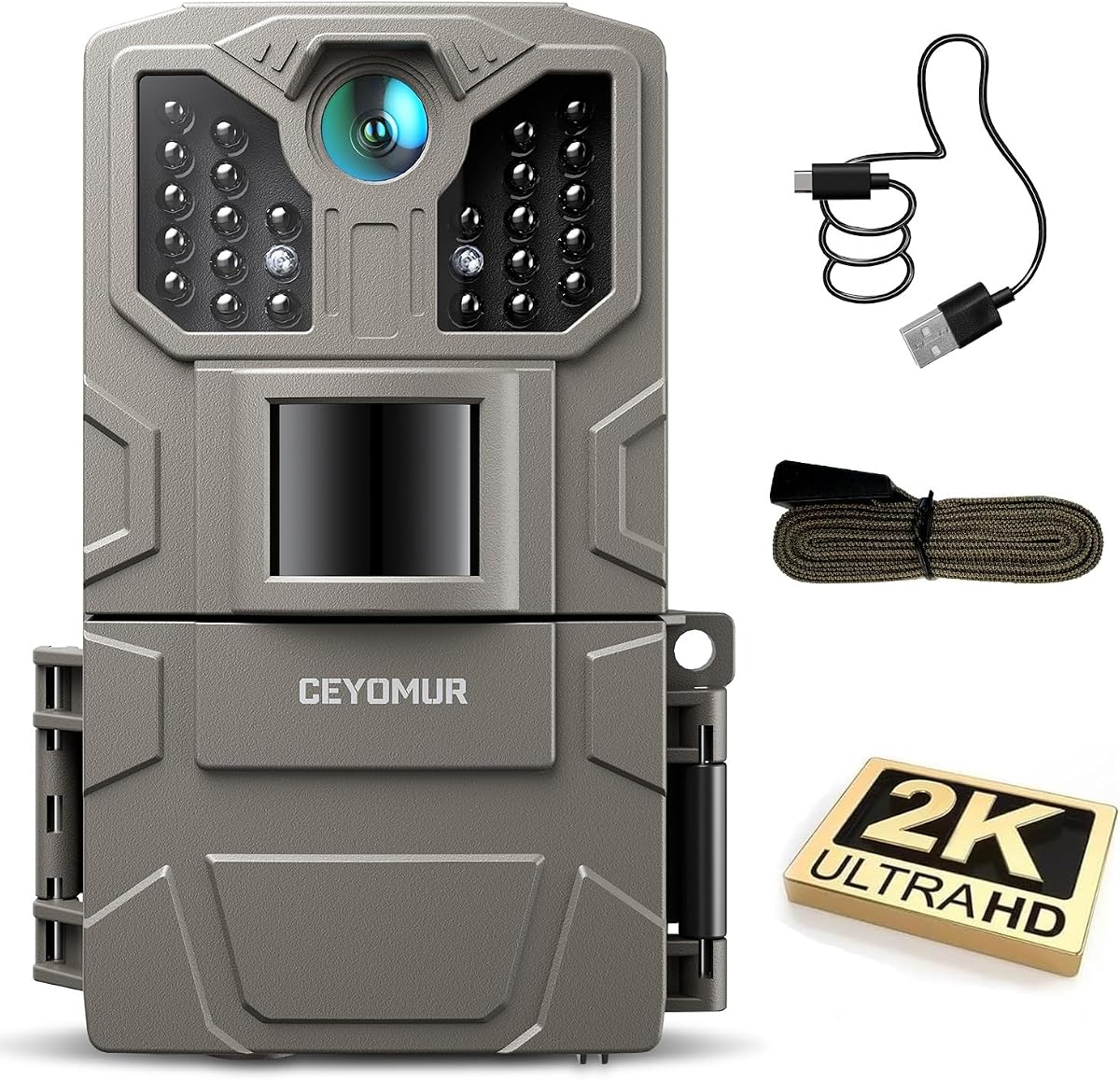
The CEYOMUR Trail Camera is a straightforward option for first-time users, with a 4.0 rating and a focus on easy operation. It records 36MP photographs and 2K video, and its classic brown housing is designed to blend into outdoor settings. A 2-inch LCD, straightforward menu, and integrated one-sided control layout simplify installation and footage review.
We may earn a commission when you buy through this link, at no additional cost to you.
Its 850nm infrared illumination uses 24 LEDs and is described as producing brighter, less noisy monochrome images than 940nm alternatives. The IP66 sealed housing is suitable for exposure to rain, dust, heat, and cold. The camera also includes time-lapse and motion modes, audio recording, timestamps, temperature display, and password protection, giving beginners useful controls without requiring a complex setup.
The principal trade-off is that the CEYOMUR is a single-camera package whose batteries and SD card are not included. Its 4.0 rating is also the lowest among the products reviewed, which may matter for buyers who place a high priority on customer satisfaction consistency. The listing notes that appearance has changed and that the current product is based on the latest page information, so buyers should carefully examine the final design and included components.
This camera is best for a first purchase, a backyard observer, or a hunter who values easy handling over advanced connectivity. Its one-sided design makes it convenient to adjust the angle while mounting, and the 2K video provides more detail than many entry-level alternatives. Users should budget for a compatible memory card and eight AA batteries before setting the camera outside.
The one-sided arrangement keeps the screen, lens, and controls together, reducing the need to reposition the camera during setup. Straightforward menus and a built-in display make the device approachable for beginners.
The 24 850nm LEDs are intended to create clear black-and-white images in complete darkness. Because 850nm illumination can have a slight red tint, buyers expecting a completely invisible source should verify their tolerance for that visible spectrum.
We may earn a commission when you buy through this link, at no additional cost to you.
The WOSPORTS Mini Two-Pack combines compact cameras with a 4.2 rating, making it appealing for buyers who want multiple coverage points in a manageable package. Each unit captures 30MP photographs and 1080P HD video through a sensitive PIR motion sensor with a 0.3-second trigger. A 4.2 rating reflects generally positive feedback without reaching the level of the guide's highest-rated option.
We may earn a commission when you buy through this link, at no additional cost to you.
The kit includes a 16GB SD card with each camera, removing one common setup obstacle. Its compact camouflage body is easier to carry and conceal than a full-sized unit, while four AA batteries offer a simple power configuration. The 850nm infrared LEDs provide black-and-white nighttime imaging, and adjustable straps allow mounting on trees, posts, fences, and other locations.
Its limitations reflect the budget-oriented design. The cameras are non-cellular and non-Wi-Fi, so users retrieve files by visiting the units. Four AA batteries are not included, and although the included cards simplify setup, wildlife-heavy locations may require larger or additional cards. The 30MP still images and 1080P video are good for routine monitoring, but they do not match the 64MP and 4K combinations offered by some competitors.
This two-pack is well suited to buyers monitoring two yards, two game trails, or separate access points without needing large wall-mounted-style cameras. It is particularly convenient for beginners because storage cards are included and the compact size simplifies placement. If remote viewing is essential, choose a connected model; otherwise, this kit provides a balanced and approachable way to cover multiple areas.
Including a 16GB card in each package reduces the chance of a delayed setup. Users only need compatible batteries, a mounting point, and a few basic configuration choices before deployment.
The mini housing takes up less space than a conventional trail camera and can be positioned more discreetly. This is helpful in gardens, near fences, or along narrow paths where a large camera would be conspicuous.
We may earn a commission when you buy through this link, at no additional cost to you.
The Moultrie Edge 3 is the clear premium choice for hunters who want remote access and location intelligence, and it carries a 4.3 rating. The two-camera package produces 40MP photographs and 1080p HD video with a 0.5-second trigger and 100-foot detection range. A low-glow flash supports nighttime capture, while AI-assisted buck detection can reduce the time spent sorting ordinary wildlife activity.
We may earn a commission when you buy through this link, at no additional cost to you.
Connectivity is its defining advantage. The cameras automatically connect to the strongest of four major United States networks without requiring a SIM card, and images or video can be delivered to the Moultrie app. Live Aim helps with placement, built-in GPS maps camera locations, and compatible feeders can be monitored and controlled remotely. Rechargeable battery packs and solar panels are supported for extended use away from a vehicle.
Connected features require an appropriate Moultrie plan, and cellular coverage must exist at the installed location. Its 0.5-second trigger is slower than the 0.1- and 0.2-second cameras in this guide, which may affect fast action close to the lens. The 40MP photos also trail some competing models on raw resolution, although the remote workflow and AI-assisted buck detection add substantial practical value for hunting applications.
Choose the Edge 3 when the ability to monitor remote land without physically visiting it justifies a service plan. It is particularly useful for established hunting properties, larger acreage, and users who want to manage multiple cameras or feeder equipment from a phone. For basic backyard observation on a strict budget, a non-cellular camera will generally serve more simply.
Automatic selection among four major networks simplifies cellular setup in remote areas. Coverage still depends on the local network and a valid service plan, but users do not need to manage a separate SIM card.
AI buck detection helps separate targeted wildlife activity from general movement. Built-in GPS and live remote controls also make it easier to manage a camera network across a large hunting property.
We may earn a commission when you buy through this link, at no additional cost to you.
The WOSPORTS Mini Camera offers a lightweight, uncomplicated option with a 4.2 rating. It captures 30MP photographs and 1080P HD video, and its 850nm infrared LEDs support black-and-white nighttime monitoring. The body measures 4.25 by 4.21 by 3.43 inches and weighs about 0.73 pounds, making it easy to carry to a location and mount discreetly.
We may earn a commission when you buy through this link, at no additional cost to you.
Four AA batteries and a simple adjustable strap keep deployment approachable. The camera can be placed on trees, posts, or fences and is suggested for positioning roughly three to four feet from the target area, adjusted for the size and habits of the animals being observed. A fast trigger response helps capture passing deer, while the camouflage appearance reduces the chance of drawing attention.
The main limitation is storage support. It accepts SD cards only up to 32GB, which is modest compared with models supporting 512GB or larger capacities. That restriction can be noticeable when using motion video in an active location, and it may require more frequent card swaps. Batteries and the memory card are not included, and the non-cellular, non-Wi-Fi design requires physical retrieval of recordings.
This mini camera is a good choice for a user who wants the lowest-burden setup in a compact package. It suits garden observation, bird watching, basic deer monitoring, and checking regularly occupied spaces. Buyers should choose a fast, reliable 32GB card and carry spare batteries if the location is difficult to reach. For high-volume video, a higher-capacity alternative is preferable.
The sub-pound body can be carried comfortably to remote mounting points. Its compact camouflage design also allows placement in tighter spaces where a larger housing might interfere with natural surroundings.
An included adjustable strap supports quick attachment to trees, posts, and fences. Placing the camera at an appropriate height and distance from the target area remains essential for obtaining useful results.
We may earn a commission when you buy through this link, at no additional cost to you.
The Tasco 12MP Trail Camera is a simple entry-level model with a 4.2 rating and a specification sheet that emphasizes practicality over advanced features. It captures 12MP still photographs and 720p HD video through a PIR motion sensor advertised to cover a 70-foot range. The low-glow infrared flash is designed for discreet nighttime photography.
We may earn a commission when you buy through this link, at no additional cost to you.
Battery endurance is its most useful budget-oriented feature. The camera can operate for up to 12 months on eight AA batteries under the manufacturer's stated conditions, although actual runtime varies with activity, temperature, recording settings, and infrared use. Its relatively simple feature set may appeal to users who want straightforward monitoring without investing in a higher-resolution camera or cellular service.
The trade-off is image quality. At 12MP and 720p, the Tasco produces less detail than nearly every other camera in this guide, including the similarly budget-minded CEYOMUR with 36MP photos and 2K video. That difference can matter when a subject is distant, partially concealed, or moving. The 70-foot detection and infrared figures describe range, not the clarity achieved at the maximum distance.
The Tasco is a reasonable pick for occasional backyard monitoring, checking a frequently visited location, or recording general property activity where fine detail is not essential. It may also suit a buyer who prioritizes long battery life over resolution. For identifying distant deer or reviewing subtle details, spending more on a higher-resolution model would usually provide a better experience.
The advertised runtime of up to 12 months is a major advantage for unattended locations. Users should still account for cold weather, frequent motion events, and video settings, all of which can reduce real-world performance.
A 70-foot motion-detection range and matching low-glow flash cover a useful area around the camera. This makes the model practical for close-to-medium-distance observation and general nighttime security.
We may earn a commission when you buy through this link, at no additional cost to you.
The Meidase P70 holds the highest customer rating in this group at 4.4 and combines 64MP photographs, 1296p video, and a 0.1-second trigger. Side sensors are designed to detect movement quickly, making the camera a strong candidate for hunters and wildlife observers concerned about fast-moving animals entering and leaving the frame quickly.
We may earn a commission when you buy through this link, at no additional cost to you.
Its optical system uses an f/1.6 aperture, while 32 940nm no-glow LEDs are advertised to illuminate scenes up to 100 feet without producing the conspicuous flash associated with less stealthy infrared sources. A 2.4-inch color display and accessible buttons make it convenient to review captured footage and adjust settings in the field. H.264 compression in MP4 or MOV formats is another thoughtful feature because it supports faster downloads and playback across common devices.
As a non-cellular, non-Wi-Fi camera, it cannot send alerts or provide live viewing. Users must retrieve the SD card physically. The main power source is eight AA batteries, which are not included, while the Meidase SP350 solar panel is a separately sold accessory. Even with efficient compression, continuous recording can consume substantial space, so motion and time-lapse settings should match the monitoring goal.
The P70 is best for buyers who prioritize trigger speed, stealth, and image resolution over remote access. It is especially appealing when a deer crosses the camera at speed or when nearby animals might be disturbed by a visible flash. It also suits users who prefer a straightforward card-based workflow and do not want to manage cellular coverage or recurring service.
The 0.1-second trigger and side sensors are designed to minimize the delay between detection and recording. This is useful for fast-moving deer and for locations where animals may not remain in frame for long.
H.264 encoding compresses video while retaining playback compatibility with common devices. Faster file handling and lower transfer times are especially helpful for hunters reviewing multiple clips off-site.
We may earn a commission when you buy through this link, at no additional cost to you.
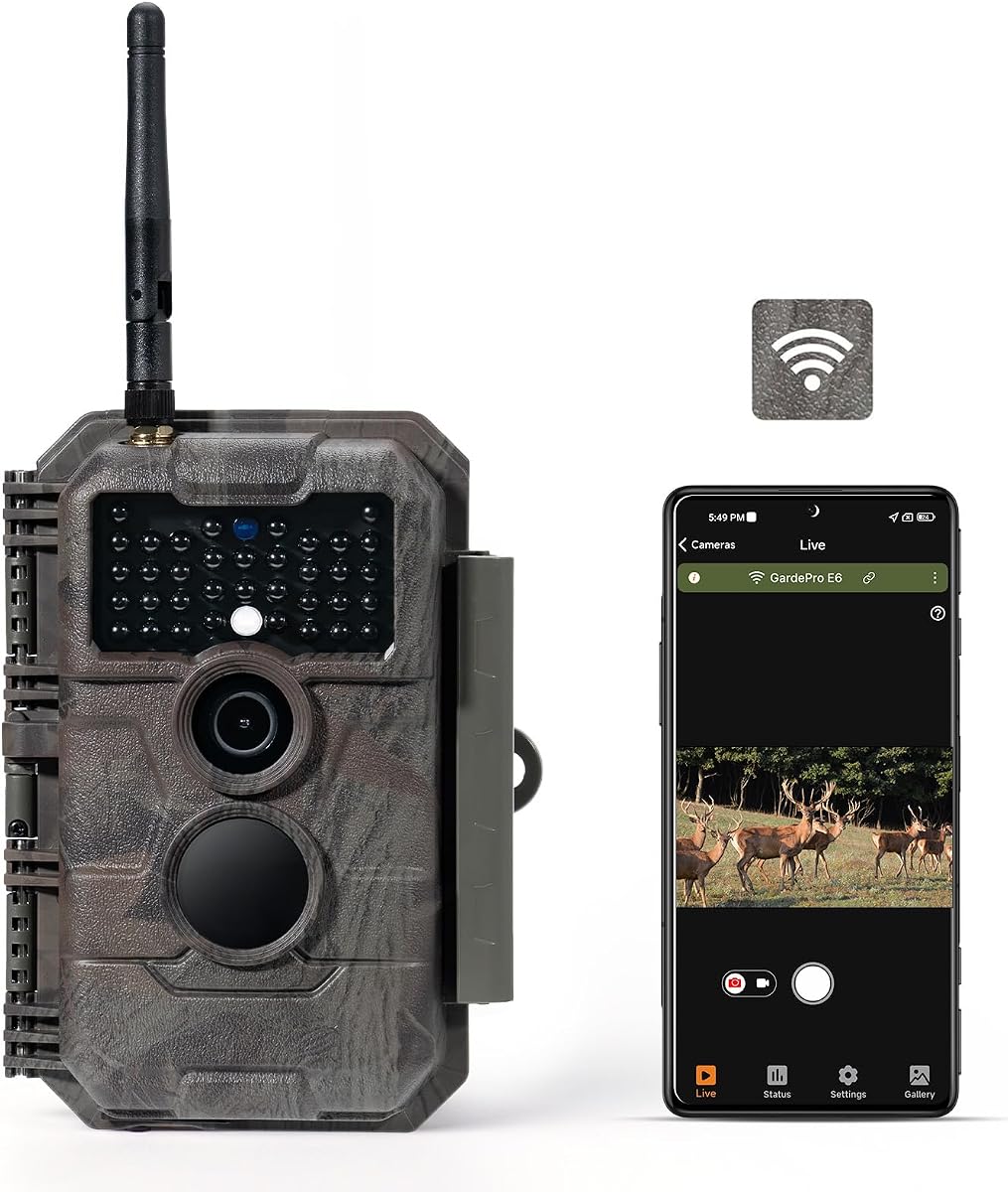
The GardePro E6 is a Wi-Fi-enabled trail camera with a 4.0 rating that appeals to users who want phone-based control without a cellular subscription. It captures 64MP photographs and 1296P HD video through a 110-degree optical field. Its external antenna and ultra-low-power Wi-Fi and Bluetooth hardware distinguish it from conventional card-only cameras.
We may earn a commission when you buy through this link, at no additional cost to you.
The camera works directly with the GardePro Mobile App and supports Live View in open areas within approximately 45 feet. That makes it useful for checking the framing during installation or observing birds, deer, and other animals at close range. It does not connect to a home Wi-Fi router or cellular network, and PCs, laptops, and web browsers are not supported for the wireless connection.
The limited connection range means this is not a substitute for a cellular trail camera. Users must come within the specified distance and use the compatible app. Its 940nm no-glow infrared system is advertised to provide clear nighttime images up to 75 feet, while adaptive illumination is intended to balance brightness and prevent overexposure. Eight AA batteries and a compatible SP350 solar panel are supported, but the batteries are not included.
Choose the E6 for close-range wildlife viewing, installation checks, and a preference for avoiding monthly app fees. It is less suitable for checking a camera from a distant hunting blind or for monitoring a property remotely across a wide area. Within its intended short-range use, the combination of live preview, 64MP images, and stealth infrared makes it a practical app-connected option.
Direct phone access allows quick previews and setting checks without removing the SD card. The stated 45-foot range works best in open areas, and the camera should not be confused with a cellular model.
The 940nm LED system is designed to limit visible illumination while retaining nighttime detail. Adaptive brightness helps keep subjects visible without the washed-out appearance that can affect some infrared recordings.
We may earn a commission when you buy through this link, at no additional cost to you.
The right inexpensive trail camera depends on where it will be used, how quickly subjects move, whether remote access matters, and how often you can service the unit. Comparing resolution, trigger speed, infrared behavior, power, storage, and connectivity prevents buyers from paying for features they will not use.
Photo and video resolution determine how much detail remains after an animal is enlarged for identification. The models in this guide range from 12MP photos and 720p video to adjustable 64MP photographs and 4K recording. Higher resolution can help distinguish facial features or markings at a distance, but it also creates larger files and may encourage users to keep recording continuously, consuming power and storage faster.
For routine backyard monitoring, 30MP or 36MP still images and 1080P video can be sufficient. Buyers who regularly photograph distant deer or need fine detail in 2K, 1296P, or 4K footage should prioritize the higher-end options. Select resolution based on the subjects and viewing distance rather than treating the largest advertised number as automatically better.
A fast trigger reduces the gap between an animal entering the detection area and the camera beginning to record. In this comparison, trigger times range from 0.1 to 0.5 seconds. The Meidase P70 and GardePro E5S lead at 0.1 second, followed by the WOSPORTS model at 0.2 second. Detection field, sensor placement, and advertised range also influence how reliably the camera responds.
Fast-moving deer benefit from a short trigger delay, while stationary birds or backyard animals may not require the quickest possible response. Check whether the camera offers a broad detection angle, multiple PIR sensors, burst shots, and a usable recovery time. Placement matters just as much as the specification, so aim the camera at the path rather than toward open sky or waving vegetation.
Trail cameras generally use either 850nm or 940nm infrared illumination. The 850nm systems in this guide can produce brighter, more detailed monochrome images, but they may have a slight red glow at close range. The 940nm systems are described as no-glow and are preferable for highly sensitive wildlife or hunters who want minimal visible light. Published night ranges are best treated as maximum figures rather than guaranteed clarity at every distance.
Compare both the infrared wavelength and the number of LEDs, while recognizing that image quality also depends on the lens and sensor. For stealth-sensitive scouting, choose a 940nm model such as the WOSPORTS, Meidase, or GardePro E6. For close-range clarity, 850nm options may be more attractive. Always check the field of view and target the camera toward the location where subjects are expected.
Trail cameras use disposable AA batteries, rechargeable packs, or compatible solar panels. AA power is familiar and portable, but cold weather and frequent recording shorten runtime. Models using eight batteries can be easier to service in the field, while compact four-battery cameras are lighter. Solar-ready models provide another path to extended operation, although the panel is generally sold separately.
Consider how often you can reach the camera and whether a trip during bad weather is inconvenient. A claimed runtime of up to 12 months, as advertised for the Tasco, is attractive, but actual life depends on activity, infrared use, temperature, and recording mode. Bring spare batteries for short visits, and verify that any rechargeable battery or solar panel is explicitly compatible with the chosen model.
SD-card support determines how much footage can be stored before files must be downloaded or overwritten. Capacities in this selection range from 32GB to 512GB, with larger cards better suited to continuous video and busy locations. Loop recording is useful for long-term monitoring because it can recycle storage according to the selected settings, but important clips should still be backed up promptly.
Motion detection, time-lapse, and hybrid modes serve different purposes. Time-lapse can document changing conditions but does not respond to movement, while motion recording captures only relevant activity. High-resolution continuous video can generate files rapidly, so users should estimate storage needs and maintain a second card for backup.
Non-cellular cameras are simpler and usually avoid recurring fees, but users must physically retrieve the memory card. Cellular models deliver photos, videos, and alerts from remote properties, making them ideal for users who cannot visit frequently. Wi-Fi options provide a middle ground by allowing direct phone control within a limited range. These technologies are not interchangeable, so buyers should confirm what their location supports.
Cellular cameras require valid service and adequate carrier coverage. Direct Wi-Fi models generally work only near the camera and through the manufacturer's app rather than through a home router. If live viewing is valuable but the monitoring site is close to your home or vehicle, a Wi-Fi trail camera may be enough. For remote acreage, a cellular two-pack with automatic network selection offers greater convenience.
A trail camera must withstand rain, dust, temperature changes, and long periods of outdoor exposure. An IP66 rating indicates protection against dust and powerful water jets, making models such as the GardePro E5S and CEYOMUR suitable for exposed placements. Even with a weather-resistant housing, correct sealing, battery orientation, and card installation remain important.
Size and camouflage influence concealment and installation convenience. Compact models are easier to carry and place in tight areas, while standard bodies can be easier to handle with eight batteries. Look for a standard 1/4-20 mounting thread when you already own compatible mounts, and check whether straps and a stand are included. A tripod socket can also improve positioning flexibility.
The purchase is not complete until batteries, memory, and any necessary mounting equipment are available. Some packages include SD cards, while most exclude them. Several compatible solar panels are also sold separately. This distinction is important for first-time buyers because a camera without power or storage cannot begin recording.
Before ordering, make a simple setup checklist: compatible batteries, a supported SD card, a secure mounting point, and a way to retrieve files. The WOSPORTS Mini Two-Pack includes 16GB cards, making it particularly convenient, while most competitors require separate storage purchases. Check the current listing carefully because package contents can change, and do not assume a pictured accessory is included.
Begin by selecting the purpose and location. Identify the likely path, feeding area, property entrance, or garden zone you want to monitor, then place the camera at an appropriate height and angle. For many deer scenarios, positioning about three to four feet from the target area is useful, but actual height should reflect the size and behavior of the target. Clear nearby vegetation, confirm that the lens has a clean view, and use a strap or compatible mount that will not shift in wind.
Install a supported SD card in the correct orientation and insert fresh compatible batteries. Set the date and time, choose motion, time-lapse, or hybrid recording, and adjust sensitivity, burst mode, video length, and infrared behavior. Trigger a test recording by walking through the detection area, then review it on the camera's display. For Wi-Fi models, connect through the specified app and test live view at the expected operating distance before leaving the camera unattended.
Maintain the unit by checking the battery level, card capacity, lens cleanliness, seal, and mounting security during routine visits. Download valuable files to more than one location before formatting the card. Replace depleted batteries promptly, and avoid leaving a partially used set in place because mixed battery ages can reduce performance. For solar-equipped setups, keep the panel unobstructed and clean. Test cellular alerts and coverage in the field as well, since a compatible network may not provide the same service quality at every hunting location.
The right resolution depends on how far the subject will be from the camera and how much detail you need. Thirty to 36MP photographs with 1080P video are practical for many backyard and close-range monitoring tasks, while 64MP images and higher-resolution video can help when identifying distant animals. Resolution should be balanced against storage capacity, battery consumption, and the likelihood of reviewing large files.
It is most useful when fast-moving animals such as deer cross the detection zone quickly. A 0.1-second camera can begin recording with very little delay, but real-world results also depend on the detection angle, sensor placement, motion settings, and recovery time. For general garden or property monitoring, a response of a few tenths of a second is often adequate.
The main difference is visibility and resulting image character. The 850nm systems in this guide generally produce brighter, clearer monochrome images but may show a faint red glow at close range. The 940nm options are marketed as no-glow and are better for minimizing visible disturbance to sensitive wildlife. Both can produce useful night images, but the lens, sensor, and target distance also affect clarity.
No. Most conventional trail cameras work without cellular data or Wi-Fi and store recordings on an SD card that the owner retrieves later. Cellular service is helpful for remote monitoring and automatic alerts, while direct Wi-Fi can provide app-based previews at close range. Choose connectivity according to how often you can physically visit the camera and whether the site has dependable coverage.
A larger card is useful when recording video continuously or monitoring a location with frequent animal traffic. The models here support different limits, ranging from 32GB on the compact WOSPORTS Mini Camera to 512GB on the GardePro E5S. Check the camera's supported capacity and format, use a reputable card, and keep a backup card available for important events.
Models with an IP66 rating, such as the GardePro E5S and CEYOMUR, are designed to resist dust and powerful water jets. Weather resistance does not eliminate the need for correct assembly, so make sure the battery compartment and card door are properly closed. Even a sealed camera should be checked after severe storms for shifting mounts, condensation, or impact damage.
Place it along a frequently used travel route, near a food or mineral source, or beside a fence line where movement is predictable. A height around three to four feet is a useful starting point for many deer, adjusted upward for larger animals and downward for smaller targets. Aim across the path rather than directly toward it, and clear nearby grass to reduce false triggers.
Motion recording is best for capturing specific animals and reducing unnecessary footage. Time-lapse is useful for documenting weather, changing light, or subjects that move too slowly to trigger the sensor reliably. Hybrid mode can combine both, while conserving storage and power. Test the sensitivity in the field because vegetation and changing weather can produce many unwanted recordings.
The WOSPORTS Trail Camera is the strongest overall pick because it combines adjustable 64MP photos, 4K video, a 0.2-second trigger, and stealthy 940nm night vision without a recurring service charge. The GardePro E5S is an excellent alternative for rugged use, multiple recording modes, fast 0.1-second detection, and larger card support. The Meidase P70 is especially compelling for hunters who prioritize an even quicker trigger and efficient video files.
For the smallest budget, the Tasco 12MP model offers long advertised battery life and a simple 70-foot detection system, while the CEYOMUR is more attractive when image resolution and beginner-friendly controls matter. The WOSODA and WOSPORTS Mini Two-Pack options cover multiple locations, and the compact single WOSPORTS Mini is easy to carry. The Moultrie Edge 3 is the premium selection for cellular delivery, AI buck detection, GPS, and remote feeder control.
Prioritize the features that match the actual monitoring location rather than selecting solely on resolution. Fast triggering, suitable infrared, reliable power, adequate storage, and weather resistance usually affect everyday usefulness more than minor feature differences. Current prices, package contents, service plans, accessory compatibility, and availability can change, so verify the latest listing and included components before making a final purchase.