
LinkTap D1 2-Zone Smart Hose Timer & Gateway
4.5Editor score
Two independent watering zones
Two built-in flow meters
Remote fault notifications
This guide compares 10 LinkTap water timers and controllers on zones, flow monitoring, range, scheduling, protection features, and ease of setup.
A dependable smart water timer can make automatic irrigation easier, more responsive, and less wasteful, especially across gardens with several planting areas. The right model should fit the number of zones you need, communicate reliably outdoors, and provide useful controls for weather, flow, freezing temperatures, and daily watering schedules.
We compared the ten products using their supplied specifications, focusing on zone capacity, gateway requirements, wireless coverage, flow monitoring, weather-aware automation, anti-freeze functions, power options, and setup complexity. The list covers hose timers, valve-box controllers, dual-zone systems, an expandable gateway, and one competing smart hose timer for context.
Each review explains the most useful capabilities, practical trade-offs, and the type of property or gardener for whom the product makes the most sense. Ratings and availability can change over time, so verify the latest listing details and account requirements before making a final purchase.
4.5Editor score

4.5Editor score

4.6Editor score
The table below highlights the central differences among hose timers, multi-zone controllers, and gateway-based systems, making it easier to match network capacity and irrigation controls to your property.
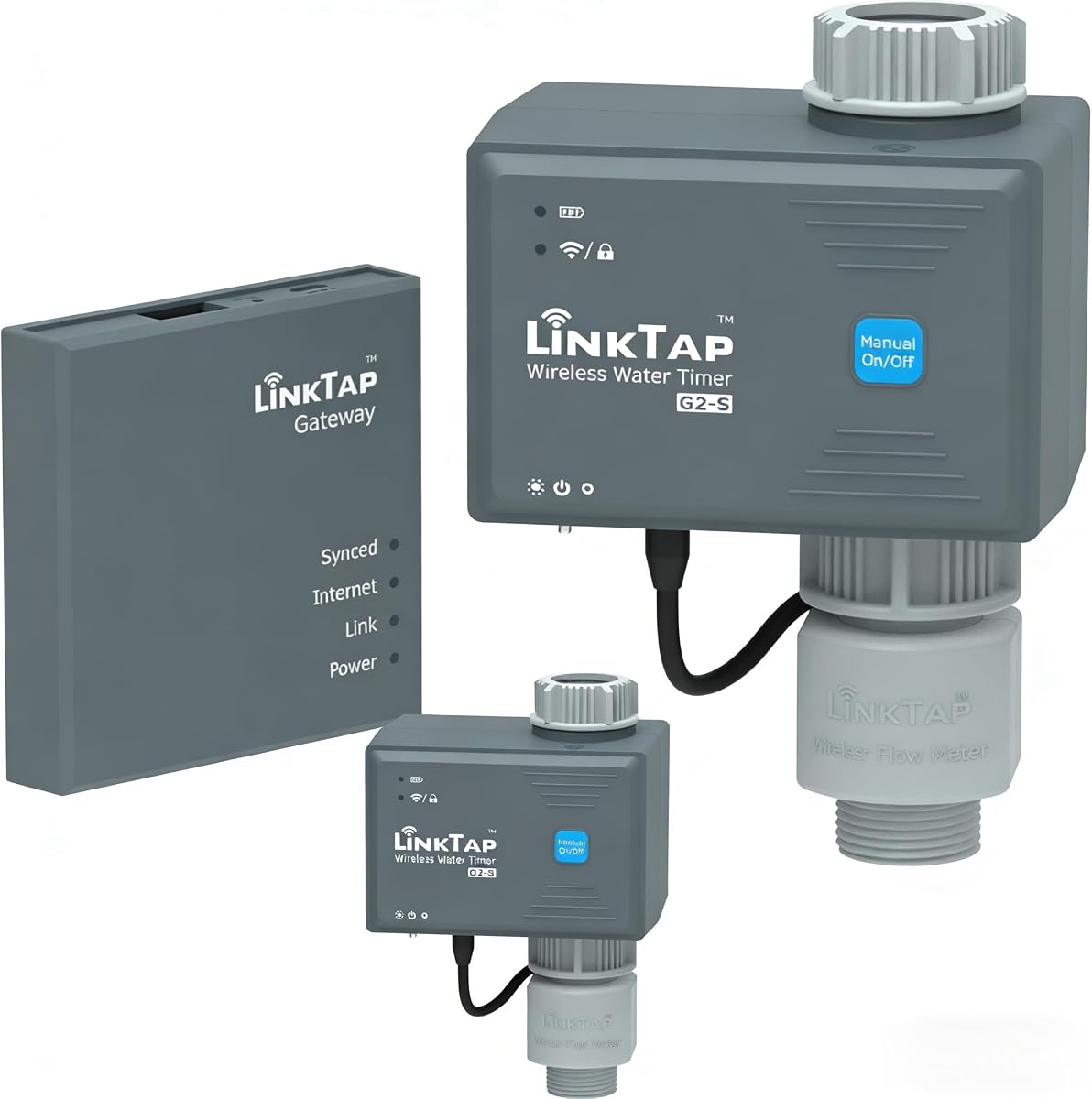


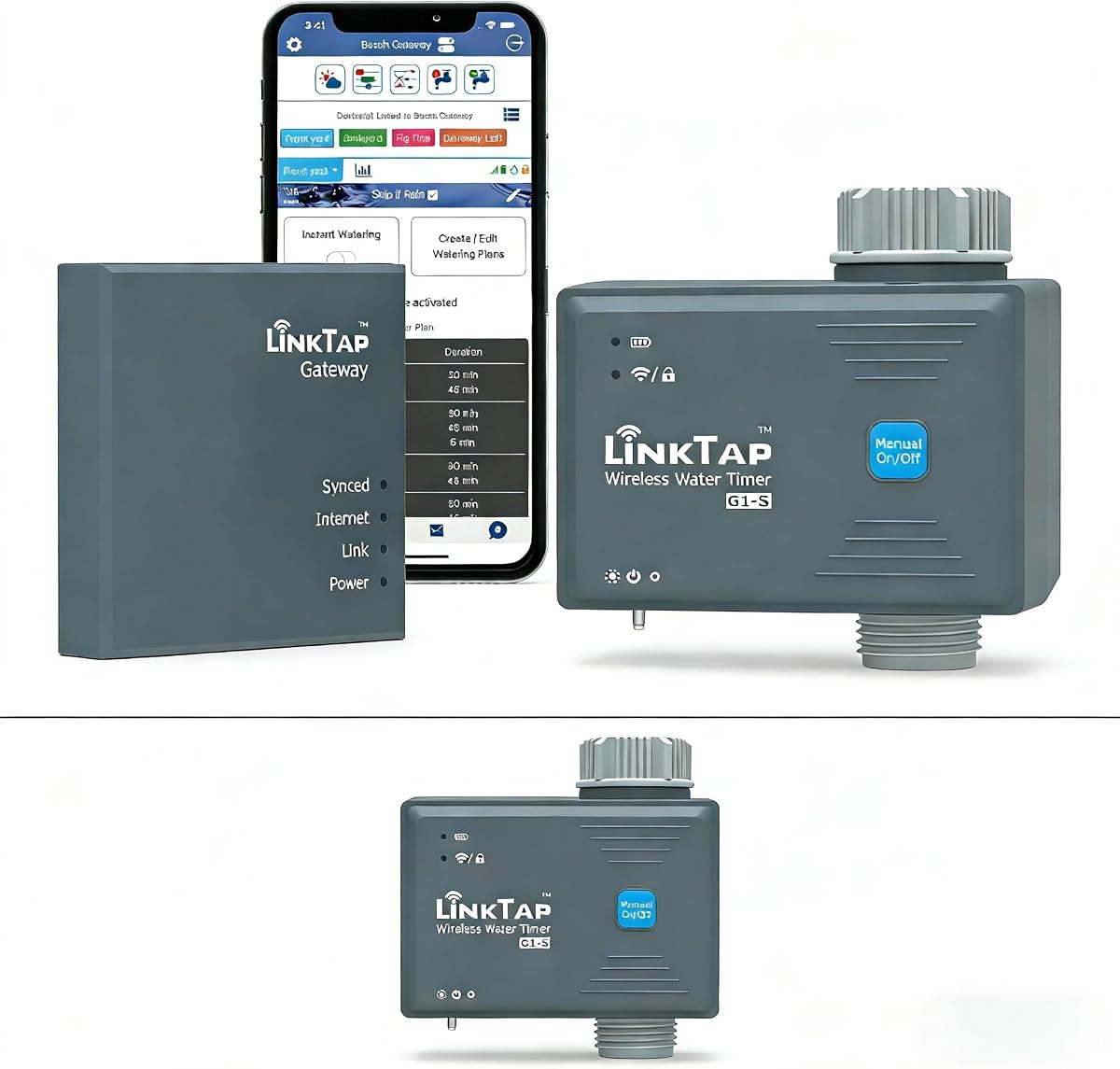

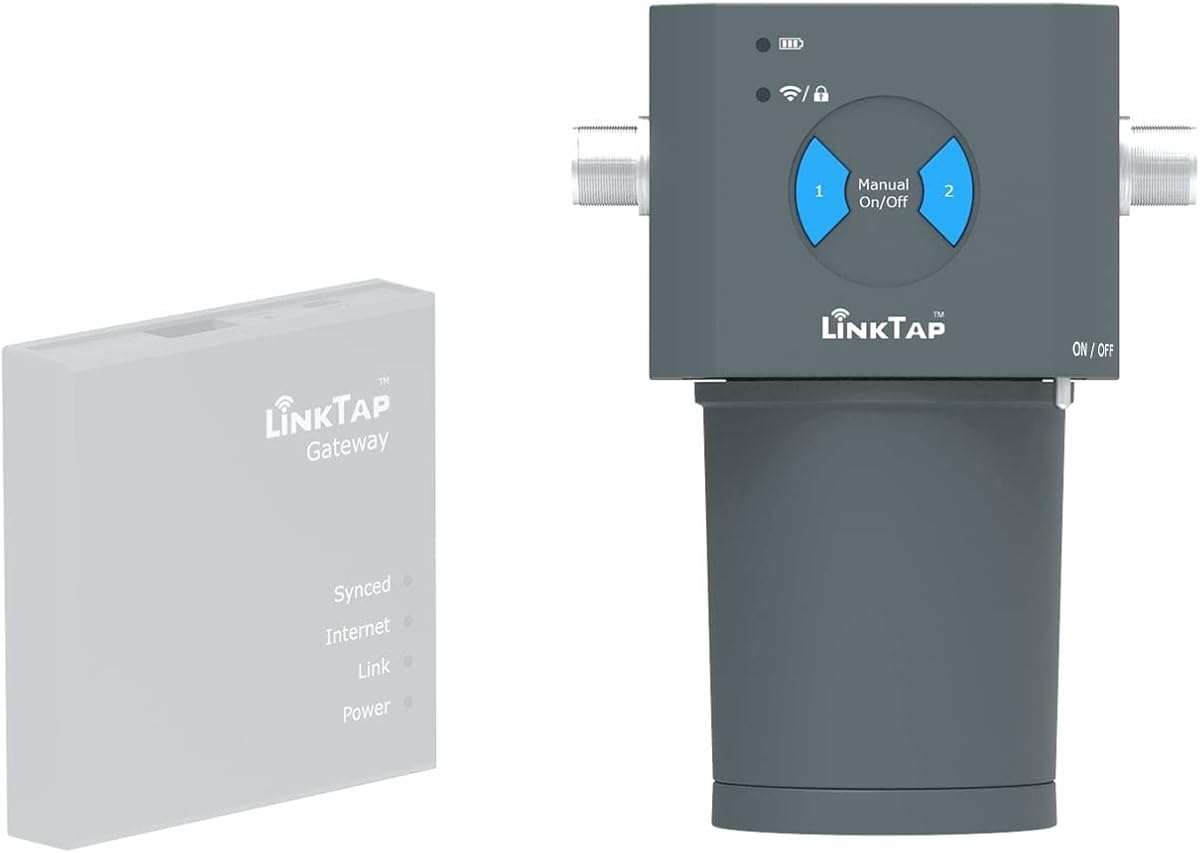

The LinkTap G2S is a well-rounded smart hose timer for gardeners who want remote control, flexible schedules, and meaningful fault detection without installing a conventional in-ground controller. Its supplied rating is 4.5, and the standout feature set combines weather-adaptive irrigation with 24/7 flow monitoring. That combination makes it more than a basic timer that merely switches water on and off according to a clock.
We may earn a commission when you buy through this link, at no additional cost to you.
Its strongest benefits center on control and diagnostics. Users can start or stop water, create multi-cycle programs by date, duration, or volume, and manage the system through mobile or web applications. Flow monitoring can identify leaks, clogs, valve failures, and disconnections, allowing notifications to arrive before minor irrigation issues become major water problems. The proprietary Zigbee protocol also gives the system a useful mesh option for larger properties where a conventional Wi-Fi timer may struggle at the edges of the signal range.
There are trade-offs. A single G2S manages one hose-based watering point, so a property with many independent areas will need additional devices or a multi-zone alternative. The gateway must be wired to the router, and the initial setup therefore involves both network placement and physical hose installation. The two-year battery figure is also a stated product specification rather than a guarantee that every installation will experience identical runtime, since watering frequency and conditions can affect consumption.
This is the strongest all-around choice for a homeowner with a garden, lawn, or mixed drip-and-sprinkler setup who values reliable long-range control and proactive alerts. It is particularly useful when manual watering is inconsistent, the property is away during part of the year, or preserving water matters. For one zone, it delivers an unusually broad feature set without requiring a more complex valve-box installation.
Weather-adaptive control adjusts irrigation using real-time weather information, helping avoid unnecessary watering when conditions do not require it. Remote app and web access then allows schedules to be changed without walking back to the spigot.
Round-the-clock flow monitoring can flag leaks, clogs, valve problems, and disconnections. Up to 15 compatible devices can be connected through one gateway, making the system practical for a gradually expanding landscape.
We may earn a commission when you buy through this link, at no additional cost to you.
The LinkTap D1 is designed for properties that need two separately controlled watering areas from one hose timer. Its supplied rating is 4.5, while the defining feature is the pair of built-in flow meters, one for each independent zone. Rather than buying and coordinating multiple basic timers, users can manage both areas through a single app and gateway.
We may earn a commission when you buy through this link, at no additional cost to you.
The D1 supports time, date, and volume-based multi-cycle schedules, along with weather-aware adjustments and immediate remote start-and-stop control. Because each zone has its own flow meter, the system can distinguish issues affecting one area from those affecting the other. That granularity is valuable when a vegetable bed needs frequent, measured watering while a lawn follows a different schedule. It also supports anti-freeze protection, real-time alerts, and the same broad mesh-network approach found elsewhere in the LinkTap range.
The premium complexity is most apparent during setup. A gardener must install and pair the timer, connect the gateway, configure two programs, and learn which alert belongs to which zone. It is therefore less attractive for a single hose or a very small patio than the G2S. Those who need only one outlet can obtain the core benefits more simply with a single-zone model, while a larger property may eventually use other compatible LinkTap devices to expand beyond two zones.
The D1 is the recommended option for households managing two distinct outdoor watering needs and willing to handle a slightly more involved configuration. Its two built-in meters, independent zone control, and unified dashboard offer a compelling combination of convenience and diagnostic capability. Those priorities make it a strong upgrade over multiple independently operated hose timers.
Independent zone programming separates watering needs without requiring separate accounts or disconnected devices. Both areas remain visible and controllable through the LinkTap application and web interface.
Two built-in flow meters provide more targeted oversight than a single general measurement. The result is better visibility into usage and more useful fault alerts for each watering area.
We may earn a commission when you buy through this link, at no additional cost to you.
This G2S listing provides the same broad smart-irrigation concept as a complete remote watering solution rather than a basic Wi-Fi hose timer. It carries a supplied rating of 5.0 and emphasizes long-range control, real-time fault detection, weather-aware scheduling, and anti-freeze protection. Those features make it appealing for users who want dependable communication between the timer and gateway across a sizable outdoor area.
We may earn a commission when you buy through this link, at no additional cost to you.
The timer supports multi-cycle schedules based on time, date, or volume and can be operated through an app or web interface. It is compatible with sprinklers, drip irrigation, and ordinary hose setups, allowing one form factor to serve several kinds of planting. Flow monitoring is the notable protective feature because it can detect leaks, abnormal consumption, and valve failures rather than waiting until water has already escaped or plants have gone too long without it.
As with other gateway-based products, network placement determines part of the experience. A low-power wireless protocol is designed to provide more reliable outdoor coverage than typical Wi-Fi, but it still depends on a suitable gateway location and compatible infrastructure. The hose-timer format is also inherently less flexible than an in-ground multi-zone controller when different parts of a property need extensive independent valve control.
This model is well suited to gardeners who want long-range connectivity, remote scheduling, and proactive fault reporting in a hose-based system. It is a particularly attractive option for larger yards, complex terrain, or installations where a standard Wi-Fi timer may lose responsiveness near boundaries or outdoor structures. Buyers should place the gateway deliberately and confirm their irrigation arrangement fits a hose-timer configuration.
The low-power wireless network is intended to maintain stable control across outdoor spaces that can be challenging for Wi-Fi. It is a sensible choice where the timer sits far from the router or near structures that interfere with ordinary wireless coverage.
Continuous flow monitoring watches for abnormal usage and valve-related problems. Early notifications can give owners time to correct a leak or obstruction before plants or nearby property are affected.
We may earn a commission when you buy through this link, at no additional cost to you.
The LinkTap G2S Micro Flow bundle is tailored to drip irrigation and other low-flow watering arrangements. It includes the smart timer, gateway, and a micro flow meter rated from 0.05 to 1.3 GPM. Although no customer rating is supplied for this particular listing, its specifications clearly distinguish it from the standard G2S by adding a meter designed around lower water flows.
We may earn a commission when you buy through this link, at no additional cost to you.
That distinction matters in a drip system, where regular sprinklers may not represent actual delivery well. Precise measurement can help the user understand whether the system is applying the intended amount and can support volume-based watering. The timer also supports date, duration, and volume programming, immediate remote control, weather-aware adjustments, and real-time notifications for leaks, clogs, valve failures, and disconnections.
The 0.05-to-1.3-GPM range is the key qualification. It is designed for relatively low flow, making it appropriate for many drip beds, container systems, and targeted planting zones, but less suitable for a broad lawn sprinkler that demands substantially more water. Users should also confirm that their emitter configuration and total demand fall within the meter's stated range before relying on the measurements.
This is the most targeted G2S option for gardeners focused on measured drip irrigation. The extra flow capability adds useful oversight, particularly for fragile plants that benefit from consistent delivery. It is less compelling for conventional high-output sprinklers, but for a properly sized low-flow system, it offers the strongest combination of remote scheduling, weather awareness, and watering-specific diagnostics.
The included micro meter measures within a 0.05-to-1.3-GPM range. That focus makes flow information more relevant to many drip layouts than a general-purpose sprinkler estimate would be.
Volume-based cycles can support consistent plant-level delivery, while duration and date programs offer alternatives for seasonal changes. Weather-aware control adds another way to avoid unnecessary irrigation.
We may earn a commission when you buy through this link, at no additional cost to you.
The LinkTap multi-zone controller is built for established irrigation systems with in-ground valves, including properties that lack convenient mains power. Its supplied rating is 5.0, and the core advantage is a battery-powered controller available in one-, two-, or four-zone configurations. It is a more serious irrigation upgrade than a hose timer because it controls solenoid valves in a central valve box.
We may earn a commission when you buy through this link, at no additional cost to you.
Remote app and web control work through the included gateway, while flexible multi-cycle schedules can be organized by date, time, or duration. Rain skip and temperature-adaptive watering help reduce waste. A particularly thoughtful feature is configurable anti-freeze protection, which lets the owner determine the temperature threshold, check interval, and flushing duration and can intensify protection as cold conditions continue.
Compatibility is essential. The controller operates mainstream DC latching solenoids from one-half to two inches but does not work with AC solenoids. Optional flow monitoring requires a separately purchased LinkTap meter. While the battery format removes the need for AC power at the valve box, installations still need a correctly configured gateway and a location with appropriate weather protection.
This controller is ideal for a homeowner who already has a professionally organized valve box, wants remote management, and needs multiple zones without running separate hose timers. It is less suitable for a simple garden hose or for an existing system built around AC solenoids. For compatible installations, it offers an excellent balance of flexibility, protection, and long-term network expansion.
One-, two-, and four-zone options map directly to separate valves for lawns, planting beds, and other irrigation areas. This allows different schedules and manual starts without relying on multiple standalone hose timers.
Users can set the anti-freeze threshold, interval, and flushing duration. Protection can become more frequent as temperatures fall, providing more targeted behavior than a fixed winter mode.
We may earn a commission when you buy through this link, at no additional cost to you.
The LinkTap G1S is a straightforward single-zone smart hose timer designed around easy scheduling, dependable outdoor communication, and basic seasonal protection. No customer rating is supplied for this listing, but the listed specification sheet gives it a clear identity: a gateway-connected timer with weather awareness, anti-freeze behavior, a two-year battery life claim, and an IP66 waterproof exterior.
We may earn a commission when you buy through this link, at no additional cost to you.
Its proprietary Zigbee protocol is intended to offer wider and more reliable outdoor coverage than Wi-Fi tap timers while using less power. Weather-aware scheduling allows the irrigation plan to respond to current conditions, helping avoid watering when it is not needed. For cold weather, the anti-freeze function automatically opens the valve below a chosen threshold to reduce the risk of ice buildup and pipe damage.
The trade-off is its single-zone format. A property with only one hose-fed sprinkler or drip zone will find it straightforward, while a garden with separate lawn, flower, and vegetable requirements will need additional devices. It also has fewer flow-oriented details in the supplied information than the D1 or G2S Micro Flow bundle, so buyers seeking detailed per-zone metering should look more closely at those alternatives.
The G1S is a sensible choice for a straightforward garden, lawn, or remote property that needs dependable wireless scheduling without complicated valve-box work. Its UV-resistant, IP66 enclosure and two-year warranty support outdoor use, while QR code pairing reduces setup friction. It is best suited to users who want the essential benefits of a smart timer in a simple one-outlet format.
Zigbee communication is designed for stronger outdoor reach than many Wi-Fi-only timers. It also supports a low-power operating approach that aligns with the stated two-year battery life.
The UV-resistant exterior and IP66 waterproof design help protect the timer from outdoor exposure. That makes the unit more appropriate for year-round hose connections than an unprotected indoor device.
We may earn a commission when you buy through this link, at no additional cost to you.
This D1 configuration is designed for gardeners who want two independently managed hose zones with multiple ways to define their schedules. No customer rating is supplied for the listing, but the stated features cover duration, weather, and volume-based irrigation, along with intelligent fault detection, anti-freeze protection, long battery life, and mesh-network expansion.
We may earn a commission when you buy through this link, at no additional cost to you.
Two-zone control is the defining advantage. One area can follow a lawn-oriented program while another operates a drip schedule for flowers or vegetables, and either can be started or stopped remotely. The volume option is particularly useful where consistent water delivery is more important than simply running the hose for a fixed period. The gateway provides app and web access, while QR code scanning links the timer to the network.
The main drawback is complexity relative to a single-zone product. Owners must determine suitable programs for both outputs, understand which alerts relate to each zone, and position the gateway for reliable service. The supplied information also does not explicitly mention the D1's two built-in flow meters here, even though another D1 bundle does, so buyers should confirm the exact package contents and measurement features on the listing they intend to purchase.
This listing suits users with two clearly different watering needs who value the flexibility of duration, volume, and weather-aware programs. It is a strong choice for mixed gardens where a single schedule would waste water or fail to meet plant requirements. For the cleanest two-zone flow-monitoring experience, compare the package that explicitly includes two built-in meters before ordering.
Independent zones allow a drip bed and a sprinkler area to operate on separate schedules. This reduces the need to compromise when plant types have sharply different moisture requirements.
Flow-related alerts can notify owners about leaks, clogs, valve failures, and disconnections. Extender support also gives larger properties a path to improve wireless coverage.
We may earn a commission when you buy through this link, at no additional cost to you.
The LinkTap two-zone indoor/outdoor controller provides remote control for in-ground irrigation valves while remaining flexible about where the controller itself is mounted. Its supplied rating is 5.0. The title makes the gateway requirement explicit, which matters for shoppers comparing this unit with hose timers that arrive as complete kits.
We may earn a commission when you buy through this link, at no additional cost to you.
Like the related multi-zone controller, it supports one-, two-, or four-zone configurations and mainstream DC latching solenoid valves. It does not support AC solenoids, so existing irrigation hardware must be checked before installation. Remote app and web control, rain skip, temperature-adaptive watering, and multi-cycle programs give it substantial scheduling flexibility, while the IP66 enclosure supports outdoor use.
The missing gateway adds a step and may be the decisive drawback for first-time LinkTap buyers. A compatible LinkTap Gateway must be obtained and wired into the network, and optional flow-meter capabilities also require additional hardware. Those dependencies make the controller less convenient than an all-in-one hose timer, but they allow owners to reuse network equipment and build a broader system over time.
This controller is best for a household with an existing valve box and a need for professional-style remote scheduling. It suits users who want weather awareness, configurable cold protection, and optional flow-based safeguards without running mains electricity to the valve box. Ensure the solenoid type, gateway, and optional accessories are available before installation day.
Indoor and outdoor suitability gives owners more freedom when a central valve box is exposed or inconvenient. IP66 protection supports outdoor placement in suitable installations.
With an optional flow meter, the controller can track usage, issue alerts, and support automatic shutoff. Those features are valuable for larger irrigation systems where an unnoticed fault can affect multiple zones.
We may earn a commission when you buy through this link, at no additional cost to you.
The YoLink Smart Sprinkler Hose Timer is the strongest non-LinkTap option in this comparison and an alternative for gardeners who want simple automation with unusually detailed usage information. It has a supplied rating of 4.6 and includes one timer plus a hub. The integrated flow meter measures real-time flow and total use, while the app retains 180 days of watering history.
We may earn a commission when you buy through this link, at no additional cost to you.
Two primary watering modes provide flexibility. Duration mode runs irrigation for a selected time, while volume mode focuses on a target amount of water. Custom schedules can follow daily, weekly, odd-and-even-day, or other recurring patterns, and ECO mode uses real-time weather information to delay watering during rain. The stated LoRa range of up to 2,034 feet in open air is particularly useful for large gardens, backyards, or small farms.
Its main limitation in a LinkTap-focused guide is ecosystem compatibility. The YoLink system cannot join a LinkTap gateway or mesh network, so it should be evaluated as a separate platform rather than a mixed-brand solution. It also includes only one timer, which means a second watering area requires another compatible device or another approach. Local button control is a welcome fallback when remote access is inconvenient.
This kit is a compelling choice for a homeowner who prioritizes flow history, flexible schedules, and long-range hub-to-device communication over LinkTap expansion. It works especially well for a single connected outdoor zone, gardens, lawns, and small farms. Buyers committed to a broader LinkTap system should choose one of the LinkTap options instead, but those who only need one hose point may appreciate its simplicity.
The integrated meter records flow and total usage, and the app retains 180 days of logs. That history can reveal overwatering, inconsistent schedules, or unexpected changes in how quickly a zone uses water.
Duration and volume modes address different watering goals, while daily, weekly, odd-even, and custom cycles accommodate varied routines. ECO mode adds automatic rain-related delay without removing the underlying program.
We may earn a commission when you buy through this link, at no additional cost to you.
The LinkTap Gateway is a network component rather than a watering device, but it is essential for understanding how the broader LinkTap ecosystem operates. It has a supplied rating of 4.5 and connects supported wireless water timers, irrigation controllers, valve controllers, and extenders. Its purpose is to provide a stable path between those devices and the LinkTap application and web interface.
We may earn a commission when you buy through this link, at no additional cost to you.
The gateway is wired to a LAN port on a Wi-Fi router, Wi-Fi extender, or network switch. That wired approach helps create a stable network backbone, while compatible LinkTap devices communicate over the system's low-power wireless protocol. The gateway works with Q1, D1, T1, G1S, G2S, G1, and G2 devices, and a user account may include up to 20 gateways.
Its limitations are obvious but important. A gateway cannot water a garden by itself, does not add a hose outlet, and does not provide a flow meter or valve. Owners must still buy compatible timers or controllers. For someone beginning with one simple hose timer, purchasing the gateway separately may be unnecessary because many timer bundles include one. Its value becomes clearer for large homes, gardens, and difficult locations with several linked devices.
The gateway is best for owners who already use LinkTap equipment or are intentionally building a broad hybrid irrigation network. It is also useful when an existing setup needs a dedicated, wired network center or additional coverage for a complex property. Treat it as infrastructure: the right gateway can make a multi-device system more coherent, but it cannot substitute for the watering hardware itself.
Support for seven listed device types makes the gateway a central point for mixed LinkTap installations. Timers, controllers, and extenders can be managed within the same account.
A wired router connection and support for numerous gateways suit homes and gardens where coverage and scale exceed a single simple hose timer. The network becomes more useful as more compatible devices are added.
We may earn a commission when you buy through this link, at no additional cost to you.
The most useful smart timer is the one that matches your irrigation layout, network requirements, watering zones, and tolerance for installation. Review these factors before choosing a product from the comparison.
Choose the form factor that matches the property before comparing features. Hose models are easiest to add, while valve-box controllers suit established multi-zone irrigation.
Count each independently scheduled area, then choose enough capacity with modest room for expansion. Do not pay for unnecessary zones that complicate setup.
Check whether a gateway is included or required, and place it where it can reach the intended devices. Extenders may be necessary for difficult layouts.
Evaluate real outdoor distances and obstructions, not merely the nominal wireless range. Use mesh extenders where a direct path is weak.
Choose built-in or supported flow monitoring for unattended systems, sensitive plants, or leak detection. Confirm that the meter matches the expected flow range.
Prioritize duration, volume, multi-cycle, and weather-aware options that suit the planting style. The best schedule is one you can easily adjust.
Treat anti-freeze operation and fault alerts as added protection, not replacements for sound installation. Match both features to your climate and monitoring habits.
Verify weather protection, power options, warranty, valve size, and solenoid compatibility. Good hardware cannot compensate for an incompatible installation.
Begin by installing the compatible timer or controller according to its intended use. For a hose model, connect the timer securely to the spigot and the irrigation line to the timer outlet. For a valve-box controller, power off the water, confirm the valve uses a compatible DC latching solenoid, and follow the supplied wiring and placement guidance. Position a hose timer where it remains accessible but protected from direct impact, while a gateway should be placed indoors or in a suitable protected network location. Do not place the gateway where an extension cord or network cable creates a trip hazard.
Create the LinkTap user account, connect the gateway to a LAN port, and pair the timer by scanning its QR code as directed. After pairing, assign a recognizable name to the device and zone. Start with a short manual run to confirm water reaches the intended area. Inspect connections for leaks, verify that the device reports activity, and test a remote start before building a long-term program. For flow-equipped systems, compare the displayed measurement with the expected behavior of the connected sprinkler or drip line.
Build schedules around plant needs rather than a single default program. Set the appropriate mode, establish watering times, and use weather-aware features when available. Review notifications after the first several cycles, checking for clogs, abnormal flow, or failed starts. Inspect the spigot, hose connection, valve box, and exposed lines periodically, especially after storms or freezing weather. Keep the app and firmware current, replace batteries according to the manufacturer's guidance, and do not ignore recurring alerts. At season's end, protect or drain vulnerable irrigation components and use anti-freeze settings where appropriate.
Most LinkTap hose timers and irrigation controllers require a compatible LinkTap Gateway for app and web access. Many product bundles include the gateway, but some controller listings state that it is required separately. The gateway connects to a LAN port on a router, Wi-Fi extender, or network switch. Check the package contents before ordering so you know whether another component is needed.
It depends on the model. A G1S or standard G2S is intended for a single hose-connected zone, while the D1 controls two independent zones and includes two built-in flow meters in the reviewed bundle. The multi-zone controllers support one, two, or four valve zones depending on configuration. Count separate lawn, bed, and drip areas before selecting a model so each can operate on the correct schedule.
No. The reviewed multi-zone LinkTap controllers are designed for mainstream DC latching solenoid valves ranging from one-half to two inches. They are not compatible with AC solenoids. If you are replacing an existing controller, check the valve label and wiring before purchasing. An incompatible solenoid type may require a replacement valve or a different controller architecture.
Duration mode runs a zone for a selected amount of time, while volume mode aims to deliver a specified quantity of water. Duration scheduling is easy to understand for sprinklers with a known coverage area. Volume mode can be more useful for drip irrigation, where consistent delivery and low-flow measurement are important. The best choice depends on the type of emitter or sprinkler and how accurately the system's actual flow can be estimated.
Flow monitoring measures water movement and can alert the owner to leaks, clogs, abnormal usage, valve failures, or disconnections. The D1's two built-in meters can separate information for its two zones, while the G2S Micro Flow meter targets low-flow drip systems. Some valve-box controllers also support optional meters and automatic shutoff. This added visibility is particularly helpful when nobody is present to observe a failed watering cycle.
The products are designed for outdoor use, and many include anti-freeze protection that opens the valve when a configured temperature threshold is reached. The multi-zone controller also allows the check interval and flushing duration to be adjusted. These functions can reduce freeze-related damage, but they do not replace draining exposed lines or protecting vulnerable components during severe cold.
LinkTap describes support for up to 15 compatible devices per gateway and up to 20 gateways per user account. The mesh network can also use extenders where additional range is needed. Expansion still requires compatible timers, controllers, or valve devices, plus the appropriate gateway and configuration. Planning the initial network layout can make later additions easier and reduce the need to relocate equipment.
No. The YoLink Sprinkler Hose Timer and Hub form a separate smart-watering platform. They cannot be paired with a LinkTap gateway or added to a LinkTap mesh network. The YoLink product is included for comparison because it offers duration and volume modes, an integrated flow meter, detailed usage history, and long-range LoRa communication. Choose it as an alternative system rather than as a LinkTap expansion accessory.
The LinkTap G2S is the most balanced overall choice because it combines remote scheduling, weather-aware irrigation, real-time flow alerts, anti-freeze protection, and expandable Zigbee coverage. The D1 stands out when two independent zones and separate flow measurements are central to the property. For a straightforward one-zone garden, the G1S offers a more compact option, while the G2S Micro Flow package is tailored to measured drip irrigation.
If your landscape includes a central valve box, the LinkTap multi-zone controllers may be more appropriate than any hose timer. Prioritize the required zone count, DC latching solenoid compatibility, gateway availability, and any optional flow hardware before installation. Simple homes may benefit from a single timer, but mixed planting areas often justify two independent zones because separate programs prevent wasted water and better match each plant's needs.
Finally, confirm the current listing details, included accessories, account requirements, and technical compatibility before ordering. Product bundles can differ even when they use the same model name, and the supplied information identifies both included and separately sold components. Checking those details ensures that the selected timer, gateway, meter, and irrigation hardware form a system that can be installed and managed as intended.
