
Skybasic Wireless Digital Microscope
4.2Editor score
50X-1000X magnification range
Eight adjustable LED lights
Wi-Fi and USB connectivity
Digital microscopes make insect anatomy accessible without requiring a traditional laboratory setup. A useful model should provide clear magnification, controllable lighting, steady focusing, and a practical way to capture or share observations. The right choice depends on whether you want a child-friendly explorer, a portable Wi-Fi tool, or a more sophisticated instrument for prepared slides.
We compared all ten models by their magnification ranges, display and camera specifications, lighting systems, focus controls, connectivity, accessories, portability, and suitability for examining insects. The list includes simple handheld microscopes for young naturalists, screen-equipped devices for independent exploration, and multi-lens systems for detailed biological study or displaying images on a larger monitor.
Each review explains the strongest reasons to choose a particular model, along with its practical limitations. Ratings reflect the supplied customer feedback, while feature descriptions are based on manufacturer information. Prices and availability can change, so confirm the current listing and included accessories before making a purchase.
4.2Editor score
4.6Editor score

4.4Editor score
As an Amazon Associate we earn from qualifying purchases.
The table below compares magnification, imaging, illumination, and display or connectivity features across all ten digital microscopes, helping readers identify the most suitable option for portable exploration, classroom learning, or detailed specimen study.


The Skybasic Wireless Digital Microscope is a straightforward, budget-conscious way to introduce children or casual observers to insects, leaves, coins, fabrics, and other small subjects. It carries a 4.2 customer rating, and its appeal comes from simple controls, a 50X-1000X advertised magnification range, and the ability to display images on a phone, tablet, or computer.
We may earn a commission when you buy through this link, at no additional cost to you.
Eight adjustable LED lights help reveal surface detail without requiring strong ambient light. The two-megapixel CMOS sensor supports still images and video, while one-button capture helps users record discoveries without navigating complex camera controls. The included bracket provides a more stable position when examining a stationary insect or plant sample, while the compact body remains easy to carry outdoors.
The primary trade-off is that this is described as a fixed-focus magnifying device rather than a traditional laboratory microscope. Users must maintain the lens within the stated 3-60 millimeter working range for the sharpest results, and the app installation adds setup that some younger children will need help with. Older application versions may cause connectivity issues, so downloading the current software is important.
This is a sensible recommendation for families seeking a low-cost way to explore insects on a phone or tablet, especially when a full-featured display is unnecessary. It is less suitable for serious biological analysis, very fine slide work, or users who want an entirely self-contained microscope, but it remains a versatile starting point for family nature observations.
The microscope connects through its own Wi-Fi hotspot for mobile devices and through USB for Windows or Mac computers. That flexibility lets a family capture an insect image, discuss visible features, and then transfer or present the observation through a larger screen.
The eight adjustable LEDs are especially valuable for shaded insects or specimens viewed beneath leaves. Starting with moderate illumination can preserve color and reduce glare before increasing the light level for a closer structural view.
We may earn a commission when you buy through this link, at no additional cost to you.
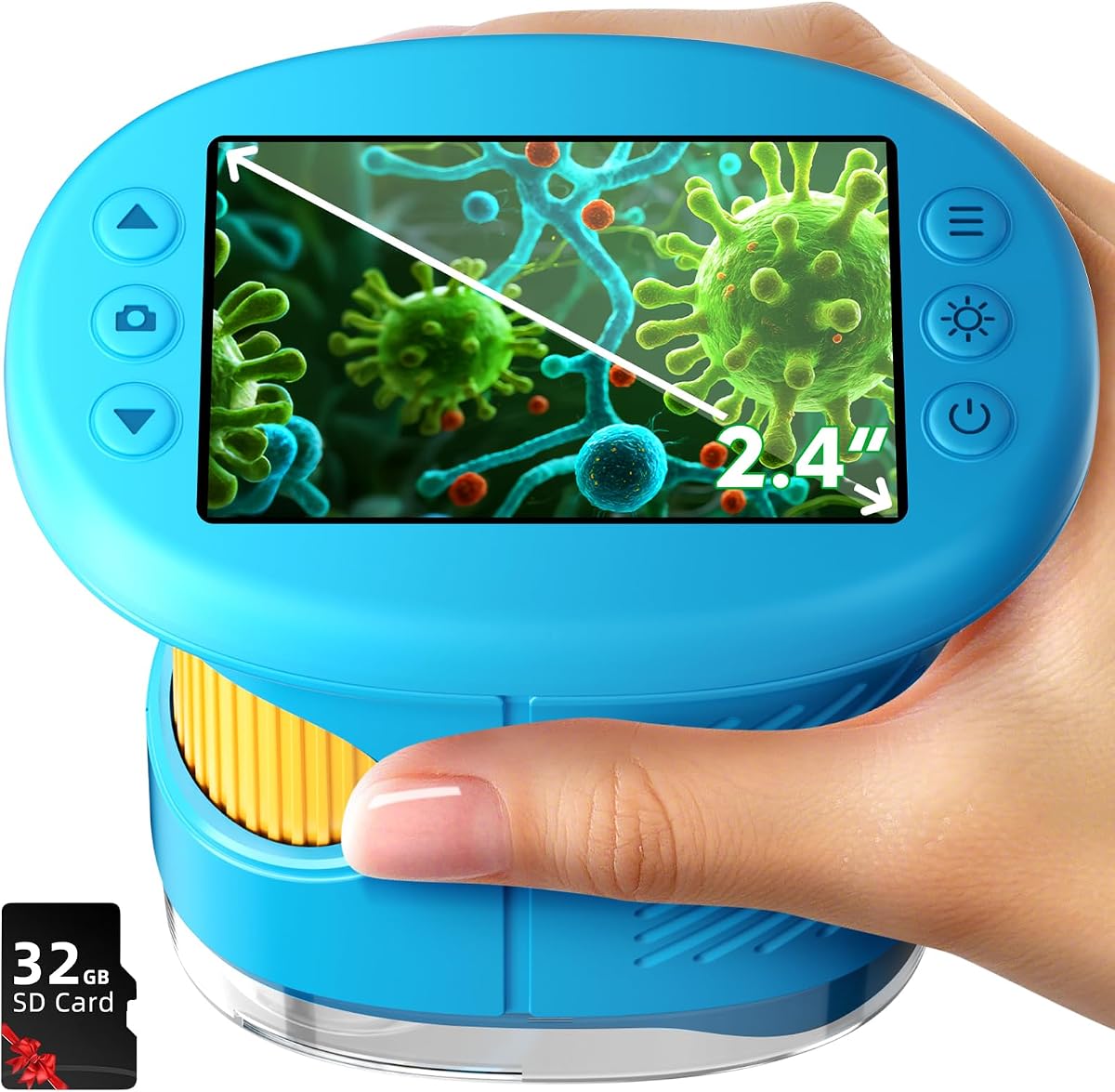
The Odatay 4K Kids Microscope is a self-contained option for young naturalists who should not need to borrow an adult's phone to examine an insect. Its 4.5 rating reflects a generally positive reception, while the built-in 2.4-inch screen, four magnification levels, and included 32GB card make the device easy to introduce into independent play and classroom discovery.
We may earn a commission when you buy through this link, at no additional cost to you.
The camera records at 4K resolution, and the lower magnification setting offers a useful long-distance view before users move closer for fine detail. Three brightness levels and eight built-in LED lights help reveal insect features under variable conditions. The kit also includes 12 prepared slides, a slide viewing cover, a data cable, lanyard, and protective silicone case, creating a more complete learning setup than a bare handheld camera.
The listing describes the product as a lightweight educational toy intended for children roughly five and older, and its 0.5-pound body is easy to carry. It can also connect to a PC for file transfer or extended use. However, the highest advertised magnification levels are less likely to reveal laboratory-grade internal anatomy than the model name alone might imply, so it is best viewed as an accessible exploration tool.
Choose this microscope when independence, a built-in screen, and plentiful storage are priorities. It is particularly well suited to children examining bugs, leaves, fabrics, and prepared slides at home, in a classroom, or during outdoor travel. For advanced biological study, an adult multi-lens microscope will provide more appropriate magnification and specimen control.
Including 12 prepared slides removes the need to prepare an initial collection of samples. New users can begin with familiar specimens, learn basic focusing and lighting controls, and then move outdoors to investigate live insects.
The 32GB card provides substantial room for documenting repeated finds. Children can save photographs and videos, review patterns in an insect collection, and transfer selected files to a computer for a school project.
We may earn a commission when you buy through this link, at no additional cost to you.
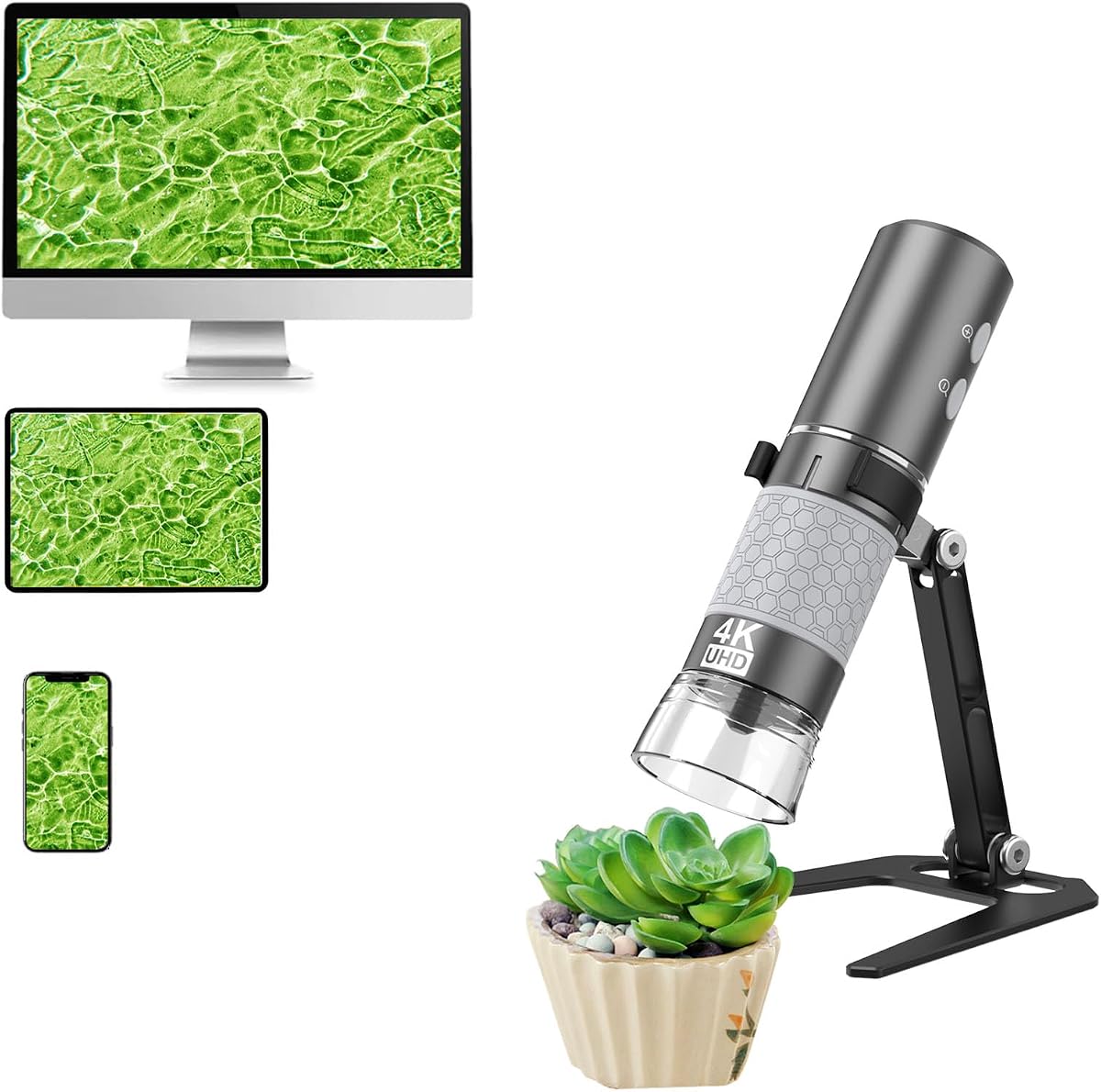
The WiFi 4K Handheld Microscope combines a high advertised resolution with a genuinely portable design. Its 4.5 customer rating makes it one of the stronger general-purpose options in the group, particularly for users who want to use a phone or tablet to examine insects during hikes, school trips, and backyard investigations.
We may earn a commission when you buy through this link, at no additional cost to you.
The camera can produce 3840×2160 images, although the manufacturer notes that a display unable to support 4K will show only its highest available pixel count. Eight adjustable LED lights illuminate the subject, and a 180-degree rotating bracket with an anti-slip base makes it easier to maintain a consistent view. The four-hour battery also stands out for fieldwork where repeated observations are expected.
Compatibility is broad, covering iPhone, iPad, Android phones and tablets, Mac systems, several versions of Windows, Linux, and Chrome OS. Wi-Fi provides wireless mobile use, while a wired connection is available for PC work. As with most app-connected devices, actual results depend on software compatibility, and users should confirm the current application before an important observation session.
This model is well matched to mobile-first users who want sharper captures than a typical inexpensive toy microscope. It is less convenient than an all-in-one unit with a physical screen because a separate display device is required, but the gain in screen size, portability, and sharing flexibility can be worthwhile for families and classrooms.
A 4K sensor can make scales, hairs, wing veins, and body segmentation more apparent than lower-resolution imagery. The improvement is most useful when the live image is enlarged on a suitably capable display.
The stated four-hour endurance is helpful when comparing many specimens without returning to an outlet. Keeping the device charged and reducing unnecessary screen brightness can further support a full day of outdoor observations.
We may earn a commission when you buy through this link, at no additional cost to you.
The Andonstar AD246S-M is designed for adults and serious hobbyists who need more than a simple surface magnifier. It earns a 4.5 rating and combines three interchangeable lenses, 2160P video, HDMI output, an adjustable metal boom stand, and professional measurement software in a more conventional microscope-style setup.
We may earn a commission when you buy through this link, at no additional cost to you.
The three lenses serve distinct purposes. Lens L is intended for soldering and repair, Lens A can provide a broad view of coins, plants, and stones, and Lens D is designed for biological slides. Magnification varies by lens, while output to a larger monitor can produce useful on-screen zoom. Five prepared slides, tweezers, a slide holder, a remote control, and a 32GB memory card make the package practical for immediate study.
The included boom stand is a major benefit when studying insects or prepared material because it reduces camera movement and leaves the hands free to manipulate a specimen. A wireless remote can operate functions from a distance, and eight LED intensity levels help adapt the illumination. The trade-off is size, cost, and complexity compared with pocket models; the user must also change lenses by removing and reinstalling screws.
Buy this model if you want the workflow of a laboratory or inspection microscope while retaining digital capture. It is especially appealing to teachers, electronics hobbyists, and adults who can prepare slides. Users seeking a lightweight device for children to carry immediately outdoors will find a simpler handheld model more appropriate.
A dedicated biological lens is more appropriate for prepared specimens than relying on one general-purpose lens. The broad-objective and repair lenses expand the system beyond insects, allowing it to serve as a general inspection platform.
Connecting the microscope to a larger display lets several learners view the same live specimen. That makes it useful for classroom demonstrations, especially when fine structures need to be identified collectively.
We may earn a commission when you buy through this link, at no additional cost to you.
The Kids 2-Inch Screen Microscope is a compact, approachable tool for children who want a screen and controls they can manage independently. It holds a 4.5 rating and combines a 2MP camera, a 2-inch IPS display, manual focus, eight LED lights, and a rechargeable battery in a lightweight body.
We may earn a commission when you buy through this link, at no additional cost to you.
Oversized focus dials are designed for developing motor skills, while the shock-absorbent rubber casing and smooth ABS construction are intended to tolerate everyday handling. The microscope can record photographs and AVI video, store more than 200 high-resolution images in 32MB, and transfer content to Windows or Mac computers. The eight LEDs offer off, medium, and high brightness settings for examining shaded specimens.
A major point of caution is the advertised 1000X magnification. Digital magnification can enlarge an image, but it does not create the same optical detail as a high-quality laboratory objective. This model is therefore better for exploring insect legs, antennae, scales, leaf textures, and other visible surface features than for resolving cellular structures. The stated two-hour battery life is shorter than some alternatives.
This is a good choice for younger children, school groups, and families wanting a durable first microscope. It provides enough independence to make discovery feel immediate without requiring a separate phone. Buyers should set realistic expectations for fine biological detail and regularly transfer important files, since internal storage is limited.
Manual focusing teaches young observers to adjust distance deliberately rather than relying on automatic behavior. Textured, oversized dials make that process more accessible to small or developing hands.
The rounded casing and shock-absorbing exterior reduce the likelihood of damage during outdoor exploration. A lanyard also makes the instrument easier to carry while leaving both hands available for specimens.
We may earn a commission when you buy through this link, at no additional cost to you.
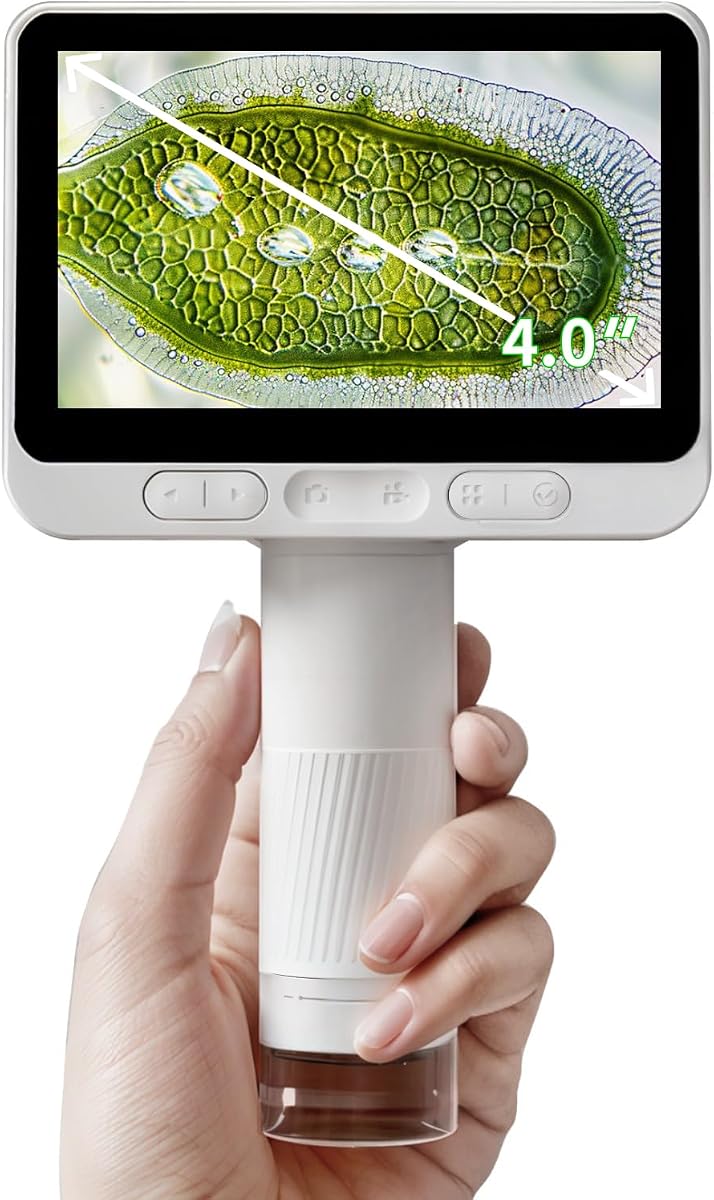
The BEAVERLAB Finder 4.0-Inch Microscope earned the highest customer rating among the products reviewed, at 4.6. It combines a relatively large 4-inch IPS screen, 1080P imaging, a 100X-1600X advertised magnification range, eight adjustable lights, and a built-in hotspot in a child-oriented portable design.
We may earn a commission when you buy through this link, at no additional cost to you.
The sizeable screen is the main advantage over smaller models. Children can see a live image, photograph a bee wing, examine a ladybird, or inspect plant veins without needing a phone. A 2MP CMOS sensor records full HD video and still images, while the built-in hotspot makes it convenient to upload observations to a mobile device or share them with family.
Its portable body suits outdoor discoveries, and the broad lighting controls make it easier to examine dark or unevenly illuminated specimens. The trade-off is that maximum digital magnification can create a large image without adding equivalent biological resolution. Users seeking cellular detail should understand the difference between displayed magnification and true optical resolving power.
The Finder is our top overall recommendation for children and families because it balances screen size, portability, sharing, image quality, and straightforward operation. It works particularly well for backyard insect hunts, classroom observations, and trips to nature centers. More advanced adults may prefer a multi-lens microscope with HDMI output and specimen slides.
The four-inch screen gives young observers more room to distinguish an insect's body outline, wing pattern, and antennae. It is also useful for showing another person a discovery without passing around a phone.
The built-in hotspot allows captured images to be moved to a mobile device. Children can build a digital collection, send observations to a teacher, or compare finds with family members.
We may earn a commission when you buy through this link, at no additional cost to you.
The Kids 1000X Handheld Microscope is a lightweight, straightforward option for outdoor insect exploration. It carries a 4.4 rating and provides a 100X-1000X advertised magnification range, a 2MP camera, a two-inch HD display, eight LEDs, four brightness levels, and a rechargeable 600mAh battery.
We may earn a commission when you buy through this link, at no additional cost to you.
The device is designed to remain stable despite movement, which is important when an insect is walking across a leaf or trying to escape a specimen cup. A textured focus wheel is sized for smaller fingers, while the anti-glare diffuser softens the illumination. Internal storage can hold more than 200 photographs and AVI videos, and the included USB-C cable allows transfer to Windows or Mac computers.
The 200-gram body and included neck strap make it convenient for hikes, camping, museum visits, and backyard exploration. The stated battery endurance reaches three hours, which is suitable for many short sessions. As with other inexpensive digital magnifiers, the 1000X figure should be treated as a maximum zoom setting rather than a guarantee of laboratory-level detail.
Choose this model for a child who wants a durable, uncomplicated microscope with enough battery life for outdoor use. Its display is smaller than the BEAVERLAB Finder, but it remains easier to carry. It is a practical middle ground for nature journals, after-school activities, and family discoveries rather than formal biological analysis.
Four brightness levels and an anti-glare diffuser make the microscope practical beneath foliage, on a shaded patio, or in a dim room. Users can increase illumination without washing out pale insect bodies.
Built-in storage lets a child document organisms without managing separate memory cards. Transferring files to a computer creates a simple archive for comparing species, dates, and repeated features.
We may earn a commission when you buy through this link, at no additional cost to you.
The Elikliv EM4K-AF is the most technically advanced microscope in this group, with a 4.4 rating and a feature set aimed at detailed inspection. Its defining feature is AI-assisted autofocus, which evaluates image clarity and adjusts focus, including when the subject moves. That automation is particularly useful when a live insect shifts position.
We may earn a commission when you buy through this link, at no additional cost to you.
The microscope supports 3840×2160 video and still images up to 9600×5400, displayed on an 1280×800 eight-inch IPS touchscreen. It also includes freeze and split-screen functions, a smart controller, 16GB storage, and a 10-inch stand with a broad extendable base. HDMI and USB outputs allow the image to be shown on a larger monitor, which is useful for demonstrations and more formal observation.
Its premium capabilities come with trade-offs. The unit is larger and more complex than a pocket microscope, and some users may not need autofocus, extensive measurement-style workflows, or a large display. The 2000X figure is still an electronic magnification specification, and actual insect detail depends on the lens, sensor, lighting, focus, and stability.
This is the best choice for adults, serious hobbyists, teachers, and lab-minded users who value autofocus and image analysis over pocketability. It can handle electronics, coins, and living specimens, but those broader capabilities make it a stronger long-term precision tool than a basic educational microscope.
Moving insects are difficult to keep sharp with a manually focused camera. The autofocus system continuously assesses clarity and refocuses, helping a live subject remain legible during observation.
The ability to display images side by side is valuable when comparing a specimen with a reference image or checking changes over time. Freeze mode similarly lets a user inspect a momentary detail without the live image continuing to shift.
We may earn a commission when you buy through this link, at no additional cost to you.
The Ninyoon 4K WiFi Microscope is a flexible connected microscope aimed at users with varied devices. It has a 4.2 rating and supports Wi-Fi operation on compatible phones and tablets alongside wired PC use. Its 3840×2160 output and 50X-1000X advertised magnification make it suitable for examining insects and collecting shareable images.
We may earn a commission when you buy through this link, at no additional cost to you.
The mention of wide-angle and long-focal-length functions adds useful flexibility. A wider view can show an entire insect or object, while a longer working distance may help when reaching into a confined area or observing a larger specimen without bringing the camera extremely close. Compatibility includes iOS, iPad, Android, Mac, Windows, Linux, and Chrome OS devices.
Users must account for connection and app requirements, and the manufacturer notes that zoom buttons work on iPhone, iPad, and Android but not on Windows, Mac, Chrome, or Linux. A separate screen is also required, which may reduce convenience for spontaneous observation. The claimed 4K detail is constrained when the connected display cannot render that resolution.
This model makes sense for users who need one microscope across several computers and mobile devices. It is a practical choice for nature study, classroom demonstrations, and general collection inspection, though its desktop controls are less convenient than those of a self-contained screen model.
A wide view helps a user frame a complete insect, while a telephoto option is useful for narrower working distances. This flexibility makes the microscope practical for both broad discovery and closer inspection.
Compatibility with major mobile, desktop, and Linux-based systems means households can use the same microscope across different devices. Software support should still be confirmed before relying on a specific workflow.
We may earn a commission when you buy through this link, at no additional cost to you.
The Andonstar AD266S is the most elaborate system in the roundup, offering five lenses, 2160P UHD video, HDMI output, a seven-inch monitor, and an X-Y movable stage. Its 4.3 rating reflects a capable package for adults, students, collectors, and laboratories that need more than handheld magnification.
We may earn a commission when you buy through this link, at no additional cost to you.
The lens selection covers both biological and general inspection work. Lens A gives a broad view of coins, plants, and stones; lenses B, C, and M serve biological slides; and Lens L is intended for soldering and repair. Advertised on-screen ranges vary by lens, with the biological M lens reaching as high as 5100X and a 28-inch HDMI display potentially extending certain ranges further.
The X-Y stage is the most important feature for careful specimen positioning. It lets an observer move a slide along two axes without losing a tiny organism or prepared sample. The metal stand reduces shake, the 32GB card stores images and videos, and measurement software supports dimensions and area calculations on Windows. The package includes biological slides, backdrop boards, tweezers, an observation box, cables, remote control, and lighting accessories.
This microscope is ideal for a dedicated learning area, classroom demonstration, or serious hobbyist seeking a broad range of optical options. Its size, weight, setup, and learning curve make it a poor first choice for a child expecting a pocket toy. Those seeking premium autofocus and a larger modern display may prefer the Elikliv instead.
Three biological options provide different working distances and magnification levels for slide work. This gives an observer more choice than a single-objective handheld model when preparing or comparing insect tissues.
Tiny features can move outside the frame quickly, especially at high magnification. X-Y stage controls provide the controlled positioning expected from a bench microscope and make repeated observations easier to reproduce.
We may earn a commission when you buy through this link, at no additional cost to you.
The most useful microscope depends on the specimens, user, and setting. Consider optical capability and focusing before focusing on maximum zoom, then choose lighting, display, portability, and connectivity to match how and where the instrument will be used.
Prioritize sensor resolution, usable focus range, lens quality, and a stable stand before treating the largest magnification number as an advantage. High zoom is useful only when the underlying image remains sharp and well illuminated.
Choose the simplest focus method you can comfortably control. Manual focusing rewards steady hands and patience, while autofocus offers convenience for moving subjects and shared demonstrations.
Prioritize independently adjustable or multi-level LEDs over a fixed lamp. A diffuser and an anti-glare surface add comfort and improve the visibility of fine features.
A built-in screen is best for independence, while a phone workflow is better for sharing and large-view collaboration. Consider both together if classroom presentation is important.
Match storage and transfer options to your intended projects. Adequate internal space is convenient, while removable cards and easy computer transfer support larger collections.
Choose a compact, rechargeable model for frequent fieldwork. Bench-style systems are more appropriate when the microscope will stay on a desk or in a classroom.
Check the package for the accessories your study method requires. Do not assume that a generic carrying pouch is included unless it is explicitly listed.
Select the least complicated instrument that supports your intended level of study. Advanced features only add value when someone is prepared to use them.
Begin with a clean lens, a stable work surface, and a specimen that is safe to observe. Remove the protective film if one is present, install the current app for connected models, and confirm that the device appears in the host system. For a handheld unit, turn on the lights, place the insect on a contrasting surface, and hold the lens at the specified working distance. Begin at lower magnification so the entire specimen is visible before zooming in.
Move the light and focus in small steps. Insects have reflective eyes, translucent wings, fine hairs, and segmented bodies that can look different under different angles and brightness levels. Save a wide image before adding detail, then capture a closer view of one feature at a time. If the image remains blurred, adjust focus before changing magnification, and stabilize the microscope with a stand or tripod instead of increasing digital zoom.
After the session, power the microscope down and disconnect the cable or app. Keep the lens free from dust, sap, and residue, and avoid immersing the device even when a specimen is wet. Store it in its case or away from direct heat and crushing pressure, remove batteries if the manufacturer recommends it for long-term storage, and transfer important photographs to a computer before clearing internal storage.
For casual observation of legs, antennae, eyes, scales, and wing patterns, a handheld digital microscope with a broad adjustment range is usually sufficient. Prepared slides and fine biological structures benefit from a multi-lens laboratory-style system. Maximum advertised magnification should be considered only alongside actual resolution, focus quality, lighting, and stability.
Yes, most of the listed devices provide a live image while the camera remains close to the specimen. Models with autofocus, such as the Elikliv EM4K-AF, are especially helpful for moving subjects. Manual-focus models can also work well when supported by a stable stand and patient adjustment.
A built-in screen is generally easier for children because it avoids app setup and device sharing. A phone or tablet can provide a much larger view, convenient wireless sharing, and access to editing or classroom apps. Connected models are also more flexible when the microscope will be used with different devices.
Handheld models are best suited to insects, plant material, fabric, coins, and other exposed objects. Multi-lens systems such as the Andonstar AD246S-M and AD266S include biological lenses and prepared slides for slide-based observation. The most demanding cellular work is better served by a dedicated laboratory microscope.
Resolution is at least as important because digital zoom cannot restore detail that the sensor did not record. A higher-resolution sensor, good focus, controlled lighting, and a stable image will reveal more useful information than a larger magnification number produced by cropping or upscaling.
Models with a physical display, large focus wheel, straightforward buttons, and protective casing are most suitable for independent use. Even then, an adult should introduce basic handling, specimen safety, and respectful treatment of living insects. Younger children may need help with app installation or file organization.
Observe insects in their habitat whenever possible and avoid collecting species that are protected or unfamiliar. If temporary collection is necessary, use a ventilated container, keep the observation brief, and return the insect to the same area. Avoid handling fragile wings and do not use a microscope as a reason to keep a living insect unnecessarily.
The compact handheld options with rechargeable batteries and included lanyards are easiest to carry. The BEAVERLAB Finder combines a four-inch display with a portable format, while the WiFi 4K model offers a larger phone display and a stated four-hour battery. Bench-style multi-lens microscopes are better suited to a permanent study area.
The BEAVERLAB Finder 4.0-Inch Microscope is the strongest all-around choice for children and families because it combines a high 4.6 customer rating, a four-inch display, 1080P imaging, adjustable lighting, and mobile sharing. The Skybasic Wireless Digital Microscope is a more affordable connected option, while the Elikliv EM4K-AF stands apart for adults who value automatic refocusing, 4K video, 52MP images, and a large display.
Prioritize the details that affect actual observation rather than the largest printed magnification. A stable focus, controlled lighting, usable resolution, and a display suited to the user are more important than an impressive zoom claim. Children generally benefit from a self-contained screen and simple controls, while serious specimen study calls for interchangeable lenses, a movable stage, and HDMI output.
Before purchasing, confirm the current listing details, device compatibility, storage method, and included accessories. Product availability and prices can change, so check the live Amazon page before ordering. With the right tool, digital microscopy can turn a backyard bug hunt into an engaging gateway to anatomy, observation, photography, and deeper scientific curiosity.
