
DaierTek 12 Way Fuse Block
4.6Editor score
Twelve individually fused circuits
Individual fault indicator LEDs
Positive and negative buses
Thirty included blade fuses
The 12V Fuse Panel for Solar System guide compares circuit capacity, grounding, diagnostics, weather resistance, and installation features for safer off-grid
A 12V fuse panel for solar system installations gives battery circuits a centralized, organized way to receive branch-circuit protection. A useful panel should offer enough fuse positions, dependable grounding, clear fault indicators, and adequate resistance to the moisture, dust, vibration, and heat found in battery compartments, boats, RVs, and outdoor enclosures.
The ten options in this guide were compared by examining their stated circuit counts, current limits, voltage compatibility, grounding arrangements, fuse formats, diagnostic features, protective covers, included accessories, and intended environments. The list includes six- and twelve-circuit models, so it covers both compact solar-control systems and more elaborate accessory and off-grid installations.
Each review explains the practical strengths and trade-offs of its featured panel, including where the design is best suited. The Blue Sea Systems model leads as the most established high-capacity option, while several 12-way products offer particularly complete accessory packages. Product availability, ratings, and prices can change, so confirm current specifications before purchasing.
4.6Editor score

4.8Editor score

4.8Editor score
The comparison below highlights the major differences in circuit capacity, grounding, diagnostics, voltage support, and physical features. It is designed to help solar installers identify the panel that best matches their wiring architecture, load count, and installation environment.


The Blue Sea Systems ST Blade Fuse Block combines twelve independently fused circuits with an integrated negative bus, giving it the strongest overall balance for a larger 12V solar installation. Its 4.8 rating reflects strong buyer satisfaction, while the 100-amp total capacity provides useful headroom for a system with several independent loads.
We may earn a commission when you buy through this link, at no additional cost to you.
The panel supports standard ATO and ATC blade fuses, with up to 30 amps available per circuit when paired with the stated fuse types. Tin-plated copper buses and corrosion-resistant fuse clips are particularly relevant in battery compartments, marine installations, and other places where humidity, salt, or contaminants can shorten the life of unprotected electrical hardware.
Its clear cover uses a secure push-button latch, includes storage for spare fuses, and provides recessed label areas. The cover adds physical protection without eliminating access to the fuses, while the integrated negative bus simplifies return-wire organization. The absence of per-circuit LEDs is the main drawback, as a fault must be located by inspection or testing rather than a panel-mounted warning light.
This is a strong recommendation for installers who want a conventional, serviceable 12-way panel with proven electrical capacity and a comprehensive ground distribution point. It is especially appropriate for permanent solar systems where battery-side circuits serve lighting, pumps, controls, refrigeration, communications, or other independent accessories. It also suits 24-hour circuits, an explicitly stated feature of this model.
Twelve separate blade-fuse positions make it possible to isolate individual solar-system accessories rather than placing unrelated loads behind one shared fuse. This simplifies fault management and makes future expansion or circuit reallocation more practical.
Tin-plated copper buses, durable clips, and a latched insulating cover are useful in locations exposed to vibration, dust, or moisture. The panel is also compatible with ring or snap fork terminals, giving installers flexibility when selecting conductor terminations.
We may earn a commission when you buy through this link, at no additional cost to you.
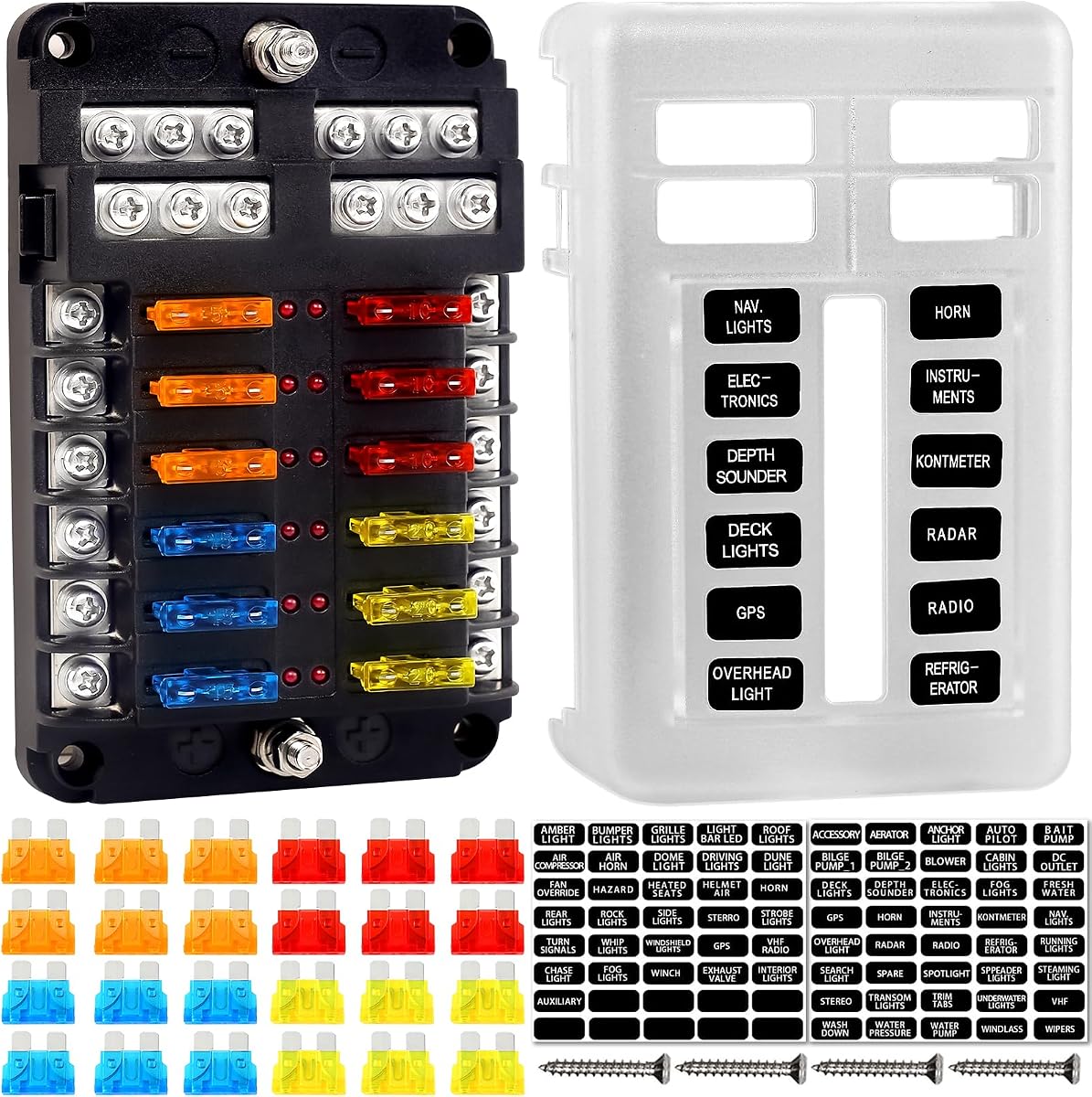
The DaierTek 12 Way Fuse Block delivers twelve circuit positions, per-circuit LEDs, a grounding bus, and a generous accessory package in one practical design. Its 4.6 rating indicates broadly positive feedback, and the combination of troubleshooting features and included components makes it an appealing choice for DIY solar wiring projects.
We may earn a commission when you buy through this link, at no additional cost to you.
Each red indicator illuminates when its corresponding fuse is blown, allowing an installer to locate a likely failed branch quickly. The panel accepts ATO and ATC blade fuses, supports up to 30 amps per circuit, and has a 100-amp total maximum. A push-lock cover helps keep wiring organized and adds protection from loose conductors and contaminants.
The package includes two power terminals, twenty-four device terminals, and thirty fuses covering 5-, 10-, 15-, 20-, 25-, and 30-amp ratings. Sticker labels are also included to identify appliances. The main consideration is that the stated 32V DC maximum is sufficient for conventional 12V and 24V systems but not a 48V installation.
Choose this panel when you want a ready-to-install 12-way distribution point without separately sourcing fuses, terminals, and labels. It is particularly useful for solar systems with several low- and medium-current accessories, such as interior lighting, fans, control circuits, USB outlets, water pumps, or small appliances. The visible fault LEDs add convenience that some competing premium panels do not provide.
A dedicated warning LED for every branch reduces the need to inspect all twelve fuses after a circuit stops working. This is particularly helpful in a solar installation where a panel may be tucked into a compartment or enclosure.
Included power and device terminals reduce the number of separate parts required for a finished installation. A selection of six common fuse ratings also provides flexibility when assigning circuits to different loads.
We may earn a commission when you buy through this link, at no additional cost to you.
The WUPP 12 Circuits Fuse Block Panel combines twelve protected branches, individual LED diagnostics, a negative bus, and twenty-four included fuses. Its 4.7 rating and stated 12-to-32-volt range make it a flexible fit for standard 12V solar systems and conventional 24V battery installations.
We may earn a commission when you buy through this link, at no additional cost to you.
Nickel-plated copper busbars and fuse pieces are designed to support conductivity and resist corrosion, including in saltwater environments. The PBT base is described as mechanically strong, heat resistant, and flame retardant, which is useful where the panel may be mounted near batteries, ventilation equipment, or other heat-producing components.
The diagnostic LEDs are not completely isolated from the circuit, so highly sensitive test equipment may detect a small residual voltage even when a fuse is present. The supplied information specifically notes that this does not represent leakage or a safety issue. Installers should nevertheless include this characteristic when establishing test procedures and interpreting meter readings.
This panel suits users who want a visual fault-finding system without sacrificing twelve-way capacity. It is a solid candidate for off-grid cabins, boats, camper systems, and mobile solar installations where several accessories need independent protection. The included labels, screws, and range of 5-, 10-, 15-, and 20-amp fuses also make initial circuit assignment easier.
Nickel-plated copper parts and a sealed-style cover make this panel a sensible option for damp or marine-adjacent installations. The construction is still intended for protected equipment compartments rather than direct outdoor exposure.
Twelve individual indicators let an installer identify the interrupted branch at a glance. The only technical nuance is the small residual voltage that may appear because the indicator circuit adds a small resistance.
We may earn a commission when you buy through this link, at no additional cost to you.
This six-circuit blade fuse box stands out for its 150-amp total capacity, 40-amp per-circuit rating, and unusually broad stated 12V, 24V, and 48V compatibility. It has a 4.8 rating and offers a different approach from the crowded 12-way panels, making it attractive for a solar system with fewer but more demanding branches.
We may earn a commission when you buy through this link, at no additional cost to you.
A nickel-plated copper ground bus with six M4 negative terminals removes the need for a separate ground distribution bar. The positive input can accept cable entry from the left, bottom, or right, which is especially helpful in tightly packed battery compartments. Individual LEDs and a single-row layout make the six branches easy to access and diagnose.
The included 32V ATO fuses suit 12V and 24V systems, but the stated instructions require appropriately rated DC fuses for 48V use. That distinction matters for installers considering it as a bridge between traditional lead-acid systems and higher-voltage solar storage. The relatively low circuit count also means it cannot provide as many separately protected loads as the twelve-way models.
This is the premium choice for compact, high-capacity systems that need only six auxiliary circuits. It is particularly practical for solar installations with a few high-demand loads, an integrated ground bus, and restricted routing space. Choose it when compactness and installation flexibility matter more than having a large number of available fuse positions.
Six circuits may sound limited beside twelve-way panels, but the 150-amp total rating creates a strong option for systems that group loads into a small number of protected branches. The single-row design also improves access during inspection.
The three-way main power input lets the installer choose the most convenient cable approach. That flexibility is valuable where battery cables, structural members, or other equipment limit conductor routing.
We may earn a commission when you buy through this link, at no additional cost to you.
The ELECTOP 6 Way 12V/24V Fuse Block provides a straightforward six-branch distribution panel with paired positive and negative terminal positions. Its 4.6 rating reflects a generally positive response, and the included protective cover, labels, screws, and assortment of fuses make it convenient for a smaller solar accessory system.
We may earn a commission when you buy through this link, at no additional cost to you.
The panel accepts 1-amp through 20-amp middle-size ATO or ATC blade fuses, supports a 20-amp maximum per circuit, and is rated for up to 75 amps total. Its maximum operating voltage is 32V DC. The transparent cover provides splash and dust protection, while the pre-printed labels make it easier to mark the function of each branch.
Compared with the other featured six-circuit model, this design has lower total and per-circuit capacity and does not include LED fault indicators. Those limitations are reasonable for light-duty accessory circuits, but it is less appropriate when a project requires several high-current branches or immediate visual fault identification.
This fuse block works well for a modest solar installation with interior lights, controls, chargers, fans, or other small loads. It is most useful when simplicity, a compact six-way format, and a complete set of mounting accessories are priorities. Installers with higher aggregate loads should carefully compare its stated 75-amp limit against the combined demand of every connected circuit.
Each positive branch terminal has a corresponding negative position, helping installers keep load returns orderly. This makes the block easier to understand and service than a collection of separate inline holders.
The transparent screw-secured cover helps protect the fuse positions and wiring from accidental contact and environmental contaminants. Labels beneath the cover can also be viewed without dismantling the enclosure.
We may earn a commission when you buy through this link, at no additional cost to you.
This 12 Way Fuse Block is one of the most complete accessory packages in the guide, combining twelve circuits, individual red fault lights, thirty-six blade fuses, twenty-four heat-shrink terminals, and a grounding busbar. Its 4.8 rating makes it one of the strongest-rated options, especially attractive for installers assembling a complete 12V or 24V solar wiring kit.
We may earn a commission when you buy through this link, at no additional cost to you.
The panel is rated for 100 amps total and 30 amps per circuit. Its push-lock cover is described as resistant to dust, corrosion, and short circuits, with an IP53 waterproof rating. Marine-grade tin-plated copper main terminals, heat-shrink tubing, and insulation sleeves support a more finished installation.
Its range of common fuse ratings allows branch circuits to be configured for different load classes, while the LED indicators simplify visual troubleshooting. The IP53 designation is useful for damp environments, but it should not be interpreted as permission to leave the panel fully exposed to weather. The protected enclosure and correct installation environment remain important.
This model is a strong fit for RV solar systems, boats, golf carts, camper vans, and mobile installations that need numerous protected accessory circuits. It is especially helpful for DIY builders who want terminals and heat-shrink accessories included. For larger solar projects, the twelve-way capacity offers room to organize lighting, pumps, refrigeration, controls, outlets, and entertainment circuits.
Thirty-six fuses, twenty-four terminals, heat-shrink tubing, and insulation sleeves reduce separate purchasing and help create consistent terminations. The included installation manual adds a useful reference during panel setup.
A separate red LED for each branch quickly identifies a blown fuse. Dedicated wiring positions and the push-lock cover help prevent stray conductors from interfering with the fuse block.
We may earn a commission when you buy through this link, at no additional cost to you.
The Snlazp 12 Circuit Fuse Box offers twelve independently protected branches, individual red warning LEDs, and both positive and negative sides. Its 4.6 rating indicates a well-received product, while the 100-amp panel and 30-amp per-circuit limits align with the needs of many 12V solar accessory networks.
We may earn a commission when you buy through this link, at no additional cost to you.
Its PBT construction is described as insulated, mechanically strong, heat resistant, and flame resistant. ATO and ATC middle-size fuses are accepted, and a red LED illuminates when the associated fuse blows. DIY stickers are included to identify the connected device or function on each branch.
The box includes twenty-five blade fuses across 5-, 10-, 15-, 20-, and 25-amp ratings, a safety clip, two sticker sheets, four screws, and twenty-four terminals. Although substantial, the package is smaller than some competitors that provide six fuses in each of several ratings. There is also no stated numerical IP rating for the enclosure.
Choose this panel when quick visual fault recognition and a familiar 12-way layout are central requirements. It works well for solar systems serving lights, control modules, ventilation, small refrigeration, chargers, and other independent loads. The lack of a published IP rating makes it best suited to a dry or suitably protected installation unless local conditions warrant additional enclosure protection.
The per-circuit LEDs turn fault finding into a visual check. After a load fails, an installer can identify the relevant branch without electrically testing every fuse position.
The PBT body is designed to retain mechanical strength and insulation under heat. This makes the panel a practical choice for protected battery and equipment compartments where heat can accumulate.
We may earn a commission when you buy through this link, at no additional cost to you.
The Kohree 12 Way Marine Fuse Block is a strong fit for solar installations on boats and other marine environments. Its 4.7 rating is supported by twelve branch circuits, individual LEDs, a clear cover, and an IP86 protection claim that distinguishes it from many general-purpose panels.
We may earn a commission when you buy through this link, at no additional cost to you.
The PBT housing is described as mechanically strong, heat resistant, and flame resistant, with CE certification also stated. Electrical capacity reaches 30 amps per circuit and 100 amps total, while the maximum operating voltage is 32V DC. The clear cover resists splash and dust, helping protect the fuse positions and wiring in a demanding environment.
The package contains thirty blade fuses in six ratings: 5, 7.5, 10, 15, 20, and 25 amps. Four screws, two sticker sheets, and a clip are also included. As with other indicator-equipped models, the LEDs assist visual diagnosis but should not be treated as a substitute for correct overcurrent protection or periodic inspection.
This is an attractive recommendation for boat solar systems, shore-power accessory circuits, and other damp installations. It provides more branches than most solar controllers and many charge controllers provide, which makes it useful for organizing pumps, navigation electronics, lighting, refrigeration, and cabin loads. Its specification is focused on conventional 12V and up-to-32V operation rather than 48V systems.
The stated IP86 rating and clear splash-resistant cover provide useful protection in wet compartments. A sound mounting position and intact cover are still necessary to maintain the intended level of environmental protection.
Twelve branches and paired positive and negative organization are useful for separating a boat’s many low-voltage systems. LEDs help an owner or technician locate an interrupted service quickly.
We may earn a commission when you buy through this link, at no additional cost to you.
The 12 Way Fuse Block with Display is distinguished by a high-precision LED screen that shows battery voltage in real time. Its 4.6 rating and combination of voltage monitoring with twelve circuit-specific indicators make it especially interesting for solar users who want system status visible at the distribution panel.
We may earn a commission when you buy through this link, at no additional cost to you.
The display covers a stated 5V-to-32V measurement range and supports panels operating from 12V to 32V, including conventional 24V systems. Individual red LEDs identify branches with blown fuses, while included DIY labels help connect each position to its intended load. The stated LED screen service life is 20,000 hours at an ambient temperature of 25°C.
Unlike several competitors, the supplied specifications do not state an aggregate current capacity or maximum per-circuit rating. The 32V operating limit also means this is not a ready-made 48V distribution panel. Users should verify the complete manufacturer specification and select appropriately rated fuses and conductors before applying it to a demanding installation.
This panel is best for solar installations where real-time battery voltage is valuable to the operator, such as mobile systems, boats, camper vans, and remote monitoring setups. The display can help identify an unexpectedly low charging state, while the branch LEDs narrow down a specific fault. It is a specialized alternative to simpler fuse blocks rather than a direct replacement for every application.
A real-time voltage readout gives operators an immediate indication of the battery system’s state without bringing a separate meter to the panel. That convenience is particularly useful during mobile or unattended installations.
The voltage display establishes the broader electrical condition, while individual LEDs identify a specific blown branch. Together they help separate a system-wide power problem from a single protected load failure.
We may earn a commission when you buy through this link, at no additional cost to you.
The Cyrico 12 Circuit Fuse Block offers twelve individually protected circuits, a grounding busbar, a protective cover, and LED fault indication in a compact housing. Its 4.7 rating and stated 100-amp total capacity make it a credible option for solar installations with numerous accessory branches.
We may earn a commission when you buy through this link, at no additional cost to you.
The housing uses PBT and PC materials, while the busbars and fuse clips are nickel-plated copper for conductivity and corrosion resistance. The stated capacity is 30 amps per fuse and 100 amps overall. Twist-lock screws and self-tapping mounting screws are intended to support quick installation in cars, trucks, boats, RVs, and trailers.
The cover provides dust and splash protection, although the supplied data does not assign a numerical IP rating. Individual LEDs indicate a blown fuse, and labels simplify circuit identification. Extra fuses are provided for immediate replacement, with different current ratings available for different load requirements.
This is a useful choice for installers seeking a compact 12-way panel without giving up individual fault alerts. It suits solar systems with controls, lighting, refrigeration, outlets, pumps, and other branch loads. The compact design is particularly valuable where enclosure space is limited, provided the panel is installed in a suitably protected location.
Twelve fused branches are consolidated into a relatively compact assembly. This makes the panel easier to incorporate into battery boxes, marine electrical compartments, and mobile solar installations where every centimeter matters.
Nickel-plated copper busbars and fuse clips are intended to maintain conductivity while resisting corrosion. The PBT and PC housing also provides mechanical strength, insulation, and heat resistance.
We may earn a commission when you buy through this link, at no additional cost to you.
The right solar fuse panel depends on your number of loads, conductor sizes, installation environment, diagnostic needs, and grounding arrangement. Use the specifications below to narrow the options before checking the physical fit and complete wiring requirements.
Begin by listing every load that needs independent overcurrent protection. Twelve-way panels offer greater flexibility for lights, fans, pumps, refrigeration, outlets, controls, communications, and future additions, while six-way panels are more appropriate when a small number of grouped branches is sufficient. Allow room for expansion if the installation may later gain additional accessories.
Choose a circuit count that matches the wiring plan without leaving unnecessary positions. More positions can improve organization, but they also require additional fuses, labels, and enclosure space.
Most conventional solar installations use 12V or 24V battery systems, and the majority of featured panels support up to 32V DC. The six-circuit premium option states 12V, 24V, and 48V compatibility, but its included fuses are intended for 12V and 24V use; a 48V installation requires appropriately rated DC fuses.
Never apply a fuse block based only on the panel’s physical format. Confirm the system voltage, fuse interruption rating, conductor insulation, and every connected device’s requirements before installation.
The total capacity limits the combined current that the panel is designed to carry, while the per-circuit limit determines the largest fuse that can safely be installed. A 100-amp panel with 30-amp branch capacity covers a useful range of solar accessories, but the selected fuse should still match the wire and load rather than simply using the maximum.
For the 150-amp six-circuit model, confirm that the feeder cables, termination points, and power source are also appropriate. Panel capacity cannot compensate for undersized upstream wiring.
An integrated negative or ground bus simplifies return-wire termination and reduces the number of separate distribution points. The Blue Sea, WUPP, six-circuit premium, Kohree, and Cyrico options feature integrated grounding arrangements, while other 12-way products also provide positive and negative sides. Compare the number and type of ground terminals with the number of circuits and conductor terminations you need.
Confirm that the negative bus is intended for the appropriate current path and that no installation method bypasses overcurrent protection. A common ground point should be organized, documented, and accessible for inspection.
Individual LEDs can save considerable troubleshooting time by showing which branch has lost its fuse. They are especially valuable in a solar system where the distribution panel may be mounted in a concealed compartment. Indicator-equipped models are convenient, although the WUPP model notes that its internal LED circuit can create a small residual voltage during sensitive testing.
Visual indicators do not replace a meter or system inspection. Confirm the grounding arrangement, monitor battery condition, and investigate why a fuse failed before installing a replacement.
Marine, RV, trailer, and outdoor solar installations expose wiring to humidity, dust, salt, and occasional splashes. The Kohree panel states IP86 protection, the 12 Way Fuse Block with LEDs states IP53, and several other models describe clear covers as splash- or dust-resistant. These protections are not interchangeable, so review the exact enclosure claim before selecting a model.
Even a well-covered panel should be mounted in a protected enclosure or compartment when exposed to direct weather. Inspect the cover, seals, terminals, and cable entries for damage during routine maintenance.
A complete package can simplify installation. The DaierTek, 12 Way Fuse Block with LEDs, and Kohree products include multiple fuse ratings, while several models also provide terminals, screws, labels, heat-shrink tubing, or a safety clip. Check that the included terminals match your conductor type and that the terminals are appropriate for the intended current.
Do not assume every required accessory is included. Verify the number of power terminals, device terminals, mounting screws, labels, and spare fuses, and budget separately for any missing cable lugs or additional fuse sizes.
A flame-retardant PBT base is used across many of the listed designs, while some also incorporate a clear PC cover. Consider how easily fuses can be reached, whether labels remain visible, whether the cover secures firmly, and whether the positive and negative sides are arranged logically for the available wiring space.
Good serviceability is especially important on boats, RVs, and mobile systems where vibration and maintenance access can complicate repairs. A clear cover and removable blade fuses make routine inspection and replacement much easier.
Before installation, disconnect the battery or otherwise de-energize the circuits feeding the panel. Identify each load, calculate its expected current, select the correct fuse and conductor, and draw a grounding plan that avoids daisy-chained return connections. Confirm that the panel's voltage, current, fuse format, and terminal arrangement match the system before tightening anything.
Mount the enclosure on a rigid, protected surface with clearance around the terminals and adequate ventilation. Connect the positive feed to the designated input and branch conductors to the fuse positions, then connect returns to the negative or ground bus as specified. Use the correct fasteners, observe stated torque practices where available, and avoid leaving exposed copper that could create a short circuit.
After all connections are complete, inspect the wiring carefully and test each branch before energizing the full installation. Label every circuit, operate the connected loads, and verify that the indicators behave as expected. Periodically examine the cover, seals, terminals, fuses, and cables; replace a blown fuse only after identifying the cause, and keep spare fuses of the correct type and rating nearby.
A 12V fuse panel is best understood as a battery-side branch-circuit distribution panel rather than the sole protection for every part of a solar installation. It can protect properly sized load circuits after the battery or main distribution point. Solar-module strings may require separate overcurrent and reverse-current protection, so the complete system design must be reviewed as a whole.
A 12-way panel is better when numerous accessories require separate circuits or when future expansion is likely. A 6-way panel can be more appropriate for a compact system with a few grouped loads, and some six-circuit products offer higher current capacity. The correct choice depends on circuit count, conductor sizing, and installation space rather than circuit count alone.
The fuse should match the load, conductor size, and the manufacturer’s instructions for the panel. Although many featured models accept fuses up to 30 amps, that is a permitted panel limit rather than a recommended size for every branch. A higher-capacity fuse cannot safely protect undersized wiring, and a lower-capacity fuse may interrupt a legitimate high draw.
A negative bus is not universally mandatory, but it can make return wiring more organized and accessible. Many of the listed products include a negative or ground bus, which reduces the need for separate distribution hardware. The panel's grounding arrangement should still match the rest of the system, and vehicle or boat chassis grounding rules should be considered where applicable.
Outdoor suitability depends on the specific enclosure rating and the manufacturer's installation instructions. The Kohree model states IP86, while another 12-way option states IP53, and the remaining products emphasize splash- or dust-resistant covers without a numerical rating. Even a sealed panel is usually best installed inside a weather-protected enclosure, especially where direct rain, condensation, or prolonged UV exposure is possible.
Some diagnostic fuse blocks use a small indicator circuit that can create a measurable residual voltage even when the fuse is intact. The WUPP panel explicitly notes this characteristic and explains that it does not by itself indicate leakage or a safety issue. A sensitive meter may register the voltage, so installers should understand this behavior before diagnosing a circuit.
Many products named as 12V fuse panels are actually rated for conventional 12V and 24V DC systems, with maximum operating voltages around 32V. That does not mean every 12V-rated fuse is appropriate for 24V operation. Confirm the panel voltage rating, fuse specification, wire type, connected equipment, and any manufacturer restrictions before using it in a 24V system.
Begin by identifying whether one or several branches have lost power, then inspect the corresponding fuse and LED indicator. Check that the panel is not being fed from a disconnected or undercharged battery, and verify the load, wiring, grounding, and connectors for a short or overload. Replace a fuse only after the underlying cause is corrected, using the exact approved fuse type and rating.
The Blue Sea Systems ST Blade Fuse Block is the strongest all-around recommendation because it combines twelve circuits, 100-amp total capacity, an integrated negative bus, and a secure protective cover. The DaierTek 12 Way Fuse Block is a compelling value-oriented alternative with individual LEDs and extensive included hardware, while the six-circuit premium model offers unusually high capacity, flexible input routing, and broad voltage compatibility.
For most solar systems, prioritize the number of independent branches, proper current limits, grounding arrangement, and environmental protection before considering small convenience features. Diagnostic LEDs are valuable, but a complete package, a suitable fuse format, and enough space for serviceable wiring can matter more. For boats, mobile systems, and other demanding environments, verify the stated IP rating and mounting conditions rather than relying on general waterproof wording.
Ratings, availability, and prices can change, so confirm the current specifications and accessories on the seller's listing before purchasing. Match the selected panel to the actual battery voltage, feeder size, load requirements, and enclosure location, and use appropriately rated fuses and conductors throughout the installation.