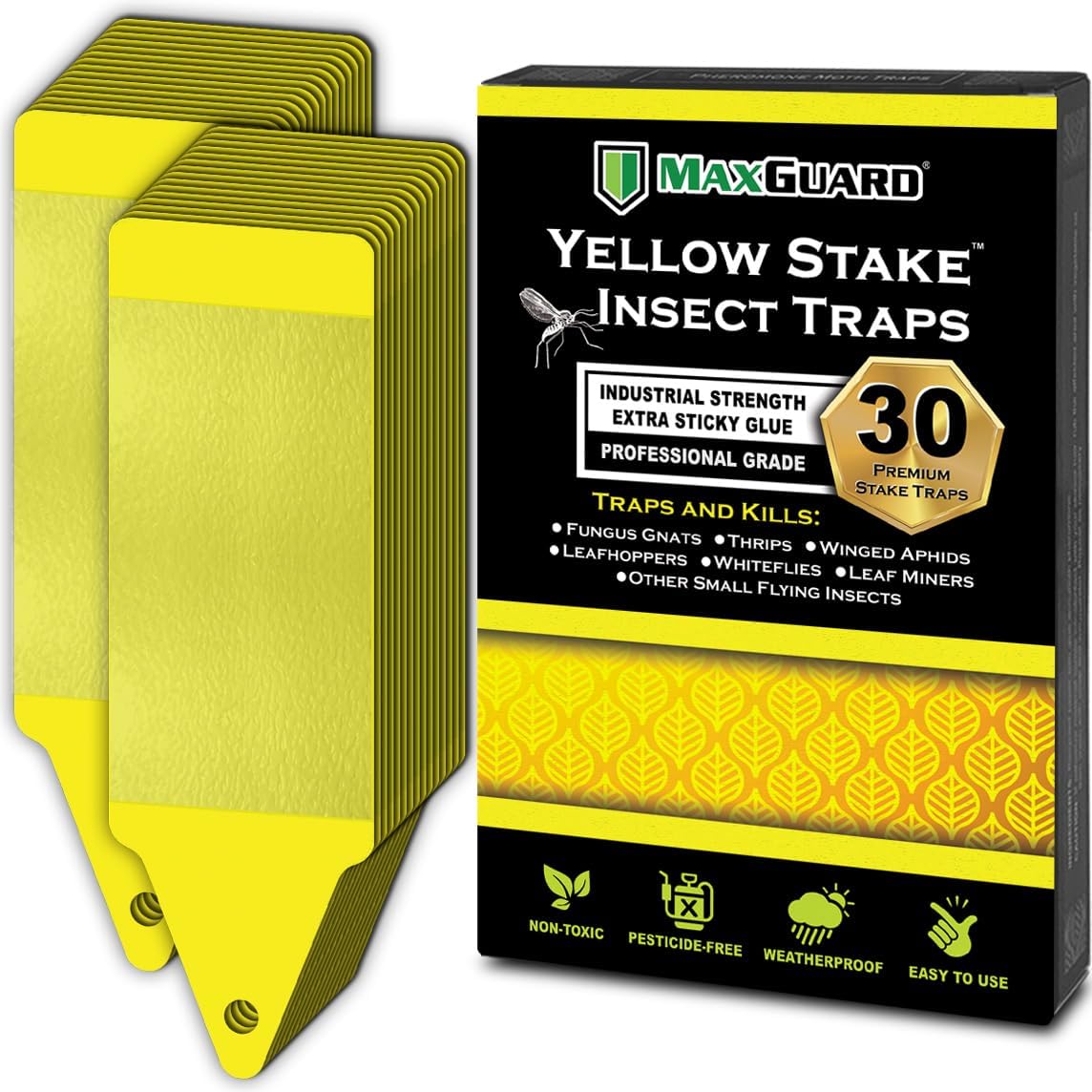
MAXGUARD Yellow Stake Sticky Insect Traps
4.5Editor score
30 dual-sided stake traps
Thick industrial-grade adhesive
Stake or hang placement
Sticky for up to six months
Discover the best Aphid Traps for indoor and outdoor plants, with a detailed comparison of sticky designs, coverage, placement, safety, and pest control
Aphid traps provide a practical way to monitor and reduce flying plant pests without relying on pesticide sprays. The best options use bright colors, dependable adhesive, and flexible placement methods, making them useful among houseplants, greenhouses, patios, and garden beds.
This guide compares ten yellow sticky trap and stake designs based on their stated dimensions, pack quantity, mounting options, environmental resistance, target insects, and suitability for indoor or outdoor use. It covers compact stake traps, hanging cards, larger trap sets, and multipacks designed for broad plant coverage.
Each review highlights the product's most useful features and honest trade-offs, while badges identify only the three leading choices. Ratings and specifications reflect the supplied product information, and availability, features, and prices may change, so readers should confirm current listing details before purchasing.
4.5Editor score

4.5Editor score

4.4Editor score
The comparison below places all ten traps side by side, emphasizing format, quantity, placement, and stated environmental features so readers can quickly identify the most suitable option for their plants and growing space.


The Gideal 20-Pack is a straightforward yellow sticky trap system designed for flying plant insects, including aphids, whiteflies, fungus gnats, leafminers, and thrips. Its supplied rating is 4.2, which reflects a generally favorable reception while leaving room for differences in individual growing conditions. The most appealing feature is the combination of 20 six-by-eight-inch cards, twist ties, and two trap stands.
We may earn a commission when you buy through this link, at no additional cost to you.
Each trap is adhesive on both sides, increasing the available catching surface without requiring the grower to orient a single sticky face perfectly. The twist ties allow a card to be secured around a stem, branch, stake, or other support, while the included stands offer another way to position traps near vulnerable plants. This flexibility is particularly useful when a collection of houseplants or outdoor containers has different heights and structures.
The product information describes bright yellow as the visual attractant and identifies the traps as non-toxic, waterproof, and able to withstand temperature fluctuations. They are suitable for houseplants, outdoor plants, balconies, and windowsills. The principal trade-off is that a large, bright yellow surface can be conspicuous in a decorative indoor display, and the sticky surface will gradually become less useful as insects, dust, and debris accumulate.
This set is a sensible choice for a broad collection of plants, particularly for readers who want both tie-on and freestanding placement. It is also attractive as an introductory option because the multipack provides enough cards to distribute across several locations. For the most attractive setup, place the traps near plant height but away from the foliage, and replace them as soon as the adhesive surface becomes dirty or heavily coated.
The included twist ties and stands reduce the need for extra mounting hardware. Use ties around plant supports and stands in pots, balconies, or garden locations where a more vertical or elevated position will improve interception.
Both faces of each card are sticky, allowing the trap to catch pests approaching from more than one direction. Peel the protective material from both sides before placement to expose the full catching area.
We may earn a commission when you buy through this link, at no additional cost to you.
The MAXGUARD 30-Pack combines a garden-stake format with thick, dual-sided adhesive and a 4.5 supplied rating. It is designed to capture fungus gnats, whiteflies, aphids, leaf miners, mosquitoes, and other flying insects, making it a broader pest-monitoring option than a trap dedicated to a single species. Its industrial-grade adhesive and three-times-thick design are the key points of differentiation.
We may earn a commission when you buy through this link, at no additional cost to you.
The traps can be inserted directly into potting soil or garden material, or they can be hung using the included twist ties. That dual approach suits mixed environments: a grower can place one trap in an affected pot while suspending another near a greenhouse rack, tree branch, or larger plant. Removing the backing paper exposes the adhesive, and the simple stake shape is intended to avoid disturbing stems or foliage.
According to the product information, the adhesive can remain effective for up to six months and is designed to withstand rain and shine. The honest caveat is that real performance depends on cleanliness, placement, sunlight exposure, and the number of insects encountered. A trap can become saturated or dusty well before the maximum stated duration, so replacement should be based on condition rather than calendar time alone.
This is a strong choice for gardeners and houseplant owners who want a generous supply of durable traps without purchasing separate stake and hanging systems. It works especially well when plants are distributed across a greenhouse, patio, or collection of pots. Position traps near the canopy and among stems rather than relying on one isolated card, and inspect the surface regularly to confirm that both adhesive faces remain exposed.
The stated six-month service period makes these traps suitable for continuous monitoring without constant replacement. That figure is a maximum under favorable conditions, so cleanliness and actual insect load should determine when a trap needs changing.
Use the stake in soil where airflow around the canopy is good, or use the twist tie near a branch or rack. This makes one pack suitable for pots, beds, greenhouses, and larger container plants.
We may earn a commission when you buy through this link, at no additional cost to you.
The LFSYS 64-Pack stands out for quantity and a 4.6 supplied rating, the highest numerical rating among the ten listed traps. Each card has a strong, chemical-free, double-sided adhesive designed to attract and catch mosquitoes, fruit flies, aphids, and other small flying insects. The stated material is odor-free and positioned for use around people and pets.
We may earn a commission when you buy through this link, at no additional cost to you.
Its main advantage is simple coverage. Sixty-four cards can be distributed among numerous potted plants, greenhouse benches, kitchen plants, outdoor beds, and other pest-prone locations without requiring many separate purchases. The bright yellow color draws attention, while the cards insert directly into soil and remain low-profile enough for routine garden or windowsill use.
The product guidance says to cool the cards before use in warmer weather. That step may help the adhesive perform as intended and underscores the importance of following the listed instructions. As with the other trap systems, a trap should be replaced when dust, moisture debris, or captured insects cover too much of the adhesive surface, regardless of how recently it was installed.
This pack is a strong fit for large plant collections, community greenhouses, or a garden where a single card per plant would be impractical. It may be more than a small household needs, but the substantial count makes distribution across multiple zones straightforward. Place cards close to affected foliage without touching delicate leaves, and ensure both protective liners are removed for full coverage.
The 64-card count is the standout specification. It enables growers to monitor many pots and garden areas at once instead of repeatedly moving a small number of traps between locations.
The listed adhesive is chemical-free and odorless, supporting use in kitchens, living areas, and greenhouses where scented sprays or aerosols may be undesirable.
We may earn a commission when you buy through this link, at no additional cost to you.
The 40-Pack Fruit Fly and Fungus Gnat Traps combine a practical sticky format with a decorative leaf-and-arrow silhouette. Its supplied rating is 4.4, and its listed applications include houseplants, patio pots, windowsill herbs, greenhouses, and gardens. Aphids, whiteflies, fruit flies, gnats, and midges are among the small flying pests the bright yellow surface is designed to attract and catch.
We may earn a commission when you buy through this link, at no additional cost to you.
The traps are double-sided, so removing the protective film exposes twice the catching area. Wire stakes are included and can be inserted into soil, while the same card may be hung using the wire where that better suits the plant. The design intentionally avoids a highly industrial appearance, which makes it more suitable for decorative indoor displays than many plain rectangular cards.
The formula is described as non-toxic and odorless, and the construction as waterproof, making the traps appropriate for both indoor and outdoor use. One limitation is that decorative styling can make some placements less convenient. A plant with dense foliage or a very small pot may offer fewer clean insertion points than a standard stake or hanging trap.
This is an excellent option for houseplant owners who want aphid monitoring without leaving conspicuous utility devices in view. It is also appropriate for mixed collections where the trap needs to work around herbs, patio containers, and greenhouse plants. Place each card near the upper or middle canopy, where incoming adults are likely to move, and keep the adhesive surface free from watering splash where possible.
The leaf-and-arrow form is intended to blend into plant decor. It is a better fit for display plants and windowsill collections than a plainly industrial card, especially when the trap must remain visible in a living space.
The included wire allows the trap to be anchored in soil or positioned near a support. That flexibility helps growers adapt the card to changing plant growth and pest movement.
We may earn a commission when you buy through this link, at no additional cost to you.
The Catchmaster GRO 72-Pack is a comprehensive sticky-trap system designed for home, farm, garden, hydroponic, and greenhouse use. Its supplied rating is 4.5, and the product information lists fungus gnats, whiteflies, fruit flies, aphids, thrips, leaf miners, sciarid flies, lepidoptera, and other crawling insects among its targets. The 72-card quantity makes it the largest numerical pack in this comparison.
We may earn a commission when you buy through this link, at no additional cost to you.
Unlike products limited to soil insertion, these traps can be placed against walls, along pathways, staked in the ground, or tied around plants and trees. The listed recommendation to use traps in three vertical zones—below the canopy at the plant base, in the middle of the canopy, and above the canopy—provides a practical framework for more complete interception coverage.
The traps are described as odorless, water-resistant, and UV-resistant, with potential use for up to one year when the surface remains clean. That long duration is a major advantage for growers who want permanent monitoring points, although the actual replacement interval will vary with dust, weather, and pest volume. The product information also states that consumption of the glue is not harmful, although consumption remains inadvisable.
This is the most comprehensive choice for large greenhouses, farms, nurseries, or extensive collections. Its flexibility also makes it useful to home growers who want to monitor pathways and plant areas rather than only individual pots. The trade-off is storage and handling: 72 cards can become unwieldy if a household only has a few plants, so keeping unused traps in a clean, dry place is important.
Placing traps below, within, and above the canopy improves interception opportunities as insects move through different heights. This approach is especially useful in greenhouses, farms, and dense outdoor plantings.
Water and UV resistance support continued use in exposed locations. Clean the surface periodically, and replace a card when accumulated dust or trapped insects makes it no longer practical or effective.
We may earn a commission when you buy through this link, at no additional cost to you.
The MaxGuard 20-Pack is built around an integrated hanging hook, giving it a distinct advantage over card-and-tie systems. It has a supplied rating of 4.0 and is intended to catch aphids, whiteflies, fungus gnats, leaf miners, mosquitoes, and other flying insects near potted plants or in greenhouses. It may also be hung outdoors from fruit trees or other plants.
We may earn a commission when you buy through this link, at no additional cost to you.
Installation is deliberately uncomplicated: grasp the trap near the bottom of the hook, remove the adhesive backing from both sides, and hang it in position. The absence of separate twist ties or clips reduces setup time and makes the traps convenient for greenhouse racks, overhead supports, and container plants with suitable branches.
The product information describes the glue as industrial-grade and the card as four times thicker than other yellow sticky traps. It also states that the adhesive can remain effective for up to six months in rain or shine. As a hanging trap, however, its effectiveness depends on access to a support and on avoiding locations where foliage, sprinklers, or weather quickly contaminate the surface.
This option suits growers who want elevated traps without assembling separate hanging hardware. It is particularly convenient in a greenhouse or around a group of indoor plants where a stake would be inconvenient. Choose a clean, well-ventilated hanging point near the canopy, ensure both protective liners are removed, and check the trap regularly for coverage or debris.
The built-in hook reduces the need for clips and twist ties. It is a convenient format for greenhouse racks, tree branches, and overhead supports where a soil stake would be unsuitable.
The stated four-times-thick design is intended to improve durability and catching performance. Keep the surface clean, and replace the trap when insects and dust obscure too much of the adhesive.
We may earn a commission when you buy through this link, at no additional cost to you.
The Garutom 20-Pack is a dual-sided yellow trap set made for flying plant insects, with aphids, whiteflies, fungus gnats, leaf miners, thrips, fruit flies, blackflies, and midges listed among its targets. Its supplied rating is 4.1. The 6-by-8-inch size, 20 twist ties, and two plastic holders provide a flexible setup for both indoor and outdoor plants.
We may earn a commission when you buy through this link, at no additional cost to you.
Its strongest feature is the stated resistance to UV exposure, water, and heat, which makes it suitable for crops and plants used through changing seasons. The product is described as non-toxic and made from thicker PVC materials. The bright yellow color is the attraction mechanism, so traps should be positioned in bright areas rather than hidden in deep shade.
As with the similar card format in this list, the adhesive will eventually be obscured by insects, pollen, dust, or plant debris. The listing recommends replacement when the card becomes completely coated with insects or dust. Another trade-off is visibility: a plain yellow card in a small indoor pot can be more noticeable than a decorative stake or compact trap.
Garutom is a practical selection for balcony gardens, outdoor crops, greenhouse benches, and houseplant groups. Use the twist ties to position cards around stems and the plastic holders where a freestanding arrangement is needed. For the best interception, place multiple traps at different heights and remove both liners so that both sticky faces are active.
The stated UV, water, and heat resistance is valuable for seasonal balconies, patios, and garden beds. These qualities help the traps remain functional when exposed to changing weather and watering.
Twenty twist ties and two holders allow multiple placement methods within the same pack. Ties suit attached positions, while holders are useful for freestanding cards near pots or garden rows.
We may earn a commission when you buy through this link, at no additional cost to you.
The Safer Brand Home SH5026 is purpose-built for indoor potted plants and includes 16 sticky stakes. Its supplied rating is 4.3, and the product information identifies aphids, whiteflies, fruit flies, fungus gnats, and other houseplant insects as targets. Rather than relying on a bright card placed beside a pot, this set uses small stakes that can be inserted directly into soil.
We may earn a commission when you buy through this link, at no additional cost to you.
The discreet design is the main appeal. Stakes may be concealed by leaves, helping the traps blend into a plant arrangement while still placing the adhesive surface within the canopy. Assembly is straightforward: adjust the stake to the desired length, attach the trap, and insert it into the soil. A fresh stake replaces the old one when the trap is full.
The traps are described as attracting insects without chemical insecticides, which can be useful for households seeking physical control methods around living plants. The trade-offs are size and scope. Sixteen traps is the smallest pack in the comparison, and the product is specifically centered on houseplants rather than farms, orchards, or large outdoor gardens.
This is a good fit for indoor plant collections where appearance and focused placement matter more than mass coverage. Insert the stakes near stems and leaf undersides, where the listed target insects tend to hide or travel. Do not confuse the stake's small size with limited effectiveness; proper height and placement determine how often airborne pests encounter the sticky surface.
The small stakes can be positioned in soil and partially hidden by foliage. That makes the system more visually integrated than a conspicuous yellow card mounted in a living room or dining area.
Adjust each stake to the desired height, attach the trap, and insert it into the pot. When the adhesive surface is full, remove the trap and replace it with a fresh stake.
We may earn a commission when you buy through this link, at no additional cost to you.
The 58-Pack Green Sticky Traps offer a decorative alternative to conventional bright yellow cards. Its supplied rating is 4.4, and the set includes 29 flower-and-cloud traps plus 29 sunflower-and-butterfly traps, with each pair of designs randomly assigned. The green color is intended to blend into plant arrangements and avoid the conspicuous appearance of many pest-control devices.
We may earn a commission when you buy through this link, at no additional cost to you.
Despite the decorative presentation, the traps use a double-sided, super-sticky, odorless adhesive intended to intercept fungus gnats, fruit flies, whiteflies, aphids, thrips, and midges. No bait, battery, scent, or attractant is required. The product information advises removing both protective liners before inserting a stake so that the entire adhesive surface is active.
Waterproof and UV-resistant construction is intended to handle rain, direct sunlight, and repeated watering cycles. The stakes can be used in potted plants, kitchen windowsills, patios, outdoor beds, and greenhouses. Dense or compact soil may require light watering or a pilot hole first, which helps prevent the pointed stake from bending.
This set is ideal for aesthetically sensitive spaces where standard yellow traps would stand out. Its quantity also allows broad distribution, making it suitable for plant rooms, kitchens, patios, and mixed collections. The main trade-off is that green cards use a different visual strategy from the bright yellow traps that rely heavily on color contrast to attract insects, so placement and exposure should be checked carefully.
Flower, cloud, sunflower, and butterfly shapes allow the traps to fit more naturally into decorative plant displays. The green finish is less visually disruptive in a living room, kitchen, or plant room.
Remove both protective films before inserting each stake. Peeling first is easier than attempting to reach the liners after placement and helps both sticky sides perform as designed.
We may earn a commission when you buy through this link, at no additional cost to you.
The 100-Pack Yellow Sticky Traps provide the largest quantity in this guide, making them a bulk monitoring option for extensive collections, greenhouses, orchards, tea gardens, and backyard gardens. The supplied rating is 4.4. Their double-sided, thickened adhesive is designed to catch fruit flies, fungus gnats, aphids, and other flying plant pests while remaining odorless and non-toxic.
We may earn a commission when you buy through this link, at no additional cost to you.
Installation requires only that both protective covers be removed and the card be inserted into the soil. This uncomplicated approach is useful for routine pest monitoring across numerous beds or pots. The card is advertised as UV-resistant and waterproof, supporting continued use in exposed outdoor areas and in locations that receive regular watering.
The main trade-off is obvious: 100 cards may be excessive for a household with only a handful of indoor plants. A large pack also requires adequate storage and a systematic placement plan, since a crowded collection of unused traps can be forgotten. The listing says replacement is unnecessary until insects completely cover the surface, but real-world cleanliness and weather exposure should also guide replacement timing.
This set is best suited to growers who need wide-area coverage and can distribute the traps across many plants. It offers a practical physical-control option without batteries, scent, or sprays. Insert cards near affected plants, maintain several monitoring points rather than relying on one trap, and keep the adhesive surface as clean as the environment allows.
A 100-card pack makes it possible to place traps throughout an orchard, greenhouse, tea garden, or extensive container collection. It is most useful when a grower can distribute the cards rather than storing most of them.
The adhesive is described as safe, odorless, and non-toxic. It provides passive interception without batteries, sprays, bait, or a fragrance that might interfere with a living space.
We may earn a commission when you buy through this link, at no additional cost to you.
The most useful trap depends on plant type, space, appearance, and the number of monitoring points required. Consider coverage, mounting style, adhesive performance, environmental resistance, and the range of insects each product is designed to attract.
Aphid traps rely on a surface that remains tacky after installation. Double-sided designs expose more catching area and can intercept insects approaching from either direction, while thicker adhesive may be better suited to exposed locations or longer monitoring periods. Review the stated materials and removal instructions, and make sure both protective liners are removed before the trap is placed.
Choose a dependable, generously adhesive surface that matches your environment. Clean the card regularly and replace it when dust, pollen, moisture debris, or captured insects obscure too much of the glue.
Stake traps are convenient for pots and garden beds because they sit directly in the soil. Hanging traps are useful near greenhouse racks, tree branches, or plants where a stake is inconvenient. Flat cards with twist ties or holders offer the greatest placement flexibility, while decorative stakes are better suited to visible indoor collections.
Match the format to the location rather than choosing only by pack size. The best position is usually near the plant canopy, where incoming flying adults are likely to pass or land.
A multipack is valuable when many plants need monitoring. The 64-, 72-, and 100-card options can cover multiple rooms, benches, beds, or pots at once. Smaller packs may be more economical for a handful of houseplants, but they may need to be moved as the infestation changes location. The quantity should match both present coverage and the number of future replacement points.
Estimate how many active plants and growing areas need monitoring before buying. A larger pack is not automatically better if most traps will sit unused, but it can be valuable for intensive greenhouse or garden coverage.
Outdoor traps face sunlight, rain, windblown dust, and temperature changes. Products described as UV-resistant, waterproof, heat-resistant, or weather-resistant are better suited to balconies, patios, orchards, and garden beds. Indoor traps still need to tolerate watering splash, condensation, and accumulated dust, especially in greenhouses or humid plant rooms.
Prioritize products with clearly stated environmental resistance when traps will be exposed. Bring cards indoors during severe conditions if their listed performance does not cover the relevant exposure.
Although the focus is aphids, many listed traps also target whiteflies, fungus gnats, fruit flies, thrips, leaf miners, mosquitoes, and midges. A broader target list can make one product more useful across a mixed plant collection. For concentrated aphid activity, placement around stems and leaf undersides remains essential because a trap cannot replace thorough plant inspection.
Choose a trap whose stated species list includes aphids and any secondary pests present in your plants. Do not assume a general-purpose trap will resolve every crawling or soil-dwelling pest problem.
Bright yellow cards are effective at attracting many flying insects and are straightforward to spot in a garden. However, they may stand out in a living room or decorative plant display. Green stakes, small houseplant traps, and leaf-shaped cards can blend more closely with foliage, although visual camouflage is not their only function.
Consider where the trap will be seen before choosing its color and shape. A discreet design can be valuable indoors, while a highly visible card may be easier to monitor in a greenhouse or outdoor garden.
Many traps in this category are described as non-toxic, odorless, or free from chemical insecticides. Those attributes can be useful around children, pets, kitchens, edible herbs, and living spaces, although consumers should still read the current manufacturer instructions and keep traps inaccessible where accidental handling or chewing is possible.
Favor products with clear material and safety descriptions. Treat the trap as a physical control method rather than a guarantee of complete eradication, and combine monitoring with proper plant care and identification of the underlying infestation.
The best system is one you will actually use consistently. Peel-and-insert cards require fewer steps, integrated hooks remove the need for separate ties, and adjustable stakes can be matched to different pot sizes. A good replacement routine is equally important: keep fresh traps available and inspect adhesive surfaces often enough that coverage does not go unnoticed.
Choose a straightforward design with mounting accessories that suit your plants. Label different areas if you are using a large multipack, and record where each trap is positioned so replacements can be made quickly.
Begin by identifying the affected plants and inspecting stems, tender shoots, and leaf undersides where aphids tend to gather. Install traps before or as an infestation develops, placing them near the canopy rather than only at the far end of a room or bed. If a trap includes a stake, insert it into loose soil without damaging roots; if it has a wire, twist tie, or hook, attach it to a clean support.
Remove every protective liner listed for the product before activation. For double-sided traps, exposing both faces is essential to the stated catching performance. Avoid covering the adhesive with leaves, place traps in a bright area, and position them where flying insects are likely to encounter the surface. Adjust the height as plants grow so the trap remains within the active canopy.
Inspect traps regularly for trapped aphids, dust, pollen, spray residue, and water deposits. Replace a trap when the surface is heavily coated or too dirty to remain tacky, even if the product's maximum stated duration has not been reached. Remove spent traps from the growing area, follow the current disposal instructions, and continue checking plants because traps monitor and reduce visible flying pests but do not replace comprehensive pest management.
Yes, but their effectiveness depends on placement and pest behavior. Aphids may fly and land on bright yellow surfaces, so traps placed near tender shoots and leaf undersides can intercept them. Sticky traps are most useful as part of a broader monitoring and pest-control routine rather than as a standalone cure for a severe infestation.
Yes. Double-sided products are designed to catch insects approaching from either direction, and leaving a protective liner on one face reduces the usable surface. Remove every listed backing before placing the trap, taking care not to touch the adhesive with your fingers.
Place the trap near the plant canopy, especially close to stems, new growth, and leaf undersides where aphids feed. Insert a stake gently into the soil or use the supplied hanging option, and keep the sticky face clear of leaves so insects can contact it.
Many products in this guide are described as non-toxic, odorless, or free from chemical insecticides, but readers should verify the current label and manufacturer instructions. Keep traps away from curious hands and animals, avoid placing them where food may contact the adhesive, and follow local safety guidance.
Replace a trap when insects, dust, pollen, or debris cover too much of the adhesive surface. Although some products state maximum durations of several months or up to one year, actual service life varies with sunlight, weather, watering, and pest load, so condition is a better guide than the calendar alone.
A single trap rarely provides adequate coverage for a large growing area. Distribute multiple traps at different plant heights and locations, with particular attention to the plant canopy and entry areas. Large packs can make this distribution easier, but they must still be positioned deliberately.
They can work in both settings, provided the adhesive remains clean and the trap is placed near vulnerable plants. Outdoor products with UV, water, and heat resistance are preferable for exposed beds, balconies, and orchards, while greenhouse traps should be positioned around benches, racks, and plant rows.
They can be, especially when monitoring is combined with identifying the infestation, improving plant health, removing heavily infested growth, and using an appropriate treatment when necessary. Because traps primarily intercept flying pests, they may be less effective against eggs, immobile nymphs, or pests that remain tightly attached to leaves.
The Catchmaster GRO 72-Pack is the most comprehensive option for broad coverage, numerous mounting positions, and long-term monitoring, while the MAXGUARD 30-Pack stands out for thick adhesive and flexible stake or hanging placement. The 40-Pack Fruit Fly and Fungus Gnat Traps offer a strong balance of practical features and decorative styling for readers who want a more attractive indoor option.
For a large garden or greenhouse, prioritize quantity, weather resistance, and the ability to place traps at several canopy heights. For houseplants, consider pack size, visual discretion, and a convenient stake format. In every case, activate both sticky surfaces, position the traps close to affected growth, and replace them as soon as the adhesive becomes dirty or heavily covered.
Ratings, product configurations, availability, and prices can change, so check the current listing and manufacturer instructions before buying. The right aphid trap is the one that fits the plant, placement, and monitoring routine you can maintain consistently, not simply the one with the largest quantity or the longest stated duration.