
YR1035+ Digital Battery Internal Resistance Tester
5.0Editor score
True four-wire measurement
Simultaneous resistance and voltage
Portable LCD field design
Compare 10 Battery Internal Resistance Tester options for accuracy, range, portability, and use across batteries, vehicles, electronics, and laboratories.
A battery internal resistance tester reveals more than voltage alone by measuring a cell or battery pack's opposition to current, helping identify aging, imbalance, or declining performance. A useful model combines accurate sensing, clear readings, safe voltage limits, and compatibility with the batteries and test methods common to your work.
The products in this guide were compared using the supplied specifications and customer ratings, with particular attention to measurement architecture, resistance and voltage ranges, display quality, data handling, portability, and intended applications. The list covers dedicated internal resistance analyzers, multifunction meters, universal battery checkers, and an automotive diagnostic tool.
Each review explains the strongest reasons to consider a particular tester, along with its limitations and ideal buyer. Ratings reflect the supplied marketplace feedback rather than personal testing, while product details can evolve. Current prices and availability change frequently, so readers should verify listings before making a purchase.
5.0Editor score

4.5Editor score

4.9Editor score
The comparison below highlights the measurement methods, ranges, displays, and most suitable uses of all ten products, helping distinguish dedicated internal resistance analyzers from broader battery and vehicle diagnostic tools.




The FNIRSI HRM-10 is a dedicated voltage and internal resistance analyzer with a supplied rating of 4.4. Its defining feature is the combination of a color TFT display, selectable measurement ranges, and a customized Kelvin four-wire connection designed to reduce the influence of lead and contact resistance. That makes it appealing for users who want more focused battery diagnostics than a general-purpose battery checker provides.
We may earn a commission when you buy through this link, at no additional cost to you.
The instrument measures voltage and internal resistance at the same time, allowing a tester to consider both of the principal electrical readings needed for a basic health assessment. The resistance range extends to 200Ω, while the voltage range reaches 100V. Users may manually adjust both ranges, which is useful when working across small cells, automotive batteries, and larger packs rather than relying entirely on automatic selection.
Historical records and exportable data tables add practical value for anyone comparing batteries over time. The display can show eight sets of voltage and resistance values for batch selection, helping users identify questionable units without repeatedly recording figures by hand. Its dedicated focus also keeps the operating concept straightforward: connect the appropriate Kelvin contacts, observe the readings, and compare results with expectations for the battery being assessed.
There are important boundaries. The device must not be used with DC voltage above 100V, and AC voltage should never be applied. It is not a multimeter, so buyers who also need capacitance, frequency, diode, or continuity functions should look elsewhere. Even so, for battery-focused work, the HRM-10 offers a strong balance of dedicated functionality, clear presentation, and recordkeeping, making it a solid overall recommendation.
A four-wire test separates the current and voltage paths, helping minimize the effect of lead-wire and contact resistance. That makes the approach especially useful when the measured battery resistance is small and ordinary two-wire readings could be less representative.
The ability to store and review sets of readings makes the HRM-10 more than a momentary meter. Technicians can compare multiple cells, document changing values, and revisit earlier results to identify batteries that may need closer investigation.
We may earn a commission when you buy through this link, at no additional cost to you.
The WESTOBIG HRM-10 listing describes a versatile battery analyzer centered on Kelvin four-terminal sensing, with a supplied customer rating of 4.3. It targets car batteries and smaller formats including AA, AAA, button, lithium, and lead-acid batteries, making it a broad option for technicians who move between different battery classes.
We may earn a commission when you buy through this link, at no additional cost to you.
The most distinguishing feature is its data preset system. Automatic mode is available, but users can also select fixed voltage and resistance ranges, including 20mΩ, 200mΩ, 2Ω, 20Ω, and 200Ω resistance positions. Up to eight sets of data can be preset against a standard, which helps users rapidly determine whether a battery meets a chosen threshold and identify problematic units.
Record management is another strength. Test records are saved automatically and may be transferred to a computer through Excel, supporting deeper analysis outside the device. The color HD display and clear layout improve interpretation, while Kelvin clips are intended to eliminate the inherent resistance of the connecting lead wires and support measurements below 0.1Ω.
The trade-off is that this remains a focused battery instrument rather than a general electrical tester. Its stated voltage range is 0 to ±100V, and it must not be connected to a DC source above 100V or any AC source. Buyers who value presets, stored histories, and spreadsheet transfer more than a broad multimeter feature set will find this configuration particularly compelling.
The ability to store eight comparison groups creates a repeatable workflow for production lines, maintenance teams, or users testing many batteries. Defining limits in advance can make anomaly spotting faster and more consistent.
Saving records and transferring them through Excel allows users to inspect trends outside the tester. This is particularly helpful for long-term battery monitoring, where a single voltage snapshot may not tell the full story.
We may earn a commission when you buy through this link, at no additional cost to you.
The ZOYI ZT-XR1 integrates a 25,000-count True RMS digital multimeter with a four-wire battery internal resistance tester, earning a supplied rating of 4.5. It is the most functionally expansive product in this guide and stands out for users who need more than a single measurement category during battery servicing or electronics repair.
We may earn a commission when you buy through this link, at no additional cost to you.
Battery measurements cover 0.1mΩ to 200Ω and 0 to ±100V through a dedicated aviation-style test port. Stated accuracy is ±0.5% for resistance and ±0.2% for voltage, while compatibility includes lithium, 18650, LiPo, LiFePO4, lead-acid, NiMH, alkaline, and supercapacitor formats. The multimeter side measures AC and DC voltage, resistance, capacitance, frequency, diode, continuity, and thermocouple temperature.
Additional functions make the device useful for trend analysis. It includes waveform curve recording, MAX, MIN, and AVG displays, and a data log function. The 2.4-inch color TFT screen has adjustable brightness from 10% to 100%, while bilingual Chinese and English menus, HOLD, REL measurement, and a configurable auto power-off improve day-to-day operation.
Its rechargeable 2,000mAh lithium battery provides a stated continuous runtime of six to ten hours, depending on backlight and active features. A low-battery reminder helps prevent abrupt shutdown, and separate test ports are intended to reduce signal interference. This breadth is ideal for electricians, repair professionals, and serious hobbyists, though buyers who need only a simple battery checker may find the multifunction design excessive.
Combining battery analysis with a full digital multimeter reduces the need to carry separate instruments. A technician can switch between battery mode and general electrical measurements without sacrificing either workflow.
Waveform curves and recorded measurements add value beyond a momentary reading. These functions allow users to compare behavior over time, identify fluctuations, and document repeated tests more effectively.
We may earn a commission when you buy through this link, at no additional cost to you.
The Dlyfull universal battery tester is aimed at everyday battery checking rather than laboratory-grade analysis. With a supplied rating of 4.4, it supports numerous common formats, including A, AA, AAA, AAAA, C, SC, D, 9V, several lithium-ion sizes, rechargeable cells, and a wide selection of button batteries.
We may earn a commission when you buy through this link, at no additional cost to you.
Its LCD reports information about the battery under test, including voltage, internal resistance, and an indicated capacity percentage. Those outputs can help determine whether a battery is charged, depleted, or in need of replacement. The rotary dial lets the user select the corresponding voltage before attaching the test leads, and no dedicated battery bay is required.
The broad format support makes it useful for maintaining household electronics, toys, flashlights, controllers, cameras, and other everyday devices. Test leads provide flexibility when cells have different shapes or terminals, while the portable construction supports storage in a toolbox, drawer, or field kit.
This is a practical choice for consumers who want a single device to inspect many household battery types. It does not offer the explicit Kelvin four-wire architecture, historical records, or advanced logging found in higher-end analyzers. Its strength is accessibility and format coverage rather than laboratory analysis, so buyers should consider whether estimated capacity information and general resistance readings are sufficient for their needs.
The wide list of supported cells makes it practical to keep one tester for cameras, controllers, flashlights, rechargeable batteries, and button cells. That broad coverage reduces the need for several specialized battery indicators.
Test-lead contact is convenient for uncommon battery formats that may not fit a dedicated holder. The dial-based approach also keeps the basic workflow easy to learn.
We may earn a commission when you buy through this link, at no additional cost to you.
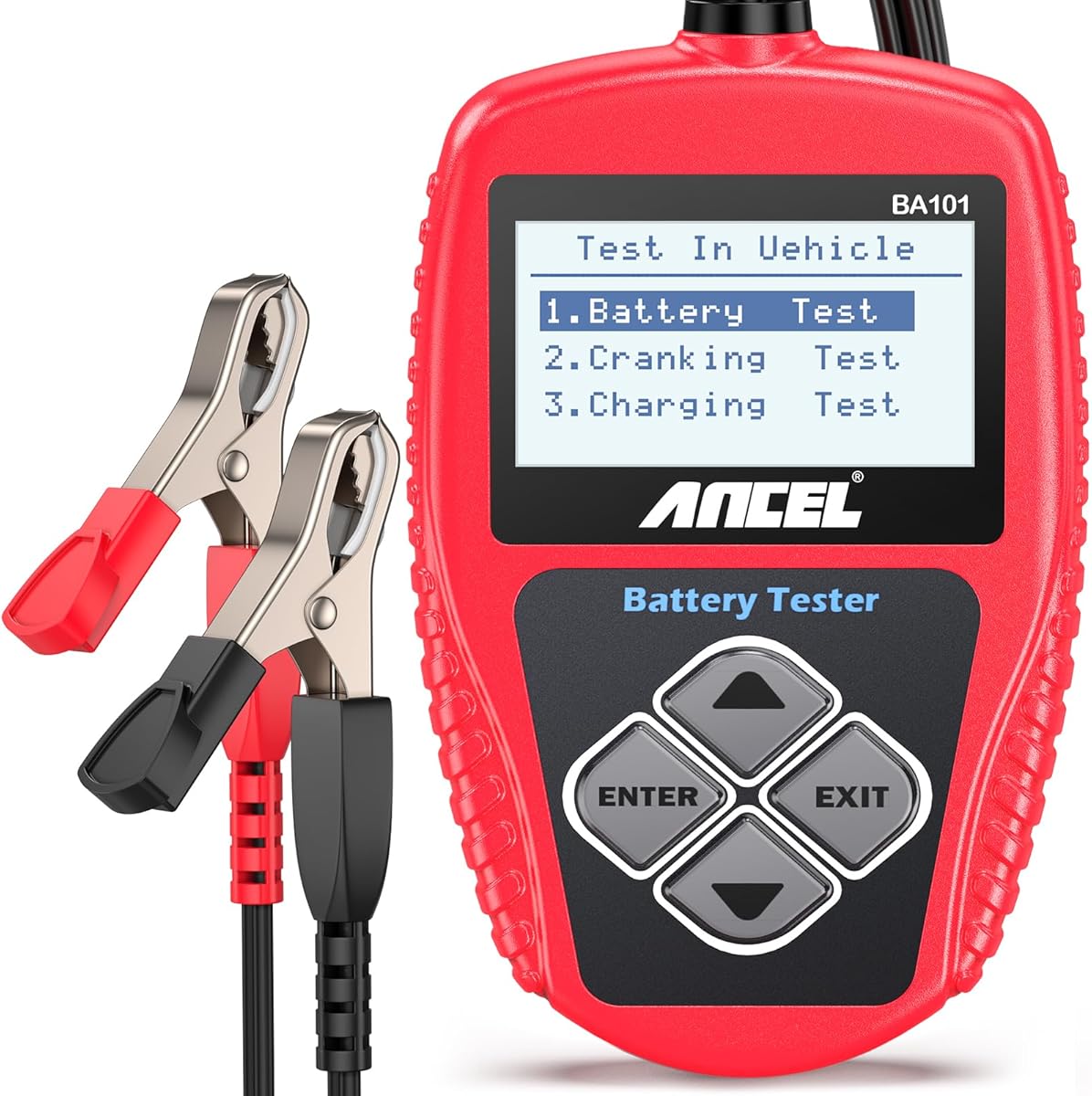
The ANCEL BA101 is primarily an automotive battery and charging-system analyzer rather than a general internal resistance meter. Its supplied rating of 4.5 reflects a tool designed to interpret vehicle battery condition through State of Health, State of Charge, voltage, current, and cold cranking amperage readings, with additional cranking and charging-system tests.
We may earn a commission when you buy through this link, at no additional cost to you.
Its stated CCA range spans 100 to 2,000, and the tester supports global standards including JIS, EN, DIN, SAE, BCI, GB, CA, MCA, and IEC. It works with 12V flooded, AGM, GEL, and EFB batteries used in cars, trucks, boats, RVs, ATVs, lawnmowers, golf carts, and motorbikes with capacities over 30Ah.
Operation is designed for field use. The black-and-white display has adjustable contrast and a white backlight for bright or dark conditions, and the unit supports one-handed operation. It draws power directly from the vehicle battery, so there is no internal battery to recharge or replace. Copper crocodile clips and four-in-one protection guard against reverse polarity, short circuits, overcurrent, and overvoltage.
This distinction matters when choosing the keyword category. The BA101 is valuable for diagnosing a 12V vehicle battery, starter draw, and charging system, but it is not a lithium-compatible or multi-voltage internal resistance analyzer. It also does not support 6V, 8V, or 24V batteries, and the listing specifically excludes motorcycles below 30Ah. Automotive users should choose it for vehicle assessment rather than general electronics work.
State of Health, State of Charge, CCA, cranking, and charging tests provide a more complete picture of a vehicle starting system. This makes the tool more relevant for roadside and workshop diagnostics.
The wide CCA range and support for several battery chemistries match common automotive applications. Users must still enter the correct battery type, rating, and temperature to obtain the clearest interpretation.
We may earn a commission when you buy through this link, at no additional cost to you.
The ZOYI XR1 combines a battery internal resistance tester, a voltage meter, and a 25,000-count digital multimeter in a single package. Its supplied rating of 3.9 is the second-lowest among the ten products, but the stated functions make it a relevant choice for users who want both battery analysis and general electrical measurement.
We may earn a commission when you buy through this link, at no additional cost to you.
The battery mode measures internal resistance and voltage simultaneously, helping users evaluate quality degradation and continued usability. Its resistance range is adjustable from 0.1mΩ to 200Ω, while the maximum voltage input is 100V. Four-wire Kelvin clips are included to minimize lead and contact resistance, and users can manually select measurement ranges as needed.
The multimeter portion handles AC and DC voltage, resistance, capacitance, frequency, temperature, diode testing, and continuity checks. A TFT color display presents the results, with brightness adjustable from 10% to 100%. The auto-shutdown timer can be configured from five to 120 minutes, and buzzer volume can be adjusted from zero to 100%.
Its main drawback is its more modest customer feedback compared with the leading products in the list. The supplied rating does not indicate a functional flaw, but it is reasonable to consider the established feedback of higher-rated options. Even so, the XR1 is well suited to a technician who wants dedicated battery measurements and a full meter in one portable unit without requiring waveform logging or extensive analysis features.
The combined format avoids carrying a separate multimeter for continuity, capacitance, frequency, or basic voltage checks. It is a practical choice for repair and maintenance work involving both batteries and powered circuits.
Adjustable screen brightness, buzzer volume, and shutdown timing make the instrument adaptable to different working environments. The settings are especially useful when working in bright areas or during longer sessions.
We may earn a commission when you buy through this link, at no additional cost to you.
The RC3563 is a handheld internal resistance analyzer with a supplied rating of 4.9, placing it among the strongest customer-feedback profiles in this guide. It is designed for lead, lithium, and nickel-cadmium batteries and can measure internal resistance and voltage simultaneously through a Kelvin four-wire test clamp.
We may earn a commission when you buy through this link, at no additional cost to you.
The sensing system is the central advantage. By using a four-wire clamp, the tester is designed to reduce the influence of contact and wire resistance, resulting in more credible readings for small resistance values. It also includes a liquid crystal display, intelligent control, and a Kalman filter mathematical algorithm intended to support high-precision, efficient measurement.
Its internal 1,000mAh lithium battery makes the unit convenient for field work and can be charged from a 5V source, including an Android phone charger. The stated applications span battery production, maintenance, testing, scientific research, and laboratory environments. It can additionally measure the AC resistance of capacitors and low-resistance resistors, extending its usefulness beyond battery maintenance.
The listing does not provide a specific numerical internal resistance range, so buyers needing a clearly stated milli-ohm minimum should verify that detail before ordering. It also omits the advanced presets and export features found in some competing instruments. Even with those caveats, the RC3563's high rating, dedicated design, and four-wire method make it the most compelling premium option in this roundup.
Unlike a general battery checker, the RC3563 is centered on resistance measurement and uses a Kelvin clamp. That focus is useful when small differences in internal resistance are the main indicators being evaluated.
The ability to measure AC resistance in capacitors and low-resistance components makes the analyzer relevant to electronics repair and quality-control work. It provides a broader low-resistance option without adding a full multimeter interface.
We may earn a commission when you buy through this link, at no additional cost to you.
The YR1035+ Combination 2 is a compact digital internal resistance tester with a supplied rating of 5.0. It uses a true four-wire testing system to measure internal resistance and voltage simultaneously, making it a focused option for users who prioritize correct sensing architecture and uncomplicated field readings.
We may earn a commission when you buy through this link, at no additional cost to you.
The large LCD provides real-time results for both electrical values. This simultaneous presentation helps users compare voltage and resistance without cycling through menus or taking separate readings, a practical advantage when screening several cells or checking a battery before and after a charge cycle.
Its physical design is compact and lightweight, suitable for both field work and bench testing. The package includes both probes and clips, giving users more connection options than a tester supplied with only one type of lead. That flexibility can help when reaching a recessed terminal, testing a small cell, or maintaining a stable connection on a larger battery.
The supplied listing does not state a precise resistance range, voltage limit, or data-export capability, which is less specific than some competing products. Buyers with unusual measurement requirements should verify those specifications. For general internal resistance screening, however, the YR1035+ combines a strong customer rating, true four-wire measurement, and portable construction into a compelling value-focused recommendation.
The large screen and simultaneous results make the device approachable for routine battery checks. Users can see both values at once and concentrate on comparing cells rather than navigating complex settings.
The included probes and clips accommodate different terminal shapes and working positions. Clips can support steadier hands-on contact, while probes offer precise access to smaller contacts.
We may earn a commission when you buy through this link, at no additional cost to you.
The T-685 is a high-precision internal resistance and battery pack analyzer with a supplied rating of 2.2. Its specification set is unusually ambitious, covering resistance from 1µΩ to 200Ω and voltage from 1mV to ±100VDC, with stated precision of ±0.5% for both resistance and voltage.
We may earn a commission when you buy through this link, at no additional cost to you.
The analyzer supports both AC and DC resistance, automatic range switching, six resistance gears, and three voltage gears. A fast test pace of five measurements per second can improve workflow efficiency, and the LCR Kelvin four-wire clamp probes are designed to improve measurement integrity. A USB port provides connectivity to a computer, while the interface supports Chinese and English.
Battery compatibility includes lithium batteries, nickel-hydrogen, nickel-cadmium, alkaline, lithium iron phosphate, lead-acid, 18650 cells, and supercapacitor ESR measurement under low-current conditions. Its measured dimensions are 7.48 by 7.09 by 3.15 inches, with a weight of 2.43 pounds, giving it a more substantial bench or field presence than compact handheld meters.
The major caution is its low supplied customer rating, which is substantially below the other products. In addition, the unit runs from AC110V or AC220V rather than an internal rechargeable battery, which may limit mobile work in locations without convenient mains power. Its advanced range and measurement features may appeal to laboratory buyers, but the feedback and power requirement warrant careful consideration before purchase.
A 1µΩ lower limit is the most specialized specification in the guide. It makes the analyzer more relevant to users working with very low-resistance cells, packs, or research applications where fine differences matter.
Supporting both AC and DC resistance expands the instrument beyond ordinary battery checks. This makes it relevant to supercapacitor ESR work and low-resistance component analysis when suitable test conditions are maintained.
We may earn a commission when you buy through this link, at no additional cost to you.
The YR1035+ Combination 4 is a universal resistance and voltage tester with a supplied rating of 5.0. It supports lead-acid, lithium, Ni-MH, Ni-Cd, and button batteries, giving it a wide collection of supported formats without requiring a separate instrument for each chemistry.
We may earn a commission when you buy through this link, at no additional cost to you.
The measurement range covers internal resistance from zero to 200Ω and voltage from zero to 99.999V. Its Kelvin clamp is designed for measuring lead ends and sheet-electrode lugs, as well as standard positive and negative battery terminals. That clamp-based approach can simplify hands-on testing by maintaining contact while the readings are displayed.
A Type-C charging interface adds convenience for routine charging, particularly for users who already rely on compatible cables and power supplies. The product remains compact enough for field service, and the combination of broad battery support and detailed voltage resolution makes it relevant for maintenance, configuration, and battery-performance screening.
The listing does not identify advanced features such as historical logs, PC export, waveform recording, or a broad multimeter suite. The reference to lead-acid in the product name may also cause some confusion for buyers focused on lithium and iron-phosphate packs, although the stated supported categories are broad. The combination of a perfect supplied rating, clear ranges, and a hands-free Kelvin clamp makes this a strong alternative for portable battery work.
Compatibility with lead-acid, lithium, Ni-MH, Ni-Cd, iron phosphate, and button-cell formats allows one device to cover many mixed inventories. This is valuable for workshops that handle more than one battery family.
A Kelvin clamp can remain attached while the user reviews the result. This reduces the chance of changing contact pressure during a reading and makes testing awkward terminals more manageable.
We may earn a commission when you buy through this link, at no additional cost to you.
The right battery internal resistance tester depends on battery chemistry, pack voltage, required precision, measurement workflow, and the amount of documentation you need. These factors help separate simple household checkers from dedicated low-resistance analyzers and multifunction shop tools.
Lead and contact resistance can distort ordinary resistance measurements, especially when the battery's own internal resistance is very low. A Kelvin four-wire system uses separate current and voltage paths, reducing the influence of the test leads and contact points. Products such as the FNIRSI HRM-10, WESTOBIG HRM-10, ZOYI ZT-XR1, RC3563, YR1035+ Combination 2, and T-685 explicitly use this sensing approach.
Choose four-wire measurement when comparing lithium cells, researching battery packs, or looking for small changes in resistance. A two-wire tester can still be useful for basic household checks, but its results should not be treated as equivalent to a dedicated low-resistance measurement.
The tester must cover the voltage and resistance of the batteries you actually intend to measure. Common dedicated models support up to roughly 100V, which suits individual cells, common automotive batteries, and many small packs. Resistance limits also matter: a model beginning at 0.1mΩ is more useful for modern lithium cells than one optimized only for ordinary AA or AAA testing.
Check both the maximum safe input and the lowest measurable resistance. Avoid assuming that a broad voltage range automatically means suitability for every pack configuration. Always remain below the stated DC limit and never apply AC voltage to a DC battery analyzer.
A universal tester may support alkaline, Ni-MH, lithium-ion, LiPo, LiFePO4, lead-acid, button cells, and other formats, but compatibility should be confirmed from the listing rather than assumed from the product category. Dedicated automotive tools may explicitly exclude lithium batteries, while some broad household checkers cannot measure small cylindrical cells accurately.
Match the instrument to your battery mix. The Dlyfull is strong for many household formats, the ZOYI ZT-XR1 covers numerous lithium and rechargeable chemistries, and the T-685 is designed for specialized low-resistance and pack analysis.
A large LCD is useful for field work, while a color TFT can make mode changes and data organization easier to understand. Consider whether readings are shown simultaneously, how large the digits appear, and whether screen brightness can be adjusted. Simple rotary controls benefit occasional users, whereas programmable ranges and auto modes suit experienced technicians.
Look for a display that presents the relevant values without unnecessary navigation. Simultaneous voltage and resistance readings are particularly helpful when quickly screening a group of cells.
History, presets, and computer transfer turn a tester into a monitoring tool rather than a simple meter. The WESTOBIG HRM-10 can save records, export through Excel, and store eight comparison groups. The ZOYI ZT-XR1 includes data logging, waveform curve recording, and MAX, MIN, and AVG values, while the T-685 offers USB connectivity.
These features are most valuable when testing production batches, tracking batteries over time, or documenting maintenance. If the intended work consists of occasional household checks, they may add complexity that is not worth paying for.
Rechargeable internal batteries are convenient for mobile work. The ZOYI ZT-XR1 includes a 2,000mAh rechargeable battery with a stated six-to-ten-hour runtime, while the RC3563 uses a 1,000mAh lithium battery and five-volt charging. The T-685 instead requires AC110V or AC220V power, making it less flexible away from a bench.
Consider the frequency of travel, availability of charging cables, and amount of screen use. A compact unit with a Type-C interface is convenient for technicians, while a mains-powered analyzer may be preferable for a fixed laboratory bench.
Internal resistance testing should be performed with the battery disconnected from active equipment whenever appropriate. Automotive testers may add reverse-polarity, short-circuit, overcurrent, and overvoltage protection, as seen with the ANCEL BA101. A general battery analyzer should still be used only within its stated voltage limits.
Some users need a complete vehicle assessment rather than a resistance figure. The BA101 provides cranking and charging-system analysis for 12V lead-acid applications, but it is not the right tool for lithium packs, 6V, 8V, or 24V systems.
A built-in multimeter can make one instrument more useful across electronics repair and maintenance. The ZOYI ZT-XR1 and XR1 provide voltage, resistance, capacitance, frequency, temperature, diode, and continuity functions in addition to battery measurements. Dedicated internal resistance analyzers remain easier to interpret for battery-specific work.
Choose a multifunction model when battery testing is only one part of your responsibilities. Opt for a dedicated analyzer when low-resistance accuracy, straightforward battery workflows, and uncluttered operation matter more than general electrical functions.
Begin by identifying the battery chemistry, nominal voltage, and terminal arrangement. Confirm that the tester supports the battery format and remains within its maximum DC input. Disconnect the battery from chargers and powered circuits when appropriate, inspect terminals for corrosion or damage, and use clean, secure contacts to avoid misleading readings.
Connect the Kelvin or standard test leads according to polarity and the manufacturer's instructions. For a four-wire clamp, ensure the voltage-sensing and current-carrying contacts are properly seated without bridging the terminals. Select the correct battery category and range, then allow the displayed voltage and resistance values to stabilize. Record both readings and repeat the measurement if the result appears inconsistent.
After use, remove the leads, wipe residue and corrosion from the contacts, and store the unit in a dry environment away from extreme heat or moisture. Charge rechargeable models as needed, inspect cables for damage, and replace loose or discolored accessories. Interpret results alongside battery specifications and, for vehicles, charging and cranking behavior rather than treating one reading as a complete diagnosis.
An internal resistance tester measures the battery's opposition to current and usually displays voltage at the same time. A rising internal resistance can indicate aging, damage, poor cell balance, or another change in condition. Results are most useful when compared with a known-good battery of the same chemistry, size, and expected age.
Lower resistance is generally favorable when comparing healthy batteries of the same type, but it is not a universal pass-or-fail standard. Temperature, chemistry, capacity, state of charge, and measurement method can affect the reading. Use manufacturer guidance, matched reference cells, and consistent test conditions before making a replacement decision.
Test-lead and contact resistance can be large compared with the internal resistance of a healthy lithium cell. A Kelvin system separates current and voltage paths, reducing this measurement error. It is therefore especially valuable when screening 18650 cells, pouch cells, and other low-resistance batteries.
A tester rated to 100V DC can generally be used on a 12V vehicle battery, provided the connection procedure and battery type are appropriate. It must not be exposed to DC voltage above its stated maximum or any AC voltage. Remember that a vehicle battery is normally connected to other components, so testing conditions must follow the device instructions.
Only use a tester that explicitly supports the relevant lithium chemistry, such as lithium-ion, LiPo, or LiFePO4. A general internal resistance meter can measure voltage and resistance but should not be assumed to provide a complete capacity or state-of-health analysis. Automotive-only tools may exclude lithium batteries entirely.
A battery tester is optimized to display battery voltage, internal resistance, and sometimes state-of-health information for supported battery formats. A multimeter measures broader electrical properties such as AC and DC voltage, resistance, continuity, capacitance, and frequency. The ZOYI ZT-XR1 and XR1 combine both approaches in one device.
Repeated readings help reveal unstable connections, inconsistent cells, and changes over time. A tester with history, presets, or data logging can make comparisons easier and support trend analysis. Keep testing conditions consistent so that differences in the result reflect the battery rather than the setup.
No capacity-percentage reading should be treated as a laboratory capacity measurement unless the manufacturer states that testing method explicitly. Household testers often estimate condition from voltage and other electrical behavior. For a definitive capacity assessment, use a controlled battery analyzer and a proper discharge-and-charge test procedure.
The YR1035+ Combination 2 stands out as a focused, value-oriented choice with a supplied 5.0 rating, simultaneous readings, and true four-wire measurement. The ZOYI ZT-XR1 is the most versatile overall option because it combines a 25,000-count True RMS multimeter with a 0.1mΩ-to-200Ω battery analyzer, while the RC3563 offers the strongest premium case for users who prioritize dedicated low-resistance analysis.
Prioritize measurement method before features. Kelvin four-wire sensing matters for accurate low-resistance work, while range limits determine whether a device can safely and appropriately test your batteries. Consider data logging for repeated monitoring, a multimeter for general electrical work, and the power source for field versus bench use. Vehicle owners seeking cranking and charging diagnostics should consider the ANCEL BA101 only within its stated 12V lead-acid limits.
Before ordering, verify the current specification, accessories, battery compatibility, and safety instructions on the product page. Ratings and product configurations can change, and prices fluctuate with promotions and availability. Comparing the present listing with your battery types and intended workflow will produce the most useful final choice.