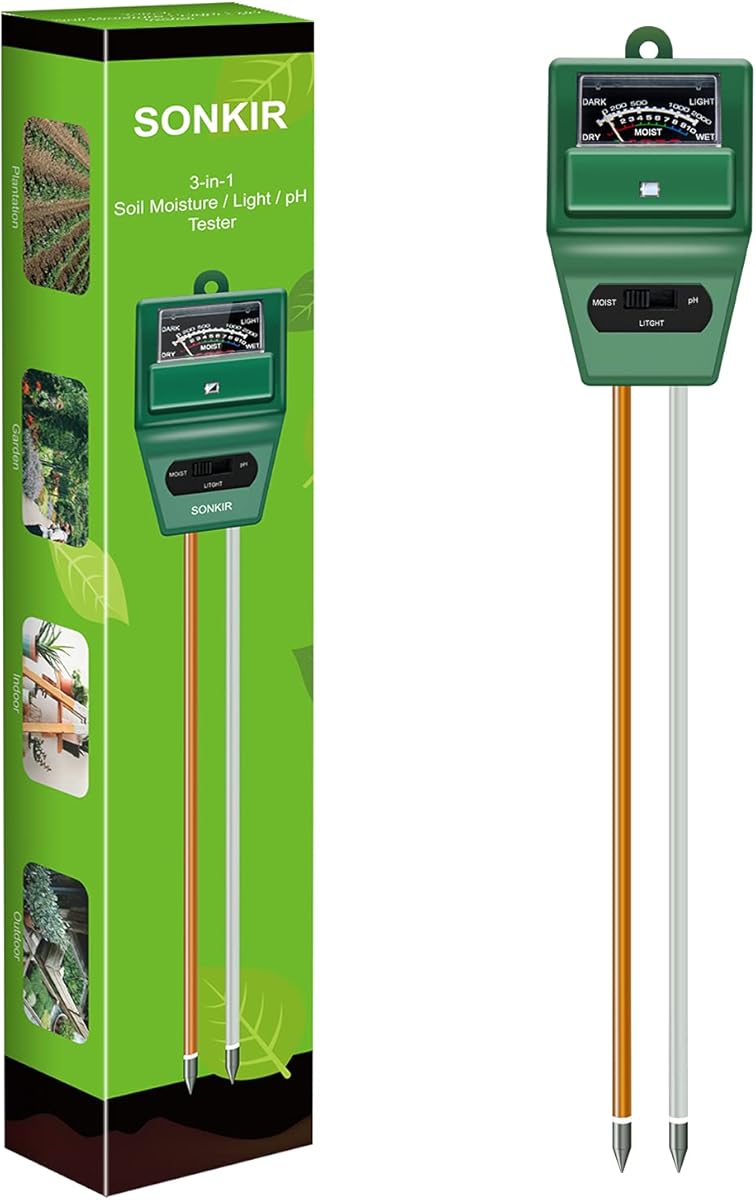
SONKIR MS02 3-in-1 Soil Tester
4.1Editor score
Measures moisture pH sunlight
Requires no batteries
Compact portable design
Compare ten Bluetooth Soil Ph Meters, covering accuracy, soil readings, displays, wireless connectivity, app support, durability, and suitability for home
Bluetooth soil pH meters help gardeners, indoor plant owners, and growers monitor soil conditions without repeatedly guessing when to water, adjust acidity, or replenish nutrients. A useful device should provide clear readings, dependable probes, and records that make changes over time easier to understand. Connectivity is helpful but should complement, not replace, sound measurement fundamentals.
This guide compares ten soil meters spanning simple analog models, handheld digital testers, wireless multi-probe systems, USB sensors, and professional Bluetooth instruments. The comparison considers stated measurement functions, display design, power requirements, probe construction, storage options, portability, and the degree of connectivity offered. Products that lack Bluetooth are included where they represent a compelling practical alternative.
Each numbered review explains who the product is best suited for, highlights meaningful strengths, and acknowledges practical limitations. The Top Picks section identifies the strongest general-purpose choice, budget option, and premium connected model. Product details and availability can change, so readers should verify current specifications, accessories, and prices on the linked listing before purchasing.
4.1Editor score

4.4Editor score

4.0Editor score
This side-by-side comparison shows the range of available soil meters, from simple battery-free readers to wireless monitoring systems and professional Bluetooth pens. It highlights each product's core measurements, connectivity, display, and intended gardening environment so you can select a model that matches your plants and monitoring habits.




This 7-in-1 digital soil tester combines pH, moisture, temperature, light intensity, fertility, EC, and TDS functions in one handheld device. Its 4.4 rating reflects a generally positive reception, while the generous display and broad measurement set separate it from basic moisture-only readers. It is the strongest all-around option here for a gardener who wants more information than a simple three-function meter provides.
We may earn a commission when you buy through this link, at no additional cost to you.
The extra-large LCD and white backlight are especially practical when checking a dense bed, a shaded pot, or a workbench in dim conditions. The listed measurement approach covers soil moisture, pH, temperature, and fertility, while EC and TDS readings extend its usefulness to water-quality checks. Intuitive symbols and numerical displays make the results approachable for beginners, although interpreting EC, TDS, and fertility values still requires some gardening knowledge.
The operating instructions are refreshingly direct: insert the probe about 10 centimeters into the soil, wait roughly 10 seconds, and read the display. The product description also offers sensible protection guidance. It should not be used to measure liquids directly, and very dry or hard soil should be moistened before insertion rather than forcing the probe. Those limitations are reasonable, but the lack of stated Bluetooth or app-based records means it is not the most convenient choice for long-term remote monitoring.
This is our Editor's Choice because it combines an informative screen, quick readings, and a wide range of measurements without forcing users to buy several specialized tools. It suits indoor plant care, raised beds, garden plots, and potted or succulent collections. Choose it when immediate visual readings and versatility matter more than wireless history. For a connected workflow, the Bluelab OnePen is the stronger premium alternative.
Combining seven functions helps users compare moisture, pH, temperature, fertility, and water-related readings without switching between separate instruments. That makes the device useful for routine checks and for investigating unusual plant conditions.
The large backlit display reduces the need to squint at fine text or leave the device outside while checking a result. Clear numbers and symbols are especially valuable for casual users who are still learning what each value means.
We may earn a commission when you buy through this link, at no additional cost to you.
This digital pH tester is designed for users who want Bluetooth connectivity in a compact soil and liquid meter. Its feature set includes a 0-to-14 range, automatic temperature compensation, a backlight, and a hold or temperature button. It can serve hydroponics, gardens, pools, aquariums, wine, beer, yogurt, and sauces, giving it broader potential uses than a dedicated soil-only instrument.
We may earn a commission when you buy through this link, at no additional cost to you.
The conical steel probe is presented as a way to protect the electrode from dirt and physical damage. Bluetooth lets the meter connect to an app for automatic storage and review of pH readings, potentially making it easier to follow a plant's condition over time. Automatic Temperature Compensation is another useful feature because temperature can influence electronic pH readings, while the backlight helps when inspecting a sample in a dim potting area.
A significant buying consideration is that no customer rating is available in the supplied listing information. Some portions of the product description are also incomplete, so prospective buyers should confirm calibration method, included accessories, power source, waterproof rating, and exact app compatibility on the current listing. The description calls the meter waterproof and suitable for several liquids, but it does not provide a detailed immersion specification.
This model makes sense for a gardener who specifically prioritizes Bluetooth record keeping and wants one pH instrument for both soil and liquid testing. It is less suitable for buyers who need moisture, light, temperature, EC, or nutrient readings in the same device. Confirm the manufacturer's instructions and app requirements before buying, because those details are more important than the broad application list when choosing a precision-oriented meter.
App-based storage can reveal whether a plant's pH is trending toward a more suitable range instead of presenting each reading as an isolated number. The practical benefit comes from consistent check-ins and meaningful location notes.
The stated compatibility with hydroponic solutions, pools, aquariums, and food or beverage liquids broadens the device's utility. Users should still follow the proper rinsing, calibration, and immersion instructions for each application.
We may earn a commission when you buy through this link, at no additional cost to you.
This wireless soil meter is built for continuous or semi-continuous monitoring rather than occasional handheld checks. It tracks moisture, soil temperature, fertility, and pH through a leave-in probe, while the controller adds air temperature, humidity, and light intensity. A 3.9 rating places it behind the stronger-rated general options, but the architecture is distinctive and useful for greenhouses, raised beds, and larger gardens.
We may earn a commission when you buy through this link, at no additional cost to you.
The solar-powered probe connects wirelessly to the controller and can remain in the soil. Data refreshes automatically every 20 minutes, while a controller button requests the latest reading manually. The ability to expand the system to 32 probes is a major advantage for users who need to monitor multiple beds, rows, lawns, or crop areas without repeatedly inserting and removing a tester.
The package includes one probe, so shoppers must budget for additional probes if they want the full multi-point capability. Another important detail is that air and light readings come from the controller rather than the buried probe. The controller should therefore be placed in the planting area for an accurate environmental reading. Corrosion-resistant stainless steel, zinc alloy, and aluminum components support outdoor use, but long-term exposure and weather protection still deserve attention.
Choose this system when the main goal is leaving sensors in place and checking a shared display. It is especially attractive for greenhouse growers and gardeners with many separate planting zones. For a single pot or compact indoor shelf, its setup and expansion-oriented design may be more than necessary, making a compact handheld or app-enabled pen a simpler choice.
Keeping a probe in the soil allows the controller to gather updates without repeatedly disturbing root zones or carrying a handheld meter between locations. This is valuable where conditions change quickly or daily monitoring is important.
Support for as many as 32 probes makes the system scalable across separate beds, rows, or plots. A larger installation requires careful placement, labeling, and maintenance so readings remain easy to interpret.
We may earn a commission when you buy through this link, at no additional cost to you.
The SONKIR MS02 is a straightforward three-in-one soil tester covering moisture, pH, and sunlight. Its 4.1 rating indicates a solid level of customer satisfaction, and the battery-free design removes a common source of inconvenience. It is our Best Budget pick because it delivers the measurements most home gardeners check most often without requiring pairing, charging, or app setup.
We may earn a commission when you buy through this link, at no additional cost to you.
Switching between functions takes only a button press, and the readout panel makes the device approachable for beginners. Because it requires no batteries, it is convenient for occasional trips to the garden, quick checks among potted plants, or use in locations where maintaining electronics would be inconvenient. Its compact, portable construction also supports lawn, farm, garden, and indoor plant-care applications.
The important limitation is that the analog display is not a substitute for a connected digital instrument. There is no Bluetooth, automated logging, or temperature compensation, and the device cannot test the pH of liquids. The manufacturer's note also says the indicator may not move in extremely dry soil, so the test area should be watered first. These are meaningful compromises rather than hidden conveniences.
For beginners, occasional gardeners, and anyone who wants a reliable basic check without app management, the MS02 is hard to beat. It is less appropriate for precision-oriented growers who need exact pH values, nutrient analysis, or historical trends. Use it as a quick screening tool and make important watering or soil-amendment decisions using the resulting color indicators in context with the plant's needs.
The analog scale makes basic moisture, acidity, and light checks approachable without learning a complicated interface. Users still need to understand what each color range means and compare it with the requirements of the plant being tested.
Removing batteries eliminates both charging and replacement concerns. That simplicity makes the meter practical for occasional outdoor use, although it also means there is no digital history or wireless transfer of readings.
We may earn a commission when you buy through this link, at no additional cost to you.
The YINMIK digital pH meter focuses on one core job: measuring soil pH without mixing soil into a slurry or estimating a dial pointer. Its 4.4 rating makes it one of the strongest-rated products in the group, and the direct digital reading is a major upgrade over basic color meters for users who need clearer pH information.
We may earn a commission when you buy through this link, at no additional cost to you.
A tapered plastic dibber helps protect the pH electrode while allowing the probe to enter different soil types, including coco coir, potting mixes, sandy soil, and loam. The package includes two dibbers, a cleaning brush, three LR44 batteries, calibration buffer powder, a dropper, a plant pH card, and instructions. These accessories make it easier to maintain the probe and perform periodic checks.
Bluetooth app support allows automatic storage of up to 1,000 readings, and users can add notes identifying where each sample came from. That historical context can be more informative than a single number, particularly when adjusting soil mix, introducing fertilizer, or comparing multiple pots. The device can also test hydroponic nutrient solution, well water, rainwater, and other water used for plants, though liquid testing requires careful technique.
This is a strong choice for indoor plant enthusiasts, balcony growers, and gardeners focused specifically on pH. It is less versatile than the seven-function digital tester because it does not provide moisture, light, temperature, or EC readings. Choose it when accurate pH tracking and app-based notes are the priorities; otherwise, a broader multi-function meter may give more value for everyday plant care.
Inserting the probe directly into the growing medium is faster and less messy than preparing a soil solution. Consistent insertion depth and careful cleaning between samples are still necessary for reliable comparisons.
Recording a pot, bed, or plant alongside each measurement makes stored data actionable. Repeating checks in the same locations creates a clearer picture of whether an adjustment is helping.
We may earn a commission when you buy through this link, at no additional cost to you.
This YINMIK set combines a dedicated digital soil pH tester with a 3-in-1 soil moisture meter that can also report temperature and EC. Its 4.5 rating is the highest among the listed products, making it an attractive option for gardeners who want focused tools instead of a single multifunction device. The two-in-one bundle offers practical specialization while keeping the kit relatively easy to understand.
We may earn a commission when you buy through this link, at no additional cost to you.
The pH tester uses a tapered stainless-steel dibber to protect the electrode and supports direct insertion into different soils without creating a slurry. The moisture meter uses an FDR measurement approach and is stated to identify a soil moisture level of 21 to 40 percent as suitable for most plants. That range should still be treated as a general guide because individual species and soil types have different needs.
The moisture and EC functions can help users assess watering status and nutrient solution conditions, while the pH tester adds a dedicated way to evaluate acidity. The package includes calibration solutions at 4.00 and 7.00, a pH probe solution, a clean brush, a dropper, a tapered steel dibber, and a manual. These calibration accessories are valuable because electrode care and regular calibration determine how trustworthy pH results remain.
Choose this package if you want separate pH and moisture instruments for a plant collection, greenhouse, or small growing operation. It does not offer stated Bluetooth connectivity, so it cannot match the YINMIK app-supported model for recorded pH history. Its strongest argument is instead the combination of a high rating, dedicated hardware, and useful calibration supplies.
Separating pH from moisture measurement reduces mode switching and makes each tool easier to become familiar with. The result is a more organized routine, particularly for users with several plants or repeated monitoring schedules.
Included reference solutions allow periodic checks of the pH electrode. Regular cleaning, correct storage, and calibration are essential if readings are going to be used to guide long-term soil changes.
We may earn a commission when you buy through this link, at no additional cost to you.
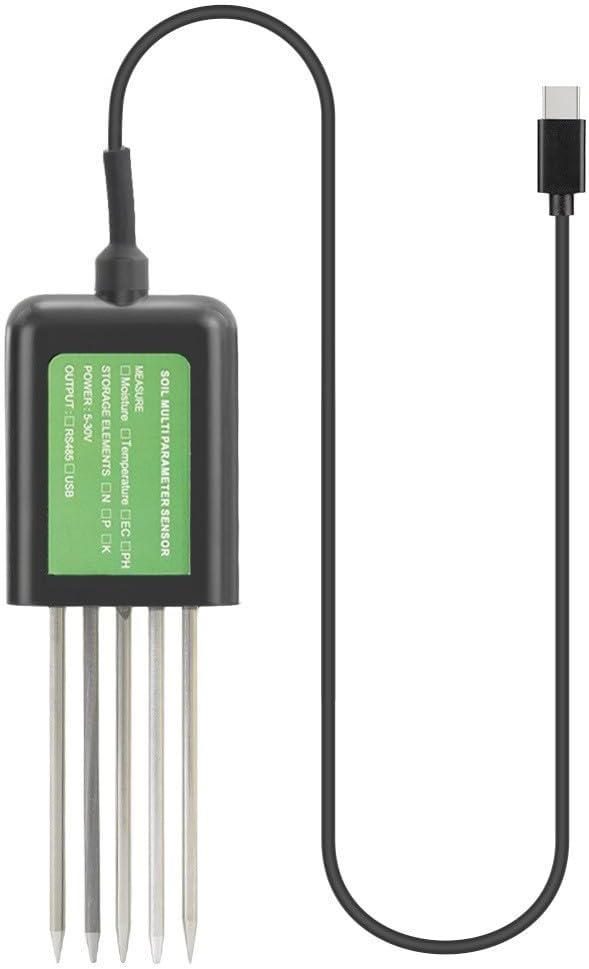
The USB Soil Sensor 7-in-1 is a wired, leave-in analysis tool intended for agriculture, floriculture, landscaping, potted plants, and research. It combines moisture, conductivity, temperature, pH, and NPK measurements in an IP68-sealed body. Its 2.6 rating is the lowest in this comparison, so buyers should examine the current customer feedback carefully and verify the app workflow before choosing it.
We may earn a commission when you buy through this link, at no additional cost to you.
The sensor connects directly to an Android device by USB and presents data through a mobile application. Users can view, save, and export measurements, which is potentially useful for repeated observations across multiple sites. The absence of batteries eliminates charging and battery degradation, while the sealed flame-retardant epoxy construction and metal alloy probe are designed to withstand extended soil exposure.
The most significant compromise is that the listed connectivity is wired USB rather than Bluetooth. Users generally need to connect the sensor to a compatible Android device to retrieve data, and the product is not described as a freely wireless system. A 2.6 rating may reflect setup, app, or reliability concerns that are not detailed in the supplied information. It should not be considered equal to a well-reviewed Bluetooth product without evaluating recent user feedback.
This sensor is best suited to an Android user who values NPK, conductivity, and exportable data over wireless convenience. It may suit a greenhouse, research trial, or agricultural monitoring setup where a tethered sensor is acceptable. For a typical indoor plant collection or mobile garden, a handheld Bluetooth meter will generally be more convenient despite offering fewer parameters.
NPK and conductivity readings can help users investigate soil fertility and nutrient conditions that a basic moisture meter cannot assess. Such values are most useful when interpreted alongside soil type, plant species, and recent fertilizer applications.
The IP68 housing and epoxy sealing are designed for prolonged exposure in soil. Long deployments still require attention to cable routing, connector protection, and the manufacturer's stated operating limits.
We may earn a commission when you buy through this link, at no additional cost to you.
The Bluelab OnePen is a premium three-in-one meter that measures temperature, EC or PPM, and pH. Its 4 rating provides a positive customer signal, while Bluetooth synchronization and Edenic app tracking distinguish it from basic handheld pens. The product is aimed at growers who need dependable measurement performance and organized records rather than a broad collection of soil-specific functions.
We may earn a commission when you buy through this link, at no additional cost to you.
The listing emphasizes rapid stabilization, automatic temperature adjustment, and accuracy stated to plus or minus 0.01. Its replaceable double-junction pH probe uses titanium electrodes, supporting easier maintenance and longer service. The IP68 housing is dustproof and waterproof to one meter, and the device floats, which adds convenience in tanks, reservoirs, and other liquid environments where dropping a meter would be inconvenient.
Bluetooth syncing allows readings to be managed, tracked, and shared through the Edenic app. That makes the OnePen more useful for growers who need to connect data from multiple tools and review trends over time. The high-contrast display remains readable in low light, while the included cap helps protect the probe. It does not measure soil moisture or light, so it functions as a precision water, nutrient, and pH instrument rather than a complete plant-care diagnostic tool.
The OnePen is our Best Premium pick because it combines established professional positioning, rugged construction, replaceable probe technology, and genuine Bluetooth history. It is well suited to hydroponics, greenhouse work, indoor grow rooms, and dedicated pH monitoring. Users should evaluate the higher cost against the value of reliable calibration, durable components, and app-based records.
Automatic compensation helps stabilize readings when sample temperature differs from the calibration environment. This is particularly relevant for hydroponic reservoirs and outdoor liquid samples that can warm or cool quickly.
A replaceable double-junction probe with titanium electrodes can help control the cost and inconvenience of long-term ownership. Routine cleaning, correct storage, and periodic calibration remain necessary to preserve performance.
We may earn a commission when you buy through this link, at no additional cost to you.
The Kelway HB-2 is a no-power analog meter designed to report soil pH and moisture over a broad outdoor area. Its 4.1 rating shows that the product has maintained a favorable customer response despite its traditional design. For users who want fast, repeatable checks without electronics, it offers a direct and durable alternative to app-based tools.
We may earn a commission when you buy through this link, at no additional cost to you.
The stated pH measurement range begins at 3.5 and extends to 8, while moisture is measured from zero to 100 percent. It requires no chemicals, distilled water, or external electrical source, so it can be taken directly to different beds, pots, lawns, or farm locations. Numerous readings can be taken across a large area without a charging routine, which makes it efficient for broad spot checks.
The product has no Bluetooth, digital data export, temperature compensation, or app history. Its pH range is narrower than the full scale offered by many electronic meters, and the conditioning film is not included. The film is a consumable that may be needed to maintain the meter's condition between uses, so buyers should review the instructions and replacement availability before considering it a complete kit.
Choose the HB-2 when fast analog readings, portability, and freedom from batteries matter most. It is less appropriate for users who want precise digital values, historical records, or alerts when conditions change. The best results also depend on following the conditioning and insertion instructions, because misuse can produce inconsistent readings regardless of how simple the display appears.
The ability to take many readings without a battery or external power makes the meter practical for surveying lawns, beds, and other broad planting areas. Consistent insertion and reading conditions are essential for meaningful comparisons.
Users can obtain moisture and pH indications without preparing solutions or operating a complicated interface. The lack of digital records is the trade-off for the straightforward field experience.
We may earn a commission when you buy through this link, at no additional cost to you.
This handheld soil analyzer measures nitrogen, phosphorus, potassium, pH, temperature, moisture, and conductivity. Its 5 rating is the highest numerical score in the group, and the full-color interface, large storage capacity, and computer export set it apart from basic garden meters. It is aimed at users who want structured soil data for agriculture, research, environmental work, or intensive growing.
We may earn a commission when you buy through this link, at no additional cost to you.
The display can query, record, and present data in real time, while the data system is stated to support up to 100W storage entries. Information can be exported to a computer through Excel, allowing users to organize readings, edit them, and print them. The secure rear clip attaches the device to a belt, bag, or backpack, improving portability during field surveys.
The absence of stated Bluetooth connectivity is notable in a category built around modern monitoring. Users must rely on the onboard system and computer export rather than automatic wireless synchronization with a phone. The very high listed product cost also makes this a substantial investment, and the listed availability figures should not be treated as proof that every field measurement is suitable for every application.
This is a compelling choice for agricultural, environmental, industrial, or research users who need NPK analysis and exportable records in one handheld unit. Buyers should verify calibration procedures, accessories, regional support, measurement interpretation, and data-transfer compatibility before purchase. For ordinary indoor plant care, a simpler meter will usually meet the need with less complexity.
Measuring nitrogen, phosphorus, and potassium can help users investigate nutrient imbalances across soil or growing areas. A reading should be treated as a screening tool unless the manufacturer's sampling and calibration instructions are followed carefully.
Storing measurements and exporting them through Excel creates a workable record system for repeated field surveys. Consistent site labels and sampling dates are necessary to make the exported data genuinely useful.
We may earn a commission when you buy through this link, at no additional cost to you.
The right soil pH meter depends on the plants you monitor, the measurements you need, and how you want to use the results. Bluetooth is valuable for records, but probe quality, calibration, readability, and the required measurement range should take priority. Review the following factors before choosing a device.
Prioritize genuine Bluetooth only when the associated workflow improves your decisions. Check whether the meter syncs with a current app, what data the app stores, and whether the manufacturer supports the platform you own.
Choose the smallest set of functions that supports your routine. More parameters are not automatically better if they complicate interpretation or require maintenance your setup cannot support.
Check the manual for the intended medium and insertion procedure. Never force a probe into compacted or dry ground, and avoid using a meter in a way that conflicts with its stated waterproof or soil-use instructions.
Budget time for electrode cleaning, storage, and periodic calibration. A protected or replaceable probe usually adds convenience, but it also requires following the manufacturer's care instructions exactly.
Favor clear units, recognizable icons, and a screen large enough for the locations where you will use the meter. A sophisticated display has little value if its labels are difficult to interpret in bright sunlight or darkness.
Choose power and connectivity methods that fit your routine. Avoid adding automation simply because it is available if manual readings would provide the same useful information with less maintenance.
Look for export formats, app availability, note fields, and the number of stored records. A large history is only useful if you can label samples and understand how the information should be reviewed.
Account for probe protection, sunlight readability, moisture exposure, storage space, and how the device will be carried. A well-matched tool is more likely to be used consistently and correctly.
Begin by learning the plant's expected pH range and the way your chosen meter reports moisture, temperature, EC, or other values. Clean the probe according to the manual, verify the battery or connection, and confirm that the device is in the correct mode. For a Bluetooth model, pair it with its app and check that readings, timestamps, and notes appear correctly before collecting a full set of samples.
Take readings under consistent conditions. Insert the probe to the specified depth without forcing it through roots or stones, wait the recommended settling time, and record the result with the plant name, pot or bed location, and date. Very dry, hard soil should be moistened and allowed to drain before testing. Between locations, rinse and wipe the probe as directed so residue from one medium does not affect the next reading.
Maintain the device by cleaning the sensing area after use, storing the probe as instructed, and recalibrating at the recommended interval. Pay special attention to pH electrodes because contamination and moisture around storage can affect stability. For wireless multi-probe systems, label each probe and check solar or battery status; for USB sensors, protect connectors and verify app compatibility; and for app-based pens, review data exports before retiring or changing devices.
No, Bluetooth is optional for many gardening routines. A simple analog or handheld digital meter can provide an immediate pH reading, while Bluetooth becomes valuable when you want automatic history, trend comparisons, notes, or remote monitoring. Choose connectivity if you will actively use those features rather than paying for them without a clear purpose.
A soil pH meter measures how acidic or alkaline the soil is, while a moisture meter estimates how much water is available in the growing medium. Many combined devices include both functions, along with options such as light, temperature, EC, TDS, or NPK. A useful model should provide the measurements that match your plants and growing method.
Some digital meters can test liquid samples, but you should confirm that the manufacturer explicitly supports hydroponic solution, the expected pH range, and the required immersion depth. Do not insert a soil-only probe into liquid unless the instructions permit it. Rinse the probe as directed and avoid leaving electronics submerged beyond their stated limits.
Calibration frequency depends on the device, how often it is used, and how well the probe is maintained. Check the manufacturer's schedule, but calibration is particularly important after a reading seems implausible, after the probe has dried or become dirty, or before a series of measurements used to guide major soil changes. Use the specified reference solutions and procedures.
Soil composition, moisture, temperature, recent watering, fertilizer use, and insertion depth can all change the result. A small amount of variation is normal, so compare readings taken under similar conditions and in consistent locations. Large differences may indicate calibration, cleaning, or technique issues rather than a sudden change in the soil.
Only if the manufacturer states that the meter supports both. Soil-oriented meters may have different probe geometry, operating limits, and calibration requirements from liquid pH pens. The YINMIK models and the app-connected digital pH meter in this guide state liquid uses, while the SONKIR MS02 explicitly cannot test liquid pH.
No, a rating is only one signal. Reviews can reveal recurring app, calibration, or durability issues, but you should also compare the stated measurements, probe design, connectivity, accessories, and suitability for your plants. The highest-rated model may be excessive for casual use, while a lower-rated feature-rich model may still fit a specialized workflow.
Label each reading with its location, date, plant, and recent watering or feeding history. Taking several samples across a bed can show whether a problem is isolated or widespread, while keeping readings from the same position makes before-and-after comparisons more reliable. Use trends to support decisions, not as a replacement for observing wilt, discoloration, drainage, and other plant symptoms.
The Moisture Meter for Plants 7-in-1 Digital Soil Tester Kit is the most versatile general pick, combining numerous soil and water-related measurements with a large backlit display. The SONKIR MS02 is the simplest budget option, offering moisture, pH, and light readings without batteries, while the Bluelab OnePen is the premium choice for Bluetooth records, temperature compensation, rugged construction, and professional-style measurement features.
Prioritize the functions you will actually use, the quality and care requirements of the probe, and whether the interface fits your experience. A connected meter is most valuable when consistent location notes and historical data can influence watering, fertilizing, or pH corrections. For one-time checks, a simple meter may be more reliable and convenient than an elaborate system you rarely use.
Before purchasing, verify the current listing, app compatibility, included accessories, calibration supplies, power requirements, and warranty information. Specifications and product availability can change, and current prices fluctuate, so compare the final cost against the measurements and connected features you genuinely need rather than choosing solely by rating or feature count.