
Pyle PLMRA402
4.0Editor score
Four-channel marine amplification
Waterproof-ready marine construction
RCA and high-level inputs
This boat amplifiers guide compares 10 marine-rated models for power, channel count, waterproofing, sound controls, connectivity, and installation ease.
A boat amplifier does more than make speakers louder: it controls the clarity, bass, and efficiency of an entire marine audio system. The right model must handle moisture, salt, vibration, limited installation space, and the electrical demands of a vessel while delivering clean power to compatible speakers.
We compared all 10 featured models using their stated channel configurations, power ratings, protection features, crossover controls, connectivity options, and marine construction. The list covers budget four-channel units, powerful multi-channel amplifiers, dedicated bass solutions, Bluetooth models, and premium systems for larger boats.
Each pick identifies its strongest use case, important compromises, and the type of installation it suits best. Amplifier prices and availability can change, so shoppers should confirm the current listing, speaker compatibility, power requirements, and marine warranty details before making a final purchase.
4.0Editor score

4.4Editor score

4.8Editor score
The table below compares the featured boat amplifiers by channel layout, stated power, marine protection, and key control or connectivity features. It is intended as a quick buying reference, with the detailed reviews providing a clearer picture of each model's strengths and limitations.




The Pyle Hydra Marine PLMRA402 is a four-channel amplifier with a stated maximum output of 400 watts and a 4.0 customer rating. Its most appealing qualities are practical marine positioning, flexible source connections, and enough output for a typical multi-speaker installation without moving into the premium tier.
We may earn a commission when you buy through this link, at no additional cost to you.
This model accepts premium RCA stereo inputs as well as high-level connections for marine receivers without RCA outputs. Dual adjustable gain controls, compatibility with 4- or 8-ohm speakers, and a dual MOSFET power supply provide a solid foundation for ordinary boat audio. A heavy-duty aluminum heatsink, thermal overload protection, short-circuit protection, and an LED indicator add practical safeguards.
The main limitation is refinement. The PLMRA402 offers less sophisticated tuning than several higher-ranked alternatives, and its 4.0 rating reflects a product that prioritizes core functionality rather than advanced features. Its IP-01 waterproof-ready designation should also be understood as part of a broader weather-resistant installation strategy rather than permission to leave every connector exposed.
This amplifier is a sensible choice for budget-conscious boat owners who need dependable four-channel power, especially when replacing a basic head-unit-driven system. It is less suited to a large yacht or a build requiring sophisticated crossovers, extensive zone controls, or high-end finishing. For straightforward marine audio on a sensible budget, it remains an easy recommendation.
Boat systems vary considerably in how they deliver audio. RCA and high-level inputs give the PLMRA402 more flexibility than a model designed only for one connection type, which can simplify upgrades involving older receivers.
A heat-dissipating aluminum heatsink, short protection, and gold-plated terminals help the amplifier handle the electrical and environmental demands associated with marine use.
We may earn a commission when you buy through this link, at no additional cost to you.
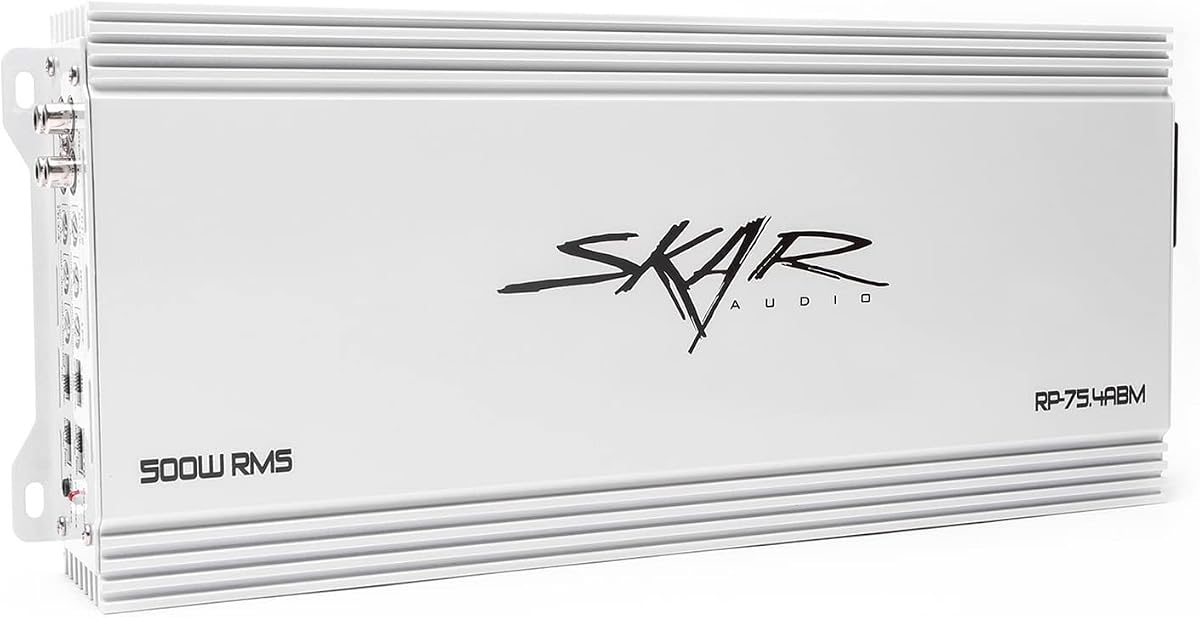
The Skar Audio RP-75.4ABM combines a 4.5 rating with traditional Class A/B architecture and substantial four-channel capability. It is rated at 75 watts RMS per channel at 4 ohms and 125 watts per channel at 2 ohms, making it a convincing choice for powerful full-range marine speakers.
We may earn a commission when you buy through this link, at no additional cost to you.
Its tuning controls include gain, variable low-pass and high-pass filters, and a bass EQ switch with 0, +6, and +12 dB positions. The stated 105 dB signal-to-noise ratio is favorable for clean playback, while four-way protection circuitry is designed to guard against operating faults. Large power and ground terminals support the current demands associated with this output class.
The trade-off is efficiency and installation space. Class A/B amplifiers can run warmer and larger than efficient Class D units, a consideration in tightly packed marine compartments. The waterproof coating on the circuit board and rust-resistant finish of the case support outdoor use, but the model does not include wireless streaming, so a separate source may be required.
Buyers who value clean full-range power and hands-on sound shaping should give this amplifier serious consideration. It is especially suitable for a boat with four conventional marine speakers or paired components where separate high-pass and low-pass control is useful. It is less attractive for minimalist installations where Bluetooth and compactness are the top priorities.
Separate variable high-pass and low-pass controls allow speakers and subwoofers to occupy different frequency ranges. This is more useful than a fixed filter when a mixed marine system includes both full-range drivers and dedicated bass.
Heavy-gauge power and ground terminals are important for stable operation. Their inclusion is particularly relevant for four-channel installations drawing enough current to make proper cable and connection sizing essential.
We may earn a commission when you buy through this link, at no additional cost to you.
The Rockville Atom 8B stands out for fitting eight channels into a relatively compact enclosure measuring 6.7 by 2 by 10.8 inches. Its 4.3 rating reflects a flexible marine amplifier with 3,500 watts of stated peak power and up to 110 watts per channel at 2 ohms.
We may earn a commission when you buy through this link, at no additional cost to you.
Bluetooth with automatic pairing adds useful convenience for streaming from a phone or tablet without a traditional head unit. The amplifier also includes independent crossover control for channels 1 through 4 and 5 through 8, variable HPF and LPF settings from 50 to 250 Hz, adjustable bass EQ, and a built-in voltage display for system monitoring.
Marine protection includes a conformal-coated printed circuit board, stainless steel hardware, and a corrosion-resistant casing. The dense feature set can also make installation more complex than a basic four-channel amplifier requires. Users must match wiring, impedance, and filter settings carefully, especially when pairing full-range speakers with subwoofers.
The Atom 8B is ideal for a larger boat with several audio zones, tower speakers, deck speakers, and additional cabin coverage. Its compact case and wireless source make it convenient for builds without a conventional marine head unit. It is less suitable for buyers who want a simple, dedicated four-speaker installation or a factory-style system that requires no configuration.
Eight individually available outputs can reduce the need for multiple amplifiers in a multi-zone installation. The relatively slim enclosure also leaves more room for wiring and service access in confined marine compartments.
Automatic Bluetooth pairing removes one common obstacle to adding audio to a boat without a dedicated source unit. It is convenient for casual listening, although the amplifier still needs adequate electrical power and correctly wired speakers.
We may earn a commission when you buy through this link, at no additional cost to you.
The Rockville DBM50 earns the Editor's Choice distinction because it combines a versatile five-channel layout with extensive marine protection and serious low-frequency capability. Its 4.4 rating is supported by 980 watts of stated RMS power, including four full-range channels and a dedicated mono subwoofer output.
We may earn a commission when you buy through this link, at no additional cost to you.
The four main channels deliver 120 watts each at 2 ohms, while the mono channel is rated at 500 watts at 2 ohms. Class AB handles the full-range outputs and Class D powers the subwoofer, combining familiar full-range behavior with efficient bass amplification. A 12 dB-per-octave crossover supports low-pass, high-pass, bandpass, and subsonic configurations.
Environmental protection is a major strength. The IPX6 rating, rustproof aluminum heatsink, stainless steel hardware, and conformal-coated PCB are designed for freshwater and saltwater environments. The included PA microphone supports onboard announcements, while a remote subwoofer control provides convenient bass adjustment. The only meaningful drawback is complexity: a five-channel mixed-output system requires more planning than a straightforward four-channel installation.
This amplifier is an excellent match for a boat seeking full-range speakers plus a dedicated subwoofer, particularly one that also needs public-address capability. It can reduce the need for separate amplification for those functions. It is less ideal for very small boats or speakers whose impedance and power requirements do not suit the amplifier's channel arrangement.
The separate mono channel delivers the stated 500-watt output at 2 ohms. That focused allocation makes the DBM50 more effective for bass than a conventional four-channel amplifier forced to handle subwoofer and full-range duties simultaneously.
The included microphone and automatic music ducking make announcements practical without requiring a separate public-address amplifier. This is valuable on larger boats where safety and crew communication may be part of the daily operation.
We may earn a commission when you buy through this link, at no additional cost to you.
The Rockville RXM8BTW is a particularly attractive option when a boat owner wants several amplifier channels and Bluetooth in a single unit. Its 4.3 customer rating reflects a well-rounded design with 1,500 watts peak and 750 watts RMS output.
We may earn a commission when you buy through this link, at no additional cost to you.
The amplifier can produce 65 watts across eight channels at 4 ohms, 95 watts across eight channels at 2 ohms, or 190 watts across four bridged channels at 4 ohms. A 4-channel or 8-channel input selector, adjustable crossovers, RCA line outputs, and bridging give users several ways to configure the system.
Its high-efficiency Class D design should run cooler and use less space than a large Class A/B unit. Four-way protection covers thermal, overload, short, and DC faults. UV and saltwater resistance, conformal-coated circuitry, and stainless steel terminals strengthen its marine positioning. The white enclosure may complement lighter-colored installations, although appearance should never outweigh installation requirements.
The RXM8BTW is well suited to boats with several speaker zones and no desire to install a traditional head unit. Bluetooth auto-pairing makes music access simple, and its compact 6.7 by 2 by 11.5-inch footprint helps with tight installations. It is less suitable for buyers requiring a bundled PA microphone or an explicitly stated multi-mode crossover specification.
Automatic pairing and support for common streaming apps make this amplifier practical as the central audio hub. Users can connect a phone directly and avoid carrying additional source equipment.
The ability to select four-channel or eight-channel inputs and use bridged outputs provides flexibility as a system evolves. It can support multiple speakers without necessarily requiring separate amplification for every zone.
We may earn a commission when you buy through this link, at no additional cost to you.
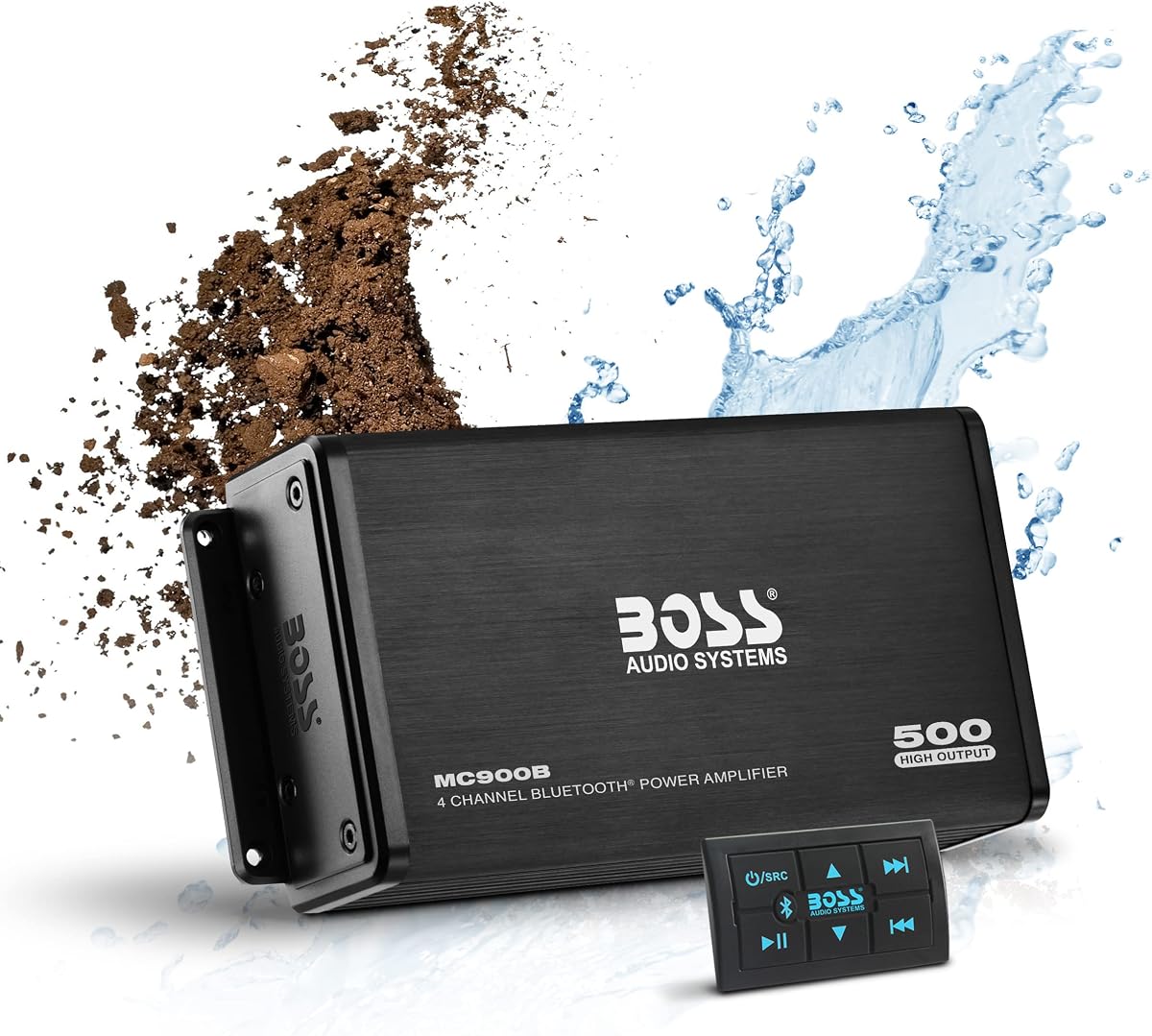
The BOSS Audio Systems MC900B focuses on simple, compact marine amplification with built-in wireless convenience. It has a 4.2 rating, four output channels, and a stated maximum output of 125 watts per channel at 4 ohms, with 94 watts RMS per channel.
We may earn a commission when you buy through this link, at no additional cost to you.
Its defining convenience is the included Bluetooth remote, which allows streaming from a smartphone and supports familiar applications such as Spotify and Pandora without a separate marine head unit. An auxiliary input supports other audio sources, while a USB port can charge connected devices. Its compact 1.75 by 6.6 by 1.75-inch body and 2.9-pound weight are useful where compartment space is restricted.
The enclosure is described as weatherproof for light conditions rather than fully sealed against severe exposure. It can also serve ATVs and other recreational vehicles, making it a versatile option for powersports audio. Its Class AB design and full-range capability suit conventional speakers, but it does not offer the advanced crossover or PA functions found in several Rockville models.
The MC900B is a good choice for a small boat, pontoon, or personal watercraft where an uncomplicated four-speaker system and phone streaming are the priorities. It is less appealing for exposed installations in harsh climates or owners who need dedicated subwoofer amplification and onboard announcements. Professional installation remains advisable for safe, reliable wiring.
Putting Bluetooth, auxiliary input, and charging in a compact amplifier makes the MC900B convenient for installations without a traditional source unit. It can simplify the visual and electrical layout of a smaller vessel.
The stated suitability for boats and ATVs gives buyers more than one possible application. The same four-channel foundation can support a compact marine system or a compatible outdoor powersports installation.
We may earn a commission when you buy through this link, at no additional cost to you.
The Rockville RXM-S6 is built for boats that need more than conventional music amplification. Its six channels can be used in six-, four-, or three-channel arrangements, allowing a single unit to serve full-range speakers, subwoofers, or wakeboard speakers in different configurations.
We may earn a commission when you buy through this link, at no additional cost to you.
Stated performance reaches 2,600 watts peak and 660 watts RMS, including 110 watts per channel at 2 ohms. A 12 dB-per-octave crossover, bass equalizer, and auto-start turn-on provide useful control and integration features. The included PA microphone includes special circuitry that lowers music volume during announcements, making it a practical communications component.
Marine durability comes from a conformal-coated PCB and stainless steel screws designed to withstand moisture, dust, and ocean elements. As with many flexible six-channel units, the number of possible arrangements can be a double-edged feature. Correctly assigning channels, crossovers, and speaker impedances requires care, and buyers should confirm their planned layout before installation.
The RXM-S6 makes sense for mid-size boats, party boats, and watersports vessels where a PA system and several speaker groups are priorities. It offers a strong feature set for its category, although the 4.2 rating suggests some variability in user experience. Those wanting the simplest possible four-channel system may find one of the more basic models easier to configure.
Supporting three different channel arrangements makes the amplifier adaptable to mixed speaker loads. The exact configuration should be planned around speaker impedance and crossover requirements before any wiring begins.
Automatic music reduction during PA use provides a more polished experience than trying to manually lower the source. It is especially useful for captains who need to communicate while music is playing.
We may earn a commission when you buy through this link, at no additional cost to you.
The Rockville RXM-F3 combines a conventional four-channel marine amplifier with a useful PA microphone. Its 4.2 rating and stated output of 1,600 watts peak, 65 watts RMS per channel at 4 ohms, and 95 watts per channel at 2 ohms place it in a practical midrange position.
We may earn a commission when you buy through this link, at no additional cost to you.
Its support for both RCA and high-level inputs means it can work with modern source units as well as receivers lacking preamp outputs. Two- and four-channel modes, auto-start turn-on, and adjustable 12 dB-per-octave high-pass, low-pass, and band-pass filters provide considerable setup flexibility. A 12 dB bass equalizer adds another layer of control.
The conformal-coated circuit board and stainless steel screws are designed to resist moisture, salt, and temperature variation. Bridging is also stated as an option for 2 by 200 watts RMS at 4 ohms, which could suit a compatible subwoofer configuration. The main limitation is that per-channel RMS power is lower than several other four-channel models, so larger or lower-impedance marine speakers may need more careful pairing.
This amplifier is an excellent match for smaller boats that want four-speaker music, a subwoofer option, and onboard announcements without a separate PA amp. It is less suitable for a large installation where every speaker requires abundant power. Buyers should confirm speaker impedances and amplifier stability before bridging or using low-impedance loads.
Both RCA and high-level inputs are valuable in a boat where the existing receiver may be older or lack convenient preamp outputs. That versatility can preserve parts of an existing installation while adding power.
Adjustable high-pass, low-pass, and band-pass filters help separate speakers by frequency. Owners using mixed full-range and subwoofer setups can create a more purposeful allocation of power and frequency range.
We may earn a commission when you buy through this link, at no additional cost to you.
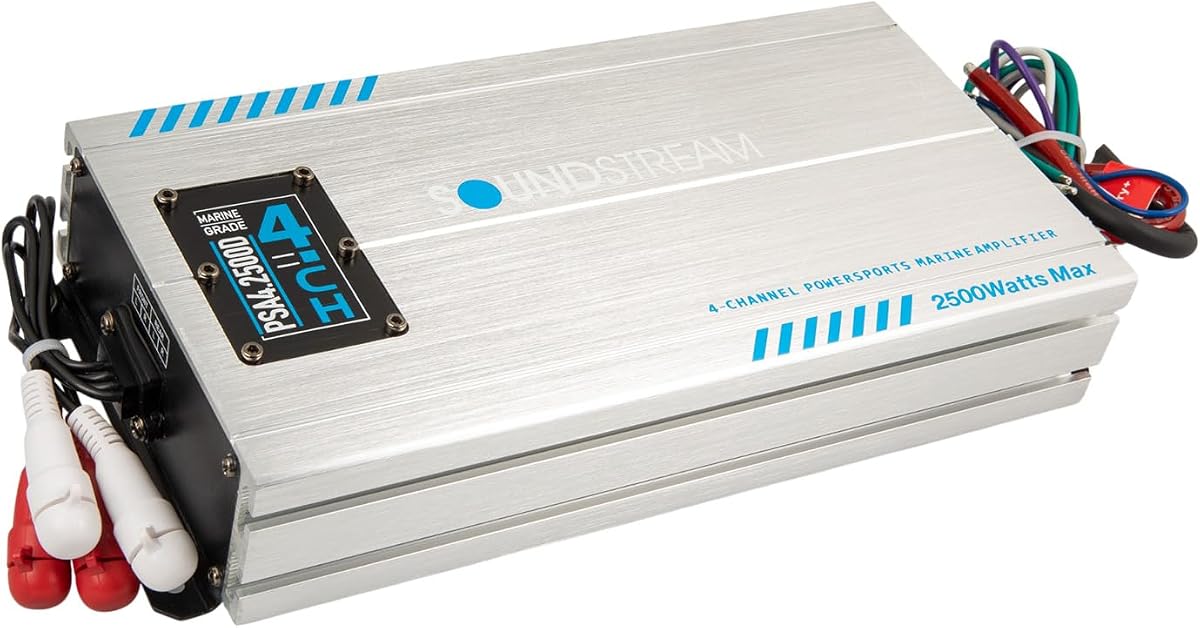
The Soundstream PSA4.2500D is the most aggressively sealed unit in this group, carrying an IP66 waterproof rating and a 4.4 customer rating. Its headline 2,500-watt maximum output and Class D efficiency make it particularly compelling for bass-oriented boat and powersports systems.
We may earn a commission when you buy through this link, at no additional cost to you.
The description identifies variable 12 dB low-pass and subsonic crossovers, adjustable bass boost, a PWM MOSFET power supply, a military-grade PCB, and corrosion-resistant components. These features suit installations exposed to salt spray, mud, vibration, and UV, including wakeboard towers, jet skis, and off-road systems.
Some listed terminology is inconsistent: the product is described as a four-channel amplifier while also being called a compact monoblock, and the stated RMS formatting is unusual. Buyers should therefore consult the current manual and verify exact channel, impedance, and RMS conditions before assuming a particular output configuration. The waterproof claim applies to the housing; connectors and installation still require correct protection.
This model is best for a build where rugged enclosure protection and low-frequency impact are priorities. It is less suitable for shoppers who need confidently stated per-channel figures without checking further documentation. With proper impedance matching, sealed connections, and clean power wiring, however, it offers a compelling combination of marine durability and high output capability.
The IP66 housing rating sets this model apart from many competitors that only describe waterproof coatings or general weather resistance. It is a strong choice for exposed compartments, towers, and other demanding installations.
Class D architecture reduces heat and power demand compared with many conventional amplifier designs. Variable low-pass and subsonic controls make it easier to tune the output for subwoofer use.
We may earn a commission when you buy through this link, at no additional cost to you.
The Kicker KMA600.6 has a 4.8 rating, the highest among the featured boat amplifiers. Its six-channel, 100-watt-per-channel design targets full-range marine audio, making it an appealing centerpiece for a boat with several conventional speakers and a polished installation.
We may earn a commission when you buy through this link, at no additional cost to you.
Marine-oriented construction is a defining strength. Conformal-coated circuit boards repel moisture, while 316L stainless-steel, rust-resistant hardware supports longevity in wet and salty environments. A small footprint helps installers tuck the unit away, and built-in variable crossovers allow the output to be matched more precisely with different speaker types.
The lack of Bluetooth and PA microphone functionality may limit convenience for some buyers, but those omissions are reasonable for a dedicated marine power amplifier intended to work with a quality source unit or compatible signal input. The six full-range channels are more useful when a vessel needs distributed coverage rather than a single amplified subwoofer output.
This is the premium choice for owners who value established marine construction, refined channel flexibility, and the top rating in the group. It can serve tower, cockpit, bow, and cabin speakers when properly configured. Buyers seeking a one-stop wireless entertainment system should look elsewhere, while those building a serious multi-zone marine system may find the KMA600.6 especially compelling.
Conformal-coated boards and 316L stainless-steel hardware address two persistent marine threats: moisture and corrosion. These details are particularly relevant in saltwater environments where ordinary hardware can deteriorate quickly.
Six full-range channels provide ample routing options for a multi-area boat. Built-in variable crossovers add precision when different speaker groups need different frequency ranges.
We may earn a commission when you buy through this link, at no additional cost to you.
Choosing a boat amplifier involves balancing available space, speaker configuration, environmental protection, signal flow, and realistic power requirements. The most important first step is to plan the complete system rather than choosing an amplifier solely by its largest headline wattage figure.
Start with a map of every speaker that needs power and how it will function. Full-range speakers generally require dedicated full-range channels, while a subwoofer often benefits from a dedicated mono output with a low-pass filter. A four-channel amplifier may suit two pairs of speakers, but it does not automatically provide the same control as a five-channel unit with four full-range channels and one dedicated bass channel. Six- and eight-channel models are useful when several speaker zones must be powered from one unit.
Maximum or peak wattage describes a limit rather than the continuous power available under normal listening conditions. RMS output offers a better basis for judging amplifier and speaker compatibility. Compare the amplifier's RMS rating at the impedance of the speakers being used, because output commonly changes at 4 ohms and 2 ohms. More power is not automatically better if the speakers are not designed to accept it or if the vessel's electrical system cannot support the load safely.
Marine exposure includes spray, humidity, salt, dust, sunlight, vibration, and temperature changes. Conformal-coated circuit boards, corrosion-resistant hardware, sealed or protected housings, and suitable connector finishes all contribute to durability. An IP rating offers a more standardized indication of ingress protection, while terms such as waterproof-ready or weather-resistant can vary by manufacturer. The enclosure should be supplemented with properly sealed connections and sound cable routing regardless of the stated rating.
RCA inputs provide a clean path from a marine head unit or signal processor, while high-level inputs allow an amplifier to work with a receiver's speaker outputs. Some models support both, and some include Bluetooth or an auxiliary input for phone-based listening. Check whether the amplifier provides line outputs for additional zones and whether it can accept high-level signals without a separate adapter. The goal is to avoid unnecessary adapters, signal splitters, and complex routing.
Crossovers define which frequencies reach each speaker. High-pass filters reduce low-frequency demand on small full-range speakers, low-pass filters direct bass to a subwoofer, and band-pass options can isolate a particular range. Variable controls are more useful than fixed settings, while adjustable bass EQ can compensate for cabin reflections and open-air listening. A multi-channel amplifier should allow the relevant channel groups to be configured independently.
The available compartment space affects both amplifier selection and installation. Class D designs are generally compact, efficient, and cooler, while Class A/B designs may offer a different operating approach but often require more space. Compare dimensions and weight, not just power. Leave room around the heatsink for airflow, ensure terminals remain accessible for service, and keep the unit away from standing water and poorly secured equipment.
Protection circuitry helps guard against thermal overload, short circuits, overload, and DC faults. A robust heatsink is valuable because it moves heat away from sensitive components and supports stable operation. The amplifier also needs an appropriately sized power fuse, correctly sized ground and positive cables, and clean connections. Marine electrical work should follow the manufacturer's guidance and use marine-rated cable and hardware where appropriate.
Bluetooth is convenient for casual streaming and can eliminate the need for a traditional head unit. A PA microphone is valuable when announcements or crew communication are necessary. Remote subwoofer control, a voltage display, input selectors, and bridged modes can improve usability but also add setup complexity. Choose extras that solve a real need for the vessel rather than selecting an amplifier solely by its longest feature list.
Begin by planning the amplifier location, speaker channels, power route, and signal path before opening the package. Verify that the speaker impedance and intended configuration are compatible with the manual. Connect power and speakers according to the manufacturer's diagram, use the correct fuse, and secure the cables so chafe, vibration, and moving parts cannot damage them.
Set gain and crossover controls conservatively during the first startup. Use a familiar source at a moderate level, adjust the amplifier's input gain to eliminate distortion without excessive drive, and then establish the appropriate high-pass or low-pass range for each channel. Connect Bluetooth or auxiliary sources after the basic system is working, and test PA functions separately to confirm that automatic music ducking behaves correctly.
Marine amplifiers require ongoing care because salt, moisture, and debris accumulate faster than they do on an indoor audio system. With the vessel powered down, inspect exposed connectors for corrosion, clean the enclosure and ventilation openings, and confirm that cables remain firmly attached. Use protective covers for openings when the amplifier is not in use, address moisture immediately, and follow the manufacturer's instructions for cleaning without opening a sealed enclosure.
A marine amplifier is strongly recommended because boat environments expose electronics to moisture, salt spray, vibration, and temperature variation. A conventional automotive amplifier may work briefly, but it is not designed around marine protection or corrosion resistance. A properly selected marine amplifier also makes it easier to match the unit's connections and protection features to the vessel's electrical system.
The correct channel count depends on the number of speaker groups and whether you need subwoofer or PA amplification. A four-channel model commonly handles two pairs of speakers, while a five-channel amplifier can add a dedicated mono bass channel. Six- and eight-channel units are useful for multi-zone boats with tower, cockpit, cabin, or wakeboard speakers.
Four ohms is the speaker's electrical impedance, and the amplifier must be rated to drive that load. Many marine amplifiers produce different RMS power at 4 ohms and 2 ohms. Always check the manufacturer's supported impedance range and never connect a speaker or subwoofer below the allowed load.
Peak power is useful mainly as a marketing reference and can describe brief output conditions. It should not be the primary basis for comparison. RMS power gives a more realistic indication of continuous output and should be checked at the same speaker impedance for every amplifier being considered.
An amplifier with a suitable IP rating may tolerate exposed conditions, but installation requirements still apply. Connectors should be sealed, cables should have strain relief, and openings not in use should be protected. Even a well-sealed amplifier benefits from a sheltered location because heat, salt, and direct weather can shorten component life.
It depends on the amplifier's channel configuration. A five- or six-channel model may include enough flexible routing for a subwoofer, but a dedicated mono amplifier often provides cleaner control and a simpler installation. Choose based on speaker impedance, required crossover settings, and the number of full-range channels you need rather than on the subwoofer's advertised wattage alone.
No. Models with Bluetooth or auxiliary inputs can use a phone or media player as the source, while other marine amplifiers connect to a receiver, radio, or signal processor. A dedicated head unit may provide better weather protection, easier system control, and broader source selection, so it should be considered for boats used frequently or in demanding conditions.
Yes, if its channel count, crossover controls, and output ratings match the zones. A six- or eight-channel amplifier can power cockpit, cabin, and tower speakers, but each group may require different crossover and gain settings. Planning the wiring by zone prevents one group from overwhelming another and simplifies future troubleshooting.
The Pyle PLMRA402 is the strongest budget-oriented choice, while the Rockville DBM50 stands out as the most balanced option for full-range speakers, bass, and PA communication. The Kicker KMA600.6 is the premium selection, combining the highest rating with marine-focused circuit protection, corrosion-resistant hardware, and six flexible full-range channels.
The most important buying priorities are speaker compatibility, continuous RMS power at the correct impedance, and protection against the boat's environment. Channel layout should follow the intended speaker map, while crossover controls, source connections, and installation space should be considered before focusing on headline wattage. A well-matched amplifier will sound better and operate more reliably than an oversized model with incompatible speakers.
Prices, ratings, product details, and availability can change over time, so shoppers should verify the current listing and manufacturer documentation before purchasing. Confirm the exact ASIN, output specifications, impedance limits, connector requirements, and included accessories. Most importantly, use marine-rated wiring, the correct fuse, secure connections, and an installation that leaves the amplifier accessible for service.