
EVAPLUS 54.6V Safe Charger
4.4Editor score
54.6V charging output
UL-certified safety design
Red and green status lights
100-240V universal input
Explore the best electric bike chargers for 48V Ebikes, comparing connectors, safety, charging speed, compatibility, and convenience for daily rides at home.
Finding the right charger for a 48V e-bike involves more than matching a nominal voltage. Connector design, battery chemistry, charging current, protective circuitry, and certification all affect whether a replacement works safely and conveniently with the bike you actually own.
This guide compares ten chargers using the specifications and product information supplied for each model. It examines output voltage and amperage, included connector tips, safety features, LED behavior, portability, and stated compatibility without relying on personal testing claims.
Each review identifies the product's strongest attributes and practical limitations. The list includes budget, general-purpose, high-output, and connector-rich options, while product information changes over time, so shoppers should verify fit and current availability before ordering.
4.4Editor score

4.4Editor score
4.3Editor score
The table below places all ten chargers side by side, focusing on output, connector coverage, protection, and practical features. Because one listing contains a major technical inconsistency, buyers should verify its supplied specifications carefully rather than relying on its product title alone.




The EVAPLUS 54.6V Safe Charger for 48V Lithium Batteries, UL Certified, combines a straightforward charging approach with safety protections and broad mains-input compatibility. Its 4.4 rating reflects a generally favorable buyer response, while the supplied information presents it as a practical option for electric bikes, scooters, and other compatible 48V lithium-powered devices.
We may earn a commission when you buy through this link, at no additional cost to you.
Its standout features include UL certification, automatic shutoff at a full charge, and protection against over-voltage, over-current, and short circuits. Red and green LEDs make the state of the charge easy to understand, and the listed 100-240V AC input makes the charger useful across international mains systems. The product information says a typical 48V 13S lithium battery can charge from empty to full in about four to six hours.
The main limitation is that the supplied listing does not state the charger's output amperage, so buyers cannot compare its charging rate directly with the clearly specified 2A and 3A alternatives. Connector coverage is also narrower, limited to the 5.5 by 2.5mm and 5.5 by 2.1mm DC formats. As with the other chargers in this guide, it should not be used with lead-acid or other battery voltages.
This is a strong pick for someone who owns a common 48V battery with a barrel-style charging socket and wants a simple, certified charger without carrying a large collection of adapters. Before buying, compare the connector dimensions and original charger label. For those needing more plug formats or a known charging current, one of the more fully specified multi-adapter options may be a better fit.
UL certification is a meaningful differentiator in this category because it provides third-party scrutiny of the charger's construction. The listed over-voltage, over-current, short-circuit, and automatic shutoff functions work together to reduce charging risk, while the simple red-and-green indicator removes the need to guess when the battery has finished charging.
The listed 100-240V AC input allows the charger to be used with widely varying wall outlets when an appropriate physical plug is available. That makes it a sensible home-and-travel replacement, provided the connected battery is 48V lithium and the correct DC connector has been confirmed.
We may earn a commission when you buy through this link, at no additional cost to you.
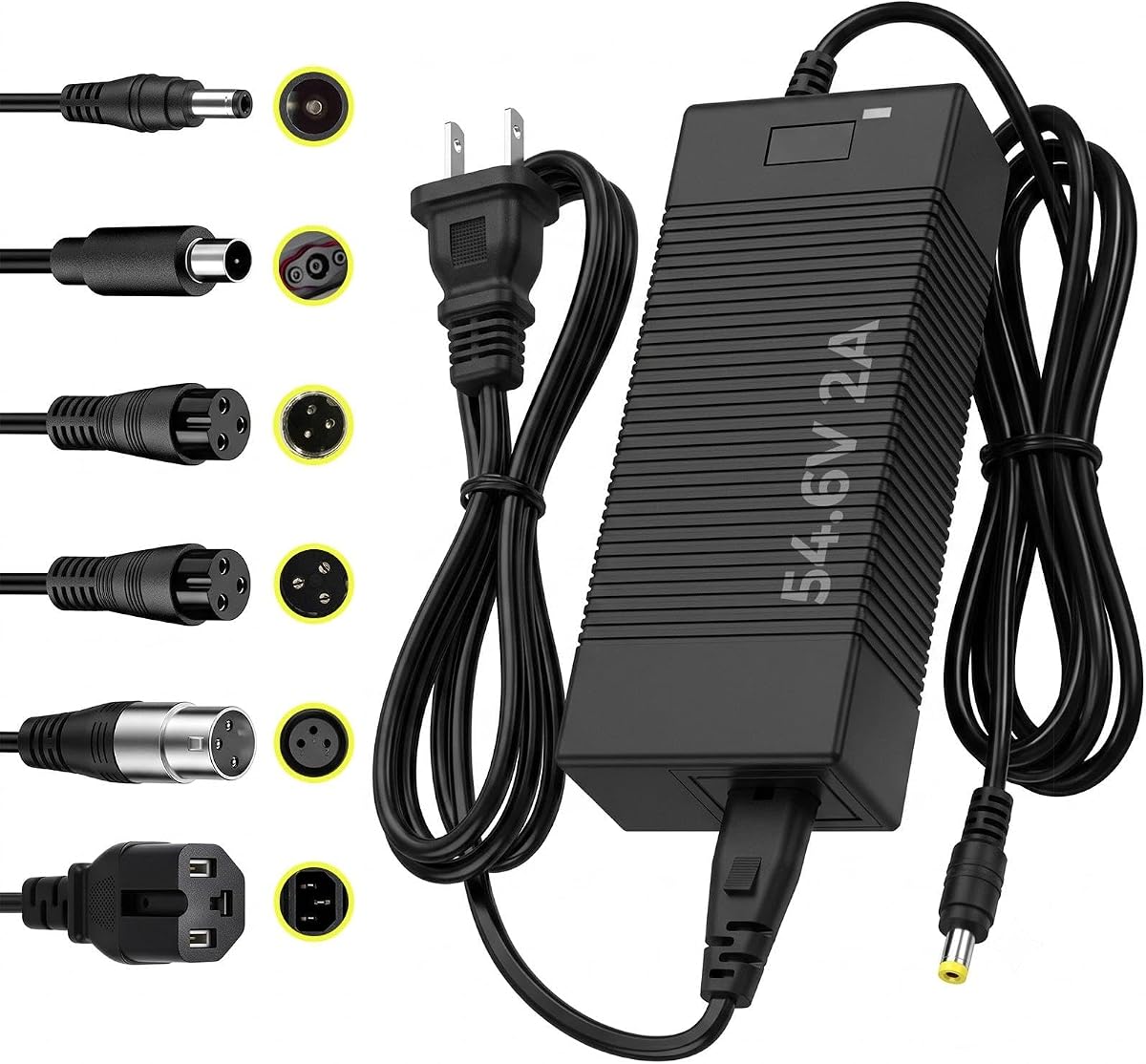
The UL Certified 54.6V 2A Fast Electric Bike Charger for 48V Ebike Battery offers a clearly specified output and a broader set of connection options than the basic EVAPLUS model. It earns a 4.2 rating and is positioned for riders who need more flexibility when replacing a charger for a branded e-bike.
We may earn a commission when you buy through this link, at no additional cost to you.
The included connection formats include DC barrel plugs, a 12mm aviation-style plug, and a Cannon connector, giving it a useful range of options. Its CC-CV operating mode is designed to manage the transition from bulk charging to voltage-controlled charging, and the charger automatically stops when the battery is full. The listed safeguards cover over-voltage, over-current, short circuits, excessive temperature, reverse connection, and fuse-related concerns.
Compatibility claims include Lectric XP 2.0 and 3.0, Ecotric City and Beach, and Evercross H5 and H7 models, but shoppers should still compare the physical port with the supplied charger label. The product listing repeats one feature block, so the text is less polished than it could be. It also states that the unit is not intended for lead-acid batteries, which is an important limitation for anyone with an older pack.
This charger is a practical candidate for owners of one of the named e-bike families or anyone who values several connector formats in one package. Its known 2A output is easy to compare with other products, and the UL-certified designation adds reassurance. Confirm the battery chemistry, port shape, and original output label before ordering, particularly if the bike uses a proprietary connector.
Five connector formats make this model more accommodating for a mixed household of e-bikes and scooters. The barrel, aviation, and Cannon-style options cover many common arrangements, although a listed connector family does not guarantee that every branded model uses the same dimensions and pin arrangement.
CC-CV control is a familiar charging method for lithium packs because it uses a controlled current phase followed by controlled voltage. Automatic termination and the broad protection suite improve convenience, but correct battery pairing remains the most important safety decision.
We may earn a commission when you buy through this link, at no additional cost to you.
The 48V Lithium Battery Charger – UL Listed 54.6V 2A Electric Bike Fast Charger is the most thoroughly documented product in this group. Its 4.4 rating, UL listing, three connector formats, detailed battery-size guidance, and explicit exclusions make it the Editor's Choice for riders who want clarity before making a replacement purchase.
We may earn a commission when you buy through this link, at no additional cost to you.
The charger produces a stated 54.6V at 2A and uses a three-in-one connector approach covering 5.5 by 2.5mm and 2.1mm barrel plugs, a 12mm three-pin plug, and an 18mm XLR plug. Its protection package includes over-voltage, over-current, short-circuit, and overheating safeguards, while the V0-rated casing adds a flame-retardant layer. The information also emphasizes silent operation, intelligent temperature control, automatic shutoff, and 100-240V input.
A major strength is the unusually clear compatibility guidance. The listing identifies numerous battery capacities and e-bike brands, then explicitly says not to use the charger with 24V, 29.4V, 36V, 42V, 52V, 58.8V, 60V, 67.2V, 72V, or 84V batteries. It also excludes lead-acid, LiFePO4, scooters, hoverboards, and golf carts. Those limitations may look restrictive, but they reduce the risk of using an unsuitable charger.
This is the best general recommendation for a conventional 48V 13S lithium e-bike battery whose port matches one of the three included formats. The 2A output offers a sensible balance between faster replenishment and compact operation, while the fanless design is convenient in a garage or living space. Buyers should still inspect the battery label and charging socket, and confirm compatibility before connecting power.
Detailed voltage and chemistry exclusions make this listing easier to use safely than many generic charger descriptions. Listing compatible capacities, named brands, and specific model families is helpful, but it cannot replace checking the port and original charger label because manufacturers can change connectors within a product line.
The fanless design avoids the sustained mechanical noise associated with many actively cooled chargers. Combined with the stated smart temperature control, it offers a practical option for overnight charging, while the V0 housing and electrical protections support routine use.
We may earn a commission when you buy through this link, at no additional cost to you.
The QKIIP 54.6V 2A Charger for 48V Ebike Scooter Lithium Battery, 7 Plugs stands out for connector variety and concise pre-purchase guidance. Its 4.4 rating indicates a positive customer reception, and the seven-tip package is designed to cover a wide range of e-bike and scooter charging ports.
We may earn a commission when you buy through this link, at no additional cost to you.
The charger supplies 54.6V at 2A and includes 5.5 by 2.1mm and 5.5 by 2.5mm barrel plugs, a 12mm three-prong connector, a 9mm mini three-prong connector, an 8mm RCA connector, a three-pin XLR connector, and a three-prong female universal option. That variety makes the unit attractive for owners of several 48V devices or for anyone who wants to keep one charger capable of handling different port standards.
Its charging system uses a stated three-stage CC/CV process, and the protection features include over-voltage, over-load, over-current, over-temperature, and short-circuit handling. The red and green indicators simplify status monitoring. The listing is also admirably clear about its limits: it applies only to 48V lithium batteries, not lead-acid, 36V, 42V, 24V, or 52V packs.
This is a strong fit for a household with mixed 48V e-bikes and scooters, especially one that wants to avoid keeping a separate adapter for every device. The tradeoff is that the numerous tips can be cumbersome to sort and store. Confirm the battery's voltage, chemistry, original 54.6V output, and physical port before ordering, because connector appearance alone can be misleading.
The broad plug package includes common barrel, aviation-style, RCA, XLR, and universal formats. That makes it convenient for riders supporting several compatible devices, although the correct tip must still be selected by measuring the charging port rather than relying on the bike's brand name alone.
The listing asks buyers to verify three things: a 48V lithium battery label, an original 54.6V charger output, and a matching port. This focused checklist is more useful than vague statements about universal compatibility because it directly identifies the information needed to avoid an unsuitable charger.
We may earn a commission when you buy through this link, at no additional cost to you.
The SGS Certified 54.6V 2A Fast Electric Bicycle Charger for 48V Ebike Battery combines a seven-plug approach with a clearly stated output and a substantial safety section. Its 3.9 rating is the lowest among the ten products here, but the supplied specifications present a focused charger for 48V 13S lithium battery packs.
We may earn a commission when you buy through this link, at no additional cost to you.
The listed protections cover over-voltage, over-current, short circuits, and excessive temperature, and the enclosure is described as V0 flame retardant. The product information also says each charger passes aging tests before shipment. Its charging output is 54.6V at 2A, with automatic shutoff and red charging and green completed LEDs providing straightforward monitoring.
Connector coverage includes 5.5 by 2.1mm and 2.5mm DC plugs, 9mm and 12mm three-prong options, an 8mm RCA plug, a three-pin male XLR connector, and a universal IEC plug. The tradeoff is that the adapter range can add clutter, and a plug being included does not guarantee the same pin configuration as the bike's original connector.
This charger is most appropriate for a 48V 13S lithium e-bike or scooter whose charging socket matches one of the supplied tips. It should not be considered for 24V, 25V, 29.4V, 36V, or 42V batteries, nor for lead-acid packs. Buyers should compare the product with higher-rated options if customer feedback consistency or broader brand-specific guidance is a priority.
Limiting the charger to 48V 13S lithium systems reduces the risk of accidental use with common mismatched voltages. It also makes the product less suitable for mixed-device households, since other nominal voltages and battery chemistries are explicitly excluded.
Over-temperature and short-circuit protection are especially relevant during extended charging sessions. The flame-retardant V0 enclosure and reported aging process complement the electrical safeguards, although certification details and labeling should always be checked on the actual unit.
We may earn a commission when you buy through this link, at no additional cost to you.
The 54.6V 2A Ebike Electric Scooter Charger for 48V Lithium Battery, 5 Adapter Plugs Fast Replacement Charger offers a middle-ground combination of known output, five adapters, and basic status monitoring. Its 4.3 rating places it among the stronger-rated products in the comparison.
We may earn a commission when you buy through this link, at no additional cost to you.
The charger is designed for 48V lithium-ion batteries and supplies a 54.6V 2A output. Five adapter plugs are included to increase the chance of matching common e-bike and scooter ports. Its protection features cover overcharging, short circuits, over-voltage, and over-current, while solid red indicates charging and solid green indicates a completed charge.
The listing names Rad Power Bikes, Velotric, Heybike, Juiced, and Ecotric as compatible brands, but those claims should be treated as a starting point rather than proof of fit. Compared with the seven-tip models, this package offers less connection coverage, and the supplied information provides fewer battery-capacity and model-specific details. It also does not clearly warn against every incompatible chemistry.
This model is a reasonable choice for a common 48V lithium bike with one of the five supplied connections, especially when the buyer prefers a smaller adapter bundle. Confirm the charger's output against the original label and measure the port before ordering. A seven-tip charger may be more practical for a household with multiple devices or unusual charging sockets.
Five plugs cover many mainstream charging arrangements without creating the clutter of a larger kit. For a single-bike owner, this can be easier to manage, while riders with several brands may prefer one of the seven-connector alternatives.
Solid red during charging and solid green when full make the indicator easy to interpret at a glance. Automatic charging behavior and overcharge protection help support unattended charging, provided the battery, voltage, and connector have all been verified.
We may earn a commission when you buy through this link, at no additional cost to you.
The 54.6V 2A Fast Charger for 48V Lithium Ebike & Scooter Battery, 6 in 1 Plugs carries a 4.4 rating, but its supplied product information contains a major inconsistency. The title presents it as a 48V e-bike charger with six plug options, while the detailed bullets describe a dedicated 12V LiFePO4 charger with 14.6V output, 20A current, Anderson connectors, and M8 ring terminals.
We may earn a commission when you buy through this link, at no additional cost to you.
The detailed description highlights useful features for a different battery class: 0V recovery, CC/CV control, tail-current cut-off below 0.5A, protection against reverse polarity and overheating, and dual high-velocity fans. It claims the ability to recharge a 12V 100Ah LiFePO4 battery from 30% to 100% in two hours. Those features may belong to another product, but they cannot be safely transferred to a 48V e-bike recommendation.
This conflict is significant because charging voltage and current must match the battery's chemistry and cell configuration. A charger described as producing 14.6V is not a substitute for a 54.6V charger for a 13S 48V pack, regardless of connector availability or the title's wording. The lack of six-tip details in the supplied bullets further weakens the case for treating the listing as a confirmed 48V charger.
As a result, this product should not be ordered for a 48V e-bike unless the seller or manufacturer confirms that the physical unit, output label, and connector set match the listing title. The other nine choices provide far more consistent 48V specifications. This review preserves the supplied rating and title, but the recommendation is to verify before purchase rather than rely on the apparent category match.
A charger must match a battery's cell arrangement and chemistry, not merely its advertised device category. Because the details describe a 14.6V LiFePO4 system rather than a 54.6V lithium-ion system, connecting this charger to a 48V 13S pack could be unsafe.
The described Anderson connector, M8 terminals, cooling fans, and three-stage algorithm may be effective in a correctly matched high-capacity charging system. However, these attributes cannot establish compatibility with a 48V e-bike while the listing provides contradictory voltage and battery information.
We may earn a commission when you buy through this link, at no additional cost to you.
The 48V Electric Bike Charger 54.6V 2A Fast Charger, 13S Lithium Battery Charger with 5 Plugs has the highest listed rating in this comparison at 4.6. Its combination of a stated 54.6V 2A output, five interchangeable plugs, and broad device positioning makes it an attractive general-purpose option.
We may earn a commission when you buy through this link, at no additional cost to you.
The charger is designed around 48V 13S lithium battery packs and includes protection against over-voltage, over-current, short circuits, and overheating. Its low-noise design and heat-dissipation structure are useful for home charging, while a compact, wear-resistant shell supports portability and travel backup use. Red-and-green status behavior is implied by the listed auto-shutoff and indicator information.
One limitation is that the supplied description does not mention a named third-party safety certification. That does not mean the product lacks safeguards, but it offers less documented certification information than products labeled UL, ETL, or SGS in this roundup. Compatibility language also spans e-bikes, scooters, and one-wheel devices, so buyers should focus on the specific 13S lithium requirement and confirm the connector dimensions.
This is a compelling choice when the highest customer rating, known 2A output, and five-tip convenience are the main priorities. It is particularly suitable for a portable backup charger that must cover several common 48V devices. Confirm the output label and charging port before ordering, and inspect the actual unit for certification markings when safety documentation is a major concern.
The compact enclosure, low-noise operation, and durable shell make this charger easy to keep with the bike or store separately from home equipment. That portability is valuable for riders who split time between locations or need a backup charger for travel.
A 2A charging output offers more capacity than a typical low-output replacement while remaining easy to compare with other 48V options. Five interchangeable plugs cover a broad selection of common charging ports without the size of a seven-tip kit.
We may earn a commission when you buy through this link, at no additional cost to you.
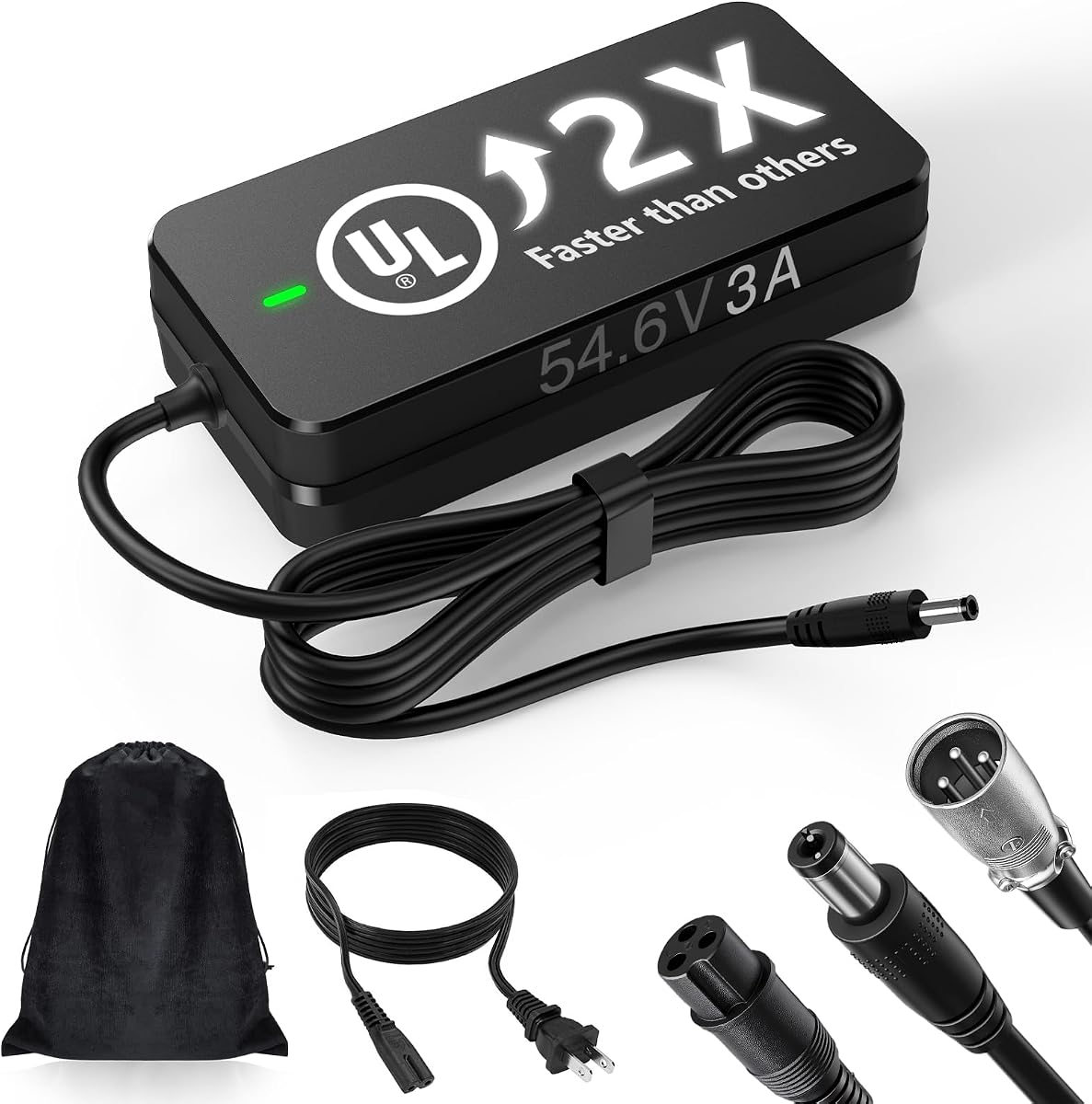
The UL Certified 54.6V 3A Faster ebike Charger for 48V Lithium Batteries is the premium, high-output option in this guide. Its 4.3 rating reflects solid buyer feedback, while the stated 3A current and intelligent temperature control distinguish it from the numerous 2A alternatives.
We may earn a commission when you buy through this link, at no additional cost to you.
The product information says a 48V 15Ah battery can be charged fully in about five hours and describes performance as twice as fast as a standard 1.5A charger and 50% faster than a 2A charger. It lists compatibility with a wide range of 48V lithium-ion capacities and brands, including TST and ESKUTE, as well as specific Lectric and Ecotric families. The connector system covers common barrel sizes plus 12mm and 18mm options.
Safety is a major focus, with UL certification, temperature control, a V0 fire-resistant case, and protection against over-voltage, over-current, short circuits, and excessive temperature. Red and green LEDs track charging and standby, while automatic shutoff or a transition to trickle current provides a clear termination method. The V0 enclosure and thermal management are particularly relevant for a unit designed to deliver more current than the standard options.
This is the best choice for a rider with a compatible 48V lithium e-bike who prioritizes faster replenishment and detailed safety construction. Buyers should still verify that the battery and charging port are supported and understand that this charger is not for LiFePO4, lead-acid, or other nominal voltages. The three-connector format is broad but smaller than the seven-tip alternatives.
The 3A output is the distinguishing feature in this guide and can reduce waiting time when the battery and charger are otherwise compatible. Intelligent temperature control is an important companion feature because sustained higher-current charging creates more heat than lower-current charging.
UL certification, a V0 fire-resistant case, four core electrical protections, and automatic termination create a well-documented safety framework. The included connector options and extensive compatibility notes make the premium option practical for a range of popular 48V e-bike families.
We may earn a commission when you buy through this link, at no additional cost to you.
The ETL Certified 48V Electric Bike Charger, 54.6V 2A Fast Charger for 13S Lithium Battery combines a documented certification designation with seven interchangeable plugs. Its 4.4 rating makes it one of the better-rated products here, and it is a strong option for households seeking broad connector coverage.
We may earn a commission when you buy through this link, at no additional cost to you.
The listed 54.6V 2A output is intended for 48V 13S lithium-ion battery packs. Its connector collection includes 5.5 by 2.1mm and 2.5mm barrel plugs, 9mm and 12mm three-prong plugs, an 8mm RCA connector, a three-pin XLR connector, and an IEC plug. The product information names Razor, Gotrax, Jetson, Ninebot, and other brands, while also mentioning e-bikes, scooters, and hoverboards.
Safety features include over-voltage, over-current, short-circuit, and temperature protection, plus an intelligent temperature-control system. Aviation aluminum plugs and high-density wiring are intended to resist wear, rust, and oxidation. Red and green LEDs indicate charging and completed charging, and the charger is described as maintaining the battery automatically once connected.
This charger is a good fit for a 48V 13S lithium device that uses one of the seven supplied connections. It should not be used with 24V, 25V, 36V, or 42V systems, nor with lead-acid batteries, despite the broad list of supported device categories. Because brand compatibility can depend on the exact model and production year, physical port verification remains essential.
The 54.6V output and 13S designation are aligned for conventional 48V lithium-ion e-bike packs. ETL certification adds a documented safety dimension, while the protections and temperature management cover several common electrical and thermal fault conditions.
The seven interchangeable plugs give this charger an advantage for owners of several brands or device types. Aviation aluminum plug construction is intended to preserve contact quality over repeated daily use, though each connection still needs to be selected carefully.
We may earn a commission when you buy through this link, at no additional cost to you.
A safe charger purchase starts with the battery rather than the e-bike's marketing name. Voltage, cell configuration, chemistry, connector geometry, and original charger output determine which replacement is appropriate.
Use only a charger that explicitly supports the battery's voltage and chemistry. Reject any listing whose detailed specifications conflict, even if the product title claims 48V compatibility.
Choose a charger with the correct connector, and consider a multi-tip model only if you actually own several devices. The right connector is more important than having the largest possible adapter assortment.
A clearly specified 2A charger is often the easiest balance for conventional 48V packs, while a 3A model is appealing when faster replenishment is important and the battery is explicitly compatible.
Prioritize chargers with multiple electronic protections, automatic termination, and a credible certification designation. These safeguards matter most during unattended overnight charging.
Look for automatic full-charge handling rather than relying solely on manual monitoring. Clear LED status behavior is especially useful when the charger operates in a garage or another location outside direct view.
Choose a broad connector bundle for mixed fleets, but prioritize the exact port your primary bike uses. Compatibility is more useful when the charger is safely matched, not when it merely contains many tips.
Consider where the charger will live and whether noise or heat matters. Do not cover the unit during charging, and ensure it is placed on a stable, nonflammable surface.
Favor products with consistent specifications and identifiable safety information. If a listing describes a different battery chemistry or voltage than its title, treat that as a reason to pause rather than assume the headline is correct.
Before connecting anything, read the charger's output label and the battery's specifications. Confirm that the battery is a compatible 48V lithium-ion pack, verify the required 54.6V output for the common 13S configuration, and select the connector that fits the charging port correctly. Never force a plug or use an adapter that changes the electrical arrangement.
Place the charger on a stable, hard, nonflammable surface in a dry, ventilated area. Keep the battery and charger away from excessive heat, moisture, children, and pets. Do not cover the charger while it operates, and route the cable so it cannot be pinched, stepped on, or pulled out of the socket.
Connect the charger to the battery and the wall as directed by the battery manufacturer. Use the red and green indicators to monitor progress, but also follow any application-specific instructions supplied with the battery. Disconnect the charger when charging is complete if the manufacturer recommends it, inspect the connector for dirt or damage periodically, and never use a charger with a cracked housing, discolored wiring, or a connector that fits loosely.
Most conventional 48V e-bike batteries use a 13S lithium-ion configuration and require a charger with a 54.6V output. Check the battery and original charger labels rather than assuming every 48V pack is identical. A charger with the wrong voltage or chemistry can fail to charge the battery correctly or create a safety risk.
A 3A charger can charge faster when the battery and manufacturer support the higher current, while a 2A charger may be the more moderate general-purpose choice. The battery's charging recommendations should take priority over a general desire for speed. It is also important to consider heat, connector fit, and the charger's protection features.
No. A 54.6V charger intended for a 48V 13S pack should not be connected to a 36V battery because its charging voltage is too high. Batteries with different cell counts, alternate chemistries, or proprietary charge requirements need a charger explicitly designed for them.
Connector diameter alone may not be enough because outer diameter, inner diameter, center-pin size, and pin arrangement must all match. Measure the port and compare it with the charger's stated plug dimensions. For three-prong connectors, also verify the configuration rather than relying only on the shape.
No. Multiple plugs increase the chance that one will physically fit, but a fitting plug is not the same as an electrically compatible connector. The battery voltage, chemistry, charging profile, connector dimensions, and pin arrangement all need to match. Confirm the original charger specifications before using an included tip.
Across the chargers in this guide, red generally indicates active charging and green indicates a full charge, disconnected state, or standby. The exact behavior can vary by model, so the product instructions remain authoritative. If a light changes unexpectedly or the battery does not charge, disconnect the charger and verify compatibility.
It can if every battery has the same required voltage and chemistry and each uses a connector configuration included with the charger. A seven-tip model offers greater flexibility for mixed fleets, but riders should label adapters and verify each bike's original charger label. Do not assume that a 48V marking guarantees electrical compatibility.
Overnight charging may be appropriate when using a charger specifically approved for the battery and equipped with sound automatic termination and protection. Place the charger on a hard, ventilated surface and follow the battery maker's guidance. Unattended charging is best avoided with damaged cables, mismatched connectors, uncertified units, or signs of abnormal heat.
The EVAPLUS charger offers a simple, UL-certified option for standard barrel connectors, the Hyleton 54.6V 2A model stands out for exceptionally clear compatibility documentation and three included connector formats, and the Hyleton 54.6V 3A provides the highest stated charging current with premium safety and thermal features. Each serves a different need while remaining focused on conventional 48V lithium-ion systems.
Start with the battery label, original charger label, and physical charging port. Match voltage and chemistry first, connector second, and charging current third. The QKIIP and ETL options are worth considering for broader plug coverage, while the 3A Hyleton is attractive for riders who value faster replenishment and detailed protection features.
Product specifications, certification claims, connector availability, and current marketplace details can change, so review the seller's latest listing before purchasing. Avoid relying on a headline alone, particularly for any listing with inconsistent technical information. With those checks completed, the right charger can provide safer, more convenient charging for the compatible 48V e-bike battery you own.