
25W 12V Linear Power Supply
4.6Editor score
Low-noise 12V regulation
25VA sealed toroidal transformer
Maximum 1.5A output
5.5/2.5mm DC connector
Full aluminum enclosure
Linear power supplies for audio compared for noise, power, outputs, protection, compatibility, and overall value across ten premium models.
Linear power supplies for audio can give sensitive components a quieter and more stable source of DC power than ordinary wall adapters. The right model depends on voltage, current, connector, noise control, isolation, and whether you need to power one device or several. A well-matched unit can also simplify a compact listening setup by reducing adapter clutter.
We compared ten linear power supplies using the specifications and feature descriptions supplied for each product. The list covers desktop models, multi-output units, fixed-voltage options, and specialized supplies for compatible DACs, streamers, preamps, headphone amplifiers, routers, and other audio or digital equipment. We focus on electrical design, usable output, installation considerations, and device support.
Each review explains the product's strongest traits, limitations, and ideal system role, helping you move from a general shortlist to a more informed choice. The top selections include a versatile overall option, a value-focused model, and a premium supply with substantial power reserves. Product listings and prices can change, so confirm the latest specifications and availability before purchasing.
4.6Editor score

4.0Editor score

5.0Editor score
This side-by-side comparison highlights output voltage, current capacity, filtering, and compatible device types so you can identify the most appropriate supply for your audio system.



The Fosi Audio PSU20 is a multi-output linear supply built for desktop hi-fi systems that combine several low-voltage components. It carries a 4.0 rating and stands out for offering selectable 5V, 12V, and 15V outputs alongside two DC sockets and one USB-A port. Its 80W custom toroidal transformer, stated 100W peak capability, and very low 0.1mV ripple target make it a flexible central power source.
We may earn a commission when you buy through this link, at no additional cost to you.
Its greatest strength is the range of connections. Independent rectification, filtering, and regulation are provided for the outputs, while isolated grounds are intended to reduce ground-loop interference. A buyer can use the 12V setting for a compatible DAC, the 15V setting for another component, and USB-A for an additional low-voltage accessory. The front-panel indicators make output selection straightforward without requiring the user to guess which mode is active.
The main trade-off is the inclusion of a 30dB cooling fan. Linear supplies can become warm, particularly when powering several devices, so active cooling may be useful in a confined listening area. Even so, the stated noise level and cooling specification do not guarantee that the fan will be inaudible in every room or system. Buyers sensitive to mechanical noise should place the unit on a stable surface and leave clearance around its ventilation.
The PSU20 is a strong recommendation for a streamer, DAC, headphone amplifier, CD player, or other compatible equipment that needs dependable low-voltage DC power. It is especially attractive when replacing several generic adapters would reduce cable clutter. Confirm the voltage, current, connector, and polarity requirements of every intended device before use, and choose this model when broad integration matters more than a completely fanless design.
The two isolated DC outputs and USB-A connection make the PSU20 more adaptable than a single-output desktop supply. It can organize a compact system without forcing every component to share the same wall outlet.
The low-noise design, selectable voltages, and front-panel indicators make this a practical choice for DACs, streamers, headphone amplifiers, and compatible Fosi components.
We may earn a commission when you buy through this link, at no additional cost to you.
The Douk Audio D2-PRO is a fixed 12V linear supply aimed at compact hi-fi installations. It has no published customer rating in the supplied data, but its technical specification is focused and persuasive: up to 35W of output, 2.5A current capability, two DC outputs, and a stated ripple measurement of 28μV RMS under no-load conditions. The architecture combines a sealed toroidal transformer, EMI suppression, rectification, matrix filtering, and an LDO regulator.
We may earn a commission when you buy through this link, at no additional cost to you.
The detailed filtering chain is the model's main attraction. Rather than relying on a basic series regulator, the D2-PRO uses several stages to reduce grid interference and smooth the DC output. Its dual outputs can serve two compatible devices from the same regulated source, reducing the need for separate adapters without necessarily combining their current requirements beyond what the unit can deliver.
The fixed voltage is both a strength and limitation. A 12V unit is straightforward for popular DACs, preamps, headphone amplifiers, streamers, digital interfaces, audio switches, and network switches, but it will not directly serve equipment that needs 5V, 15V, or another level. The no-load ripple figure also does not represent every operating condition, so users should consider output stability under real load as well.
This is a compelling option for building a small, tidy 12V audio setup where measured low ripple and dual outputs are priorities. It suits buyers who have already identified compatible equipment and want a focused power source rather than a universal supply. Verify the required connector and current, and check both outputs' combined load before connecting multiple devices.
A sealed toroidal transformer, EMI suppression stage, high-speed rectifier, matrix filtering, and LDO create a layered approach to clean 12V power.
The dual DC outputs suit space-conscious setups using compatible DACs, preamps, headphone amplifiers, streamers, and network audio accessories.
We may earn a commission when you buy through this link, at no additional cost to you.
The 25W 12V linear supply is a straightforward desktop solution for compatible audio equipment. Its 4.6 rating is the second-highest available figure in this group, and its 25VA sealed toroidal transformer, EMI filtering inductor, precision reference, high-speed op-amp, and MOSFET output stage indicate attention to the basic elements of low-noise regulation.
We may earn a commission when you buy through this link, at no additional cost to you.
This supply targets DACs, headphone amplifiers, digital transports, and digital players that accept 12V DC. The listed maximum current is 1.5A, with a 5.5/2.5mm output and a full aluminum case. That combination keeps the unit relatively simple while still adding a durable enclosure and effective heat dissipation, two useful traits for a device intended to remain powered in a desktop setup.
Its obvious limitation is the restriction to one voltage and a comparatively modest current ceiling. It cannot power a 5V or 15V component without an appropriate, separately regulated intermediary, and its total output must remain within 1.5A. Buyers should also make sure the included 5.5/2.5mm connector matches the device and that polarity and voltage requirements agree.
The 25W model is a strong recommendation for one low-to-moderate-power 12V component when simplicity and strong customer feedback matter. It offers a clear upgrade path from a generic adapter without adding controls or outputs that most single-device setups would not use. Its constrained output makes it less suitable for high-current amplifiers, but ideal for focused DAC and digital transport installations.
The fixed 12V, 1.5A design is easy to integrate when powering a compatible DAC, digital transport, or headphone amplifier.
A precision reference, high-speed op-amp, MOS output transistor, EMI inductor, and toroidal transformer form a focused low-noise supply chain.
We may earn a commission when you buy through this link, at no additional cost to you.
The DoukAudio D2 5V is a compact linear supply for 5V-powered audio components, earning a 4.5 customer rating. Its defining feature is output flexibility: depending on the configuration, it can provide USB and DC connections or dual DC ports. This allows a DAC, preamp, or streamer setup to draw from one low-noise source while keeping cable requirements manageable.
We may earn a commission when you buy through this link, at no additional cost to you.
Inside the design, a custom sealed toroidal transformer works with an EMI filter and CLC architecture. The manufacturer describes microvolt-level ripple suppression and emphasizes stable transient response, low distortion, and reliable operation. The CNC aluminum enclosure is intended to improve heat dissipation while also acting as a shield against radio-frequency and electromagnetic interference.
Because the output is fixed at 5V, compatibility is the decisive issue. The 15W maximum output is suitable for many small DACs, preamps, and streamers, but it may be insufficient for a high-current device or a demanding combination of components. Shared current management also means that every connected product must be considered as part of the total load.
The D2 5V is most appropriate when you have identified a compatible 5V device and want a quiet, compact alternative to a switching adapter. It also makes sense for a two-device arrangement where the available USB and DC connections align with your equipment. Check connector types, current needs, and polarity before installation.
The dedicated 5V output targets compact components that would otherwise depend on a basic external adapter.
USB and DC options make it easier to connect compatible low-voltage audio devices without introducing additional wall adapters.
We may earn a commission when you buy through this link, at no additional cost to you.
The PR2 linear supply combines a 5.0 customer rating with unusually broad application potential. It uses true linear regulation centered on a precision TL431 reference and discrete high-current transistor regulation. A custom 50VA pure copper R-Core transformer, Nichicon FW audio-grade capacitors, and an EMI, capacitor-array, and CLC filtering chain support its clean-power objective.
We may earn a commission when you buy through this link, at no additional cost to you.
Its output is not restricted to the usual audio supplies. Depending on the selected voltage, it can deliver up to 3.5A at 5V or 1.5A at 12V, with 15V also listed as an available output option. Two GX16-2 ports deliver the same voltage and share the available current, which makes the unit useful for a DAC and streamer or for a DAC and compatible network device.
The breadth is useful, but the shared-output arrangement needs attention. Two connected devices cannot each draw the maximum current simultaneously. GX16-2 connectors are also less universally included with consumer audio gear than barrel plugs, so some users may need to source an appropriate cable. The substantial transformer and internal filtering network also make this more of a permanent desktop component than a highly portable adapter.
The PR2 is recommended for users who want a clean, linear source for multiple compatible devices beyond a single DAC. It is particularly interesting for a music server, streamer, NAS, router, optical network device, external storage enclosure, Mac mini, or Mini PC when their voltage and current requirements match. Confirm the output settings and connector format before purchasing.
The PR2 serves audio components as well as routers, network devices, storage enclosures, and selected compact computers that accept the available output.
A 50VA R-Core transformer, Nichicon FW capacitors, and layered EMI, capacitor-array, and CLC filtering support stable, low-noise operation.
We may earn a commission when you buy through this link, at no additional cost to you.
The LHY Audio LPS50 is a 12V, 50W linear supply designed for DACs, preamps, and amplifiers. No customer rating is supplied, so the decision should rest on its technical specification. Its headline figure is ripple of 9μV or less, supported by triple-stage CLC filtering intended to suppress high-frequency noise and preserve finer detail in the listening environment.
We may earn a commission when you buy through this link, at no additional cost to you.
Regulation uses a reference stage, high-speed operational amplifier, and MOSFET output stage to maintain voltage under changing loads. The transformer has a Japanese core and oxygen-free copper windings, combining conversion efficiency with reduced electromagnetic interference. Those details target both steady-state purity and the dynamic behavior of connected audio equipment.
The main limitation is that this is a specialized 12V model rather than a general-purpose multi-voltage supply. It offers no stated USB output or alternate DC voltage in the supplied information. The 50W rating also describes capability, not permission to exceed the current limits of the connected device, so matching remains essential.
The LPS50 is a compelling recommendation for a fixed 12V system that needs more headroom than a modest desktop adapter can provide. It suits users of compatible preamps, DACs, and amplifiers who prioritize low ripple, filtering, and dynamic voltage stability. Confirm the connector, polarity, and exact current draw before connecting it to a component.
The 50W capacity and fast regulation architecture provide useful headroom for compatible DACs, preamps, and amplifiers with changing power demands.
Triple-stage CLC filtering targets high-frequency interference while the Japanese-core transformer and oxygen-free copper winding support efficient conversion.
We may earn a commission when you buy through this link, at no additional cost to you.
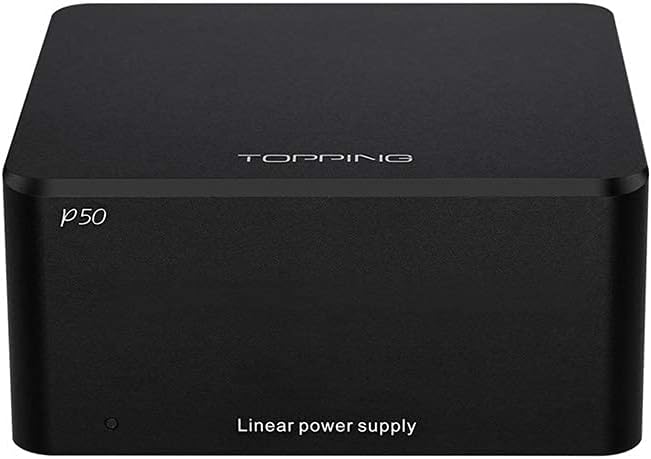
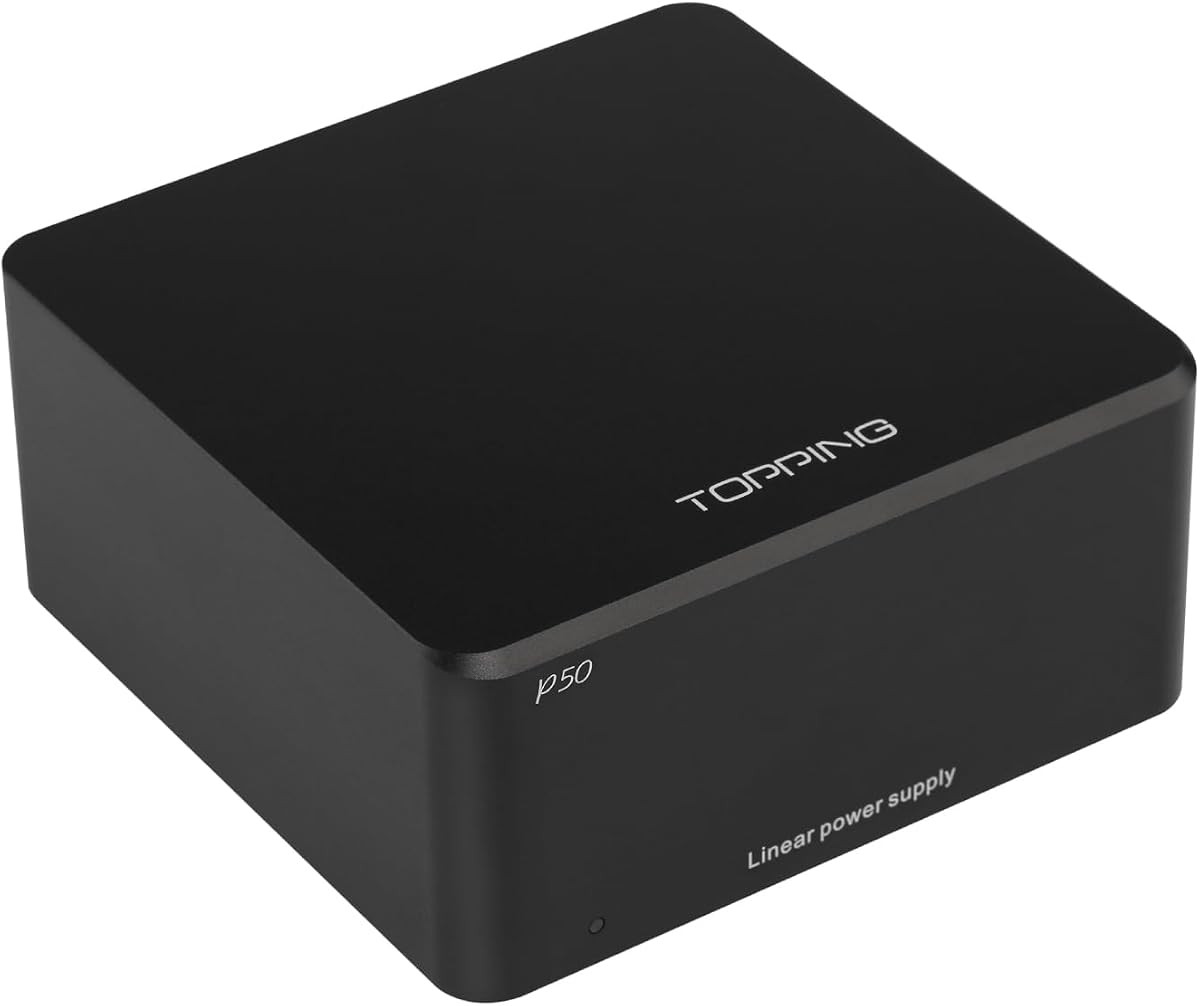
The Topping P50 is a purpose-built linear supply for several compatible components in the Topping ecosystem, including the D50III, DX3 Pro+, E50, and A50III. It carries a 4.4 rating and provides separate 5V and 15V outputs rated at 1A each. Its design centers on a sealed toroidal transformer engineered to reduce magnetic leakage, electromagnetic interference, and acoustic noise.
We may earn a commission when you buy through this link, at no additional cost to you.
Each voltage module has substantial capacitor reserves: more than 8,000μF for the 5V module and more than 10,000μF for the 15V module. Three TPS7A4700 linear regulators provide the final regulation stage. The result is aimed at high-precision analog applications where stable voltage and low noise can support accurate signal handling.
This is intentionally specialized. The 5V and 15V options cover many compatible DACs, headphone amplifiers, and related components, but they do not include a 12V output. The 1A limit for each rail also means it is better suited to low-power sources than high-current amplifiers. Cable and connector compatibility should be verified before integrating it with equipment outside the supported Topping range.
The P50 is an excellent choice for a Topping-based desktop system, especially when a DAC and headphone amplifier require their specified 5V and 15V feeds. Its global input support broadens its usefulness across regions. For other brands or higher-current needs, a more flexible model may be a better foundation for the system.
Dedicated compatibility with several Topping DACs and headphone amplifiers makes the P50 especially convenient for an existing ecosystem.
Large capacitor banks give both voltage modules greater energy reserves, while three precision linear regulators handle the final low-noise output stage.
We may earn a commission when you buy through this link, at no additional cost to you.
The FiiO Darkside PRO is a premium linear supply with a 5.0 customer rating and a clear focus on high-performance desktop audio. Its custom 75W toroidal transformer provides substantial reserve for transient current, while the fully discrete NMOS regulation circuit uses dual MOSFET parallel output stages. The design targets low output impedance, high current capability, and rapid transient response.
We may earn a commission when you buy through this link, at no additional cost to you.
Component selection is unusually thorough. The supply includes a Japanese SHINDENGEN D15XB60 rectifier bridge, ELNA capacitors, Rubycon filter capacitors, WIMA film capacitors, and a silver-plated monocrystalline copper DC cable. These premium internal parts complement the stated goal of reducing noise and supporting cleaner power delivery to demanding components.
The relay-switched output can be set to 12V or 15V, with a stated maximum current of 3A. Precision voltage adjustment and self-resetting overcurrent protection add practical safeguards. A rigid, ventilated aluminum enclosure helps suppress vibration, reduce electromagnetic interference, and dissipate heat. The trade-off is that this larger, more capable design consumes more space and power than a compact single-device supply.
The Darkside PRO is our premium recommendation for a serious desktop system using compatible DACs, headphone amplifiers, streamers, or digital transports. It is particularly persuasive when transient performance and power reserves matter more than compactness or multi-voltage flexibility. Match the device's required voltage and current, and verify the supplied connector before installation.
A 75W transformer, low-impedance discrete regulation, and parallel MOSFET stages give demanding audio components useful dynamic headroom.
A Japanese rectifier, ELNA and Rubycon capacitors, WIMA film capacitors, and a copper DC cable underscore the attention paid to the internal power path.
We may earn a commission when you buy through this link, at no additional cost to you.
The HiFi DC19V supply is a high-current desktop linear unit designed around a 19V output and a 4.2A rating. It has a 5.0 customer rating, which reflects strong customer feedback, while its technical targets include low noise, low impedance, fast response, low power consumption, and high reliability. It is intended for audio equipment that specifically accepts the available voltage.
We may earn a commission when you buy through this link, at no additional cost to you.
Its regulation stage uses a fully discrete, single-pass series topology. The listed output noise is less than 13μV even at the maximum stated 24VDC output, with still lower noise at lower voltages. That approach is intended to provide clean, stable power for demanding analog circuits and components that respond well to a low-impedance source.
The obvious constraint is voltage. Although the manufacturer offers other versions in 5V, 9V, 12V, 15V, 18V, 19V, and 24V, the product listed here is specifically the 19V model. It is therefore not a universal supply, and a router, DAC, or amplifier requiring 12V cannot use it directly. The connector and polarity also need to match the target device.
The DC19V model is a strong recommendation for a compatible 19V system that needs more current than a typical compact adapter can provide. It may be especially relevant to larger compatible audio or network components. Buyers with mixed-voltage equipment should consider whether a multi-output model would serve the entire system more effectively.
The 4.2A capacity gives compatible equipment more current availability than many compact desktop adapters can offer.
A single-pass discrete topology is designed to maintain low noise and quick response as the connected audio load changes.
We may earn a commission when you buy through this link, at no additional cost to you.
The Topping P50 Black is a refined version of the dedicated approach used for compatible Topping DACs, streamers, and headphone amplifiers. It carries the same 4.4 customer rating as the other P50 listing and provides 5V and 15V outputs rated at 1A each. Its main visual and mechanical distinction is a CNC-machined unibody aluminum enclosure.
We may earn a commission when you buy through this link, at no additional cost to you.
The sealed toroidal transformer is designed for low magnetic leakage, reduced noise, and electromagnetic suppression. Large capacitor banks—10,000μF for the 15V module and 8,000μF for the 5V module—provide energy reserves, while three TPS7A4700 regulators handle the final precision, low-noise stage. The result remains focused on high-performance analog and digital applications.
The unit supports 115V input at 50 or 60Hz and 230V input at 50 or 60Hz, making it suitable for use in multiple regions. Like the other P50, however, it does not offer 12V and is limited to 1A per output. This is most appropriate when powering selected compatible components rather than trying to build one supply for a broad collection of equipment.
The Black P50 is a sound recommendation for a Topping-centered desktop system where the one-piece enclosure, global voltage support, and dedicated output rails are priorities. Users should choose between the available P50 listings based on the exact color, listing details, included accessories, and current availability, while checking the power requirements of both connected components.
The CNC aluminum unibody offers mechanical strength, improved heat handling, and additional resistance to external interference.
Support for both 115V and 230V inputs at 50 and 60Hz broadens the unit's usefulness across different regional power systems.
We may earn a commission when you buy through this link, at no additional cost to you.
The right linear power supply depends first on device requirements, then on the quality of its filtering and regulation. Voltage, current, connectors, isolation, protection, physical size, and system integration should be evaluated before considering brand or appearance.
Begin with the manufacturer's power specification for every device you intend to connect. A linear supply cannot safely power equipment if its output voltage is higher or lower than the device expects, and reversing polarity can cause damage. Some products offer selectable outputs, while others are fixed at 5V, 12V, 15V, 19V, or another level. Treat the label on the audio component as the source of truth and confirm whether the supply must deliver DC or AC.
The supply must deliver enough current for the connected equipment, preferably with additional headroom for startup, dynamic changes, and multiple outputs. Compare both the voltage and current rating because watts alone do not reveal whether a unit can support a particular device. A 12V supply rated at 2.5A provides 30W, while a 5V supply at 3A provides 15W, even though the latter may have the larger current figure. For dual-output models, determine whether the rating is shared across both ports.
Low noise is the core reason to consider a linear supply, but the useful figure depends on how it was measured and under what load. Look for toroidal transformers, EMI filtering, rectification, capacitor filtering, and a capable linear regulator. CLC or multi-stage filtering can further improve high-frequency suppression. Specifications such as microvolt ripple are attractive, but shoppers should also consider output impedance, transient response, and whether the claimed performance applies at the voltage and load they intend to use.
A single output is enough for one compatible component, while dual outputs can simplify a compact system. Independent isolation is particularly useful when two devices might otherwise share noisy grounds, as it can help reduce ground-loop interference. USB-A can be convenient for compatible accessories, but it should supplement rather than replace the correct DC connection. Avoid assuming that two sockets automatically mean two fully independent power channels; check the architecture and shared current limits.
Even a supply with the correct voltage may not fit a device. Common audio equipment uses barrel connectors with different outer and inner diameters, and specialized GX16-2 ports require cables with locking connectors. Check the supplied plug, the socket on the equipment, and whether the device uses a center-positive or center-negative arrangement. A USB output should likewise be confirmed as a power output rather than a data connection.
The transformer determines how much power the supply can deliver and influences heat, magnetic leakage, and acoustic behavior. A larger VA rating provides more reserve but usually means a larger enclosure and greater heat generation. Aluminum cases improve heat dissipation, while ventilation and fan-assisted cooling can help in tightly packed systems. If silence is critical, consider whether a fan might become audible and whether the unit has enough clearance around it.
Protection features can reduce the risk of damage from overheating, excessive voltage, or overcurrent. Overcurrent recovery, thermal protection, and clear output indicators make a supply easier to operate safely. Also check the AC input range: a unit supporting both 115V and 230V at 50 and 60Hz is easier to use internationally. These practical details matter especially when the supply will remain connected for long periods in a shared listening space.
Desktop audio systems often benefit from a single coordinated power source rather than several unrelated wall adapters. Look for a chassis size that fits your shelf or listening area, understandable front-panel indicators, and outputs that support your established equipment. Matching an ecosystem product can simplify voltage and connector compatibility. If future expansion is likely, choose a model with selectable outputs or enough current for additional devices, but avoid buying unused features simply because they appear sophisticated.
Before connecting anything, identify the required voltage, current, polarity, and connector for each device. Inspect the power supply, cables, and output sockets for damage, then connect the audio equipment while the supply is switched off. Start with one compatible device at a time, confirm the selected output matches the equipment, and listen for normal operation before adding a second load. Do not exceed the stated current or combined power limits.
Place the unit on a hard, stable surface with room for ventilation. Keep it away from heat sources, long cable loops, and devices that generate substantial heat. If the model includes a cooling fan, leave adequate clearance and do not block its intake or exhaust. Connect outputs only to compatible equipment, and periodically inspect barrel or locking connectors to ensure they remain secure without forcing them.
Linear supplies can become warm during extended use, so occasional ventilation checks are sensible. Unplug the unit from the wall before changing cables, cleaning it, or altering voltage settings. Wipe the enclosure with a dry or lightly damp cloth after disconnecting power, and avoid moisture around sockets, switches, and transformer openings. Keep documentation or notes for voltage and polarity settings, especially when operating multiple outputs or changing equipment over time.
A well-designed linear supply can provide lower ripple and a cleaner DC output, which may help sensitive audio equipment in some systems. The audible result depends on the device, the original adapter, the room, and the rest of the chain. A linear supply is not a guaranteed upgrade if it is operated beyond its limits or paired with incompatible equipment.
Check the power label, manual, or markings on the original power adapter. The label should list the output voltage, current, and polarity. Match the voltage exactly, ensure the supply can provide at least the required current, and verify that the connector fits before purchasing or connecting anything.
Yes, if the unit has suitable outputs and the combined load remains within its current rating. Some dual-output supplies share their available current, while others provide independent regulation. Add the current requirements of connected devices and check the total output limit, especially for amplifiers or other high-draw equipment.
Independent ground isolation can help prevent unwanted connections between device grounds, which may reduce ground-loop problems. It does not automatically eliminate every source of noise, and poorly connected cables or devices can still create interference. A single grounded connection and properly terminated cables remain important.
The listed products use combinations of DC barrel connections, USB-A power, and GX16-2 locking sockets. The 25W 12V model specifies a 5.5/2.5mm connector, while the PR2 uses GX16-2 ports. Check connector dimensions, polarity, and cable availability before choosing a model.
A larger supply can offer greater current reserves, larger filtering capacitors, and lower output impedance, but those benefits matter only when the connected equipment benefits from them. A large, lightly loaded supply may be unnecessary. Choose a model that comfortably supports the load and offers the required voltage rather than selecting purely by physical size.
They can, especially at higher output currents because the difference between mains power and low-voltage DC is dissipated as heat. Aluminum housings, ventilation, and fan-assisted cooling can manage that energy. Place the unit where airflow is available and follow any thermal guidance supplied by the manufacturer.
No. Compatibility depends on output voltage, current, polarity, connector type, and sometimes the electrical requirements of the input stage. Several models are specialized for particular Topping or FiiO equipment, while others target fixed 12V or 5V applications. Always consult the audio device's power requirements before making a final choice.
The Fosi Audio PSU20 is the most versatile overall selection because it combines selectable voltages, two isolated DC outputs, USB-A, protection, and a generous transformer. The 25W 12V supply stands out as the best focused value choice for a compatible DAC or digital component, while the FiiO Darkside PRO takes the premium position with a 75W transformer, discrete regulation, premium internal components, and a 5.0 customer rating.
The right decision begins with the equipment, not the specification sheet. Match voltage, current, polarity, and connectors first. Then consider whether you need one output or several, shared or isolated grounds, fixed or selectable voltage, and enough thermal capacity for the intended load. Low ripple, large capacitors, and sophisticated filtering are useful, but they cannot compensate for an incompatible connection.
Finally, review the current listing, included accessories, warranty information, and availability before ordering because product details and prices can change. Confirm the exact requirements of every device, select the output with care, and leave ventilation around the enclosure. With those checks completed, the right linear supply can provide a cleaner, more organized, and potentially more revealing foundation for the audio system.