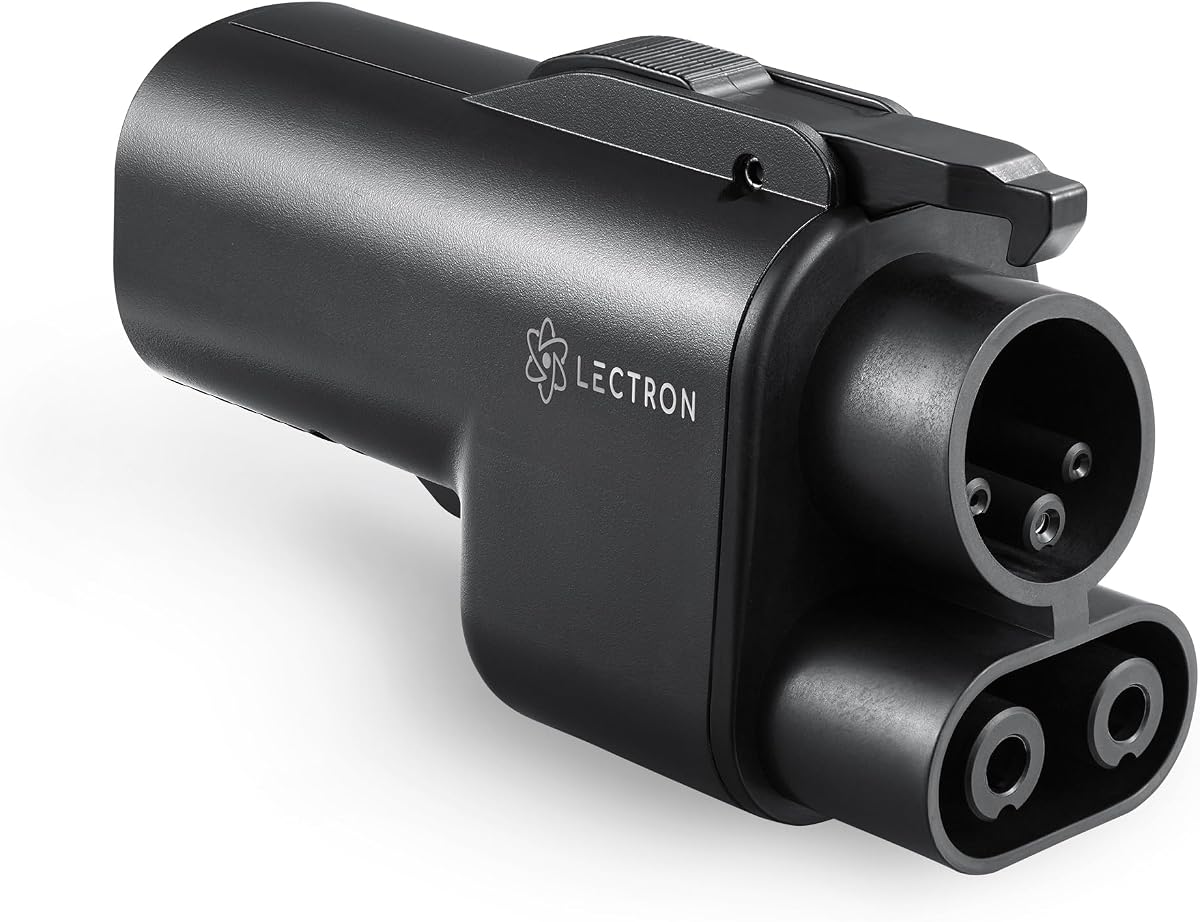
Lectron Vortex Plug
4.6Editor score
Dual-side secure locking
500A and 1000V capacity
Tesla Supercharger access
Explore the best Nacs to Ccs Adapter options, comparing safety certifications, power ratings, locking systems, vehicle support, and compatibility.
A NACS to CCS adapter bridges the newer North American Charging Standard and the widely deployed CCS1 connector, potentially giving compatible electric vehicles access to Tesla Superchargers. A worthwhile adapter should combine verified electrical safety, secure locking, correct high-voltage ratings, and confirmed automaker compatibility rather than relying on physical fit alone.
This guide compares ten current adapters based on their stated power capacity, safety certifications, thermal protections, connector locks, charging-network access, and vehicle compatibility. It covers NACS-to-CCS adapters for approved CCS1 vehicles, along with reverse CCS-to-NACS products for Tesla and newer NACS-equipped vehicles.
Each review explains the product's strongest qualities, practical limitations, and ideal buyer. The top selections include a certified Lectron with an interlock, a high-power Lectron model, and a more affordable upgraded adapter. Prices and network policies change, so verify current listings and charger access before purchasing.
4.6Editor score

4.6Editor score

The table below compares each adapter by charging direction, electrical capacity, safety certification, and intended network use. Because connector shape alone does not guarantee operation, vehicle authorization, software support, and charger availability remain essential checks.


The Lectron Vortex Plus is a NACS-to-CCS1 adapter created for non-Tesla CCS1 vehicles that have been approved to use Tesla Superchargers. It carries a 4.6 rating and stands out through its stated UL 2252 certification by SGS, a built-in interlock, and a 500A/1,000V rating. Those details make it one of the most safety-focused choices in this guide.
We may earn a commission when you buy through this link, at no additional cost to you.
Its interlock is intended to help maintain a secure connection during high-voltage DC fast charging, while the 500A and 1,000V rating allows the adapter to accommodate demanding vehicles and Supercharger generations. Lectron states that compatible vehicles may gain up to 150 miles of range in 15 minutes, although actual results depend on the charger generation, battery, vehicle software, temperature, and charging curve.
The main trade-off is strict compatibility. This is not a general-purpose adapter for every CCS1 car, and it cannot be used with Tesla vehicles or AC charging stations. Drivers must first receive Supercharger access through their automaker and confirm the vehicle appears as eligible in the relevant software or app. Those restrictions reduce convenience but also prevent an unsupported connection.
This is the strongest all-around recommendation for a buyer who prioritizes documented electrical safety and can verify automaker approval. The Lectron Vortex Plus is particularly attractive to owners of an approved CCS1 vehicle who regularly travel along Tesla Supercharger corridors and want a high-current adapter with an explicit interlock.
UL 2252 certification by SGS is the headline feature because high-voltage adapters carry substantial mechanical and electrical risk. The stated certification indicates the product was evaluated for safety, thermal performance, and durability rather than merely being marketed as a physical connector converter.
The 500A/1,000V specification gives compatible vehicles room to accept high Supercharger output. Real charging speed still remains the limiting result of the car, station, software, battery state, and ambient conditions, so the rating should be understood as capacity rather than a guaranteed pace.
We may earn a commission when you buy through this link, at no additional cost to you.
The Lectron Vortex Plug is another 500A/1,000V NACS-to-CCS1 adapter, and its 4.6 rating reflects a generally favorable customer reception. It is designed to give approved non-Tesla vehicles access to V3 and V4 Tesla Superchargers while adding locking mechanisms at both the NACS and CCS1 connections.
We may earn a commission when you buy through this link, at no additional cost to you.
Dual locking is especially valuable during high-speed charging because a stable mechanical connection helps maintain proper alignment under vibration and heavy cable loads. Lectron also includes thermal-fault guidance: if excessive heat causes a charging fault, the instructions call for allowing the adapter to cool for 30 minutes before trying again. That behavior is presented as a built-in safety feature.
Like the Vortex Plus, this adapter requires more than a matching CCS1 port. The vehicle must have been granted access to the Tesla Supercharging network by its manufacturer. It also excludes Tesla vehicles and AC charging. Those limitations make the product suitable for a narrower but clearly defined driver group.
The Vortex Plug is a strong premium-style choice for approved CCS1 owners who want substantial current capacity and locking at both ends. It may be especially useful for frequent road travelers who want more Supercharger choices but must follow the automaker's authorization and operating instructions.
The NACS-side and CCS-side locks help keep the adapter aligned throughout a high-current session. This is a practical advantage when compared with a simple passive adapter, although owners must still fully engage every connector and follow the prescribed sequence.
The specified 30-minute cooling period gives users an actionable response to an excessive-heat fault. It also underscores that the adapter's high rating does not eliminate charger, vehicle, or environmental limits.
We may earn a commission when you buy through this link, at no additional cost to you.
This upgraded NACS-to-CCS1 adapter offers a high-power specification of up to 500A and 1,000V, with a stated maximum output of 250 kW. It is designed for CCS1 vehicles that support Tesla's Supercharger protocol and provides a more budget-conscious option than the premium Lectron adapters.
We may earn a commission when you buy through this link, at no additional cost to you.
The product information states access to more than 25,000 V3 and V4 Superchargers and says a compatible car can reach approximately 80% charge in 30 minutes. It also lists Ford, GM, Rivian, and other CCS-standard vehicles, while making clear that the manufacturer must support the relevant Tesla Supercharger protocol and that the adapter is not suitable for Level 1 or Level 2 AC chargers.
Its principal drawback is that the supplied product information does not mention UL 2252 certification, a formal interlock standard, or a customer rating. Buyers therefore need to place more weight on the included instructions and independent compatibility checks. High-power claims alone should not be treated as a substitute for documented safety testing.
This adapter is best for a value-conscious driver who has confirmed both CCS1 hardware and automaker-enabled Supercharger access. It combines large stated electrical capacity with simple operation, but shoppers who prioritize independent certification may prefer one of the explicitly certified models.
A 500A/1,000V and 250 kW specification is unusually ambitious for an entry-oriented listing. That makes the adapter relevant to modern high-power vehicles, provided the charger, car, and automaker software support the negotiated output.
Having a CCS1 port is not the same as being approved for Tesla Superchargers. The listing specifically asks buyers to verify manufacturer authorization, and that software-level approval is essential before attempting a session.
We may earn a commission when you buy through this link, at no additional cost to you.
This Lectron performs the reverse conversion from CCS1 to NACS, allowing supported Tesla and other NACS-equipped vehicles to use CCS1 DC fast-charging stations. It has a 4.6 rating, a 500A/1,000V rating, UL 2252 certification, built-in thermal protection, and an IP67 enclosure rating.
We may earn a commission when you buy through this link, at no additional cost to you.
Its environmental testing claim covers operation from -22°F to 122°F, along with impact, crush, high-power cycling, and over-temperature protection. That makes it a compelling option for owners of a Model 3, Model Y, Model S, or Model X who travel extensively across the broader CCS1 charging network.
Compatibility is not automatic. Teslas must show CCS Adapter Support as enabled under the vehicle's Additional Vehicle Information menu. The product explicitly excludes the Cybertruck, even though other NACS vehicles from Chevrolet, Hyundai, Kia, Lexus, Lucid, Rivian, and Toyota are listed for various model years.
This is the strongest reverse-direction pick for drivers who need CCS1 access and can verify the required software support. It is less relevant to a buyer searching specifically for a NACS-to-CCS adapter for a non-Tesla CCS1 vehicle, but it is highly relevant to the expanding group of NACS owners who want more charger choices.
The combination of IP67 protection, crush testing, and temperature limits is useful for an adapter likely to live in a vehicle trunk and be connected outdoors. It does not mean the product can be submerged or used beyond the manufacturer's instructions.
Before ordering, a Tesla owner should locate the CCS Adapter Support setting and confirm that it is enabled. The same general principle applies to newer NACS vehicles: consult the manufacturer's app or manual for CCS1 fast-charging support.
We may earn a commission when you buy through this link, at no additional cost to you.
The Raylix is a CCS1-to-NACS adapter for CCS-enabled Tesla and newer NACS vehicles rather than a NACS-to-CCS1 product. It holds a 4.4 rating and supports up to 400A and 250 kW, positioning it as a high-power option for owners seeking additional CCS1 fast-charging locations.
We may earn a commission when you buy through this link, at no additional cost to you.
Its most distinguishing feature is a stated six-layer thermal-protection system with real-time temperature monitoring. The product information also reports testing across more than 50 station brands and over 100,000 charging sessions, along with resistance to more than 30,000 mating cycles and 5,700 pounds of load pressure.
Compatibility requires care. The listing supports Model 3, Model Y, Model S, Model X, and Cybertruck vehicles, but Teslas built before 2021 should be checked individually. CCS Adapter Support must also be enabled in the vehicle. The claimed 250 kW ceiling is an adapter limit, not a guarantee of the rate delivered by every vehicle or station.
This is a useful CCS1-access solution for compatible Tesla and NACS owners who prioritize thermal monitoring and Cybertruck support. It should not be purchased by a CCS1 vehicle owner seeking to connect to Tesla Superchargers, because the conversion direction is the opposite.
The multi-layer protection system is designed to reduce the risk of overheating during repeated high-current connections. For public charging, where adapters may be handled by different drivers, real-time monitoring adds a useful layer of operating confidence.
The listing expressly includes the Cybertruck, which many competing CCS-to-NACS adapters exclude. Owners should still confirm CCS support in the vehicle and verify that the connector fits their exact model and production period.
We may earn a commission when you buy through this link, at no additional cost to you.
The LENZ NACS-to-CCS1 adapter is aimed at approved non-Tesla CCS1 vehicles that have been granted Tesla Supercharger access. It carries a 4.4 rating, a stated 500A/1,000V rating, and SGS certification to ANSI/CAN/UL 2252, according to the supplied product information.
We may earn a commission when you buy through this link, at no additional cost to you.
Its molded connectors, secure locking, and stable current delivery make it appropriate for public DC fast charging. Setup follows a clear sequence: connect the adapter to the NACS Supercharger first, then to the vehicle, and use the Tesla app to initiate charging and payment.
Compatibility remains vehicle-specific, and LENZ explicitly warns that not every CCS1 vehicle is approved. The adapter does not work with Level 1 or Level 2 chargers, so it cannot serve as a general home-charging converter. A protective travel case is included, a practical addition for owners who carry it between vehicles.
This is an appealing choice for an approved CCS1 driver who values certification, locking, and portability. It competes strongly with the Lectron models, although its public listing does not emphasize a built-in interlock to the same degree as the Lectron Vortex Plus.
SGS certification to ANSI/CAN/UL 2252 addresses the safety standards most directly associated with EV communication adapters. Secure locking complements the electrical design by helping maintain a dependable physical junction during fast charging.
The included protective case makes storage and transport more practical. Because the adapter is specialized and not for AC charging, it is best kept with drivers who regularly visit Supercharger locations rather than left as a general-purpose EV accessory.
We may earn a commission when you buy through this link, at no additional cost to you.
The Fluxelle NACS-to-CCS1 adapter has a 4.5 rating and combines a stated UL 2252 certification with 500A/1,000V capability. It is designed for CCS1 vehicles whose manufacturers have enabled access to Tesla's Supercharger network and is limited to V3 and V4 stations according to the product description.
We may earn a commission when you buy through this link, at no additional cost to you.
Its safety design includes locking at both ends, an automatic charging lock that releases when power is cut, triple temperature monitoring, and a low-leakage electrical design. These are meaningful details for an adapter handling several hundred amps, particularly during repeated public-network use.
The listing names a wide range of brands, including Ford, Rivian, General Motors, Volvo, Polestar, Nissan, Lucid, Mercedes-Benz, Hyundai, Genesis, Kia, Honda, Acura, JLR, and Audi. That list should still be treated as a starting point, because each manufacturer must approve the specific vehicle and software configuration.
Fluxelle is a strong choice for a broadly compatible CCS1 vehicle owner who wants explicit certification and multiple monitoring systems. Its one-year replacement service and two-year customer support also provide some reassurance, although buyers should retain proof of purchase and follow the instructions carefully.
Triple temperature monitoring provides more detailed oversight than a single temperature check. It cannot eliminate every thermal or electrical risk, but it is a useful feature in products expected to deliver high DC charging power.
The broad brand list helps shoppers identify likely candidates, but it does not establish that every model is approved. Check the automaker's app, charging instructions, and any required software update before relying on the adapter at a specific site.
We may earn a commission when you buy through this link, at no additional cost to you.
This 2026 NACS-to-CCS1 adapter has a 4.4 rating and combines a 500A/1,000V rating with UL 2252 safety certification. It includes a safety interlock, dual locking with automatic release after power is cut, multilayer temperature monitoring, and low-leakage circuitry.
We may earn a commission when you buy through this link, at no additional cost to you.
The product's detailed compatibility section is a major strength. It lists approved CCS1 vehicles from Ford, General Motors, Chevrolet, Polestar, Cadillac, Acura, Audi, BMW, Genesis, GMC, Honda, Hyundai, Jaguar Land Rover, Kia, Lucid, Mercedes-Benz, MINI, Nissan, Porsche, Subaru, Volkswagen, Volvo, and others.
It also explicitly says the adapter is not compatible with Mazda, Stellantis vehicles such as Chrysler, Dodge, and Jeep, or legacy models lacking authorization. Tesla vehicles and AC stations are also excluded. These clear exclusions reduce the chance of an unsupported purchase.
This is a well-specified choice for a driver who has an authorized CCS1 vehicle and values environmental resistance. Its IP65 rating and safety interlock make it especially attractive for regular outdoor charging, while its extensive compatibility notes help prevent incorrect assumptions.
The interlock helps coordinate a safe connection at high voltage, while the stated automatic release after power-off improves the shutdown sequence. Both features are important because a physically fitting connector is not enough for safe communication and controlled disconnection.
An IP65 rating provides a meaningful degree of dust and water protection. The adapter should still be kept dry during storage and handled according to the included instructions, especially around damaged or wet connector surfaces.
We may earn a commission when you buy through this link, at no additional cost to you.
The Takrabbsin NACS-to-CCS adapter offers a 500A/1,000V rating and a stated UL 2252 certification by SGS. Its 4.2 rating is the lowest among the rated NACS-to-CCS selections, but the product still presents several useful qualities for compatible owners.
We may earn a commission when you buy through this link, at no additional cost to you.
Its compact design is intended to fit inside a vehicle for travel, and operation requires no elaborate configuration. The adapter sits between the vehicle's CCS1 port and the Tesla Supercharger cable, allowing a CCS1 EV to draw DC fast power where it has been approved to use that network.
The instructions emphasize using the Tesla app to identify the car and start the charging session before plugging in. If the adapter is connected first, the relevant charger may appear grayed out in the app. This sequence is an important operational detail rather than a defect.
Takrabbsin is a practical choice for an approved CCS1 driver who wants a certified, portable adapter and clear support. The two-year replacement or return service adds confidence, but users should follow the app workflow carefully and confirm that their exact vehicle appears in the eligible charger list.
Charging begins through the Tesla app after the vehicle and account are recognized. Starting the session before connecting avoids the grayed-out charger state described in the product instructions.
The portable format is practical for owners who want Supercharger access without carrying a large fixed adapter. A protective pouch or dedicated storage location can prevent the connector faces from collecting dirt during travel.
We may earn a commission when you buy through this link, at no additional cost to you.
The LENZ CCS1-to-NACS adapter allows Tesla and selected newer NACS-port vehicles to connect to CCS1 DC fast chargers. It has a 4.4 rating and is built around a stated 500V limit, with performance up to 500 kW where supported by the car and station.
We may earn a commission when you buy through this link, at no additional cost to you.
Its stated certifications include UL 2251 and CSA C22.2, while the product uses a reinforced locking interface and precision-engineered fit. It is intended for networks such as Electrify America, EVgo, ChargePoint, and other public DC fast-charging operators.
The most important limitation is direction: this adapter is not for a CCS1 vehicle charging at a Tesla Supercharger, nor is it for Level 2 AC charging. It also excludes the Tesla Cybertruck. The listing emphasizes 2026-and-newer NACS vehicles, including selected Hyundai, Kia, Rivian, and Toyota models.
This product is most relevant as the charging landscape transitions toward NACS. It gives a compatible NACS vehicle access to a large CCS1 ecosystem, although buyers should compare its stated 500V ceiling with their vehicle's architecture and the output available at the selected station.
As automakers move from CCS1 to NACS, an adapter can preserve access to a large installed network of CCS1 DC chargers. It is particularly relevant to drivers of newly delivered NACS vehicles who travel beyond dense Supercharger corridors.
The product is specifically for CCS1 DC fast charging and must not be confused with a Level 2 adapter. Confirming the charger's connector, voltage, and communication protocol before departure prevents an unusable stop.
We may earn a commission when you buy through this link, at no additional cost to you.
The right adapter depends on connector direction, vehicle authorization, network support, safety certification, and the power architecture of your car. Compare those factors before considering convenience features or a headline charging-speed claim.
A NACS-to-CCS adapter lets a CCS1 vehicle connect to a NACS charging cable, most notably at Tesla Superchargers. A CCS-to-NACS adapter works in the opposite direction and lets a Tesla or newer NACS-port vehicle use a CCS1 DC fast charger. The physical connectors look different, but a cable can also include both connector types, so determine which cable end must reach the car and which must reach the station. Reversing the intended direction may create an unsafe or simply unusable connection.
Choose the adapter direction based on the connector in your vehicle and the charging network you plan to visit, not merely the adapter's popularity.
Most modern automakers now control whether and how their vehicles use Tesla Superchargers. A CCS1 vehicle may have the correct port and still be unable to initiate a session without an approved adapter, updated software, an activated account, or a charger that is enabled for that model. Check the manufacturer's app, vehicle interface, support page, and owner manual. For Teslas using CCS1 chargers, confirm that CCS Adapter Support is enabled. Approval is vehicle-specific and can change over time.
Treat automaker authorization as essential, and recheck eligibility before a trip because network policies can change.
A high-current adapter participates in a safety-critical communication and power connection between the car and charging station. Independent certification to a relevant UL standard provides information that marketing language alone cannot. In this group, several products explicitly state UL 2252 certification or SGS certification to ANSI/CAN/UL 2252, while another lists UL 2251 and CSA C22.2 compliance. Look for the exact standard, certifying organization, and product identity rather than assuming that a similarly named adapter is certified.
Independent safety certification is one of the most important selection factors for an adapter used on public DC fast-charging networks.
Adapters may be advertised at 500A and 1,000V, 250 kW, 400A, or another rating, but an adapter's capacity is only the upper ceiling. The car, charging cable, station, battery state, temperature, and software negotiation determine the delivered rate. A vehicle limited to a lower voltage or current will not charge faster simply because the adapter supports more. Reverse adapters may also have a lower stated voltage ceiling, making architecture verification especially important for new NACS vehicles.
Choose an adapter that comfortably covers your vehicle's requirements, but never expect its maximum rating to override vehicle or station limits.
Fast charging places substantial force and vibration on the connection. Dual locking mechanisms help hold the adapter and cable in alignment, while an interlock coordinates the connection sequence and may prevent energization until conditions are safe. Some products also provide automatic release after power is cut or have locking mechanisms on both the NACS and CCS1 ends. These details are more meaningful than decorative grip improvements because communication depends on stable, clean electrical contact.
Favor products with documented locking and interlock features, then follow the prescribed connection and disconnection sequence every time.
DC fast charging generates heat, and connectors can be exposed to rain, road dust, temperature changes, and repeated mating cycles. Look for real-time temperature monitoring, automatic thermal shutdown, overcurrent protection, and an ingress rating such as IP65 or IP67. A stated test range and cycle count can indicate additional durability effort, but these features do not authorize use outside the manual's environmental limits. The adapter should also be stored dry and protected from impact between uses.
Look for active thermal monitoring, automatic shutdown, and a suitable ingress rating for regular outdoor use.
Not every Supercharger generation or CCS1 network behaves identically. Some product descriptions specifically target Tesla V3 and V4 stations, while others mention ChargePoint, Blink, EVgo, Electrify America, and other DC networks. The charging app may also need the adapter registered to the vehicle before a cable appears as available. Some adapters require a sequence in which the session is started before plugging in. These workflow requirements are normal parts of using third-party adapters, not evidence that the physical connector has failed.
Read the setup instructions and app workflow before departure, and confirm the target charger type is explicitly supported.
A road-trip adapter should be compact enough to store in a trunk or frunk, yet robust enough for repeated use. Some models include a protective travel case, while others offer storage guidance. Consider whether the vehicle has a dry compartment for the adapter and whether the connector faces are protected during transport. Frequent travelers should also think about support, warranty, and replacement service, because a failed adapter can interrupt a trip far from a dealer or specialist repair facility.
Choose a durable, easy-to-store design with clear support terms, and keep the connectors clean and dry between sessions.
Before the first use, confirm that your vehicle has the correct physical port, its manufacturer has authorized access to the intended network, and the required software is current. Open the automaker or charging app and verify that your exact vehicle appears as eligible. Inspect the adapter, connector faces, and charging cable for damage, contamination, moisture, bent pins, or a loose locking mechanism. Do not use a connector with damaged insulation or a locking mechanism that fails to engage.
For a typical NACS-to-CCS Supercharger session, follow the charging app's sequence. Some adapters require the account and vehicle to be selected and the charging session to be initiated before plugging in. Connect the NACS adapter end to the Supercharger cable first, then attach the CCS1 end to the vehicle. Ensure both locking mechanisms engage fully, confirm that the app shows an active session, and monitor the vehicle and adapter for unusual heat, odor, noise, or repeated fault messages.
To disconnect, stop the session in the app before unplugging whenever the network permits. Release the locks rather than pulling against a cable that has not disengaged. After use, wipe the connector faces with a clean, dry cloth, allow any moisture to evaporate, and return the adapter to its case or a dry compartment. If a thermal fault occurs, follow the manual's cooling instruction; the Lectron Vortex Plug specifically calls for a 30-minute cooldown after an excessive-heat fault.
A NACS-to-CCS adapter connects a CCS1-equipped vehicle to a NACS charging connector, commonly at an authorized Tesla Supercharger. A CCS-to-NACS adapter connects a Tesla or newer NACS-port vehicle to a CCS1 DC fast charger. These are opposite conversion directions, so identify the port on your car before ordering.
No. The vehicle must generally support the Tesla Supercharger protocol through manufacturer authorization, compatible software, and an active charging account. Even if the CCS1 connector physically fits, the automaker must permit the vehicle to charge at the relevant station. Check the manufacturer's app or owner manual before purchasing.
No. Those figures describe the adapter's maximum capacity. Actual charging power depends on the vehicle's accepted voltage and current, battery state, charger output, cable limits, temperature, and software negotiation. The vehicle and station will normally determine the final rate.
The NACS-to-CCS and CCS-to-NACS products in this guide are designed for DC fast charging. They are not intended for Level 1 or Level 2 AC charging. Attempting to use them with the wrong charger type may cause failure to start and can create electrical or safety risks.
The charger may not list the vehicle as eligible, the adapter may not be recognized, or the required session sequence may not have been followed. Some instructions require starting the charging session in the app before plugging in the adapter. Confirm that the vehicle is approved for that site and reset the session before trying again.
It indicates that the stated adapter has been evaluated against a safety standard developed for communication devices used between EVs and charging equipment. It is more meaningful than an unsupported high-power claim because it points to documented testing. Buyers should still verify the exact model, use the adapter correctly, and inspect it for damage.
The NACS-to-CCS adapters listed here are intended for supported CCS1 vehicles and explicitly do not support Tesla vehicles. Tesla owners seeking CCS1 DC fast-charging access should instead consider a CCS-to-NACS product, after confirming that CCS Adapter Support is enabled in their vehicle.
Keep it dry, protect it from impact, and store it in a clean compartment or protective case. After charging, inspect the connector faces and wipe away dirt with a clean, dry cloth. If the locking mechanism, insulation, pins, or housing appears damaged, stop using the adapter and contact the manufacturer or seller.
The Lectron Vortex Plus is the leading all-around recommendation for approved CCS1 vehicle owners because it combines UL 2252 certification, a built-in interlock, and a 500A/1,000V rating. The Lectron Vortex Plug offers similarly strong performance with dual locking, while the upgraded 500A/1,000V adapter provides a more value-oriented route into Supercharger access.
Before buying, prioritize connector direction, exact vehicle authorization, independent safety certification, and the charging network's app workflow. High current ratings and broad brand lists are useful only after those foundational requirements are satisfied. For Tesla or newer NACS owners seeking CCS1 access, the reverse-direction Lectron, Raylix, and LENZ options serve a different purpose.
Finally, recheck current product details, support terms, network policies, and prices before ordering. Charging hardware, vehicle software, and eligible-station lists evolve, so the safest purchase is one supported by current manufacturer instructions rather than an old compatibility chart or an assumed connector fit.