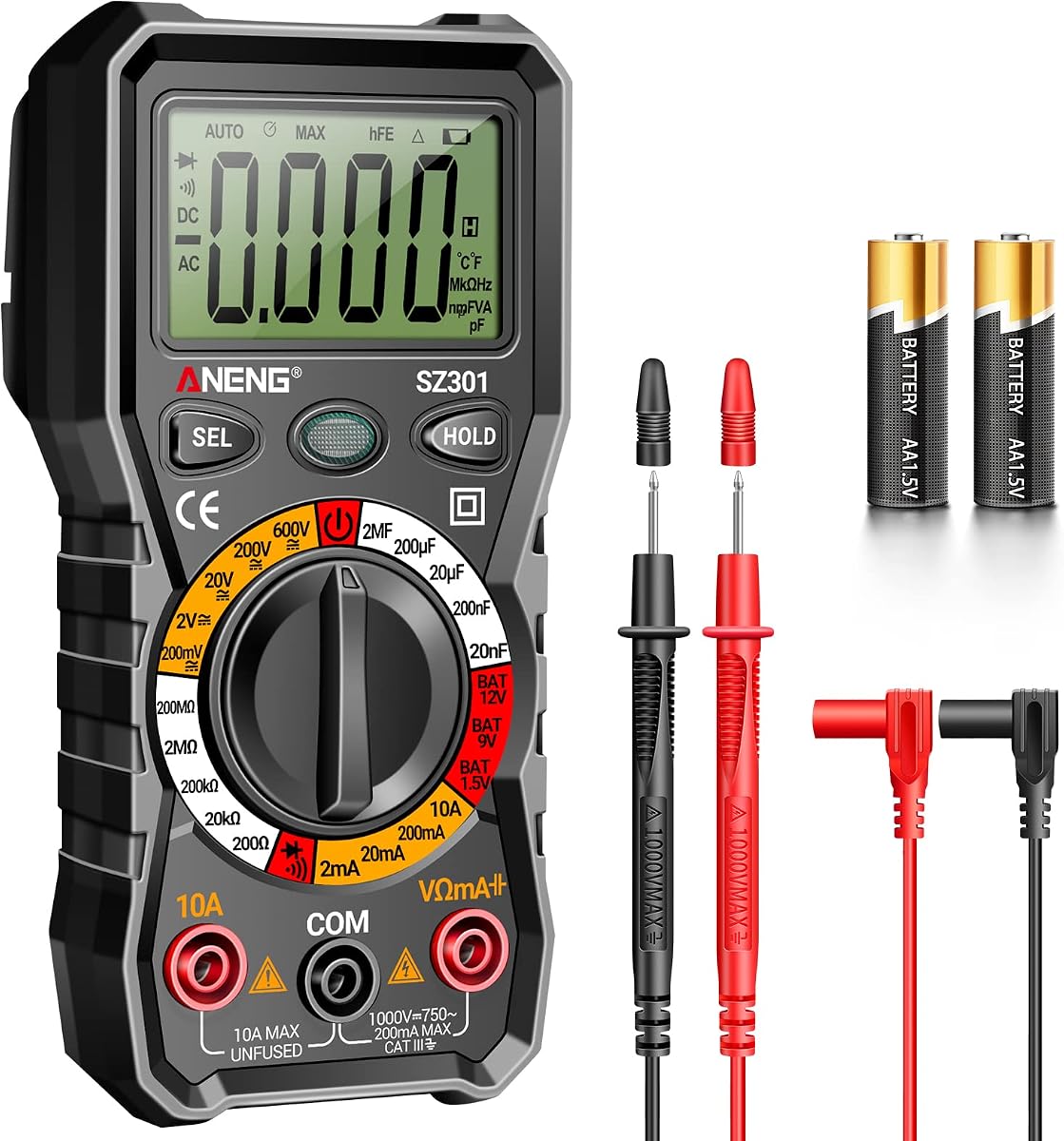
ANENG Digital Multimeter
4.4Editor score
Wide resistance measurement range
Double-fuse overload protection
Protective silicone case included
Supports multiple electrical measurements
Our Ohm Meter guide compares ten analog and digital multimeters for resistance, voltage, current, continuity, safety, and ease of use in the workshop.
An Ohm meter measures electrical resistance, but the best models also help diagnose voltage, current, continuity, capacitance, and component faults. A useful instrument should display readings clearly, offer suitable measurement ranges, and include safety features that reduce the risk of mistakes in everyday electrical troubleshooting.
This guide compares ten analog and digital multimeters selected for home maintenance, automotive work, electronics, and professional electrical applications. We evaluated their stated resistance capabilities, supporting functions, ranging options, display features, lead management, protection, and intended uses rather than claiming hands-on testing.
Each review explains who benefits most from the model and where its trade-offs lie. The three featured picks cover budget, professional, and premium needs, while the complete ranking includes conventional meters, true-RMS instruments, and an insulation tester for more specialized resistance work. Product availability and pricing can change.
4.4Editor score

4.8Editor score

4.7Editor score
This side-by-side comparison highlights each meter's display type, resistance capability, ranging approach, protection features, and broader measurement functions so readers can match an instrument to their specific testing needs.


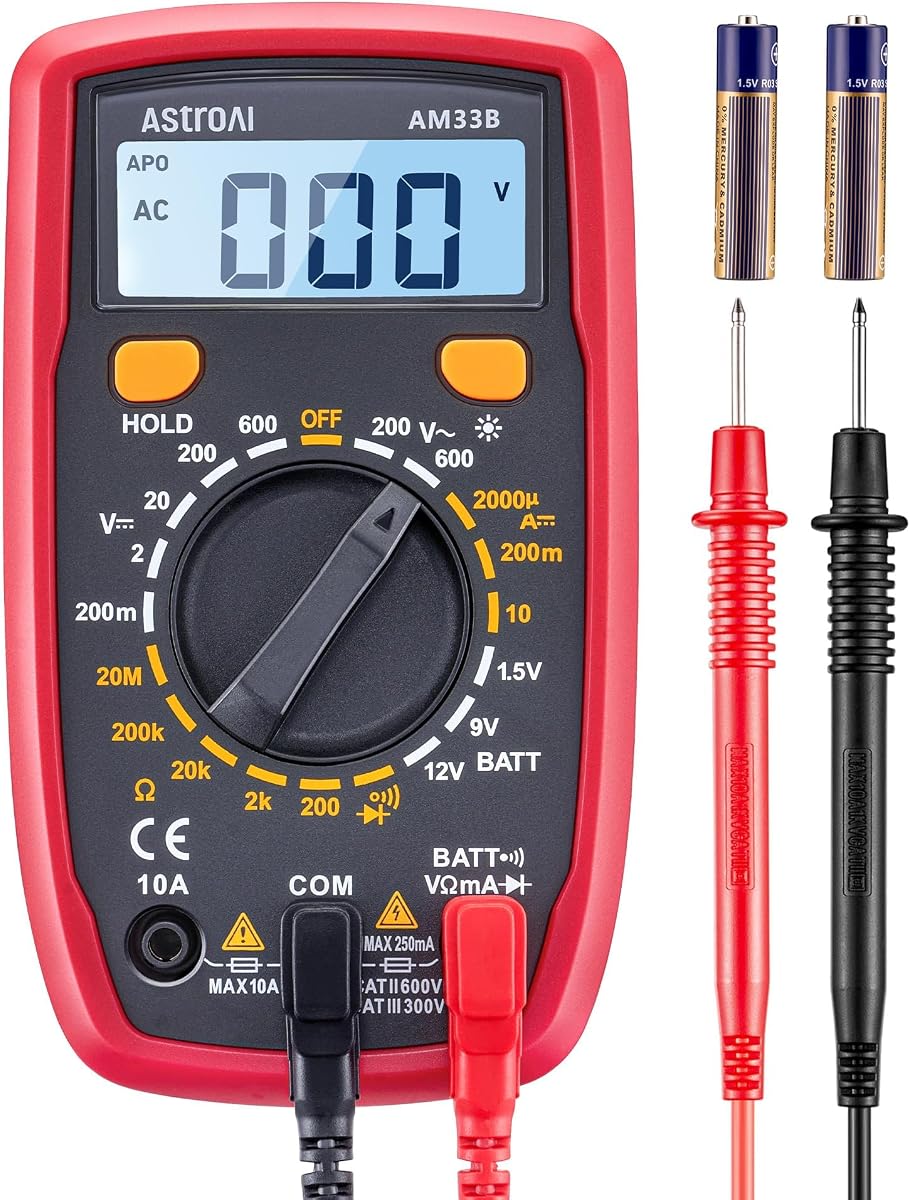


The AstroAI Digital Multimeter Tester 2000 Counts is a general-purpose meter for users who need reliable resistance measurements alongside routine voltage, current, continuity, and diode checks. Its 4.5 rating reflects a practical balance of measurement capability, protective features, and ease of use, making it a sensible first meter for household and automotive troubleshooting.
We may earn a commission when you buy through this link, at no additional cost to you.
Its 2,000-count LCD can display detailed resistance values while also handling DC current, AC and DC voltage, continuity, and diode functions. Data hold freezes the displayed result, which is useful when working with small components or testing a circuit in a confined area. A backlit screen improves readability in dim spaces, and the stated sampling rate is two readings per second.
Protection is particularly important for a general-purpose electrical tester. This model uses a double-fuse arrangement intended to resist overload, while its silicone cover adds physical protection and is described as helping reduce the risk of damage or electric shock. A low-battery indicator helps prevent confusing inaccurate readings with a depleted battery.
The limitation is that it does not support AC current measurements and cannot test AC voltage below 100mV. That makes it less appropriate for specialized electronics analysis, but it remains useful for many household outlets, fuses, batteries, charging systems, and automotive circuits. Buyers wanting a straightforward, capable Ohm meter should place it near the top of their list.
The meter's voltage, current, continuity, and diode functions let one instrument cover many common diagnostic tasks. This makes it more useful than a dedicated resistance tester for household and vehicle work.
The backlit 3.5-digit display and data hold improve readability when the work area is dark or the reading changes. Low-battery indication adds another layer of operational clarity.
We may earn a commission when you buy through this link, at no additional cost to you.
The Klein Tools MM325 is a compact digital multimeter designed for electricians, technicians, and advanced hobbyists who want dependable resistance measurements alongside routine electrical testing. Its 4.7 rating and combination of manual ranging, lead-alert protection, battery testing, and hands-free features make it especially appealing for users who value deliberate instrument control.
We may earn a commission when you buy through this link, at no additional cost to you.
The MM325 measures AC and DC voltage up to 600V, DC current up to 10A, and resistance up to 2MΩ. Continuity, diode, and battery testing extend its usefulness. Manual range selection lets the operator choose the appropriate range, which can be preferable for stable, repeatable observations when diagnosing circuits or components.
Its lead-alert LEDs illuminate to show when test leads are placed in the wrong sockets. That is a meaningful safety and accuracy feature because an incorrectly placed lead can produce confusing results or route the circuit inappropriately. The backlit LCD improves visibility, while holders on the rear, a kickstand, and compatibility with an optional magnetic hanger simplify one-handed work.
Its principal limitation is the 2MΩ resistance ceiling, which is lower than the 50MΩ maximum offered by the MM420. It also requires users to select ranges manually. Even so, for common residential, commercial, and maintenance diagnostics, the MM325 offers a well-balanced feature set and a strong recommendation.
The illuminated lead-alert system helps users confirm that the leads are correctly positioned before taking a measurement. This reduces avoidable mistakes and supports more confident troubleshooting.
Rear lead holders keep accessories together, while the kickstand and optional magnetic hanger provide practical ways to position the meter. Its backlit display remains readable in low-light workspaces.
We may earn a commission when you buy through this link, at no additional cost to you.
The AstroAI True RMS 6000 Counts is a comprehensive auto-ranging meter for users who want resistance measurement alongside a broader electrical diagnostic toolkit. Its 4.6 rating reflects a strong combination of measurement breadth, true-RMS capability, a large backlit display, and features aimed at automotive and household troubleshooting.
We may earn a commission when you buy through this link, at no additional cost to you.
The meter covers AC and DC voltage, AC and DC current, resistance, capacitance, frequency, duty cycle, continuity, diode, and temperature. True RMS is a notable distinction for AC measurements because it is designed to provide accurate readings on AC signals that do not follow a simple sinusoidal shape. Auto-ranging also removes much of the need to preset a range manually.
User-friendly features include data hold, auto shutoff, a large LCD backlight, and a kickstand. Safety is supported by F400mA/600V and F10A/600V explosion-proof ceramic fuse tubes, while the removable test-lead cap must be taken off before using the leads. Those instructions illustrate why reading the manual and confirming the selected mode are essential.
This model is more capable and more complex than a basic manual-ranging meter. The extra functions are valuable for automotive work, electronics, and mixed household diagnostics, although a beginner may need to learn the rotary controls before handling live circuits. For users who want one adaptable instrument, it is a strong choice.
Temperature, capacitance, frequency, duty cycle, and electrical measurements make this instrument useful for vehicles, household systems, and electronics. The broad function set reduces the need for separate diagnostic tools.
Automatic range selection helps reduce setup mistakes and allows the meter to adapt to different resistance values. The large backlit screen and data hold support practical field use.
We may earn a commission when you buy through this link, at no additional cost to you.
The ANENG Digital Multimeter is a value-oriented instrument that reaches up to 200MΩ while also supporting AC and DC voltage, current, resistance, continuity, diode, and live-wire testing. Its 4.4 rating makes it a credible budget choice for students, hobbyists, and homeowners who need broad functionality without moving to a specialist insulation meter.
We may earn a commission when you buy through this link, at no additional cost to you.
Resistance measurement extends from 0Ω to 200MΩ, with stated resolution ranging from 0.1Ω to 100kΩ and accuracy of ±4.0% plus ten digits. The meter also handles AC and DC current from 2mA to 10A, voltage up to 600V, and capacitance up to 2mF. This combination gives it more measurement authority than many simple entry-level meters.
The included silicone case, two test leads, and preinstalled AA batteries improve convenience and portability. Double fuses, overload protection, and insulated probes support safer use. Because it is compact and lightweight, the meter can also be carried between household, vehicle, and electronics projects without taking up much room.
Its stated accuracy is less impressive than the precision-focused devices in this guide, and the included accessories may make the kit less compact than a meter sold alone. For most general resistance checks, however, the range and protective design are unusually useful. It is a strong budget selection for learning and routine troubleshooting.
The 200MΩ maximum accommodates a broad range of component and circuit checks. It gives budget users more headroom than meters with only basic low-resistance ranges.
Preinstalled batteries, included leads, and a silicone carrying case make the package straightforward to use. Its compact body suits technicians, students, and mobile repair workers.
We may earn a commission when you buy through this link, at no additional cost to you.
The AstroAI Digital Multimeter Tester 2000 Counts in black is a straightforward household and hobby meter with a 4.6 rating. It supports resistance, continuity, diode, voltage, and current measurements, and adds dedicated battery testing for common 1.5V, 9V, and 12V cells.
We may earn a commission when you buy through this link, at no additional cost to you.
Its 2,000-count screen presents readings clearly, while the backlight helps in dim work areas. Data hold is useful for preserving a resistance or voltage result, and auto shutoff conserves battery power. Automatic battery-status detection is available in the 1.5V and 9V modes, making it convenient to check whether a common battery still has usable charge.
Double-fuse overload protection and a silicone cover support dependable handling. The meter is supplied with batteries, test leads, and a user manual, so the core kit is ready for immediate use. Its stated applications include household outlets, fuses, vehicle batteries, charging systems, automotive circuits, and commercial or DIY improvements.
The most important limitation is explicit: it cannot test AC current. It is also a manually ranging model, so the operator must select the correct setting. Those constraints may discourage users with advanced electronics needs, but the meter remains a capable and approachable choice for household battery, fuse, and basic circuit diagnostics.
Dedicated 1.5V, 9V, and 12V modes turn the meter into a useful battery checker. Automatic status detection in two modes speeds up routine checks.
Data hold, auto shutoff, and a backlit LCD cover the needs of common troubleshooting work. These details make the meter easy to operate without adding complicated software.
We may earn a commission when you buy through this link, at no additional cost to you.
The Fluke 15B+ Digital Multimeter is a professional-oriented meter for electricians, technicians, and serious enthusiasts. Its 4.8 rating is the highest among the ten products, and the combination of CAT III 600V safety classification, high voltage capability, current measurement, resistance, continuity, diode, and capacitance functions makes it compelling for professional troubleshooting.
We may earn a commission when you buy through this link, at no additional cost to you.
AC and DC voltage measurements reach 1000V, while AC and DC current measurements reach 10A through the dedicated current input terminal. These limits allow the meter to support automotive systems, electrical panels, and commercial equipment. Resistance, continuity, and capacitance tests cover the common tasks used to identify open circuits, shorts, and faulty components.
Safety is the central differentiator. The CAT III 600V rating indicates suitability for electrical systems in common residential and commercial environments. That makes it more relevant to serious field work than a meter intended only for small electronics, provided the correct category, leads, and operating procedures are used.
The product data does not prominently state its maximum resistance value, so buyers focused specifically on high-ohm insulation work should look to the ET600 instead. Even so, for professionals needing a compact, safety-conscious meter with broad electrical measurement support, the 15B+ is a highly recommended option.
The 1000V voltage and 10A current limits give technicians room to work across automotive, residential, and commercial equipment. Resistance, continuity, capacitance, and diode functions round out the diagnostic set.
The CAT III 600V rating is a meaningful advantage for users working around installed electrical systems. It provides a documented safety classification beyond the generic protection features found on many general-purpose meters.
We may earn a commission when you buy through this link, at no additional cost to you.
The Klein Tools MM420 is a feature-rich auto-ranging true-RMS multimeter for technicians who need resistance measurement as part of a broader professional toolkit. Its 4.7 rating reflects a strong combination of measurement range, automatic operation, lead-placement protection, and physical durability.
We may earn a commission when you buy through this link, at no additional cost to you.
The meter measures AC and DC voltage up to 600V, AC and DC current up to 10A, and resistance up to 50MΩ. It also includes continuity, temperature, capacitance, frequency, duty-cycle, and diode tests. Auto-ranging reduces manual range selection, while true-RMS technology is intended to deliver more accurate readings on standard and non-linear AC waveforms.
Lead-alert LEDs show whether test leads have been placed correctly, helping users avoid erroneous setups. The package includes test leads with CAT III/CAT IV safety caps, a thermocouple, instructions, and two AAA batteries. A backlit LCD supports low-light work, while lead holders, a kickstand, and optional magnetic hanger improve access and positioning.
The stated ability to withstand a 6.6-foot drop adds confidence for residential, business, HVAC, and light-industrial settings. It is not designed to perform high-voltage insulation-resistance certification testing, however. For everyday field diagnostics and component measurements, it offers an excellent balance of capability and convenience.
Auto-ranging allows the meter to select an appropriate resistance range with less manual input. This improves workflow when testing components of widely differing values.
The documented two-meter drop resistance, lead storage, kickstand, and optional magnetic hanger support mobile work. Included safety caps and a thermocouple round out the package.
We may earn a commission when you buy through this link, at no additional cost to you.
The Klein Tools ET600 is a specialized megohmmeter for technicians who measure insulation resistance rather than relying only on ordinary multimeter resistance ranges. Its 4.8 rating and ability to test up to 4000MΩ distinguish it as the strongest option in the list for cables, installed wiring, motors, and related equipment.
We may earn a commission when you buy through this link, at no additional cost to you.
The tester supports insulation measurements at 125V, 250V, 500V, and 1000V DC. A test-and-lock button arrangement simplifies procedures, while the warning alarm and high-voltage icon help identify the presence of voltage before testing. It can also measure up to 1000V AC/DC, resistance, and continuity for broader electrical work.
Automatic ranging and true-RMS technology support dependable readings. The backlit display includes a bar graph, while icons indicate auto poweroff, high voltage, maximum, minimum, and hold status. A low-battery indicator, replaceable battery, and replaceable fuse support ongoing maintenance.
This is not the best choice for someone who only needs occasional checks on a small circuit board; its test voltages and specialized workflow go beyond that use. For electricians and maintenance personnel who regularly evaluate insulation condition, it is the most capable ohm-resistance instrument in this guide.
The 4000MΩ limit and four test voltages suit insulation diagnostics far better than a general-purpose multimeter. It can reveal degradation that ordinary resistance checks cannot measure.
Voltage-detection warnings, a high-voltage icon, and simple test controls help users prepare before energizing the insulation test. The bar graph gives quick visual feedback.
We may earn a commission when you buy through this link, at no additional cost to you.
The Gardner Bender GMT-318 is an analog meter for users who prefer a straightforward needle display over digital readings. Its 4.4 rating reflects a durable, familiar design with six functions, fourteen ranges, and support for AC and DC voltage up to 500V.
We may earn a commission when you buy through this link, at no additional cost to you.
Color-coded analog scales help users interpret resistance and other values at a glance. The 15-position rotary dial provides direct access to functions and ranges, while manual selection gives operators visible control over each measurement. Replaceable test leads are included, and operating instructions support proper setup.
Agency approval and fuse overload protection circuitry are notable for an analog instrument. These protections help address the risks of incorrect range selection or overload. The meter also offers a useful alternative for users who find digital auto-ranging displays distracting or who want to observe gradual needle movement.
The tradeoff is lower reading resolution and less precise data capture than modern digital meters. A user may need to interpolate values from the printed scale rather than view exact digits. For basic field checks, training environments, and users who value simplicity, it remains a distinctive and worthwhile analog Ohm meter.
The color-coded needle display offers immediate visual feedback without menu navigation. It may appeal to students and field technicians who favor conventional meters.
Fourteen ranges and a 15-position dial let users select functions directly. Fuse overload protection circuitry adds an important safeguard to this manual configuration.
We may earn a commission when you buy through this link, at no additional cost to you.
The Westinghouse 600V True RMS is a durable digital multimeter intended for commercial and residential electricians as well as advanced DIY users. Its 4.7 rating reflects a useful combination of true-RMS accuracy, automatic ranging, broad measurement functions, and a 4,000-count backlit display.
We may earn a commission when you buy through this link, at no additional cost to you.
The meter handles AC and DC voltage up to 600V and current up to 10A. It supports resistance, continuity, frequency, temperature, diode, and capacitance testing. Temperature readings can switch between Celsius and Fahrenheit, which is useful for HVAC and appliance diagnostics, while true-RMS operation helps with standard and non-linear AC waveforms.
MAX/MIN mode captures fluctuating readings, making it easier to identify intermittent values. The stated 6.5-foot drop resistance targets rugged job-site use. Safety certifications to UL 61010-1, CSA C22.2, and UL/CSA 61010-2-033 provide documented standards coverage, and a two-year warranty adds purchase reassurance.
It is not an insulation tester and the supplied information does not state a maximum resistance figure, so users requiring very high-ohm readings should examine the ET600. For general electrician work, especially temperature and fluctuating-signal tasks, the Westinghouse remains a versatile and durable recommendation.
Temperature measurement in Celsius and Fahrenheit adds practical value for appliance, HVAC, and electronic component checks. The function set supports general electrician workflows.
MAX/MIN capture helps isolate peak and low values in fluctuating circuits. True-RMS improves confidence when working with complex AC waveforms.
We may earn a commission when you buy through this link, at no additional cost to you.
The right Ohm meter depends on the resistance range, type of circuits, safety requirements, and level of precision you need. Consider the full measurement package rather than focusing on resistance alone.
Resistance range determines the largest values the meter can measure, while resolution affects how precisely small changes can be seen. General circuit checks may work with a moderate range, but high-value resistors, insulation, and some electronic components require a much higher limit. The ANENG reaches 200MΩ, the Klein MM420 reaches 50MΩ, and the Klein ET600 reaches 4000MΩ for insulation work.
Choose a range comfortably above the values you expect to test. Also consider low-end resolution, not just the maximum.
Digital meters provide exact numerical readings, easier trend comparison, and typically support more functions. Analog meters offer a familiar needle scale and may satisfy users who prefer direct visual movement. The Gardner Bender GMT-318 uses a color-coded analog display, while every other model in this guide is digital.
Digital is generally more practical for precise troubleshooting; analog may be preferable for simple demonstrations and traditional workflows.
Manual ranging gives operators direct control over the selected range but requires more knowledge and attention. Auto-ranging detects the appropriate range automatically, reducing setup errors and speeding up work with components of varying resistance. The AstroAI 6000-count model, Klein MM420, and Westinghouse use auto-ranging, while several simpler meters use a rotary selector.
Automatic ranging is convenient for mixed work; manual selection may be preferred when an operator wants deliberate range control.
True-RMS measurement is particularly valuable for modern electronics, variable-speed drives, lighting equipment, and other circuits that may produce non-sinusoidal AC waveforms. The Klein MM420, Klein ET600, and Westinghouse meter support true-RMS operation, while the AstroAI 6000-count model also includes it.
For basic AC voltage checks, a conventional meter may suffice; for distorted waveforms, true-RMS is worth prioritizing.
Look for documented safety categories, fuse protection, lead alerts, overload protection, and voltage-detection warnings. The Fluke 15B+ has a CAT III 600V rating, while the Klein MM420 package includes CAT III/CAT IV safety caps. The ET600 adds a warning alarm and high-voltage icon for insulation testing.
Protection matters more than extra convenience features when working around energized or high-energy circuits.
A useful Ohm meter should also support the measurements needed for diagnosis. Continuity and diode tests help identify opens and component direction, while voltage and current functions help trace faults. Temperature, capacitance, and frequency add value for HVAC, electronics, and advanced troubleshooting.
Match the extra functions to your work rather than assuming more modes always mean a better meter.
Consider backlighting, display count, data hold, auto shutoff, maximum and minimum capture, lead storage, a kickstand, and a magnetic hanger. A 4,000-count or 6,000-count display provides additional numerical detail, while analog scales trade that precision for immediate visual interpretation.
Choose controls that remain easy to use in dim, cramped, or mobile working environments.
Test leads are essential, and replaceable leads are helpful for long-term ownership. Some models include batteries, a protective case, thermocouples, or safety caps. Physical construction also matters: the Klein MM420 and Westinghouse meter carry stated two-meter drop resistance for field use.
Check the included accessories before ordering, but do not treat extras as substitutes for the measurement ranges and safety features you actually need.
Before testing resistance, disconnect power from the circuit or component whenever possible. Verify that the meter is in the correct resistance mode, insert the leads fully, and select the appropriate range on a manual meter. A reading on an energized or connected component may reflect parallel paths rather than the resistance of the part being checked.
Touch the probe tips to the component leads or test points without letting them touch. For a through-component resistance measurement, isolate at least one side of the component when it remains connected to a circuit. Zero the leads if the meter supports lead compensation, and compare the displayed value with the component's expected resistance or tolerance.
After use, switch the meter off, remove the leads, and store it in a dry area away from heat and impact. Inspect probes for damaged insulation, replace batteries when indicated, and avoid opening the housing unless the manufacturer's instructions permit it. For insulation testing with the ET600, follow the complete voltage-detection and discharge procedure before handling leads or connected equipment.
No. Most entries are general-purpose digital multimeters that measure resistance alongside voltage, current, continuity, and other functions. The Klein ET600 is the notable specialist, with dedicated insulation-resistance testing up to 4000MΩ at several DC test voltages.
Many household circuits can be checked with a meter offering several megohms of resistance range. Very large resistors, insulation, and some electronic components may need a higher maximum, such as the 50MΩ MM420 or 200MΩ ANENG model. The appropriate range depends on the components in your projects.
Generally, no. Disconnect power and discharge stored energy before using a meter in resistance mode. Measuring a powered or connected circuit can produce an incorrect reading, create a safety hazard, or potentially damage the meter.
A manual-ranging meter requires the user to choose the resistance range, while an auto-ranging meter selects it automatically. Manual control can be useful for deliberate diagnostics, but auto-ranging is generally faster and less prone to setup mistakes.
True-RMS meters calculate the effective value of the complete AC waveform rather than relying on an assumption that the signal is perfectly sinusoidal. This is valuable for modern electronics, variable-speed equipment, and other circuits that may produce irregular waveforms.
Only models with a dedicated battery-test mode can provide battery-status results rather than a general voltage reading. The AstroAI black 2000-count model includes 1.5V, 9V, and 12V battery modes, and the Klein MM325 also includes battery testing.
Choose an insulation tester when diagnosing the insulation of wiring, cables, motors, or installed electrical systems. The Klein ET600 measures much higher insulation resistance and uses specific DC test voltages, making it more suitable for that work than an ordinary resistance function.
Turn it off after use, remove the batteries if it will be stored for a long period, and keep it in a dry, temperature-stable location. Inspect test-lead insulation regularly, replace damaged probes, and install fresh batteries when the low-battery warning appears.
The Fluke 15B+ stands out for professionals who prioritize a documented CAT III 600V safety rating, broad voltage and current support, and essential resistance functions. The Klein MM420 offers a more expansive modern package with auto-ranging, true-RMS measurement, 50MΩ resistance capacity, and a durable field-oriented design.
For buyers working within a limited budget, the ANENG provides an impressive 200MΩ resistance range, multiple electrical measurement modes, double-fuse protection, and an included case. Users with very high-resistance or insulation-testing needs should instead focus on the Klein ET600, while those who prefer a conventional needle display can consider the Gardner Bender GMT-318.
Before purchasing, confirm the resistance range, voltage and current limits, safety rating, display features, and accessory package required for your work. Ratings and product configurations can change, and current pricing should be checked at the time of purchase to ensure the meter best fits both your technical needs and budget.