
Zoom R4 Multi-Track Recorder
4.5Editor score
Four-track recording
Two XLR/TS inputs
USB audio interface
Our guide compares the best portable recorders for field recording, covering sound quality, inputs, portability, battery life, timecode, and ideal users.
Portable recorders for field recording help creators capture dialogue, ambience, wildlife, interviews, performances, and location sound with more control than a phone or camera. The most useful models combine dependable amplification, flexible inputs, clear monitoring, long recording capability, and enough portability for demanding outdoor, studio, and production environments.
This guide compares ten recorders based on the supplied specifications, including recording format, microphone configuration, connectivity, power options, storage support, monitoring features, and intended applications. It covers compact wearable units, handheld stereo recorders, multitrack production tools, professional location recorders, and timecode-equipped models for video production.
Each review explains the strongest reasons to consider a particular recorder while also identifying practical trade-offs. The shortlist spans different experience levels and project types, from simple voice capture to advanced film sound workflows. Product availability, configurations, and prices can change, so readers should verify current details and accessory requirements before purchasing.
4.5Editor score

4.6Editor score

4.6Editor score
The table below compares the ten shortlisted portable recorders by format, input flexibility, built-in microphones, and workflow fit, making it easier to match a recorder to interviews, music, ambience, voice notes, or synchronized video production.
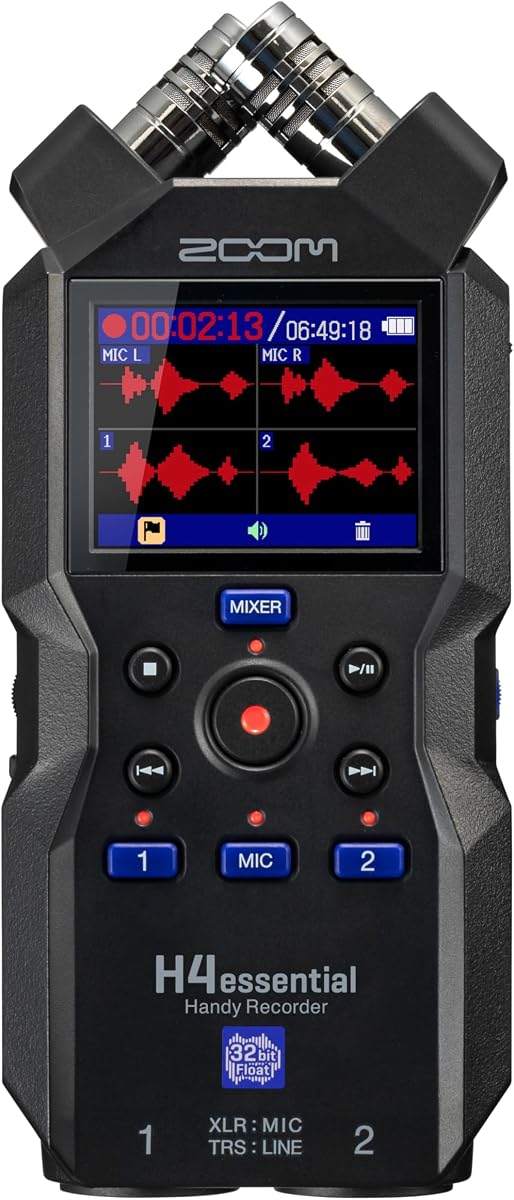


The Zoom H4 Essential is a 4.4-rated handheld recorder designed to cover music, interviews, podcasts, video audio, live performances, and field recordings. Its defining advantage is flexibility: a creator can begin with the built-in stereo microphones, add external microphones or instruments through two XLR/TRS inputs, or connect a mixer or soundboard for a larger recording setup.
We may earn a commission when you buy through this link, at no additional cost to you.
The ability to capture up to four tracks makes the H4 Essential useful when a project needs room sound and a foreground source, stereo material alongside a dedicated microphone, or several live sources at once. USB-C connectivity adds another layer of utility by allowing connection to a phone, tablet, or computer for recording or streaming, while direct SD-card recording provides a useful backup workflow.
The model is not the smallest or simplest recorder in this guide. Its broader feature set can take more time to learn, and dedicated field recorders may better suit a crew that needs locking professional connectors. Even so, the combination of built-in stereo microphones, two external inputs, multitrack capability, and computer connectivity makes the H4 Essential unusually versatile for creators who want one device to span several kinds of work.
Choose the Zoom H4 Essential when one recorder must handle interviews, rehearsals, location audio, narration, and small production sessions. It is a particularly strong fit for podcasters, filmmakers, musicians, and beginners who want more input options than a basic stereo model without moving to a dedicated professional location recorder.
Two XLR/TRS inputs and support for microphones, instruments, mixers, and soundboards let users change recording configurations as the project changes. The built-in stereo microphones remain useful for ambience, rehearsals, and quick location recordings.
Recording to an SD card while connected by USB-C for device or computer capture can provide convenient backup options. This makes the recorder adaptable to both self-contained sessions and connected production workflows.
We may earn a commission when you buy through this link, at no additional cost to you.
The Zoom H1 Essential is a compact 4.1-rated recorder aimed at musicians, podcasters, and content creators who want a dedicated tool for stereo recording. It is particularly well suited to short videos, tutorials, voiceovers, behind-the-scenes clips, interviews, and everyday environmental recordings where a phone or camera microphone may not provide sufficient control.
We may earn a commission when you buy through this link, at no additional cost to you.
Its built-in stereo microphones provide the central proposition: users can capture detailed sound for songs, rehearsals, lessons, jam sessions, natural ambience, room tone, sound effects, and travel audio without assembling a separate microphone chain. USB-C connectivity expands the functions by allowing the recorder to serve as a microphone for livestreams, calls, meetings, podcasts, and desktop or mobile recording.
This is not the most flexible model in the guide. The absence of professional XLR inputs limits its suitability for multi-microphone interviews or polished location productions, and its two-channel stereo approach does not match the layering and simultaneous source capture of multitrack recorders. Those limitations are reasonable if the priority is a simple, portable stereo tool rather than complex routing.
The Zoom H1 Essential is best for creators who need a compact dedicated recorder for polished content, ambience gathering, rehearsals, or voice work. It offers an approachable way to improve recordings without requiring microphones, mixers, or a large interface, while USB-C connectivity broadens its use beyond standalone capture.
Keeping a dedicated recorder in a bag can provide a convenient way to capture room sound, performances, lessons, and location ambience. Its stereo microphone configuration gives those recordings a dedicated place in the workflow without relying on a camera or phone.
USB-C operation allows the H1 Essential to work as a microphone for calls and streaming. That makes it a practical bridge between standalone field capture and live or connected content creation.
We may earn a commission when you buy through this link, at no additional cost to you.
The Zoom H1 XLR is a 4.5-rated two-channel recorder for filmmakers, musicians, and podcasters who want professional connections in a compact package. It supports 32-bit recording at 96kHz and provides two XLR/TRS combo inputs, allowing microphones, instruments, and other compatible sources to be connected without a large production rig.
We may earn a commission when you buy through this link, at no additional cost to you.
Its OLED waveform display is a major usability benefit. Seeing signal levels at a glance makes it easier to monitor a take and recognize problems that might otherwise be discovered only after the recording. A 3.5mm stereo input and headphone output add further flexibility for monitoring and connecting external devices.
The main constraint is its two-channel format. Creators who need to record three or four sources simultaneously must look to a four-track model, while those requiring locking connectors for a mounted professional setup may prefer a more specialized location recorder. Even with those boundaries, the H1 XLR offers an attractive combination of small size, serious input support, high-resolution capture, and straightforward monitoring.
This model is a strong recommendation for interview recordists, documentary filmmakers, podcasters, and musicians working with one or two sources. It is especially useful for users who want more control and professional connectivity than a basic stereo recorder while retaining a compact footprint for mobile work.
The OLED waveform display gives operators a visual reference for incoming levels. This is valuable during interviews and location sessions because it helps confirm that a take is being captured cleanly before moving on.
Support for SDXC cards up to 1TB provides substantial room for extended recordings and high-quality files. That capacity is useful for projects that generate multiple takes, separate source files, or lengthy environmental recordings.
We may earn a commission when you buy through this link, at no additional cost to you.
The Zoom F3 is a 4.6-rated professional field recorder built for filmmakers, musicians, and recordists who may not get a second chance to repeat a take. Its 32-bit float recording captures a wide range of levels without requiring the operator to stop and adjust gain, which is a major advantage when a source suddenly becomes louder or quieter.
We may earn a commission when you buy through this link, at no additional cost to you.
Dual locking XLR inputs are designed for demanding rigs and mounted setups where a loose connection could interrupt a session. Ultra-low-noise preamps support clean, consistent capture, while flexible power options and both standalone and USB workflows allow the recorder to fit different production environments without forcing one operating method.
This is a specialized two-input instrument rather than a general-purpose multitrack recorder. A creator who wants to layer several instruments, record a large group at once, or use a comprehensive rhythm and effects system may find a different model more appropriate. For a filmmaker capturing dialogue and a separate production track, however, the F3's focused design is an advantage rather than a limitation.
Choose the Zoom F3 when reliability, secure connections, low-noise recording, and rapid level handling matter more than broad creative features. It is a particularly convincing option for documentary, film, and music professionals who need a dependable standalone recorder for quiet dialogue, unexpected peaks, and unpredictable working conditions.
32-bit float recording is particularly valuable in live and unpredictable environments. It allows the operator to capture a wide dynamic range without repeatedly riding gain when voices, instruments, or environmental noise change unexpectedly.
Locking XLR inputs suit a recorder mounted on a rig or positioned out of immediate reach. Secure connections reduce the likelihood that a cable movement will interrupt a critical recording.
We may earn a commission when you buy through this link, at no additional cost to you.
The Zoom R4 is a 4.5-rated multitrack recorder that combines a four-track workflow, two XLR/TS combo inputs, a built-in stereo microphone, effects, rhythms, and USB audio interface functions. It is less narrowly focused on location recording than several professional recorders in this guide, but that breadth makes it an appealing option for musicians and creators who want to develop ideas without a complex studio setup.
We may earn a commission when you buy through this link, at no additional cost to you.
Its standout feature is the ability to record, layer, mix, and bounce tracks to a dedicated bounce track. That frees channels for additional material, while undo offers a way to reverse steps. More than 80 drum patterns across genres can support songwriting and practice, and 32-bit float capture reduces the need to adjust gain during an informal session.
The trade-off is that a music-centered device may not offer the same specialized advantages as a dedicated field recorder. Its inputs are XLR/TS rather than the locking XLR arrangement favored by professional location rigs, and the effects and rhythm features may be unnecessary for someone who only records voices or ambience. It also requires four AA batteries or USB-C power rather than simply arriving with a built-in microphone setup.
The Zoom R4 is a compelling pick for budget-conscious musicians, songwriters, podcasters, and mobile producers who want recording, layering, and computer connection in one device. It can also function as a 32-bit float 2-in/2-out interface for a computer or smartphone, adding value for creators who move between sketching ideas and polished production.
The record, layer, mix, and bounce workflow is useful for building arrangements one part at a time. A dedicated bounce track and undo function make it easier to keep experimenting without filling every available channel immediately.
More than 80 built-in rhythm patterns and included effects extend the device beyond basic capture. These features can support songwriting, rehearsal, and idea development when a full drum machine or production setup is unavailable.
We may earn a commission when you buy through this link, at no additional cost to you.
The Zoom F2 is a compact 4.0-rated lavalier recorder intended for weddings, filmmaking, journalism, videography, podcasting, and other on-the-go productions. Its 32-bit float recording captures at 44.1kHz or 48kHz without the need to adjust gain, allowing the operator to focus on the performance or interview rather than continually managing input levels.
We may earn a commission when you buy through this link, at no additional cost to you.
The included LMF-2 omnidirectional lavalier microphone has a screw-lock connector, windscreen, and lapel clip. Those details support secure, discreet placement during interviews, vlogs, and on-camera work. A REC Hold switch helps prevent accidental stops, while the internal clock operates at plus or minus 0.5ppm for precision audio and video synchronization.
The format emphasizes simplicity and endurance rather than extensive routing. The maximum capacity is 512GB through compatible microSD, microSDHC, and microSDXC cards, and the stated runtime reaches 15 hours on two AAA batteries. Users should not expect the same multitrack flexibility or broad input selection provided by larger handheld recorders, and storage media must be considered separately.
Choose the Zoom F2 for a person who needs to wear a recorder discreetly and capture clean dialogue or presentation audio. It is especially well suited to creators who value long battery life, secure microphone attachment, and synchronization accuracy more than large displays, extensive controls, or simultaneous multi-source recording.
The included lavalier microphone and lapel clip allow a participant to wear the recorder discreetly. Its screw-lock connection adds security for interviews, ceremonies, and on-camera productions where a loose connector would be inconvenient.
A stated runtime of up to 15 hours on two AAA batteries supports extended shoots and events. The REC Hold control reduces the chance of interrupting a critical recording, while the precision clock supports synchronization workflows.
We may earn a commission when you buy through this link, at no additional cost to you.
The EVIDA 9296 is a 4.3-rated digital voice recorder built for lectures, meetings, speeches, interviews, notes, and conversations. It differs from the music and film recorders in this guide by focusing on speech capture, generous internal storage, voice activation, file organization, and straightforward playback rather than professional microphone inputs or multitrack production.
We may earn a commission when you buy through this link, at no additional cost to you.
Its upgraded noise-cancelling microphone and recording chip support clear PCM capture, with selectable MP3 formats at 128kbps and 192kbps or WAV at 1536kbps. Voice activation can be set across six sound levels, helping the device concentrate on speech while reducing blank sections and brief whispers when the threshold is correctly adjusted.
The 128GB internal storage holds up to 9296 hours of recording or 40,000 songs, according to the supplied product information, while continuous recording reaches up to 54 hours on a full battery. Other practical tools include four storage folders, A-B repeat, auto record, bookmarks, password protection, and transfer to a computer. It can also operate as a USB flash drive and MP3 player.
The EVIDA 9296 is a strong fit for students, teachers, senior users, businesspeople, writers, and bloggers who need long-duration voice capture. It is less appropriate for high-end field sound, music, or multi-microphone filming, but for spoken documentation and meetings, its storage and organization features are unusually useful.
The large internal storage reduces the need to transfer files frequently, especially for lectures and meetings. Support for four folders also helps separate recordings by project, subject, or date before later transfer to a computer.
Six adjustable voice-decibel levels allow operators to tune when recording begins or stops. Correct calibration is important: the feature reduces unwanted silence, but the threshold must suit the environment and the desired amount of ambient sound.
We may earn a commission when you buy through this link, at no additional cost to you.
The Zoom H5 Studio is a 4.5-rated handy recorder for filmmakers and musicians who want a combination of detailed stereo capture, direct physical controls, and high-resolution multitrack recording. Its 19.4mm X/Y microphone capsule is the largest on a handheld recorder according to the supplied information and is designed to provide rich, wide-stereo audio with a broad dynamic range.
We may earn a commission when you buy through this link, at no additional cost to you.
Dedicated gain knobs make level adjustments direct and intuitive, an important benefit when operating quickly or working in environments where screen-based menus are less convenient. The recorder can capture up to four tracks simultaneously in WAV format at resolutions up to 192kHz, offering considerable detail for professional-quality results.
The trade-off is that this level of capability may be unnecessary for a simple voice memo or short ambience gathering. The larger body, dedicated controls, and high-resolution options can also make the device less convenient than a compact recorder for users who value minimum size above all else. File and storage planning is also important when using the highest resolutions.
Choose the Zoom H5 Studio when you want a capable handheld recorder for music and film work with four-track flexibility, detailed stereo sound, and direct control. It is a strong fit for a creator who values capsule size, hands-on gain access, and very high-resolution capture more than minimal dimensions.
The 19.4mm X/Y capsule is intended to capture rich stereo detail across a wide dynamic range. It gives the H5 Studio a strong identity for ambience, performances, ensembles, and production audio without requiring an attached stereo microphone.
Dedicated gain knobs let an operator make precise level changes without navigating menus. That direct access is helpful for fast-moving shoots, rehearsals, and sessions where reliable monitoring is more important than a large display.
We may earn a commission when you buy through this link, at no additional cost to you.
The TASCAM DR-40XP is a 4.1-rated portable handheld field recorder designed for music, video audio, interviews, and location production. It combines 32-bit float recording, four-channel capture, two XLR/TRS inputs, adjustable built-in microphones, and ultra-low-noise HDDA preamps in a device intended to work across different environments.
We may earn a commission when you buy through this link, at no additional cost to you.
Its built-in microphones can operate in adjustable A-B or X-Y unidirectional configurations and handle up to 125dB SPL. The four-channel workflow can capture the built-in microphones and external inputs at the same time, allowing an ambient stereo bed and dedicated sources to be recorded together. This is particularly useful for interviews with surrounding sound or musical sessions combining room capture and close microphones.
The model supports 32-bit float, 24-bit, and 16-bit WAV recording at 96kHz, 48kHz, or 44.1kHz, and can serve as a 2-in/2-out USB-C audio interface. A practical limitation is that a microSD card and batteries are not included. It also does not provide the built-in timecode generation and synchronization features found in the TASCAM FR-AV2.
The TASCAM DR-40XP is a versatile pick for creators who want several source options and flexible built-in microphone positioning. It suits location interviews, music sketching, video production, and any project where capturing stereo ambience alongside external sources would improve the final mix.
The ability to switch between adjustable A-B and X-Y unidirectional configurations gives the operator more control over direction and stereo coverage. This makes the built-in pair useful across wide scenes, close sources, and location sound.
Recording built-in microphones and external inputs at the same time preserves a broad soundscape while adding focused sources. That combination supports richer location recordings without requiring separate standalone recorders for every layer.
We may earn a commission when you buy through this link, at no additional cost to you.
The TASCAM FR-AV2 is a 4.6-rated compact field recorder built around the needs of videographers who need high-quality audio and accurate timecode. Dual ADCs and 32-bit float recording support fast setup and worry-free capture, while the integrated timecode generator can synchronize with compatible professional video equipment without a separate timecode device.
We may earn a commission when you buy through this link, at no additional cost to you.
Two XLR/TRS combo inputs with Ultra HDDA preamps and a 3.5mm input provide flexible source connections. Timecode input and output, generation, and synchronization functions use a high-accuracy TCXO, giving the recorder a clear role in multi-camera or camera-and-audio production workflows where consistent timing matters.
Wireless signal monitoring requires the optional AK-BT2 Bluetooth adapter, and no other adapter is compatible. The model is also specialized: users who only need an easy ambience recorder or a speech dictation device may not benefit from timecode, professional combo inputs, and high-accuracy synchronization. Its strengths make more sense within a structured film or video production environment.
Choose the TASCAM FR-AV2 when synchronized audio and video are central to the project and an external timecode generator would add unnecessary complexity. It is a premium choice for videographers, documentary teams, and location sound professionals who value a compact combination of 32-bit float recording, flexible inputs, and integrated timing tools.
Internal timecode generation integrates timing directly into the recording workflow. This can simplify setups that previously required a dedicated external timecode device, particularly when working with compatible professional video gear.
Dual ADCs, 32-bit float recording, and two professional combo inputs make it possible to connect multiple sources while reducing the need for immediate gain corrections. The 3.5mm input adds another convenient connection point.
We may earn a commission when you buy through this link, at no additional cost to you.
The right portable recorder depends on the sources being captured, the number of tracks required, environmental conditions, synchronization needs, and how recordings will move from the field to a computer. Reviewing these factors before purchasing helps prevent an expensive mismatch between features and real production requirements.
Begin by identifying what will be recorded and how many sources need to be isolated. A built-in stereo microphone is well suited to ambience, ensembles, room tone, and quick location sessions, while XLR or combo inputs are preferable for interviews, instruments, isolated dialogue, and productions using dedicated microphones. Models such as the Zoom H4 Essential, Zoom F3, TASCAM DR-40XP, and TASCAM FR-AV2 offer external connections, but each supports a different track count and workflow.
Choose a recorder with enough inputs for the planned session, not simply the largest number available. Include room sound and environmental context in the decision, because built-in microphones can be valuable even when dedicated sources are present.
Resolution determines how much detail is retained and how much storage a session requires. The shortlist includes 32-bit float models, the Zoom H1 XLR's 32-bit and 96kHz option, the Zoom H5 Studio's WAV capture up to 192kHz, and the TASCAM FR-AV2's 48, 96, and 192kHz choices. The EVIDA 9296 focuses on speech-oriented MP3 and WAV files rather than high-resolution production audio.
Match the format to the deliverable and storage plan. Higher-resolution recording is useful for detailed professional work, but it requires more card capacity and careful file management.
Track count determines how many sources can be captured independently. Two-channel recorders are suitable for a focused stereo source or one primary microphone plus ambience, while four-track devices can preserve separate layers. The Zoom R4 also supports mixing, bouncing, undo, effects, and rhythms, making it particularly useful for musicians who want to build an arrangement over multiple passes.
More tracks can provide creative flexibility, but they also increase routing, monitoring, and storage demands. Choose the smallest multitrack system that comfortably supports the intended production rather than paying for complexity that will remain unused.
A field recorder must be easy to carry and comfortable to operate away from a desk. The Zoom H1 Essential and Zoom H1 XLR are compact choices, the Zoom F2 is designed to be worn, and the TASCAM FR-AV2 emphasizes compact field use. Larger handhelds such as the Zoom H5 Studio may provide larger controls and features while remaining portable.
Consider the recording environment as carefully as the size. Wind, moisture, dust, temperature changes, and rough transport can affect sensitive equipment, so protective cases, wind protection, and suitable storage matter even when a recorder is described as professional.
Power configuration determines whether a recorder can support an all-day event, an extended shoot, or a connected computer session. The Zoom F2 offers up to 15 hours on two AAA batteries, the Zoom R4 runs on four AA batteries or USB-C, and the Zoom F3 provides flexible standalone and USB power options. The EVIDA 9296 states up to 54 hours of continuous recording on a full battery.
Carry backup power when the work is remote or extended. Confirm the battery type, carry spares, and use a suitable charging or USB power method, especially when a model does not include batteries.
Storage capacity should match both recording length and file quality. The Zoom H1 XLR supports SDXC cards up to 1TB, while the Zoom F2 supports compatible microSD, microSDHC, and microSDXC cards up to 512GB. The TASCAM DR-40XP supports microSD but does not include a card, and the EVIDA 9296 provides 128GB of internal storage with four-folder organization.
Check card type, maximum capacity, formatting requirements, and included accessories before ordering. Reliable file transfer and clear folder structures can save considerable time during a large session.
Monitoring helps an operator judge a source before and after capture. The Zoom H1 XLR includes an OLED waveform display, the Zoom H5 Studio provides dedicated gain knobs, and multiple models support headphone output or connected-device monitoring. For video, the TASCAM FR-AV2 adds internal timecode generation, timecode input and output, and synchronization functions using a high-accuracy TCXO.
Choose the monitoring system that matches the pace of the work. A visual waveform is useful when levels must be checked at a glance, while physical controls can be valuable during fast sessions. Timecode becomes essential when recorded audio must align with separate video files or multiple synchronized cameras.
A recorder may need to function only as a standalone capture device, or it may also serve as a USB audio interface, streaming microphone, or connected computer recorder. The Zoom H1 Essential, Zoom H4 Essential, Zoom R4, TASCAM DR-40XP, and Zoom F3 support connected workflows, although their USB roles and input configurations differ. The TASCAM FR-AV2 can also be monitored wirelessly with the optional AK-BT2 adapter.
Confirm the exact connection required by the project rather than assuming every USB-equipped recorder has the same functions. Separate the need for computer recording, live streaming, calls, and wireless monitoring, then select the model that supports the relevant workflow.
Before the session, format a compatible storage card in the recorder, confirm the battery or USB power plan, update or review recording settings, and test the intended microphone arrangement. Check input connections and monitoring levels with a short sample, then note the sample rate, bit depth, file format, and timecode settings so every file can be identified during post-production.
During recording, place microphones as close as practical to the intended source, use wind protection outdoors, and monitor the incoming signal without speaking into an open microphone. For stereo recorders, consider both microphone direction and the consistency of movement. For multitrack devices, confirm which built-in or external source is assigned to each track before beginning a take.
After recording, save files to a computer before formatting the card, back up important projects in more than one location, and retain original source files. Clean the recorder gently, keep moisture away from openings, inspect cables and connectors, and store the device in a protective case. Review battery contacts, card formatting, firmware, and clock or timecode settings before the next outing.
It can be, especially when levels change unexpectedly. Recording in 32-bit float gives a recorder a wide range of levels without requiring the operator to adjust gain continually, which is useful for interviews, performances, and unpredictable environments. It does not improve every recording automatically, and users still need sensible microphone placement, storage, and backup practices.
Two channels are often enough for a conversation when each participant has a dedicated microphone, although ambience and room sound may be desirable as an additional layer. Four-track models are more useful when a production needs separate dialogue, stereo room sound, and another source simultaneously. Choose based on the planned mix rather than the number of people present alone.
Several models in this guide support USB connectivity, including the Zoom H1 Essential, Zoom H4 Essential, Zoom R4, Zoom F3, and TASCAM DR-40XP. Their USB roles vary: some act as audio interfaces, while others can also serve as a microphone for connected recording or streaming. Confirm the model's supported connection mode before planning a computer session.
No. Timecode is most valuable when separate audio and video files need precise synchronization, when multiple cameras are involved, or when a production uses separate timecode equipment. A simpler recorder can be sufficient when audio is recorded directly to the camera or when the final production does not require elaborate synchronization. The TASCAM FR-AV2 is intended for the more structured end of that spectrum.
The correct card must match the recorder's supported format and maximum capacity. The Zoom H1 XLR supports SDXC cards up to 1TB, while the Zoom F2 supports compatible microSD, microSDHC, and microSDXC cards up to 512GB. The TASCAM DR-40XP uses microSD, but no card is included. Format the selected card in the device before an important session.
A stereo recorder captures a left and right channel as a paired sound, which is ideal for ambience, ensembles, and spatial recordings. A multitrack recorder saves multiple independent tracks so each source can be adjusted separately in post-production. Some multitrack recorders can still capture a stereo pair, but the key benefit is greater control over the final balance.
They can be enough for ambience, room tone, performances, and quick documentation, particularly on recorders with adjustable or high-quality stereo capsules. Dedicated external microphones usually provide more source isolation and control for interviews or video dialogue. A recorder that supports both built-in and XLR inputs offers the most flexibility as conditions change.
Keep the device away from moisture and extreme temperatures, protect it from impact with a suitable case, and use wind protection whenever moving air or exposed microphones could affect the recording. Inspect cables, connectors, and battery compartments regularly. After a damp session, allow the equipment to dry before storing it in a closed bag.
The Zoom F3 stands out for professional location work because of its 32-bit float capture, ultra-low-noise preamps, locking XLR inputs, and flexible power options. The Zoom R4 offers a different kind of value for musicians and budget-conscious creators through four-track recording, bouncing, rhythms, effects, and USB interface functions, while the TASCAM FR-AV2 is the premium synchronization option for videographers.
Prioritize the features required by the actual production: source isolation, track count, recording resolution, runtime, storage, monitoring, and synchronization. A compact stereo recorder may be ideal for ambience and quick content, whereas a wearable lavalier model suits discreet dialogue, a multitrack recorder supports layering, and a timecode-equipped unit serves structured video workflows.
Before buying, verify the current configuration, included accessories, storage requirements, battery needs, and product details on the listing. Prices and availability can change, and optional items such as cards, batteries, lavalier accessories, or a Bluetooth adapter may affect the final setup. A recorder is only as useful as the recording plan, microphone placement, monitoring, and file backup behind it.