
Outlet Extender with Rotating Plug
4.7Editor score
Six widely spaced outlets
Three integrated USB ports
180-degree rotating plug
1800J surge protection
Looking for a surge protector for kitchen counter? Compare 10 top models for outlet capacity, USB charging, surge protection, mounting options, and everyday
A surge protector for the kitchen counter must do more than provide extra outlets. It should accommodate frequently used appliances, chargers, and bulky plugs without crowding the work area or creating a cable-management problem. The right model also needs appropriate surge protection, grounded connectivity, and a format suited to counters, walls, or appliances.
We compared all ten products by examining their outlet counts, wattage limits, joule ratings, USB charging options, physical dimensions, mounting features, and safety protections. The list includes direct wall taps, rotating plug extenders, short extension cords, and a heavy-duty appliance power strip designed for higher-powered kitchen equipment.
Each review explains where a product stands out, where its compromises may matter, and which type of counter setup it suits best. The top three selections recognize overall versatility, budget-friendly convenience, and heavy-duty kitchen capability. Product availability and pricing can change, so confirm the current listing and electrical specifications before purchasing.
4.7Editor score

4.7Editor score

4.6Editor score
The comparison highlights the most important differences among wall taps, rotating outlet extenders, short-cord power strips, and heavy-duty appliance models, including capacity, protection, charging support, and installation style.



The Belkin 6-Outlet Surge Protector Power Strip combines six protected AC outlets with one USB-A port and one USB-C power-delivery port. It has a 4.7 rating and stands out as a strong all-around solution because it provides generous outlet capacity, a slim direct-to-wall format, and clearly stated surge and safety protections.
We may earn a commission when you buy through this link, at no additional cost to you.
Its 1,680-joule protection rating is among the stronger figures in this group, while the 14-point safety system covers conditions such as over-temperature, overload, over-current, short circuit, clamping, and overvoltage. The wall-mountable design eliminates a trailing extension cable, making it particularly useful above or behind a kitchen counter where loose cords are inconvenient.
The main compromise is that this is a wall-mounted unit rather than a freestanding strip with an extended cord. It may not reach an island or appliance located several feet from the receptacle, and it does not offer the higher 1,800-joule figure seen on a few rotating-plug alternatives. Its USB charging set is also more modest than models with four to six USB ports.
This is the strongest general recommendation for a kitchen counter with a nearby wall outlet. It suits households using several small appliances, countertop electronics, and a phone that benefits from USB-C charging. Belkin also includes a two-year limited warranty and a $25,000 connected equipment warranty, adding useful reassurance for connected electronics.
Because the protector plugs directly into a wall receptacle, it keeps the counter free of a bulky strip and long cable. It is especially useful for phones, speakers, kitchen scales, and other frequently connected devices that otherwise compete for limited outlet space.
The illuminated indicator provides an at-a-glance status check, while USB-C and USB-A ports simplify charging without separate wall blocks. The comprehensive safety system also makes this a more versatile option for a mixed collection of electronics.
We may earn a commission when you buy through this link, at no additional cost to you.
This rotating-plug outlet extender provides six AC outlets, three USB charging ports, and 1,800 joules of surge protection in a compact 5.7-by-1.9-by-1.7-inch body. Its 4.7 rating reflects a well-balanced design that offers strong capacity and useful charging options without taking up much counter space.
We may earn a commission when you buy through this link, at no additional cost to you.
The wall plug rotates 90 degrees in either direction, which can make a duplex receptacle easier to use when another plug is already present. Three outlets appear on each side with generous separation, reducing the chance that large AC adapters will block neighboring sockets. A grounded indicator light also confirms the protective circuit's status.
Its surge protection uses TVS, MOV, and GDT components, with a stated response time under one nanosecond. Over-current, over-charge, short-circuit, and over-temperature safeguards are included, and the fire-resistant ABS shell is rated to 1,382 degrees Fahrenheit. However, the three USB ports share a total 5V/3.1A output, so simultaneous charging can be less powerful than dedicated high-output configurations.
This is a compelling option when a counter needs more plug locations but not additional cable length. It works especially well beneath wall cabinets, behind appliances, or beside a sink where a rotating plug improves access. It is also a sensible lower-cost selection for consumers who want more than a basic three-outlet adapter.
A rotating plug can preserve access to the second socket of a duplex receptacle, even when several bulky adapters are connected. This flexibility is particularly valuable in tight spaces along a backsplash or inside a cabinet.
Combining three USB ports with six AC sockets reduces the number of wall blocks needed on a busy counter. Smart charging detection is convenient for common phones, earbuds, and small accessories, while the compact body limits visual clutter.
We may earn a commission when you buy through this link, at no additional cost to you.
The Heavy Duty Appliance Power Strip is designed for counters where a conventional lightweight power strip may not feel appropriate. It combines a 24-inch, 14-gauge extension cord with eight AC outlets, six USB ports, a 1,080-joule surge rating, and a stated maximum capacity of 1,875 watts. It carries a 4.6 rating.
We may earn a commission when you buy through this link, at no additional cost to you.
The thicker cord and high-wattage rating make it more relevant for microwaves, cookers, steamers, aquarium equipment, freezers, and other demanding appliances, although every connected load must remain within the total circuit limit. Its short length is intended to bridge the gap between a wall receptacle and nearby work surface rather than trail across the room.
Three USB-C ports and three USB-A ports provide up to 22 watts of combined USB output, with automatic device detection. Two-screw mounting tabs allow the strip to be secured to a wall, workbench, floor, or counter. The trade-off is its 1,080-joule rating, which is lower than the 1,680- and 1,800-joule options elsewhere in the guide.
This is the best fit for a dedicated appliance station, garage workbench, or compact kitchen where multiple high-draw devices and charging accessories need one centralized connection. Buyers should verify the combined wattage of connected appliances and avoid using a single high-power appliance beyond the strip's stated limits.
The 14-gauge cord and 1,875-watt ceiling make this more relevant to countertop appliances than many lightweight strips. Short length keeps the connection close while reducing excess cable across walking areas.
Integrated screw tabs let the strip move from a free-standing position to a wall- or bench-mounted installation. That flexibility is useful for fixed appliance zones where a stable, organized connection matters.
We may earn a commission when you buy through this link, at no additional cost to you.
The QINLIANF 5 Outlet Extender combines five AC sockets, four USB charging ports, and 1,680 joules of surge protection. With a 4.7 rating, it offers a balanced combination of outlet spacing and charging convenience, particularly for counters where large plugs are used frequently.
We may earn a commission when you buy through this link, at no additional cost to you.
The outlets are distributed across three sides and are spaced 2.1 inches apart, exceeding the spacing of a typical wall receptacle. This gives large adapters more room and reduces blocked access. A central screw can secure the extender to a standard duplex outlet so it is less likely to be pulled loose while disconnecting a plug.
The mounting method is also the model's main limitation. The stated instructions say it works on duplex outlets only and cannot be secured to GFCI receptacles. It also requires more clearance around a receptacle than a standard adapter, so countertop cabinets or trim can interfere with installation. One USB-C port is limited to 5V/3A and does not support protocols requiring 9 to 22 volts.
This model is a good choice for a household that wants wide outlet spacing, several USB connections, and optional wall security without a long cord. It is less appropriate near a GFCI-protected sink, where compatibility with the receptacle format is essential. A protected indicator light helps confirm normal operation.
The extended outlet spacing helps prevent a large transformer from taking over adjacent sockets. That makes the unit more practical for countertop appliances and charging bricks than a tightly packed basic splitter.
The included middle screw is useful in busy homes where a wall-mounted unit might otherwise be pulled free. It also helps maintain a neater appearance in locations where cords will be plugged in and removed regularly.
We may earn a commission when you buy through this link, at no additional cost to you.
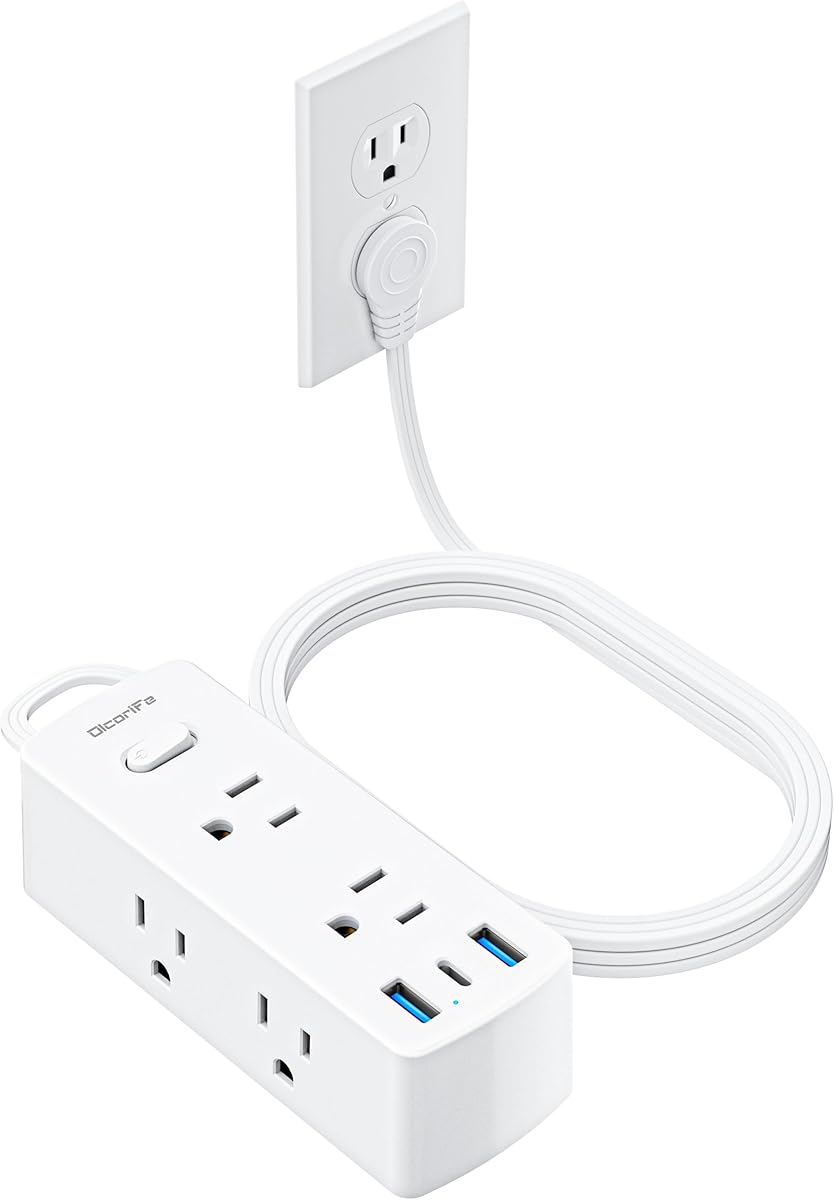
The Olcorife Flat Plug Power Strip provides six AC outlets, two USB-A ports, one USB-C port, and a five-foot extension cord. Its 4.7 rating and compact three-sided design make it especially useful when the nearest wall receptacle is not directly beside the appliance or charging area.
We may earn a commission when you buy through this link, at no additional cost to you.
The extension cord adds meaningful flexibility for kitchen counters, islands, and temporary work areas. A 0.27-inch flat plug can slide behind furniture or into a tight gap where a conventional plug cannot, while the three-sided outlet arrangement allows several cords to approach from different directions.
The built-in circuit breaker cuts power when the rated load is exceeded, helping reduce overcurrent and overheating risk. However, the supplied product information does not state a surge-protection joule rating, so it should not be assumed to offer the same transient-voltage protection as the explicitly rated models in this guide. The five-foot cord can also introduce excess cable if the outlet is close.
This strip is best for people who value reach and a thin wall connection more than a specifically stated surge rating. It works well for countertop appliances, a phone-charging station, or a home-office setup away from the wall. Buyers who prioritize protection for expensive electronics should favor a model with a clearly published joule figure.
A five-foot cord gives the strip enough freedom to sit where it is useful instead of directly under the outlet. This is valuable for mobile appliances and countertop charging stations that are repositioned frequently.
The thin plug profile can fit behind cabinetry or against an outlet where a bulky standard head would not. Combined with the compact body, it reduces obstruction in frequently accessed counter locations.
We may earn a commission when you buy through this link, at no additional cost to you.
The Philips 6-Outlet Wall Tap converts one grounded duplex outlet into six grounded three-prong outlets in a low-profile housing. It has a 4.7 rating and is designed for shoppers who want outlet expansion without a loose power strip occupying the counter.
We may earn a commission when you buy through this link, at no additional cost to you.
Its main advantage is simplicity. There is no long cord to route, and the wall-tap body can sit behind furniture, along a backsplash, or inside a cabinet. The 900-joule protection level and illuminated indicator provide a clear statement of operational status, while the grounded outlets support appropriate three-prong appliances.
Compared with several rotating-plug and premium options, its 900-joule rating is more modest. It also lacks USB charging ports, so phones, tablets, and accessories still need separate wall blocks. A low-profile design is attractive in appearance, but it offers less flexibility if the desired device is several feet away from the receptacle.
This wall tap is a good fit for a counter with several low-draw appliances, lamps, chargers, and small household devices near a wall outlet. It is especially appealing where preserving backsplash space matters more than fast USB charging. Philips also includes a limited lifetime replacement plan and a $50,000 connected equipment policy.
The wall-mounted form keeps cords elevated and leaves the work surface open. It is an attractive option where a freestanding strip would interfere with food preparation or cleaning.
Six grounded three-prong outlets support common household plugs, and the LED indicator makes it easy to check whether surge protection is active. The 900-joule specification gives buyers a clear measure of its intended protection level.
We may earn a commission when you buy through this link, at no additional cost to you.
The Fosmon 3-Outlet Appliance Surge Protector includes two compact units, each providing three grounded outlets, 1,200 joules of surge protection, and a total capacity of 1,875 watts. Its 4.7 rating reflects a practical choice for appliances that need a dedicated protected connection.
We may earn a commission when you buy through this link, at no additional cost to you.
The product is marketed for refrigerators, microwaves, washing machines, and garage doors, and the two-pack allows one protector to serve more than one appliance area. Each unit conforms to UL498A and UL1449 standards, with protected and grounded indicator lights that help users verify operation.
Three outlets are fewer than most models in this guide, and there are no USB ports, so the design is deliberately focused rather than feature-heavy. The compact body is also less useful as a general-purpose charging station. A user should confirm that each appliance has a three-prong plug and that the connected load remains within the stated 15-amp, 125-volt limit.
This two-pack is best for protecting major appliances or creating protected connections in separate kitchen and utility locations. It may also appeal to travelers because the small adapter is easy to carry, though its primary appeal is appliance use. The included warranty and USA-based customer service add confidence for long-term ownership.
Two units make it possible to protect devices in separate areas without buying separate adapters. One might serve a refrigerator while the other protects a garage or laundry-room appliance.
The 1,200-joule rating and 1,875-watt capacity provide meaningful surge protection while preserving a small footprint. Its three-prong grounded design is suited to substantial household appliances rather than temporary travel accessories alone.
We may earn a commission when you buy through this link, at no additional cost to you.
The Wall Outlet Extender with Shelf combines six AC outlets, three USB charging ports, a removable shelf, and 490 joules of surge protection. Its 4.5 rating makes it an interesting niche option for counters where keeping small devices elevated and organized is as important as expanding outlet capacity.
We may earn a commission when you buy through this link, at no additional cost to you.
The shelf creates a dedicated landing place for phones, razors, toothbrushes, speakers, and other small countertop objects. Because it is removable, the owner can remove it when more counter area is needed. Six outlets are distributed for multiple devices, while one USB-C and two USB-A ports support common charging accessories.
The 490-joule figure is the lowest stated surge-protection rating among the ten products, and it should be considered carefully when powering sensitive or expensive electronics. The product also uses safeguards for over-current, over-charging, and over-heating, but those protections do not make the joule rating equivalent to the higher-rated units in the guide.
This model is best for a small charging station near a bathroom or kitchen wall outlet where a shelf would make frequently used items easier to reach. The supplied instructions specifically advise checking the outlet type when considering kitchen or bathroom use. It is less compelling as a primary high-surge protector for major electronics.
The shelf gives phones and small accessories a consistent place to sit while they charge. That can reduce clutter and make frequently used devices easier to find.
Removing the shelf restores the area underneath for a different layout. Users can therefore keep the organizer in place during a charging session and remove it for heavier food preparation.
We may earn a commission when you buy through this link, at no additional cost to you.
The Surge Protector Rotating Plug Extender offers six widely spaced AC outlets, four USB charging ports, and 1,800 joules of surge protection. It has a 4.7 rating and is a strong option for counters that combine several appliances with multiple phones, tablets, watches, or accessories.
We may earn a commission when you buy through this link, at no additional cost to you.
Two USB-C and two USB-A ports make this more charging-oriented than the Belkin wall protector or Philips tap. The rotating plug rotates 90 degrees in both directions, helping users retain access to a duplex receptacle, while the three-sided arrangement and 5.7-by-1.9-by-1.7-inch dimensions preserve a compact footprint.
The protection system combines TVS, MOV, and GDT circuits with a stated response speed under one nanosecond. ETL certification is listed, along with fire-resistant construction and protection against over-current, over-charge, short circuits, and overheating. The important operational limitation is the 1,875-watt and 15-amp ceiling; connected loads must remain below that rating.
This extender is ideal for a busy breakfast or coffee station with many small personal devices. Its four USB ports can eliminate several charging blocks, although the total output is shared, so charging speed may decrease when several ports are used simultaneously. It is less suitable when an appliance is physically distant from the wall outlet.
Two USB-C and two USB-A ports give common devices several convenient connection options. This makes the unit particularly useful for households that routinely charge several small electronics at once.
Using TVS, MOV, and GDT components gives the design a more layered protection approach than a basic adapter. Its 1,800-joule specification is among the highest ratings represented in this comparison.
We may earn a commission when you buy through this link, at no additional cost to you.
The TESSAN Short Extension Cord is a compact seven-in-one outlet solution with four AC sockets, one USB-C port, two USB-A ports, and a 5.5-inch extension cord. Its 4.7 rating reflects a useful design for adding a modest number of connections directly beside a wall receptacle.
We may earn a commission when you buy through this link, at no additional cost to you.
The short cord gives the flat plug enough flexibility to be repositioned without producing the loose cable loops associated with a full-length extension strip. The head is only 0.34 inches thick, allowing it to slide behind a sofa, cabinet, desk, or other piece of furniture where a conventional plug would not fit.
Protection features include over-current, over-voltage, and short-circuit safeguards, but the supplied specifications do not provide a joule rating. As a result, buyers seeking a known surge-absorption capacity should choose one of the models that publishes that figure. The USB-C port is rated to 15 watts, and each USB-A port is rated to 12 watts.
This product is a good fit for a small kitchen charging area, bedside table, office, or entertainment center where short reach is desirable and four AC outlets are enough. Its three-sided body allows four large adapters to be connected without each blocking the others. It is not the right choice for distant appliances or a large collection of simultaneous users.
The 5.5-inch extension section provides just enough movement for placement while preventing excess wire from collecting behind a cabinet. It is a focused alternative to a long extension cord.
Four AC outlets and three USB ports cover the most common charging and powering needs in a compact package. The three-sided design gives bulky adapters more usable room than a simple inline splitter.
We may earn a commission when you buy through this link, at no additional cost to you.
The most useful kitchen counter surge protector depends on outlet location, appliance demands, plug size, charging habits, and the amount of counter space available. These factors matter more than simply choosing the model with the most sockets.
A direct wall tap or rotating-plug extender is best when a receptacle is close to the counter and you want to keep the work surface open. A short extension cord adds a small amount of positioning freedom, while a longer cord is more useful for an island, appliance cart, or separate prep area. Consider where the strip will be plugged in, how far devices sit from the wall, and whether the cord could interfere with cleaning or food preparation.
Most listed products are rated for 125 volts, 15 amps, and up to 1,875 watts, but the connected loads share that capacity. Adding a microwave, coffee maker, kettle, and countertop heater at the same time can exceed what one strip is designed to carry. Check appliance wattage, avoid daisy-chaining power strips, and stop using a protector if it becomes warm, smells unusual, or repeatedly trips its overload control.
A higher joule rating indicates greater stated energy-absorbing capacity. Products in this guide range from 490 to 1,800 joules, with 1,680 and 1,800-joule models offering the strongest published figures here. A joule rating does not guarantee that a surge will be stopped, so protectors should still be paired with properly grounded outlets and sound electrical wiring. Models without a published rating offer less information for comparison.
Counter outlets often hold large transformer plugs for speakers, appliances, and chargers. Wide-spaced or three-sided designs reduce blocked sockets, while a rotating wall plug can make both halves of a duplex receptacle more accessible. Look for the stated spacing between outlets and compare the dimensions with your largest plug and adapter before installing the unit.
USB-A remains useful for older accessories, while USB-C is increasingly important for modern phones, earbuds, and tablets. Models with four to six USB ports can replace several wall chargers, but total output is commonly shared across ports. Check the individual and aggregate wattage, especially if several devices charge at once or a device requires a USB-C protocol above 5 volts.
Wall mounting is valuable above a backsplash, under a cabinet, or behind a stationary appliance. Some models include tabs or a central screw, though compatibility with GFCI receptacles varies. Longer strips with screw tabs can be secured to a workbench or wall, while flat plugs can disappear behind furniture. Keep cords away from sinks, hot surfaces, and edges where they could be pinched or pulled.
Look for independent certification such as ETL and conformity with applicable surge-protector standards. Also check for grounded three-prong plugs, over-current or overload protection, short-circuit protection, and a visible status indicator. Certifications support confidence in the product, while indicators and automatic cutoff mechanisms help users recognize when protection or power is no longer active.
Not every wall-mounted extender fits every outlet. Some require a standard duplex receptacle and cannot be secured to a GFCI outlet, while others may fit but extend too far from the wall. A kitchen counter near a sink may also involve local electrical requirements. Verify the form factor, grounding, wet-area suitability, and manufacturer instructions before installation.
Before installation, inspect the unit and cord for damage, confirm that the wall receptacle is grounded, and compare all intended loads with the strip's voltage, amperage, and wattage limits. Install the protector where it will remain dry, away from heat, and where its outlets and cord cannot interfere with appliances, cabinet doors, or cleaning.
Plug high-draw appliances directly into the AC sockets and use the USB ports for compatible phones, tablets, and accessories. Do not daisy-chain the protector with another power strip or extension cord, and avoid using appliances that exceed the shared rating. If the overload control trips, unplug devices until the load is reduced before resetting or using the unit again.
Inspect the protector periodically for loose connections, discoloration, unusual odors, buzzing, or warmth. Keep the housing dry and dust-free, and unplug the unit if liquid enters it. Replace a protector after a severe surge or if its status light, reset mechanism, or protection indicator no longer functions as described. Never attempt to modify the wiring or internal components.
A surge protector is suitable for many kitchen-counter electronics and appropriately rated small appliances. The key requirements are a grounded outlet, compliance with the combined wattage limit, and placement away from water, heat, and interference. High-draw appliances such as heaters should be checked especially carefully, and a surge protector should never substitute for proper circuit and wiring capacity.
A higher joule rating indicates greater stated energy-absorbing capacity, so a model rated around 1,680 or 1,800 joules offers a stronger published specification within this group. Joules alone do not guarantee protection from every event, however, and reliable grounding and sound electrical wiring remain essential. For valuable electronics, compare the rating, safety certifications, and warranty terms together.
Only if the power strip explicitly supports the microwave's electrical demand and the combined load remains below the listed limit. The heavy-duty appliance model in this guide specifies 1,875 watts and describes suitability for microwaves, but a typical microwave may consume a large share of that capacity. Because heaters, kettles, and coffee makers can also draw substantial power, avoid connecting multiple high-load appliances to one strip.
USB-C is useful when you regularly charge a modern phone, tablet, earbud case, or other USB-C accessory, and it may eliminate the need for a separate charging block. The number of USB ports and their output still matter. If several devices charge simultaneously, shared total output can reduce charging speed, and some USB-C ports support only basic 5-volt charging rather than faster high-voltage protocols.
A wall tap plugs directly into a receptacle and has little or no cord, making it compact and reducing cable clutter. An extension cord includes a cable that allows the strip to be positioned farther from the wall. Your choice depends on proximity, counter layout, and whether the added reach of a cord is more valuable than keeping the connection immediately beside the receptacle.
Yes, if the product offers suitable mounting holes or tabs, the location is dry and ventilated, and the cords do not interfere with cabinet hardware. Some rotating-plug models are intended to remain freestanding, while others have explicit mounting features. Follow the manufacturer's instructions and avoid creating tight bends or pinching the cable at the mounting point.
No. Surge protection cannot compensate for an absent or faulty ground, damaged wiring, an overloaded circuit, or unsafe use near water. The protector should be connected to a properly grounded outlet, and its total load must remain within its rating. If an outlet sparks, feels hot, has discoloration, or frequently trips a breaker, it should be inspected by a qualified electrician.
It is prudent to replace or professionally inspect a unit after a severe surge, especially if its indicator is off, the reset control will not operate, the housing is damaged, or connected equipment behaved abnormally. Surge protectors can degrade after absorbing an event even when they appear intact. Follow the manufacturer's replacement and warranty guidance, and discontinue use if there is any physical or electrical concern.
The Belkin 6-Outlet Surge Protector is the most versatile overall choice because it combines six outlets, 1,680 joules of protection, USB-C and USB-A charging, and a direct wall-mounted format. The rotating-plug extender is a strong budget option for more outlet access and three USB ports, while the heavy-duty appliance power strip serves counters that need a 14-gauge cord, eight outlets, and multiple charging connections.
Prioritize the form factor that matches your outlet location, the stated surge rating, and the total wattage of connected appliances. Wide outlet spacing and a rotating plug can prevent frustrating conflicts with bulky adapters, while a short cord or wall tap can keep counters clean. Verify GFCI compatibility, grounding, safety certification, and any mounting restrictions before installation.
Product details, availability, and pricing can change, so confirm the current listing and manufacturer specifications before making a final decision. Choose a model whose capacity and protection level match the devices you intend to connect, rather than selecting only by outlet count or extra features.