
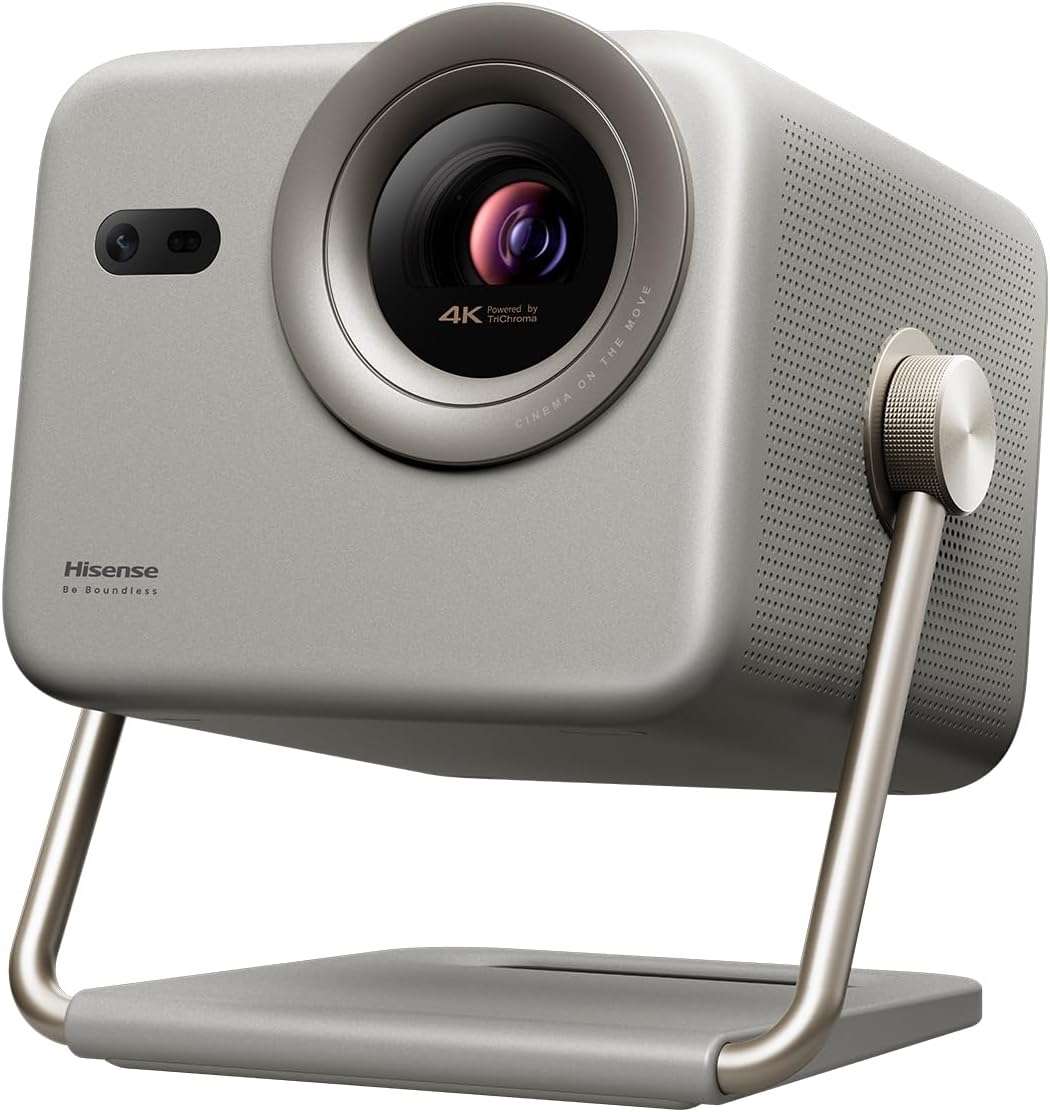
Hisense PL1 Ultra Short Throw Home Theater Smart Projector
4.5Editor score
Up to 120-inch image
2200 ANSI lumens
3000:1 native contrast
Dolby Vision and Atmos
Google TV platform
A short throw projector can create an enormous, cinematic image without requiring a long room or a ceiling-mounted installation. Hisense offers several UST and portable-style models with different laser systems, brightness levels, screen ranges, and smart ecosystems, making careful comparison essential.
This guide evaluates ten Hisense short throw projector listings based on their stated resolution, brightness, contrast, color coverage, throw distance, HDR support, operating system, audio, and gaming features. It covers new and renewed configurations, including dedicated home cinema models and more flexible lifestyle projectors.
Each review highlights the strongest reasons to consider a particular projector, along with its practical trade-offs. The PX3-PRO leads the dedicated cinema category, while the PL1, PX1, L9G, M2 Pro, and C2 serve different rooms and use cases; availability and configurations can change.
4.5Editor score

4.3Editor score

4.0Editor score
As an Amazon Associate we earn from qualifying purchases.
The following comparison organizes all ten Hisense projector listings by image scale, light output, color technology, major smart features, and gaming capabilities, making it easier to identify the right model for a dedicated theater, living room, or portable setup.



The Hisense PX3-PRO is the most complete dedicated home theater projector in this guide, combining a triple-laser light engine, 4K UHD resolution, 3000 ANSI lumens of brightness, 3000:1 native contrast, and an image measuring up to 150 inches diagonally. Its 4.3 rating reflects a strong feature set, particularly for viewers who prioritize color range, large-screen immersion, Dolby presentation, and responsive gaming in one system.
We may earn a commission when you buy through this link, at no additional cost to you.
The projector uses Hisense LPU TriChroma technology to combine red, green, and blue laser light sources. According to the supplied specifications, it covers 110% of BT.2020 and achieves color accuracy around Delta E 0.9, indicating a particularly wide palette and an emphasis on precise reproduction. Real-time Pro AI algorithms are also listed as improving brightness, contrast, and noise, while the DLP system uses 2.07 million micromirrors to support sharp 4K imagery.
Its cinema credentials extend beyond resolution and color. Dolby Vision, Dolby Atmos, IMAX Enhanced, HDR support, and Filmmaker-style presentation options make it suitable for films and high-production television. The 240Hz high refresh rate and automatic low-latency mode are especially relevant to console gaming, while the included audio capabilities reduce the need for a separate sound system for casual viewing. The principal trade-off is financial: this is intended as a premium home theater centerpiece rather than an inexpensive secondary display.
Ultra short throw technology is the feature that fundamentally changes placement. Rather than being placed across the room, the PX3-PRO can sit inches from the wall and still produce an image as large as 150 inches, making it practical for apartments, modern living spaces, and dedicated media rooms. It is the strongest all-around choice here for a buyer who wants serious cinema features, broad color, excellent scale, and advanced gaming rather than a portable lifestyle design.
The primary caution is setup discipline. A UST projector benefits from a flat, properly positioned surface and room planning for the equipment, cables, ventilation, and viewing distance. A dedicated screen may also reveal more detail than a painted wall, although that is an optional enhancement rather than a requirement. Buyers should also consider the space needed for the picture because even a 150-inch image is not suitable for every room.
Within the list, the PX3-PRO stands out because it does not ask buyers to compromise sharply between image quality, operating system, sound, gaming, and screen scale. Its renewed counterparts offer the same stated core hardware, but this standard configuration is the most straightforward option for anyone prioritizing a complete, current feature set and direct comparison with the other models.
Triple-laser light is the PX3-PRO's defining advantage. The stated 110% BT.2020 coverage, high color accuracy, Dolby Vision, and IMAX Enhanced support make it especially well suited to richly graded films, vivid nature content, and a large television-like picture in a dedicated theater.
Because the image can reach 150 inches from a position close to the wall, the PX3-PRO can replace a large flat-panel display without a long throw distance. That makes it ideal for compact rooms where conventional projector placement would be inconvenient.
We may earn a commission when you buy through this link, at no additional cost to you.
The Hisense PT1 brings a 150-inch ultra short throw cinema system into consideration with 4K UHD resolution, 2500 ANSI lumens, 3000:1 native contrast, and a triple-laser light source. Its 4.1 rating indicates a generally capable package, and the renewed designation means buyers should assess the exact condition, warranty coverage, and included accessories carefully.
We may earn a commission when you buy through this link, at no additional cost to you.
Picture performance is supported by Dolby Vision and Dolby Atmos, IMAX Enhanced, and a 4K AI upscaler designed to improve the presentation of older films, streaming programs, and other lower-resolution material. The 240Hz high refresh rate also makes the PT1 relevant to fast-moving games. Google TV consolidates popular streaming applications, recommendations, voice search, free channels, and user profiles in an interface that is more current than a basic smart-projector system.
The headline advantage is flexibility. At 2500 ANSI lumens, the PT1 should provide a vivid large-screen image while remaining somewhat more restrained in output than the 3000-lumen PX3-PRO. It can fill a wall with up to 150 inches of content from inches away, making it suitable for rooms where a long throw would be impractical. Its 3D capability is another distinctive feature for compatible content and compatible glasses.
There are trade-offs beyond the renewed status. The stated contrast ratio matches the flagship PX3-PRO, but maximum brightness is lower, and the supplied data does not specify the same 110% BT.2020 coverage or Delta E color-accuracy figure associated with that model. Buyers seeking maximum peak brightness or the broadest stated color specification may prefer the PX3-PRO, while those who prioritize a similar overall feature set may find the PT1 more approachable.
Installation still deserves careful planning. UST models must be placed very close to the projection surface and kept square, and the image should be evaluated with the room's ambient light and screen characteristics in mind. A proper screen is optional, but it can improve perceived contrast, uniformity, and perceived sharpness, particularly in a room where walls reflect more light.
For a buyer interested in a large, feature-rich, renewed home cinema projector, the PT1 is a credible middle-ground choice. It offers 3D, modern streaming, Dolby features, strong contrast, and a high refresh rate, but it is best suited to buyers who are comfortable assessing the condition of a renewed product and can live with 2500 rather than 3000 ANSI lumens.
Dolby Vision, Dolby Atmos, IMAX Enhanced, 3D, and Google TV give the PT1 a broad set of features for movies, series, and games. It is a particularly compelling choice when a household wants more than basic streaming and a large screen without moving to the flagship PX3-PRO.
Its 2500 ANSI lumens still provide useful brightness for a large projected image, but controlled lighting will be important for preserving contrast and rich color. Screen choice and room treatment can matter as much as the raw lumen figure.
We may earn a commission when you buy through this link, at no additional cost to you.
This renewed PX3-PRO listing delivers the core specifications associated with Hisense's flagship UST cinema projector: 4K UHD resolution, 3000 ANSI lumens, 3000:1 native contrast, and a 110% BT.2020 color gamut. With a 4.4 rating, it is one of the strongest-rated entries in the guide, although renewed status makes the condition and seller support important parts of the decision.
We may earn a commission when you buy through this link, at no additional cost to you.
The LPU triple-laser system is designed to provide precise color and lifelike images, while the stated approximately 151% DCI-P3 equivalent reinforces the emphasis on saturated yet accurate color. A 4K AI upscaler improves the look of older and lower-resolution material, and Dolby Vision, IMAX Enhanced, and HDR10+ provide a strong cinema processing package. The 240Hz high refresh rate and automatic low-latency mode also suit demanding games.
Google TV brings the familiar smart-TV experience, with access to major services such as Netflix, Disney+, Hulu, and Amazon Prime as listed in the supplied information. Active 3D support adds another option for compatible films, while Dolby Atmos and Harman Kardon speakers provide a more complete out-of-box entertainment system. It is not necessary to own a full surround setup simply to enjoy dialogue, music, and effects with the projector.
The main distinction from the standard PX3-PRO listing appears in the configuration rather than the headline panel technology. This entry's supplied title does not explicitly include Google TV in the same way, and its feature list differs, so buyers should verify the exact operating system, included accessories, remote, speakers, and connectivity. Renewed products can also vary in cosmetic condition, usage history, and warranty treatment.
Its ultra short throw design supports images up to 150 inches from a position close to the wall, making it a strong option for a dedicated media room. As with every UST projector, placement must be precise, and ambient light can reduce the impact of the otherwise strong contrast specification. A dedicated ALR screen may be worthwhile if the wall is reflective or the room is not fully dark.
This renewed configuration is best for informed buyers who recognize the PX3-PRO's capabilities but want a potentially more attainable route into the range. It is less attractive to someone who prioritizes identical package contents or maximum assurance. Reviewing the current listing, seller information, return terms, and warranty is essential before making a final choice.
The combination of triple-laser light, 3000 ANSI lumens, 3000:1 native contrast, and wide color coverage gives this renewed listing the same fundamental visual strengths emphasized for the PX3-PRO family. It is well suited to large, carefully controlled viewing spaces.
Renewed listings can differ in included components and cosmetic condition. Confirming the smart platform, remote, speakers, accessories, warranty, and return terms helps prevent surprises and ensures the selected package matches the buyer's priorities.
We may earn a commission when you buy through this link, at no additional cost to you.
The Hisense PL1 is a value-focused UST home theater projector that still brings 4K UHD resolution, 2200 ANSI lumens, 3000:1 native contrast, Dolby Vision, Dolby Atmos, and Google TV. Its 4.5 rating is the second-highest among the ten listings, making the renewed PL1 an attractive option for buyers who want meaningful premium features without moving to the flagship specification level.
We may earn a commission when you buy through this link, at no additional cost to you.
Native contrast is the most persuasive number in the PL1 feature set. A stated 3000:1 ratio can produce the deeper blacks and more dimensional separation between highlights and shadows that make dark cinema scenes look convincing. Support for Dolby Vision, HDR10, HLG, and Dolby Atmos creates a broadly compatible entertainment platform, while Filmmaker Mode gives viewers a straightforward way to reduce unnecessary image adjustments.
The maximum 120-inch image is smaller than the 150-inch capability of the PX3-PRO and PT1, but that difference may be an advantage in normal living spaces. A 120-inch diagonal picture still feels enormous while being easier to accommodate at typical furniture distances. UST placement means the projector can sit close to the wall, reducing the visual disruption caused by a long throw or ceiling installation.
Google TV supports the major streaming platforms named in the product data, including Netflix, Prime Video, Disney+, Google Play Movies and TV, and Hulu. This makes the PL1 a more convenient all-in-one entertainment device than a basic projector. Built-in Dolby Atmos can improve casual viewing, although a dedicated surround system or soundbar remains desirable for critical listening and deeper low-frequency impact.
The main trade-offs are its renewed condition, lower 2200-lumen output compared with 3000-lumen flagship models, and smaller maximum picture size. These are meaningful limitations, but they also make the PL1 more approachable for a bedroom, apartment, den, or moderate-size media room. Controlled lighting will help it preserve the contrast advantage suggested by its specification.
Overall, the PL1 is a strong recommendation for value-conscious buyers who prioritize 4K, Dolby features, Google TV, and a cinema-style UST image over maximum scale or flagship brightness. A 120-inch ALR screen can improve results further, but buyers should first verify the current listing's condition, warranty, and included items.
The 80-to-120-inch range is practical for many apartments and living rooms, where a 150-inch image may be too dominant. UST placement preserves a large, theater-like presentation while allowing the hardware to remain near the wall.
Google TV, Dolby Vision, and Dolby Atmos provide a much more modern and entertaining package than a basic smart projector. The platform is straightforward for streaming, while the cinema formats support both casual and critical viewing.
We may earn a commission when you buy through this link, at no additional cost to you.
This PX3-PRO configuration combines the flagship projector family's 4K UHD resolution, triple-laser color engine, 3000 ANSI lumens, and 3000:1 native contrast with Google TV and a maximum 150-inch image. Its 4.0 rating still reflects solid overall performance, particularly for buyers who want a single system to handle theatrical movies, streaming, and high-speed gaming.
We may earn a commission when you buy through this link, at no additional cost to you.
Color is a major strength. The stated 110% BT.2020 coverage, equivalent to approximately 151% DCI-P3, indicates a broad cinema palette, while the 4K AI upscaler can improve the presentation of older films, home videos, and broadcast television. Dolby Vision, Dolby Atmos, HDR10+, and IMAX Enhanced make the model a natural fit for content created or mastered with these formats.
The 240Hz high refresh rate and automatic low-latency mode differentiate the PX3-PRO from many conventional home theater projectors. The listing specifically notes its Xbox-oriented design, making it attractive to console gamers who want a large image and responsive input performance in the same device. The 150-inch maximum creates genuine theater-scale immersion, provided the room can accommodate it.
Google TV consolidates streaming applications and discovery features in a familiar operating system. This is one of the clearest advantages over projector packages built around less capable or less consistent software. It reduces the need for an external streaming box and makes day-to-day use more convenient, which is especially important for a device likely to be used for television as well as films.
The trade-off is primarily the scale of the purchase. A 3000-lumen, 4K, triple-laser, large-screen cinema projector is a substantial home entertainment investment, and the UST form factor requires an appropriate surface, ventilation clearance, and deliberate placement. The image may also need careful ambient-light control to deliver the perceived contrast promised by the hardware specifications.
This listing suits a buyer who wants the standard PX3-PRO platform with Google TV and an extensive cinema feature set. It is less compelling for a small room or casual user who will not use 150-inch projection, but it is among the most balanced choices for a dedicated media room, modern living space, or gaming-focused home theater.
Dolby Vision, IMAX Enhanced, wide color, and 240Hz gaming support make the PX3-PRO more versatile than a projector aimed only at movies. It can serve as the main display for streamed series, films, and console games without requiring a separate media ecosystem.
A 150-inch picture needs viewing distance, a suitable surface, and careful control of reflections. Planning these details before installation will produce a better result than choosing the maximum size solely from the specification list.
We may earn a commission when you buy through this link, at no additional cost to you.
The renewed PX3-PRO listed here retains the headline specifications that define the series: 4K UHD resolution, 3000 ANSI lumens, 3000:1 native contrast, 110% BT.2020 coverage, and a 240Hz refresh rate. Its 4.2 rating places it in the middle of the list's customer ratings and suggests a broadly well-received product despite its renewed status.
We may earn a commission when you buy through this link, at no additional cost to you.
The visual benefits come from the same advanced LPU triple-laser platform highlighted across the PX3-PRO range. Pure laser color sources enable the stated wide gamut, while the 4K AI upscaler refines lower-resolution material. Dolby Vision, Dolby Atmos, HDR10+, and IMAX Enhanced establish a strong home cinema profile, and the ultra short throw design allows an image of up to 150 inches from a position close to the wall.
Gaming is another priority, as the 240Hz refresh rate and automatic low-latency mode are designed to make fast movement appear smooth and responsive. That makes the projector useful for more than passive streaming. Its large image can also create a more engaging experience for racing games, sports, action titles, and cooperative console play, although the room must support a suitable viewing arrangement.
The renewed designation introduces uncertainty that should be addressed before buying. Cosmetic wear, accumulated usage, accessory differences, and warranty limitations can affect the long-term experience. A buyer should examine the current condition description, what is included, the return window, and the seller's support. It is also wise to confirm the exact smart platform and connectivity because the titles of renewed listings do not always present package details identically.
Compared with a standard configuration, the attraction here is the possibility of obtaining flagship picture hardware at a more attainable level. The trade-off is that some buyers place a higher value on new-condition assurance and an identical package. For a knowledgeable buyer comfortable with renewed electronics, the potential value can justify that trade-off.
This is a strong recommendation for a home theater enthusiast who wants the PX3-PRO's core strengths—bright triple-laser color, 3000:1 contrast, 4K imagery, huge screen capability, and gaming responsiveness—but can accept a refurbished product. Verify the listing details, retain appropriate expectations, and prioritize setup quality.
The important theater specifications remain present in this renewed configuration. That makes it practical for buyers focused on image quality, color, contrast, and scale rather than model-specific extras.
Review the condition, warranty, accessories, operating system, and return terms before ordering. These factors can distinguish a genuinely favorable renewed deal from one that is less complete than expected.
We may earn a commission when you buy through this link, at no additional cost to you.
The Hisense PX1 is a compact UST home projector with a 5.0 rating, 4K UHD resolution, a triple-laser light source, and a 90-to-130-inch image. It provides a compelling combination of color capability, compact placement, smart features, and built-in sound, making it particularly relevant for buyers who want a large picture without adopting the maximum 150-inch scale.
We may earn a commission when you buy through this link, at no additional cost to you.
The PX1 uses pure red, green, and blue lasers to produce 107% of the BT.2020 color space according to the supplied data. That wide gamut supports vivid color across the image, while HDR10 and Dolby Vision add high-dynamic-range presentation. Its 4K UHD resolution offers more than eight million pixels, which is especially useful when the image fills a substantial portion of the wall.
Brightness is specified at 2000 lumens. That is less output than the 3000-lumen PX3-PRO models and the 3000-lumen L9G, so the PX1 is best suited to a room where lighting can be managed. In a darkened theater, its contrast and wide color can create a strong cinematic result. In a bright living room, ambient light will have a more noticeable effect.
Android TV provides access to major streaming applications and supports the built-in Alexa and Google Assistant voice platforms. For sound, the listed 30W stereo Dolby Atmos system is designed to deliver clear dialogue, crisp highs, and fuller low-end output than a typical projector speaker. It does not replace a calibrated home theater system, but it can make the projector more satisfying as a standalone entertainment device.
Adjustable focus and the 90-to-130-inch range make the PX1 feel more manageable than larger UST models. It is still a full-size home cinema projector rather than a handheld unit, but its smaller image range and 2000-lumen output may be easier to accommodate in a conventional room. As with other UST products, precise placement close to the screen is important.
The renewed condition and 2000-lumen ceiling are the principal trade-offs. Nevertheless, the perfect rating, triple-laser color, 4K resolution, and large-but-manageable screen size make this an excellent choice for buyers who prioritize color and compact home theater scale over maximum brightness.
The 130-inch ceiling is large enough for genuine immersion but less dominant than a 150-inch image. That range can be easier to accommodate in apartments, apartments with open layouts, and medium-sized media rooms.
The 107% BT.2020 claim, 4K resolution, and Dolby Vision make the PX1 visually distinctive. Its 30W Dolby Atmos system adds convenient stereo sound for everyday viewing, although serious movie nights may still benefit from external speakers.
We may earn a commission when you buy through this link, at no additional cost to you.
The Hisense M2 Pro is the most flexible lifestyle projector in the guide, supporting image sizes from 65 to 200 inches while using a 4K UHD DLP system and triple-laser light source. Its 4.7 rating is the second-highest overall, and the combination of optical zoom, intelligent screen adjustment, and a huge image range separates it from fixed-purpose UST theater projectors.
We may earn a commission when you buy through this link, at no additional cost to you.
The MCL38 triple-laser design is intended to deliver vivid color and clarity, while the 2.07-million-micromirror DLP system supports sharp 4K images up to 200 inches. AI 4K Clarity and frame-by-frame color enhancement add processing that can improve perceived detail and natural skin tones. Dolby Vision provides scene-level optimization of brightness, contrast, and color.
Setup flexibility is the defining advantage. The optical zoom uses a 1.0-to-1.3 ratio while retaining 4K sharpness, allowing the image to be resized without relying entirely on digital scaling. Intelligent screen adjustments are intended to make placement easier, which is especially helpful when moving the unit between a wall, outdoor screen, and other positions.
The 1300 ANSI lumens are lower than those of the PX3-PRO, PL1, PX1, and other dedicated home models. This makes the M2 Pro less compelling for a bright living room but well suited to controlled indoor viewing and nighttime outdoor entertainment. At 200 inches, it can create a memorable backyard movie experience, although ambient light, screen gain, and weather conditions will affect the result.
VIDAA OS provides access to Netflix, YouTube, Disney+, and other services named in the supplied data. Active 3D is supported through DLP-Link active shutter glasses, which must be purchased separately. The product data also emphasizes responsive gaming, smooth performance, and minimal lag, making it useful for both entertainment and interactive entertainment.
This is the pick for a buyer who values portability, placement adjustment, and a huge range of image sizes more than dedicated theater refinement. It offers a rare combination of 4K detail, triple-laser color, optical zoom, and intelligent setup, but its lower output means lighting control remains essential.
The M2 Pro can serve as a living room display, a bedroom projector, or a backyard cinema system. Its wide size range and intelligent adjustments reduce the need to redesign the room around a fixed installation.
Optical zoom offers a cleaner way to adjust image size than digital resizing. The stated 1.0-to-1.3 ratio gives users more framing flexibility while the 4K DLP system maintains the project's detail.
We may earn a commission when you buy through this link, at no additional cost to you.
The Hisense 120L9G-CINE120A is a complete theater package consisting of a 4K UHD UST laser TV and a 120-inch Ambient Light Rejecting screen. Its 4.0 rating reflects a capable established system, and the included screen is a major differentiator for buyers who want a ready-made large-screen setup rather than projecting onto a wall.
We may earn a commission when you buy through this link, at no additional cost to you.
The projector uses three pure color lasers to reach 107% of the BT.2020 color space. Its 3000-lumen output is among the highest in this guide, making it better suited to bright highlights and partially lit rooms than many alternatives. 4K HDR support adds high dynamic range, while the included ALR screen is intended to improve contrast and reduce the influence of ambient light.
Its motion processing is another distinguishing feature. The supplied data credits MEMC technology with a microsecond-level processor response and a motion rate up to ten times faster than OLED. That specification suggests the L9G is designed to make fast action look smoother, although individual source material and settings influence the final result.
The 40W Dolby Atmos system is unusually substantial for a projector and is intended to provide clearer speech, stronger treble, and more impactful bass. It still cannot replicate a full dedicated theater system, but it reduces the need for immediate external audio. Android TV, HDR10, built-in Alexa, and Google Assistant provide a convenient smart entertainment platform.
The main limitation is the fixed 120-inch screen. That surface is valuable for picture quality and gives the package a turnkey character, but it requires adequate wall space and careful installation. It is less flexible than a bare projector that can be moved, and the screen cannot simply be resized for a smaller room or alternate aspect ratio.
For a buyer creating a dedicated media room, the L9G stands out as the premium pick because it combines projector and screen. The fixed installation, physical size, and 4.0 rating make it less flexible than the M2 Pro or PX3-PRO, but the package offers a clear path to a polished 120-inch theater environment.
A dedicated ALR surface can manage stray light and improve perceived contrast more effectively than a general wall. Pairing it with 3000 lumens makes the package especially useful where completely darkening the room is inconvenient.
Bundling the projector and 120-inch screen simplifies the decision for a dedicated room. Buyers gain a coherent display surface, while the Android TV platform and 40W audio provide a ready entertainment system after setup.
We may earn a commission when you buy through this link, at no additional cost to you.
The Hisense Laser Mini C2 is a highly flexible 4K lifestyle projector with an extraordinary 65-to-300-inch image range. Its 4.2 rating reflects a strong overall package built around triple-color laser light, 2000 ANSI lumens, 1700:1 native contrast, Dolby Vision, a 240Hz refresh rate, and a motorized-looking gimbal design for flexible positioning.
We may earn a commission when you buy through this link, at no additional cost to you.
The gimbal mount allows 360 degrees of horizontal rotation and 135 degrees of vertical tilt, enabling projection toward walls, ceilings, or different viewing directions. That flexibility makes the C2 useful for unconventional rooms, elevated screens, and mobile entertainment setups. It is less of a permanently installed theater projector and more of a display that can adapt to the space around it.
Its pure triple-color laser system uses 18 laser chips and is specified to cover 110% BT.2020 with color accuracy around Delta E 0.9. The 4K DLP system and AI upscaling support detailed imagery, while Dolby Vision handles high-dynamic-range presentation. At 1700:1 native contrast, it remains below the 3000:1 figure of the PX3-PRO and PL1, but it can still provide a convincing picture when the room is appropriately controlled.
Gaming is a major strength. The projector offers a 240Hz refresh rate, 12ms input lag, and automatic low-latency mode. These are meaningful specifications for fast shooters, racing games, and competitive play, and they help distinguish the C2 from lifestyle projectors that focus primarily on convenience.
Sound by JBL and DTS Virtual:X provide clear dialogue, bass, and simulated surround effects without requiring immediate external speakers. Built-in time-of-flight and gyroscope sensors support digital zoom and spatial adaptation, allowing the image to be resized to half its original size or adapted to the placement environment.
The C2's most impressive capability is also its most demanding: a 300-inch picture requires a very large surface, a suitable viewing distance, and careful ambient-light management. For most buyers, its flexibility between 65 and 200 inches will be more practical. It is a strong recommendation for someone who wants a portable-looking premium laser projector, exceptionally fast gaming, and far more placement freedom than a fixed UST cinema model.
The stated 360-degree horizontal rotation and 135-degree vertical tilt are unusual for a consumer projector. They allow the C2 to adapt to walls, ceilings, temporary screens, and seating arrangements that would challenge a fixed-position model.
A 240Hz refresh rate, 12ms input lag, and automatic low-latency mode create a strong foundation for fast games. The large image adds immersion without sacrificing the response characteristics sought by performance-oriented players.
We may earn a commission when you buy through this link, at no additional cost to you.
Choosing the right Hisense short throw projector requires balancing screen size, room size, brightness, color, smart features, audio, and gaming performance. The following factors explain the most important differences among the ten listings and help prevent an expensive mismatch.
A true ultra short throw projector is designed to sit only inches from the display surface and still create a large image. That is ideal for a living room wall, media cabinet, or dedicated theater because it eliminates the need for a long throw distance, ceiling mount, and long cable run. Hisense's dedicated UST cinema models, including the PX3-PRO, PT1, PL1, PX1, and L9G, fit this category. The M2 Pro and C2 are more lifestyle-oriented and offer broader placement or size flexibility, which is useful for outdoor use and changing spaces.
Choose a fixed UST cinema model for a room where the projector will remain near one wall. Choose a gimbal or portable-style model when you need to move the unit, alter the image size frequently, or project onto temporary surfaces.
The listed maximum image size is useful, but it should not be treated as a target that every room can comfortably support. The PX3-PRO and PT1 reach 150 inches, the L9G uses a 120-inch screen, the PL1 reaches 120 inches, and the PX1 spans 90 to 130 inches. The M2 Pro and C2 extend as far as 200 and 300 inches, respectively, offering more flexibility but requiring much larger spaces or surfaces for the upper limits. A wide image can dominate a room if the viewing distance is too short, while an undersized picture can feel less cinematic than intended.
Measure the available wall, seating distance, ceiling height, and furniture placement before selecting a model. The best result comes from a picture that feels large without overwhelming the room.
ANSI-lumen ratings provide a more standardized indication of brightness than informal lamp or light-source values, although they do not eliminate the importance of screen gain, room color, and ambient light. The 3000-lumen PX3-PRO and L9G offer the most output in this group, while the 2200-lumen PL1, 2000-lumen PX1, 2000-lumen C2, 1300-lumen M2 Pro, and 2500-lumen PT1 create different compromises. Dark rooms favor deeper blacks and more visible contrast, while brighter spaces place greater demands on light output and a reflective screen.
For a controlled media room, prioritize contrast, color, and processing. For regular daytime television or a room that cannot be darkened, favor higher brightness, an ALR screen, and realistic expectations about black levels.
Triple-laser systems use separate red, green, and blue sources to create the displayed image. The PX3-PRO, PT1, PX1, L9G, M2 Pro, and C2 all use this general technology, but their stated coverage differs. The PX3-PRO and C2 are listed at 110% BT.2020, the PX1 and L9G at 107%, and the PT1 is described as a triple-laser model without a specific gamut figure in the supplied data. The C2 and standard PX3-PRO also list color accuracy around Delta E 0.9, an indication of emphasis on precise color reproduction.
A wide gamut is only as useful as the content, screen, and processing behind it. If accurate skin tones and saturated cinema color matter most, compare the stated gamut, Delta E accuracy, and support for Dolby Vision or IMAX Enhanced.
The PX3-PRO, PT1, and PL1 list 3000:1 native contrast, compared with 1700:1 for the C2. Native contrast is more meaningful than a theoretical dynamic figure because it describes the contrast the projector can maintain without relying on dynamic tone mapping. It has a visible effect on letterboxing, shadow detail, and the separation of dark objects from darker backgrounds. The L9G includes a 120-inch ALR screen, which can further improve the presentation in a room that cannot be completely darkened.
A dedicated screen is not mandatory for a UST projector, but it can improve uniformity, color accuracy, and perceived contrast. If the wall is textured, reflective, or non-white, a proper projection screen is usually worth considering.
Google TV appears on the standard PX3-PRO, PT1, PL1, and another PX3-PRO listing, and supports major services including Netflix, Disney+, Hulu, Prime Video, and Google Play Movies and TV according to the supplied data. The PX1, L9G, and older PX3-PRO configuration use Android TV, while the M2 Pro uses VIDAA OS. The C2's supplied description focuses on image, sound, and gaming features without identifying a specific operating system in the provided data.
Choose the ecosystem you understand and trust, and confirm that the required applications are available for your region. For many buyers, a familiar interface and reliable voice search are more important than a small difference in processor specifications.
The PX3-PRO models and PT1 list a 240Hz high refresh rate and automatic low-latency behavior. The C2 pairs its 240Hz specification with 12ms input lag, while the M2 Pro emphasizes smooth performance and minimal lag. These numbers are most meaningful for high-speed shooters, racing titles, competitive multiplayer, and large displays where visible lag can interrupt the experience. Resolution, brightness, and image processing still influence the final result even when a high refresh rate is available.
Check the supported gaming modes, input configuration, and whether the desired console or display device can take full advantage of the stated refresh rate. A projector can still be an excellent media display for a family that does not play competitively.
Built-in sound varies meaningfully. The L9G offers 40W Dolby Atmos, the PX1 lists 30W stereo Dolby Atmos, the C2 provides Sound by JBL with DTS Virtual:X, and several PX3-PRO configurations include Dolby Atmos with Harman Kardon speakers. These systems are useful for everyday viewing, but a soundbar or dedicated speaker system can provide better dialogue clarity, dynamics, and low-frequency impact for movies. Renewed listings may also differ in remote controls, accessories, app compatibility, and warranty coverage.
Compare the full package rather than only the headline lens and light source. Confirm the current listing's included items, condition, return policy, and support before ordering a renewed configuration.
Begin with room preparation rather than unboxing. For a fixed UST model, measure the wall or screen, place the projector close to the surface, remove obstructive furniture, and confirm that the viewing distance suits the intended diagonal size. Turn off nearby lights and use blinds or curtains to control reflections. Lifestyle models with zoom and gimbal systems offer more freedom, but they still benefit from a flat surface and stable support.
Perform the initial picture setup after the projector and screen are in their final positions. Connect the preferred streaming source or game console, select the matching input, and choose a picture mode appropriate for the room. Calibrate brightness, contrast, color, sharpening, and noise reduction with the content you actually watch. Leave room for image adjustment rather than assuming factory settings will account for every wall color and ambient light condition.
Maintain clear ventilation and clean the lens gently with a microfiber cloth designed for optics. Do not use harsh cleaners, compressed air that may introduce dust, or fingers on the lens surface. Keep the projector stable, avoid blocking its vents, and follow the manual's guidance for cleaning the filter or internal components. For outdoor use, protect the unit from moisture, dust, insects, and direct weather exposure even when the image appears suitable for a backyard screen.
An ultra short throw projector can create a large image while positioned only inches from the screen or wall. A regular projector generally needs to sit much farther away from the display surface. UST models are especially useful in compact rooms because they eliminate long throw distances and can often sit on a low cabinet close to the wall.
The Hisense M2 Pro and Laser Mini C2 are the most flexible choices because they are designed as lifestyle projectors. The M2 Pro supports 65-to-200-inch images with optical zoom and intelligent adjustments, while the C2 includes a gimbal with wide horizontal and vertical movement. Both remain large home projectors, so their size and weight should still be considered before moving them.
A special screen is not required, but it can improve picture quality. A flat white wall can work well in a controlled room, while an ALR screen can reduce ambient-light interference and improve perceived contrast. A fixed UST model is particularly well suited to a dedicated screen because it allows consistent placement close to the surface.
The right brightness depends on room size, screen size, screen gain, and ambient light. The 3000-lumen PX3-PRO and L9G offer the most output in this list, while 1300 to 2500 ANSI lumens can work well in darker or smaller spaces. If the room will regularly have daylight, consider the brighter models and an ALR screen.
Triple-laser systems can produce a broad color gamut without relying on a conventional color filter wheel. The listed Hisense models reach 107% or 110% BT.2020 according to their specifications, supporting vivid color and strong HDR presentation. Actual results also depend on the screen, calibration, room lighting, and selected content.
Yes, and the PX3-PRO, PT1, M2 Pro, and C2 explicitly emphasize high refresh rates or low-latency features. The PX3-PRO family and PT1 list 240Hz operation, while the C2 states 12ms input lag and automatic low-latency mode. A modern console, suitable cable, and correctly configured game mode remain important for achieving the intended performance.
A renewed projector can be a sensible option when the core hardware meets your needs and the listing provides appropriate condition details, warranty coverage, and return terms. Check the image or laser behavior, ports, remote, accessories, smart-platform functionality, and any signs of use. A complete standard configuration may offer more assurance, while an informed renewed purchase can provide access to capable hardware at a more attainable level.
Leave enough clearance for ventilation and maintain the placement distance specified in the manual. A fixed UST projector generally needs to remain very close to the wall, but it should not be pushed tightly against it if airflow would be restricted. Lifestyle models also need stable support and should not have cords or objects placed where they could interfere with the lens, sensors, gimbal, or adjustment mechanisms.
The Hisense PX3-PRO is the strongest all-around dedicated cinema choice, combining a 4K DLP system, triple-laser color, 3000 ANSI lumens, 3000:1 native contrast, Dolby Vision, Atmos, IMAX Enhanced, Google TV, and 240Hz gaming. The PL1 is the more value-focused home theater option, while the L9G stands out as a premium projector-and-screen package with a 120-inch ALR surface.
For buyers who prioritize adaptability, the M2 Pro offers an enormous 65-to-200-inch range, intelligent setup features, and optical zoom, while the C2 goes further with a gimbal, 65-to-300-inch flexibility, 240Hz gaming, and JBL sound. The PT1 and PX1 offer useful alternatives depending on preferred brightness, screen size, smart platform, and renewed configuration. Prioritize room fit, controlled lighting, intended screen dimensions, and the features you will use most.
Before ordering, compare the current listing closely, especially when choosing a renewed model. Verify condition, accessories, warranty, return terms, smart-platform details, and the exact product configuration. Current availability and promotions can change, so checking the live listing before making a final decision is an important final step.