
SuperEar SE5000 Hearing Amplifier
4.2Editor score
Amplifies television and ambient sound
Includes stereo headphones and earbuds
Tactile volume control
Portable battery-powered design
This guide compares the best assistive listening devices for TV, including hearing amplifiers, wireless headsets, Auracast transmitters, and speakers.
Assistive listening devices for TV can make dialogue easier to follow without requiring everyone else to increase the television volume. The right choice depends on your hearing needs, TV outputs, hearing aid compatibility, and whether you prefer private headphones, amplified room sound, or direct streaming.
We compared ten products across personal amplifiers, wireless TV headsets, Auracast transmitters, and portable wireless speakers. The evaluation considers connection methods, listening features, range, battery life, included accessories, ease of setup, compatibility limitations, and the situations each device is designed to serve.
Each pick in the guide reveals what it handles best and where its trade-offs appear. Some products are especially convenient for older adults, while others are better for listeners who already own compatible hearing aids. Product availability and prices can change, so confirm the current details before purchasing.
Every selection provides a different way to improve television listening. The comparison includes direct hearing aid streaming, analog and digital wireless systems, ambient-sound amplification, and portable speaker solutions, allowing readers to choose by compatibility and listening preference.
4.2Editor score

4.1Editor score

4.3Editor score
The table below compares all ten devices by device type, connection method, listening range or gain, and major compatibility consideration. It highlights the practical differences between hearing aid systems, wireless headsets, personal amplifiers, and portable speakers.




The Avantree Audikast 4HA is an Auracast TV transmitter made for people whose hearing aids support the Auracast ecosystem. It has a 4.0 rating and distinguishes itself by sending television audio directly to compatible hearing aids rather than relying on room speakers, conventional Bluetooth, or a wired headphone connection.
We may earn a commission when you buy through this link, at no additional cost to you.
Its most useful feature is direct, private listening. The transmitter accepts optical or AUX television audio, then broadcasts that signal through Auracast. Users can adjust the listening level through their hearing aid or companion app, allowing the television to remain at a comfortable household volume without forcing every viewer to listen at the same level.
The device also supports stable Auracast broadcasting and USB-C firmware updates, which can help maintain compatibility as the hearing aid ecosystem develops. It works with only the selected Auracast-enabled models shown in the product imagery, so checking the exact hearing aid model is essential before buying. It cannot serve conventional Bluetooth earbuds or non-Auracast hearing aids.
This is a strong choice for an existing Auracast hearing aid owner who wants television audio delivered directly to the ear. It offers less universal compatibility than a wireless headset, but for the right hearing aid it provides a clean, personalized experience with minimal cable management. It is our top overall pick because it addresses the need most directly for compatible modern hearing aid users.
It is less appropriate for someone who has not yet confirmed hearing aid compatibility or wants a product that works with ordinary Bluetooth headphones. The television connection is straightforward, but joining the Auracast broadcast still requires the hearing aid app. Owners should also verify whether their television will continue sending sound to its own speakers while the hearing aid stream is active.
Because the television audio reaches the hearing aids directly, listeners can set a personal level through the hearing aid or its app. This is particularly helpful when someone watches at a different pace, needs more amplification for dialogue, or prefers not to turn the household television too loud.
Auracast is the decisive requirement. Check the exact hearing aid model against the compatible models shown in the listing before ordering, and note that ordinary Bluetooth earbuds cannot receive this transmitter's broadcast.
We may earn a commission when you buy through this link, at no additional cost to you.
The SuperEar SE5000 is a personal sound amplifier for seniors, adults, and anyone who wants more volume from television dialogue, conversations, and everyday environmental sound. Its 4.2 rating reflects a straightforward product that avoids television pairing, complex menus, and app-based setup.
We may earn a commission when you buy through this link, at no additional cost to you.
The amplifier has a swivel microphone, tactile volume wheel, and amplification of up to 50+ dB. It can be positioned near a television to capture sound from the speakers, though it does not connect directly to the television by cable or wireless. That distinction makes it flexible but also means the microphone will collect voices, household noise, and other sounds in addition to the program.
The package is notably complete. It includes the amplifier, deluxe stereo headphones, discreet stereo earbuds, one AAA battery, a belt clip, and a screw. Users can choose over-ear headphones for more private, fuller listening or low-profile earbuds for a less conspicuous experience. The device offers up to 30 hours of battery life with moderate to heavy use.
The SE5000 is a good budget choice for a viewer who wants a portable amplification system without troubleshooting a wireless transmitter. It also works for face-to-face conversations, making it more versatile than a TV-only headset. The included belt clip keeps the unit accessible during the day, and its simple physical controls reduce the learning curve.
Its main limitation is the absence of a direct television connection. The microphone must be placed near the TV, and other room sounds may be included. It is better for a user who values simplicity and affordability than pristine, isolated program audio, so it works best as an accessible general-purpose listening aid rather than a dedicated home theater product.
The SE5000 is not limited to a television input. Its microphone and included headphones also help with family conversations, meetings, lectures, worship, and outdoor activity, making it a broader personal listening solution.
Place the microphone close to the television and keep it pointed toward the speakers. Check the room for competing noise, then adjust the volume gradually. Direct placement improves the clarity of the captured television sound.
We may earn a commission when you buy through this link, at no additional cost to you.
The Avantree Oasis Aura is a versatile Auracast transmitter intended for home television setups as well as churches, classrooms, and meeting rooms. Its 3.5 rating places it behind several alternatives, but the product fills a distinct role for listeners with compatible hearing aids or other Auracast-enabled devices.
We may earn a commission when you buy through this link, at no additional cost to you.
The Oasis Aura accepts optical, 3.5mm AUX, and Bluetooth audio input. It can then broadcast to compatible hearing aids, headphones, and speakers, providing a one-to-many listening arrangement. The listed compatibility includes select Starkey, ReSound, and Oticon models, although the product warns that many hearing aids do not support Auracast and that buyers should verify their exact model.
Its stated broadcast range reaches 100 meters, or 328 feet, under line-of-sight conditions. That makes it suitable for a home, a small meeting room, or a mid-size assistive listening environment. Walls, dense furnishings, and other heavy obstructions can reduce performance, while stadiums, arenas, and other very large spaces demand more specialized distribution equipment.
The strongest use case is a shared TV or venue audio source sent to several Auracast-compatible listeners. The flexible input selection makes it easier to use with different source equipment, and the one-to-many broadcast is more accommodating than a personal transmitter designed for one dedicated hearing aid.
Compatibility is the central caution. This transmitter does not work with regular Bluetooth headphones or earbuds, including popular AirPods, Sony, and Bose models. It is a strong choice only when every intended listener already owns Auracast-compatible equipment. For ordinary households seeking a self-contained wireless TV headset, a digital headset from this list will be easier to deploy.
Unlike a one-person personal headset, the Oasis Aura can broadcast one source to multiple compatible recipients. That makes it useful for family viewing, classes, small worship spaces, and meeting rooms where several listeners may use compatible hearing aids.
Optical, 3.5mm AUX, and Bluetooth inputs provide several paths into the transmitter. The source device can still determine whether an adapter is needed, so check its available outputs before installation.
We may earn a commission when you buy through this link, at no additional cost to you.
TV Ears Analog Wireless Headsets provide private television listening for older adults and hard-of-hearing viewers using televisions with RCA or 3.5mm audio outputs. The 3.8 rating reflects a useful, uncomplicated product constrained by its analog-only connection design.
We may earn a commission when you buy through this link, at no additional cost to you.
The system uses a base transmitter and a wireless headset. Viewers can adjust the headset volume independently of the television remote, which is valuable in shared rooms. Voice Clarifying technology is designed to emphasize dialogue and reduce background noise, while the headset can reach 120 decibels of output for listeners who need substantial amplification.
Foam ear tips help block environmental noise, and the headset supports up to four hours of wireless use on a full charge. The manufacturer recommends charging for at least 14 hours before first use to help prolong battery lifespan. Setup is otherwise described as plug-and-play, with no complicated pairing sequence.
The system is most sensible for an older television, an easy-to-reach analog output, or a buyer willing to confirm that the current TV supports the required connection. It avoids app setup and offers independent volume control, which are meaningful benefits for a senior seeking a straightforward solution.
The compatibility limitation is substantial. A television with only HDMI-ARC output will not work with this model, and the product title explicitly warns that it is not compatible with digital TV audio output. Its four-hour wireless runtime is also shorter than the rechargeable systems in this comparison. Confirm the output before purchasing; otherwise, a digital alternative offers broader modern-TV support.
This headset requires RCA or 3.5mm audio output. Locate those ports on the television before ordering, and do not assume a label such as headphone jack exists on every newer model.
The headset's independent volume control allows one viewer to set a suitable level while others keep the television at an ordinary level. Foam tips add further isolation from household activity.
We may earn a commission when you buy through this link, at no additional cost to you.
The Conqier 2.4G Digital Wireless TV Headphones combine long range, rechargeable operation, and detailed listening controls in a modern digital headset. Its 4.1 rating makes it one of the strongest general-purpose options for viewers who do not use Auracast hearing aids.
We may earn a commission when you buy through this link, at no additional cost to you.
The headset supports optical, RCA, and AUX connections, covering most common television outputs. A television limited to HDMI-ARC will require a separately purchased HDMI-ARC audio extractor. Once connected, the 2.4GHz system is advertised as delivering real-time audio without lip-sync delay over a range of up to 164 feet, including through walls.
Listening can be tailored with dialogue, standard, and cinema tone settings, mono or stereo modes, and left-right balance adjustment. These controls are valuable when different frequencies or channels are harder to hear. An optical bypass also allows the television audio to reach a soundbar or receiver while the wearer continues hearing it privately through the headset.
Two rechargeable batteries are included, with each rated for up to 14 hours of use. The headset weighs 1.78 ounces, includes soft memory foam tips and ear loops, and uses adjustable arms. An Ambient Sound Mode lets the wearer remain aware of people nearby without removing the headset.
This is our Editor's Choice for its balance of connection options, wireless range, battery life, and personalization. It suits a senior who wants private television audio but still needs to hear a family member call from another room. The main compromises are the separate HDMI-ARC extractor requirement for some televisions and the presence of small magnets, which warrant attention from pacemaker users.
Tone selection, mono mode, and left-right balance make it possible to adapt the television presentation to individual hearing preferences. These are meaningful benefits for listeners who struggle mainly with speech frequencies or hear one channel more clearly than the other.
The stated 164-foot range allows a listener to move through a home without losing the television feed. Walls can reduce the practical distance, so placement of the transmitter base remains important.
We may earn a commission when you buy through this link, at no additional cost to you.
TV Ears Improved Digital Wireless Headset System Model 11741 is designed for viewers who need a large volume boost and clear television dialogue. Its 3.9 rating reflects a capable digital system with straightforward operation and broad television connection support.
We may earn a commission when you buy through this link, at no additional cost to you.
The system's major specification is a maximum output of 120 decibels, which is substantially greater than typical consumer headsets. Voice Clarifying Technology is intended to emphasize speech frequencies while reducing background noise. This combination can make dialogue more intelligible without requiring the television itself to be turned up to an uncomfortable level for others.
The transmitter supports digital televisions with optical or coaxial connections and older analog televisions with 3.5mm auxiliary or RCA connections. That flexibility makes it a practical option for mixed television setups. The included system also provides troubleshooting and reset guidance for common connection issues.
Setup is deliberately uncomplicated. Large visible dials and indicator lights make the controls easier to identify, while the headset does not require pairing, programming, a smartphone application, or a Wi-Fi connection. At two ounces, it is light enough for longer viewing sessions, though it is not as minimal as a modern in-ear digital system.
The buyer should treat maximum volume as a capability rather than a daily target. Start at a lower level, increase gradually, and consult a hearing professional if uncertain about appropriate listening levels. This model is well suited to a senior who values large physical controls, dependable television connections, and exceptional amplification without app-based setup.
Voice Clarifying Technology targets the frequencies used by speech while reducing background noise. It can be particularly useful for dialogue-heavy programs, although the TV Ears base remains the source of the audio and overall result will vary by content.
The system avoids smartphone setup and account creation. Its physical controls and indicator lights are designed to make daily operation more approachable for users who prefer straightforward household electronics.
We may earn a commission when you buy through this link, at no additional cost to you.
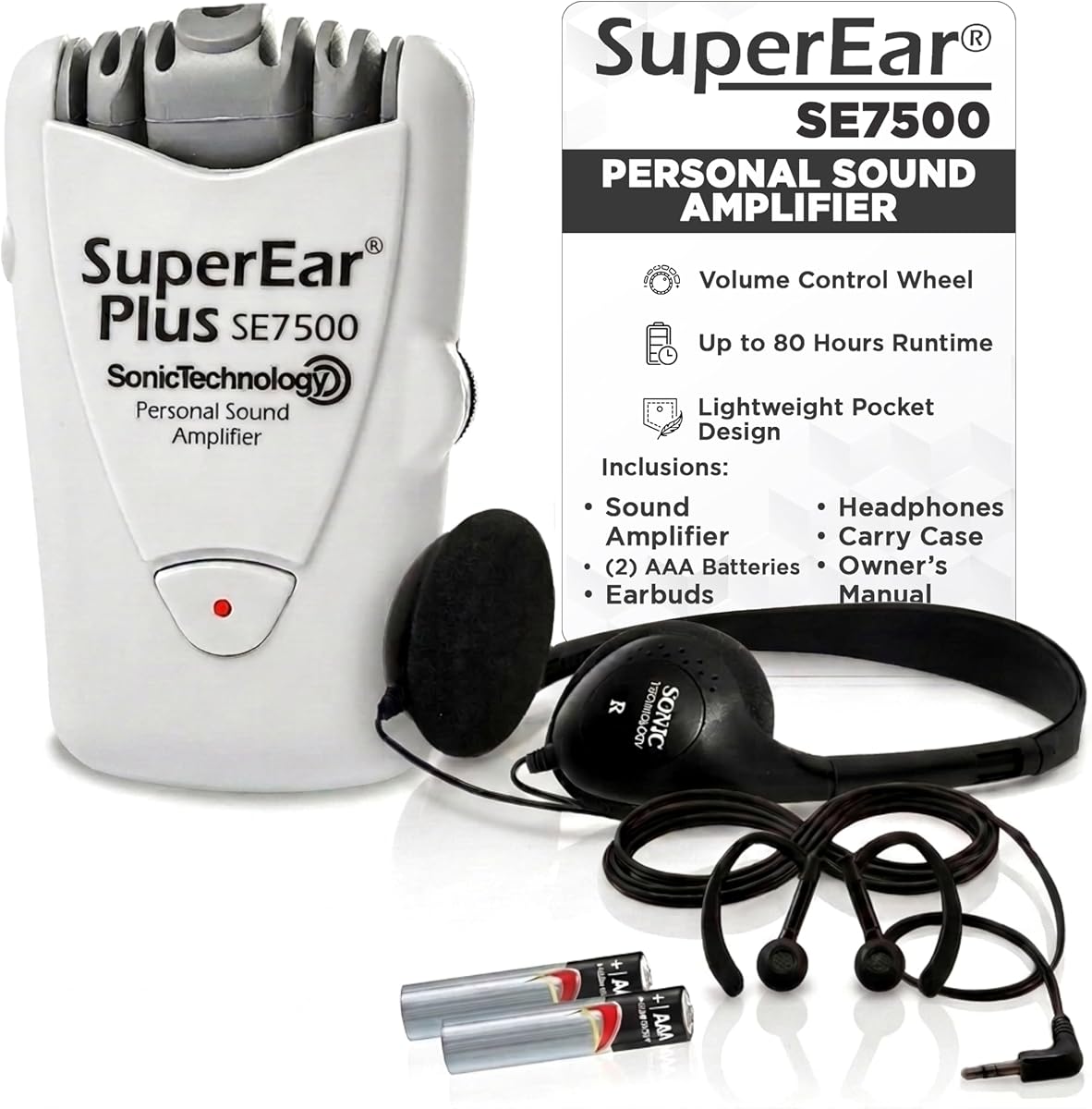
The SuperEar SE7500 is a personal sound amplifier built for seniors and adults who want additional volume for television dialogue, conversations, meetings, lectures, worship, and outdoor sounds. Its 4.1 rating reflects a versatile package with a particularly long stated battery life.
We may earn a commission when you buy through this link, at no additional cost to you.
The amplifier provides up to 50+ dB of ambient sound gain and uses a redesigned microphone intended to make voices easier to hear while minimizing carry noise. A tactile volume wheel makes it easy to adjust the sound for different rooms, programs, and listening environments. Like the SE5000, it captures sound through a microphone rather than connecting to a television output.
The package includes the amplifier, two AAA batteries, lightweight earbuds, headphones, a carry case with belt clip, and an owner's manual. The device is also compatible with disposable earpad covers and a SuperEar extension cable. Users can select discreet earbuds for public settings or headphones for a more private television-listening experience.
Its strongest practical advantage is battery endurance. The SE7500 is rated for up to 80 hours of use and includes an automatic shut-off feature. A compact body, belt clip, and carry case support use at home, while traveling, or during social events.
The SE7500 is a compelling choice for someone who wants one personal amplifier to cover television and everyday listening rather than a dedicated wireless headset. It also offers more listening options than a basic TV-only device. The trade-off is that the television sound arrives through an open microphone, so nearby voices and environmental noise may be included. Placement and moderate volume settings are important.
The amplifier can move from television viewing to family conversations, classes, worship, and outdoor activity. That versatility makes the included earbuds and headphones more useful than they would be with a narrowly focused television product.
With a stated battery life of up to 80 hours, the SE7500 can remain ready for regular use without frequent charging. Carry spare batteries if uninterrupted listening is important.
We may earn a commission when you buy through this link, at no additional cost to you.
The Williams Sound PockeTalker Ultra DUO is a personal sound amplifier with a 4.3 rating, the highest among the ten products listed. It combines a directional listening approach, external gain and tone controls, a wired television cord, and a five-year manufacturer warranty.
We may earn a commission when you buy through this link, at no additional cost to you.
The amplifier offers 20–40 dB of acoustic gain and uses a removable microphone with an extension cord. A two-foot television listening cord provides a more stable audio path than open-microphone amplification, while the headset and single earbud allow the user to choose between private listening and awareness of nearby sounds.
External volume and tone controls are useful for users who want to adjust the balance of loudness and clarity without navigating menus. A removable integrated belt clip supports portable use, and the two-AAA battery configuration keeps the power system familiar and replaceable.
Williams Sound also includes a user guide and a five-year manufacturer warranty, which adds reassurance for a device intended to improve daily communication. The package provides multiple ways to listen, including a headset and a single earbud, making it adaptable to different social situations.
The PockeTalker Ultra DUO is our premium selection for users who want a premium personal listening package and substantial included warranty. It is not the most flexible option for moving around while watching television, since the TV connection uses a short cord. A hearing aid user with active wireless models may also prefer a direct Auracast or Bluetooth hearing solution, but for a wearer of cochlear implants or hearing aids who does not use Bluetooth, this remains a highly capable choice.
The included television cord reduces dependence on microphone placement and creates a direct route for the program sound. It is a sensible approach when the viewer can remain within a few feet of the television.
The five-year manufacturer warranty, replaceable batteries, included headset, earbud, and user guide create a package centered on long-term practical use rather than disposable consumer electronics.
We may earn a commission when you buy through this link, at no additional cost to you.
The SIMOLIO 824D1 is a digital wireless TV headset for seniors and viewers who want clearer dialogue without disturbing others. Its 4.1 rating reflects a capable system with broad range, useful sound controls, and an ambient-listening mode.
We may earn a commission when you buy through this link, at no additional cost to you.
The headset uses advanced 2.4GHz FHSS technology with a stated effective range of up to 164 feet. The signal can pass through ceilings and walls, making it practical for viewing in a bedroom, den, or nearby room. The product claims no pairing requirement and no audio delay, which helps preserve natural synchronization between dialogue and action.
Voice highlighting and noise reduction are intended to make dialogue stand out from television background effects. Users can select a tone setting, adjust right-left balance, and choose mono or stereo output. Auto signal control is also included to keep output stable and reduce the risk of a sudden increase in television volume.
A spare battery is stored in the transmitter base, and a full charge lasts about 14 hours depending on volume. The Ambient Sound Mode allows nearby conversations to remain audible without removing the headset. The bypass feature works with a soundbar or stereo receiver through the television's optical output, so other household members can listen conventionally while the wearer receives private audio.
The main limitations concern source connections and medical-device compatibility. There is no HDMI input or Bluetooth, and a television limited to HDMI-ARC needs an external converter. The product also states that it is not available for pacemaker carriers. For a household with optical, RCA, or AUX output, it offers one of the most well-rounded feature sets in the comparison.
The tone selector, left-right balance, and mono or stereo choices let users shape the television presentation around their hearing. Starting with the standard setting and making small adjustments can help identify the most comfortable configuration.
The optical bypass lets the headset operate alongside a soundbar or receiver using the same optical source connection. This supports private headphone listening without forcing everyone else to wear a headset.
We may earn a commission when you buy through this link, at no additional cost to you.
SEREONIC Portable Wireless TV Speakers offer a different approach to assistive TV listening: instead of private headphones, they carry television sound to a portable speaker positioned near the listener. The 4.1-rated system is intended for hard-of-hearing viewers, seniors, and anyone who wants more effective sound without a very loud television.
We may earn a commission when you buy through this link, at no additional cost to you.
The base connects to a television or other source through RCA, 3.5mm AUX, or digital optical jacks. It then transmits custom-tuned, zero-lag RF audio to the portable speakers. The stated range reaches 100 feet, allowing the speaker to be moved to a den, bedroom, kitchen, or other suitable location.
The portable speaker produces output up to 95 decibels and can operate for up to eight hours on a charge. It takes roughly three hours to charge on the USB-powered base, or it can be connected to a standard charger. This makes it more flexible than a permanently installed home-theater speaker and more audible to one listener than earbud-based systems.
The system supports digital formats, including Dolby and PCM audio, and does not require a television audio converter. It also works with television streaming services because it receives the audio from the television's output. The base remains wired to the television, but the speakers themselves are wireless.
This product is best for a viewer who wants television sound brought closer rather than routed directly into the ear. It may be especially useful for someone who dislikes wearing headphones for long periods. The trade-off is that a nearby speaker can create sound for others in the room, and an HDMI-only television still requires an external HDMI converter. Check outputs and placement before buying.
A portable speaker placed near the viewer can make dialogue easier to hear without making the television itself excessively loud. It is a useful alternative for someone who wants stronger sound but not a headset or earbud.
RCA, AUX, and optical inputs allow the base to serve more than one source device. The base must remain connected by cable, but the portable speakers can move throughout the home within the stated range.
We may earn a commission when you buy through this link, at no additional cost to you.
The right assistive listening device depends on hearing needs, television connections, mobility, and whether private or shared listening is preferred. Use the following factors to narrow the field before comparing features.
Begin by checking the outputs available on the television. Optical, RCA, 3.5mm AUX, and HDMI-ARC are not interchangeable. The Audikast 4HA and Oasis Aura accept optical or AUX, the Conqier and SIMOLIO headsets accept optical, RCA, or AUX, and the TV Ears digital system supports several analog and digital outputs. A television with only HDMI-ARC may require a separate extractor.
If you already wear hearing aids, determine whether they support Auracast, Bluetooth, or neither. The Avantree Audikast 4HA is limited to selected Auracast-enabled hearing aids, while the Oasis Aura supports select models from Starkey, ReSound, and Oticon but not ordinary Bluetooth earbuds. A personal amplifier or wireless headset can serve listeners whose hearing aids lack wireless audio streaming.
Wireless headsets and earbuds deliver private audio, allowing a viewer to set a personal volume without changing the television for everyone else. The SEREONIC speaker system is designed to bring stronger sound closer while potentially sharing it within the room. Personal amplifiers can also be used privately with headphones or more discreetly with earbuds.
Range matters if the listener watches away from the television. The Conqier and SIMOLIO systems list a range of up to 164 feet, the SEREONIC system reaches 100 feet, and the Oasis Aura offers up to 328 feet under line-of-sight conditions. Walls, floors, and heavy furnishings can reduce actual performance, particularly with RF systems.
Voice clarification, noise reduction, tone presets, balance, and mono mode can make dialogue easier to distinguish. The Conqier offers dialogue, standard, and cinema modes with left-right balance, while SIMOLIO provides similar tone and balance adjustments. TV Ears emphasizes speech frequencies through Voice Clarifying Technology. Personal amplifiers instead concentrate on adjustable gain and microphone placement.
Battery life determines whether a device is convenient for extended viewing. The SuperEar SE7500 is rated for up to 80 hours, the SE5000 for up to 30 hours, the Conqier and SIMOLIO systems for about 14 hours per rechargeable battery, and the SEREONIC speaker for up to eight hours. The analog TV Ears headset provides about four hours of wireless use per charge.
A lightweight, properly fitted headset is more likely to be worn consistently. The Conqier under-chin headset weighs 1.78 ounces, and the TV Ears digital headset weighs two ounces. Personal amplifier packages offer both headphones and earbuds, allowing users to select the least intrusive option. Start with short sessions when adjusting to a new wearing style.
Simple setup can matter greatly for a senior or a person with limited technical experience. The TV Ears systems emphasize plug-and-play operation and physical controls. Wireless headsets generally require only a base connection, while Auracast products require compatible devices and, for the Audikast 4HA, joining a broadcast through a hearing aid app.
Start by identifying the correct television output and testing the source at a moderate level. Connect the transmitter or amplifier using the specified cable, power the base, and complete any required pairing or app-based broadcast setup. For a wired personal amplifier, connect the TV cord and position the microphone toward the television.
For wireless headsets, begin with the lowest available volume and increase it gradually. Use the tone, balance, mono, or voice-enhancement controls to find a comfortable presentation. If the product has an ambient mode, test it to confirm that nearby conversations remain audible without making the television difficult to understand.
Clean removable ear tips, headphone cushions, and microphones according to the manufacturer's instructions. Replace disposable earpad covers when soiled, keep battery contacts dry, and store devices in a dry location. Charge rechargeable batteries as directed, remove batteries from long-stored personal amplifiers, and contact a hearing professional if you have concerns about appropriate listening levels.
Not every device works with every television. Check whether the TV has optical, RCA, 3.5mm AUX, or HDMI-ARC output, then compare that with the product's supported connections. Some systems accept only analog audio, while others require a separate HDMI-ARC extractor.
The best option depends on the hearing aids' wireless capabilities. The Avantree Audikast 4HA is intended for selected Auracast-enabled models, while the Oasis Aura supports select Starkey, ReSound, and Oticon models. Traditional headsets and personal amplifiers may be more appropriate if the hearing aids do not support these standards.
The Conqier and SIMOLIO systems are designed for real-time audio without the delay associated with some Bluetooth products. The SEREONIC system also advertises zero-lag RF audio. Actual results can depend on the equipment, connection, and operating environment, so test the complete setup before regular viewing.
A TV headset usually receives television audio through a connected transmitter, providing private wireless sound with individualized controls. A personal sound amplifier generally captures nearby sound through a microphone, making it useful for conversations and other environments as well as television. The latter is more flexible, but it can also capture unwanted background noise.
Some systems support an optical bypass that lets the headset operate alongside a soundbar or stereo receiver. The Conqier and SIMOLIO systems include this type of arrangement, with the SIMOLIO bypass requiring an optical connection. Confirm the specific bypass method and available TV output before buying.
They can be helpful because they allow television sound to be brought closer to the listener, where it may be easier to understand. The SEREONIC system offers portable wireless speakers with adjustable placement, but it does not replace a professionally fitted hearing solution. Users with significant or sudden hearing changes should consult a healthcare professional.
First verify that the exact hearing aid model supports Auracast and appears on the product's compatibility list. Confirm that the television is sending audio through the selected optical or AUX output, then restart the transmitter and complete the hearing aid app setup again. Also check for any required firmware updates.
Use the lowest level that makes dialogue comfortable, and increase it gradually. Avoid assuming that maximum device output is appropriate for prolonged use. If you have a hearing condition, are unsure about safe levels, or experience discomfort, dizziness, or pain, consult a hearing professional for personalized guidance.
The Avantree Audikast 4HA is the strongest overall choice for compatible Auracast hearing aids because it sends television audio directly to the wearer. The Conqier 2.4G system is the most versatile general option, offering strong range, rechargeable batteries, personalized controls, and soundbar-compatible bypass, while the Williams Sound PockeTalker Ultra DUO stands out as a premium personal amplifier with a five-year warranty.
Your television outputs and hearing devices should determine the shortlist more than any other factor. Choose an Auracast transmitter only after confirming exact hearing aid compatibility, use a digital headset for modern TVs with optical, RCA, or AUX output, and consider a personal amplifier when conversation support and simplicity matter as much as television listening.
Features, compatibility lists, and prices can change over time, so review the current product listing before purchase. Verify the included accessories, charging or battery details, return terms, and any adapter requirements. Most importantly, choose a comfortable device that you will use consistently and set its volume responsibly.