
RIOWOIS Powered Bookshelf Speakers
4.4Editor score
Bluetooth 5.3 wireless streaming
Direct auxiliary turntable connection
Multiple digital input options
No external amplifier required
This expert guide compares the best Bluetooth speaker for record player options, covering turntable compatibility, sound, inputs, wireless features, and setup.
A Bluetooth speaker for a record player can make vinyl playback more flexible by adding wireless streaming, convenient source switching, and room-filling sound. The right model depends on whether your turntable outputs line-level audio, has Bluetooth transmission, or requires a phono preamplifier, so compatibility deserves careful attention before aesthetics.
We compared all ten products for turntable usability, Bluetooth support, wired inputs, speaker configuration, amplification, controls, and sound-focused features. The list includes powered bookshelf speakers, compact wireless speakers, and home speakers from Edifier, Marshall, Victrola, RIOWOIS, Saiyin, and Audio Technica, with particular attention to real-world source compatibility.
Each review explains the standout strengths, practical limitations, and ideal setup for a particular listener. The three top picks show the strongest balance of budget value, overall turntable relevance, and premium features, while ratings, configurations, availability, and prices can change, so confirm the latest listing details before purchasing.
4.4Editor score

4.5Editor score

4.7Editor score
This side-by-side comparison highlights Bluetooth support, turntable input options, speaker format, and major listening features. Because Bluetooth receiver and transmitter roles are not interchangeable, buyers should also verify whether their turntable can send audio to the selected speaker.


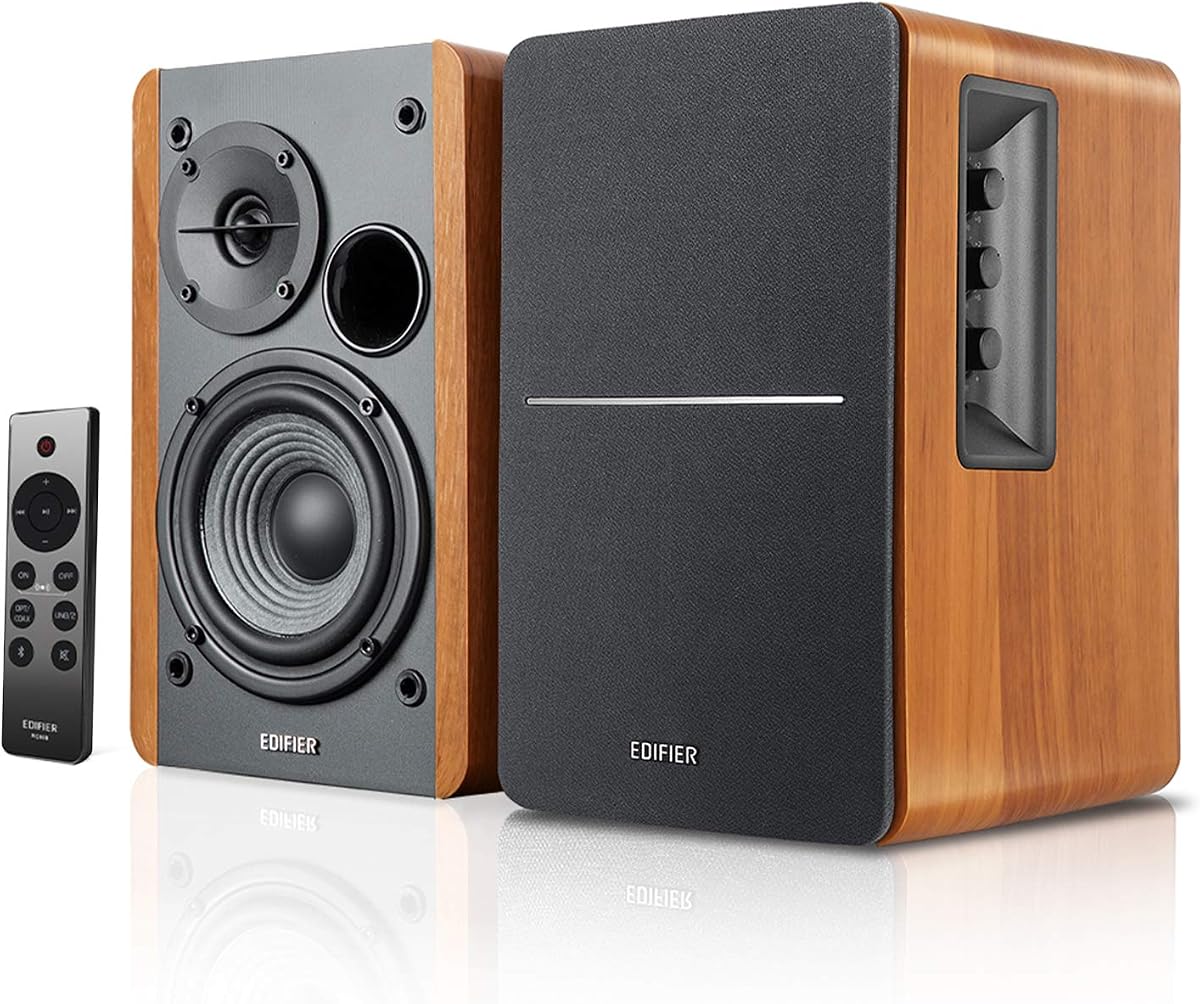

The Edifier R1280T is a powered 2.0 near-field bookshelf system with a 4.6 rating. It does not include Bluetooth, so it is better viewed as a capable wired destination for a record player than as a wireless speaker. Its strongest appeal lies in the combination of a built-in amplifier, dual AUX connections, and a conventional stereo speaker layout.
We may earn a commission when you buy through this link, at no additional cost to you.
Two auxiliary inputs allow two wired sources to remain connected at the same time. That makes it possible to keep a turntable and another audio device available without constantly unplugging cables. The active speaker contains side-panel bass and treble controls, while the included remote offers convenient volume adjustment without leaving the listening position.
Sound is produced by a 13mm silk-dome tweeter and a 4-inch full-range unit. The supplied information describes the speakers as suitable for studio-style sound reproduction, although their warmer wood-effect cabinet is also suited to living-room listening. The main limitation is that they cannot receive audio wirelessly from a Bluetooth-capable turntable or phone.
This is a strong choice for someone who wants traditional powered bookshelf speakers and has a turntable with a line-level output. It will also appeal to buyers who value two simultaneous wired inputs and physical tone controls more than wireless convenience. For the specific goal of adding Bluetooth to a record-player setup, however, one of the models with explicit Bluetooth support is the more direct fit.
Because two AUX connections can operate at the same time, listeners can switch between vinyl and another wired source without rearranging the rear panel. This makes the R1280T a practical hub for a mixed analog setup.
The remote handles volume, while separate bass and treble knobs provide hands-on tonal adjustment. Those physical controls are useful when matching the speakers to a turntable's output level and the acoustics of a room.
We may earn a commission when you buy through this link, at no additional cost to you.
The Saiyin Powered Bluetooth Bookshelf Speakers combine a 4.4 rating with Bluetooth 5.3 and a broad selection of wired and digital connections. This makes them a flexible option for a household that wants vinyl, television audio, computers, phones, and streaming services to feed the same powered speaker pair.
We may earn a commission when you buy through this link, at no additional cost to you.
The speaker system includes optical and coaxial digital inputs, RCA connection support, and a subwoofer output. Its active design means an amplifier or receiver is not required. The remote can change among Bluetooth, optical/coaxial, and line-level modes while also handling volume and mute functions, and top-panel buttons provide a second control method.
Turntable compatibility depends entirely on the turntable's output. A model with line-level output can connect directly, while one with only a phono output needs a preamplifier. Bluetooth transmission is also necessary if the goal is wireless vinyl playback; a turntable that only receives Bluetooth cannot send its audio to these speakers.
This pair is a good choice for buyers who want one speaker system to handle several source types. It may be especially useful beside a television because the digital inputs can support lossless connections. Vinyl listeners should first verify the output format and avoid assuming that every Bluetooth-equipped turntable can transmit wirelessly to external speakers.
Optical, coaxial, RCA, and wireless connections give the system more flexibility than a simple AUX-only pair. Keeping several sources connected can simplify daily switching between records, television programs, and streamed music.
The speakers can receive Bluetooth audio when paired with a compatible source. A turntable must actively transmit its signal, however; a Bluetooth receiver built into a turntable generally serves a different purpose and cannot simply send that turntable's records outward.
We may earn a commission when you buy through this link, at no additional cost to you.
The RIOWOIS Powered Bookshelf Speakers are a value-focused option for record-player listening, carrying a 4.4 rating and offering Bluetooth 5.3. Their built-in amplification eliminates the need for a separate receiver or amplifier, while the input selection covers analog, optical, and television-oriented connections.
We may earn a commission when you buy through this link, at no additional cost to you.
For vinyl, the most straightforward route is the 3.5mm auxiliary input. The speakers can also receive audio wirelessly from a compatible source with a Bluetooth transmitter. The remote controls power, volume, input selection, and sound effects, while pressing and holding the Bluetooth button disconnects the current wireless device.
A reinforced MDF cabinet is intended to reduce crackling, and rounded corners give the speakers a more finished appearance than basic desktop models. The optical and TV-ARC connections broaden their usefulness, although the required optical and ARC cables are not included. They are also specifically designed for standard audio outputs rather than Dolby or DTS surround processing.
This is the strongest budget-oriented choice in the group for a new turn-table speaker system. It suits first-time vinyl listeners who want Bluetooth and multiple source options without building a larger component stack. The key warning is that powered speakers are not meant to be connected to an external receiver or amplifier, and phono-only turntables still require appropriate preamplification.
The speakers place the required amplification inside the active bookshelf design. A line-level turntable can feed the auxiliary input directly, creating a simpler setup than a passive speaker paired with a separate stereo receiver.
The remote handles common functions and offers quick access to three sound effects. Physical buttons on the main speaker preserve basic operation when the remote is not within reach or needs to be replaced.
We may earn a commission when you buy through this link, at no additional cost to you.
The Marshall Acton III is a compact Bluetooth home speaker with a 4.7 rating and a strong emphasis on room-filling sound. Its signature design gives it immediate visual appeal, while the straightforward pairing process makes it approachable for listeners who want a single statement speaker rather than a conventional stereo pair.
We may earn a commission when you buy through this link, at no additional cost to you.
Bluetooth 5.2 handles wireless playback, and a 3.5mm input provides a wired path for compatible equipment. The listed features emphasize an immersive soundstage, simple setup, and a design that draws on Marshall's rock-and-roll heritage. The PVC-free build includes 70% recycled plastic and vegan materials.
Because it is a single home speaker rather than a powered bookshelf pair, it should not be confused with a conventional two-speaker monitor system. It also does not list an RCA input, making the 3.5mm connection the relevant wired option in the supplied information. A turntable with Bluetooth transmission can stream to it, while a line-level wired source may require an appropriate adapter or separate interface.
The Acton III is well suited to a stylish room, a smaller listening area, and anyone who values appearance alongside wireless convenience. It is a strong general-purpose Bluetooth speaker for the keyword category, but vinyl owners who require native RCA turntable connectivity should confirm that route before choosing it.
The stripped-back, amplifier-inspired appearance stands out in a room more than a conventional black computer speaker. Bluetooth 5.2 adds current wireless convenience without altering the speaker's strong vintage identity.
Marshall describes the soundstage as wider than that of the preceding generation. The straightforward pair-and-play approach is attractive for users who want minimal setup between a record player, phone, or computer.
We may earn a commission when you buy through this link, at no additional cost to you.
The Edifier R1280DB is a 4.6-rated powered bookshelf system that adds Bluetooth to the familiar near-field speaker format. A 4-inch bass driver and 13mm silk-dome tweeter provide the core acoustic design, making it a practical option for listeners who want conventional stereo separation and a modern wireless source.
We may earn a commission when you buy through this link, at no additional cost to you.
Bluetooth connectivity supports phones, tablets, computers, and other compatible devices. Optical and coaxial digital inputs broaden the system's role to digital audio, while the wired line input remains important for a turntable. The remote handles volume and input selection, and side-panel knobs provide separate bass and treble control.
The 42W RMS rating gives the system a more substantial powered-speaker specification than many compact Bluetooth alternatives. Its wood-grain cabinet also helps it fit naturally into a home entertainment area rather than looking strictly like computer equipment. Compared with the R1280DBs, however, the available information does not list a subwoofer line output.
This model is a good middle ground for a listener who wants a traditional pair of powered bookshelf speakers with wireless convenience. It is especially useful if a turntable has a line output and the same system may later serve a television or computer. A phono-only turntable would still need a preamplifier.
The two-speaker arrangement preserves left and right channels, which can make records feel more spacious than playback through a single home speaker. Bluetooth adds flexibility without requiring separate active and passive speakers to be purchased.
Side-panel bass and treble knobs let listeners fine-tune the output without software. The remote adds convenient volume and input switching, while digital inputs broaden compatibility beyond a basic analog setup.
We may earn a commission when you buy through this link, at no additional cost to you.
The Audio Technica AT-SP65XBT is a portable wireless Bluetooth speaker with a 4.7 rating. Its supplied product information is intentionally concise, identifying it as a portable wireless speaker rather than providing a detailed turntable input or amplifier specification.
We may earn a commission when you buy through this link, at no additional cost to you.
The obvious attraction is mobility. A compact wireless speaker can move between a listening area, shelf, and other locations more easily than a pair of larger powered bookshelf speakers. Bluetooth gives it a natural role for wirelessly playing music from a phone, tablet, or computer, provided the source supports the required Bluetooth profile.
For record-player use, compatibility depends on the available connections and Bluetooth transmitter function. A turntable with only a Bluetooth receiver cannot automatically send vinyl to an external Bluetooth speaker. Likewise, if the AT-SP65XBT has no suitable analog line input, an additional audio interface may be necessary for wired playback.
This model is best considered when portability and wireless simplicity matter more than a dedicated turntable connection or full stereo bookshelf system. Its high rating is encouraging, but the limited published specifications make careful listing review essential. Buyers should confirm the current input selection, power method, and dimensions before finalizing a setup.
Portable construction makes the speaker easier to reposition than fixed bookshelf monitors. That flexibility can be useful for moving music between rooms or keeping a compact listening setup near the turntable.
Bluetooth audio requires a transmitter at the source and a receiver at the speaker. Because turntables commonly include Bluetooth for receiving phone audio, buyers should verify that their model can actually transmit its own record-player audio.
We may earn a commission when you buy through this link, at no additional cost to you.
The Edifier R1280DBs is a 4.6-rated active bookshelf system that stands out for its subwoofer line output. It combines that expansion option with Bluetooth 5.0, digital inputs, and a 42W continuous power specification, making it a flexible choice for a room shared by vinyl and modern media.
We may earn a commission when you buy through this link, at no additional cost to you.
The subwoofer output includes automatic detection and a built-in crossover. That allows a compatible powered subwoofer to handle low frequencies without requiring a separate receiver. Optical and coaxial inputs support digital sources, while the wireless remote handles volume, mute, input selection, and Bluetooth mode.
Audio is produced by a 13mm silk-dome tweeter and a 4-inch subwoofer unit, with a stated 42W continuous undistorted output. The Soundfield Spatializer is included as an additional listening feature. Bass and treble controls remain on the main speaker, so tuning is possible even when the remote is not nearby.
This system is a particularly good fit for a listener who wants a stereo pair now and may add a subwoofer later. It remains important to use the correct turntable output: line-level audio can connect more directly, while a phono-only model requires a preamplifier. The optional subwoofer is not included.
The dedicated subwoofer line out and automatic crossover make low-frequency expansion straightforward. This is useful for large rooms, vinyl that needs more bass presence, or listeners who want optional extra impact without replacing the stereo pair.
Bluetooth 5.0 supports phones and computers, while optical and coaxial inputs cover digital equipment. The combination creates a practical path for combining vinyl playback with contemporary streaming and television audio.
We may earn a commission when you buy through this link, at no additional cost to you.
The Marshall Stanmore III combines a 4.6 rating with a larger home-speaker format and both RCA and 3.5mm inputs. Those analog connections make it one of the more direct options in the list for connecting a turntable, while Bluetooth 5.2 adds wireless access to compatible phones and computers.
We may earn a commission when you buy through this link, at no additional cost to you.
Marshall describes the sound as having a wider soundstage than the previous Stanmore generation, with an immersive, home-filling presentation. The speaker is designed to pair and play with minimal setup, avoiding the complexity associated with component-based audio systems.
The cream cabinet carries Marshall's recognizable vintage-inspired design. Its PVC-free construction includes 70% recycled plastic and vegan materials, providing a more sustainability-focused build while preserving the brand's characteristic appearance.
This is an excellent option for a stylish room where a single substantial home speaker is preferred over a visible stereo pair. The RCA input gives vinyl owners a straightforward wired route, and Bluetooth covers everyday streaming. As with any turntable, a phono-level signal still requires a preamplifier before reaching the line input.
The RCA input removes much of the uncertainty involved in connecting a turntable to a compact home speaker. Line-level turntables can use this connection directly, while phono output requires preamplification.
The larger cabinet and cream finish are designed to be seen as well as heard. A wider listed soundstage and home-filling presentation make it appropriate for a main listening area rather than a purely compact desktop arrangement.
We may earn a commission when you buy through this link, at no additional cost to you.
The Marshall Acton IV is a 4.7-rated premium home speaker that improves the visual and technical foundation of the Acton line. It offers Bluetooth, a new RCA input, a 3.5mm auxiliary connection, customizable controls, and app-based personalization, making it one of the most flexible premium options here.
We may earn a commission when you buy through this link, at no additional cost to you.
Improved tweeters and waveguides are intended to disperse sound across a larger area, while the redesigned bass port produces cleaner and more powerful low-end performance. Its placement is also more practical against a wall. Dynamic Loudness is designed to keep the presentation consistent and balanced as volume changes, an important feature for variable listening levels.
The tactile top panel continues the amplifier-inspired design with an improved media control and signature power switch. A customizable M-button provides direct access to music, sound adjustment, or Spotify Tap. The Marshall app allows the speaker's actions and sound to be personalized for the room.
For a turntable, the RCA input is the decisive advantage over many compact home speakers. A line-level turntable can connect directly, while a phono-only model needs a preamplifier. Bluetooth can serve as a convenient secondary path when the turntable itself supports transmission. This model is best for listeners who prioritize design, room coverage, flexible controls, and a polished connected experience.
The redesigned bass port is intended to reduce unwanted resonance while supporting cleaner, more powerful bass. Dynamic Loudness helps preserve a balanced impression when the volume is raised for a more immersive listening session.
The customizable M-button, tactile top controls, and app support make the speaker adaptable to different routines. RCA and auxiliary inputs ensure that vinyl and other analog equipment can remain part of the setup alongside wireless sources.
We may earn a commission when you buy through this link, at no additional cost to you.
The Victrola M1 Monitors have a 4.5 rating and the clearest turntable focus in the group. They are designed to complement the Victrola Premiere T1 turntable, sold separately, and combine a powered stereo system with Bluetooth 5.0 so the same speakers can serve vinyl and digital libraries.
We may earn a commission when you buy through this link, at no additional cost to you.
The set includes one powered speaker with a 60W amplifier and one passive speaker connected by cable. A 2-way design uses a 2-inch tweeter and a 4-inch woofer for rich, natural-sounding stereo playback. The amplifiers are built in, so users do not need to add a separate receiver for basic operation.
Connectivity is comprehensive. The speakers offer an analog stereo RCA input, dual analog auxiliary inputs, a 3.5mm auxiliary connection, and Bluetooth 5.0 with a listed range of 33 feet. A mono-RCA subwoofer output can connect to the Victrola Premiere S1 Subwoofer, although that accessory is also sold separately.
The lacquered wood finish, removable grilles, and illuminated multifunction control knob give the monitors a furniture-friendly appearance. They can sit on a table, bookshelf, desktop stand, or floor stand, with stands sold separately. This is the most straightforward recommendation for someone specifically building a record-player system and wants Bluetooth without abandoning a traditional stereo pair.
Unlike general-purpose Bluetooth speakers, the M1 monitors are explicitly designed around a Victrola turntable setup. Their RCA connection and powered stereo configuration closely match the needs of a new record-player owner.
Bluetooth 5.0 adds a wireless path for music stored on a phone, tablet, laptop, or computer. With the listed 33-foot range, listeners can move between the record player and other compatible sources while using the same speaker pair.
We may earn a commission when you buy through this link, at no additional cost to you.
The most important decision is whether the speaker can receive audio from the turntable in the form and direction you need. After resolving that compatibility question, compare stereo design, power, input selection, controls, placement, and wireless features.
A record player may provide a line-level output, a phono-level output, or both. Speakers with line-level inputs can generally work directly with a line-output turntable. A phono output produces a much lower signal intended for an amplifier with a built-in phono preamplifier, so connecting it directly to a line input can result in very quiet, thin, or distorted playback.
Check the labels and manual for the turntable rather than assuming every model is line level. If the available output is phono only, add a suitable preamplifier between it and the speakers. Some turntables include a preamp switch, but the precise behavior varies by model.
Bluetooth playback requires two matching roles: a transmitter at the source and a receiver at the speaker. Many turntables with Bluetooth are designed to receive audio from a phone so the turntable's built-in speakers can play streamed music. That receiving function does not necessarily let the turntable transmit its own records to a separate Bluetooth speaker.
If wireless vinyl is important, look for explicit Bluetooth transmitter or output support on the turntable. The speaker itself should support the relevant Bluetooth playback mode, commonly identified in listings as Bluetooth 5.x wireless streaming or pairing.
Powered bookshelf speakers include their own amplification, allowing them to connect directly to ordinary audio sources without a separate stereo receiver. In a two-speaker set, one cabinet is usually active and the other passive, with a cable carrying the signal between them. This arrangement makes setup simpler but reduces flexibility when choosing external amplification.
Passive bookshelf speakers require an amplifier with appropriate power and connections. Do not connect passive models directly to a turntable unless the turntable includes a suitable preamplifier and powered output. The Edifier R1280T and RIOWOIS models in this guide are explicitly powered designs, and their product information advises against using an external receiver with them.
A pair of bookshelf speakers can preserve the left and right channels found on a record, creating a wider and more natural stereo image. A single home speaker may still produce room-filling sound, but it does not reproduce the same physical channel separation. The desired arrangement depends on room size, furniture, placement flexibility, and how important traditional stereo imaging feels.
The Victrola M1, Edifier R1280DB, Edifier R1280DBs, and RIOWOIS systems use paired speakers. Marshall Acton, Stanmore, and Audio Technica models are single-speaker products. Consider speaker stands, desk clearance, wall distance, and cable routing before choosing the configuration.
A useful speaker should accept the sources already in your home. RCA is common for turntables, while 3.5mm and AUX connections can serve compatible wired devices. Optical and coaxial inputs are valuable for digital sources such as televisions and computers, and some systems also support TV-oriented control methods.
A subwoofer output can matter in a larger room or when listeners want deeper bass. Marshall Acton IV and Stanmore III provide convenient wired connections, while the Edifier R1280DBs and Saiyin system include a subwoofer output. Additional cables and compatible accessories may not be included, so check the box contents.
Small desktop speakers can work well on a shelf or near-field setup, but room-filling home speakers are intended to cover a larger area. A speaker chosen for a compact listening area may feel restrained in a spacious room, while a large home speaker may be excessive for a desk. The relationship between driver size, power, cabinet design, and placement matters as much as the specification alone.
Marshall emphasizes wide soundstage and room coverage in its Acton and Stanmore models. Edifier describes its bookshelf systems as near-field studio monitors with adjustable bass and treble. Consider furniture, room dimensions, and whether another listener will be seated in different positions.
Physical controls remain useful when a device or remote is unavailable. Side-panel knobs for bass, treble, and volume make quick adjustments possible, while illuminated controls can help identify the current source. Remotes add comfort for volume, mute, and input switching from across the room.
The RIOWOIS remote also provides sound-effect selection and Bluetooth-device disconnection. Marshall Acton IV adds a customizable M-button and app-based personalization. The Saiyin speakers support remote and top-button operation. Choose the controls that match your routine rather than paying attention only to the number of functions.
The most capable speaker can sound compromised if it is placed poorly. Leave enough room around the cabinet for airflow, avoid enclosed shelving that traps sound, and consider whether the included cables and power connections will be visible. Compact models suit smaller surfaces, while larger home speakers function more naturally as part of the furniture.
The Victrola M1 has removable grilles, a lacquered wood finish, and several placement options. The Edifier models use wood-grain finishes, while the Marshall speakers make a stronger visual statement with amplifier-inspired styling. A finish that complements the turntable and existing furniture can make a two-speaker system feel intentionally integrated.
Begin by identifying the turntable's output level and the speaker's corresponding input. Connect the line output to a line input with an appropriate cable, or place a phano preamplifier between a phono-only turntable and the speakers. Power the speaker first, select the correct wired input, and keep the volume low while confirming that the signal is clean and at a reasonable level.
For Bluetooth playback, put the speaker into pairing mode and choose it from the Bluetooth menu on the compatible source. Once paired, adjust the source and speaker volumes independently. If a turntable has a Bluetooth transmitter, follow its specific pairing instructions; a turntable that only receives Bluetooth cannot send its record-player audio to an external speaker.
Keep the speakers on stable surfaces with ventilation around the cabinets, and route cables away from foot traffic. Clean the wood-grain or lacquered finishes with a soft, dry cloth, avoid moisture around controls and connectors, and periodically check that cables remain firmly seated. When the system is not in use, reduce the volume and disconnect power if the manufacturer recommends it.
Only if the speaker and turntable support compatible connection paths. A turntable with Bluetooth transmitter output can send audio to a Bluetooth receiver speaker, while a turntable with only Bluetooth receiver capability generally cannot transmit its records. For a wired connection, the turntable also needs a compatible line-level output unless a phono preamplifier is added.
A phono output carries a low-level signal that requires a phono preamplifier before it can be played at normal volume through ordinary speakers. A line output is already amplified to a consumer-source level and is more convenient for direct connection. Check the turntable's manual and rear-panel labels to determine which outputs are available.
No, powered bookshelf speakers include their own amplification and normally connect directly to source devices. The powered and passive speakers in the pair are linked by a cable. These products should not be connected to an external receiver or amplifier unless the manufacturer explicitly permits that arrangement.
A stereo pair preserves the separate left and right channels found on a record and can create a wider image. A single home speaker may still deliver room-filling sound and can be easier to place. The best choice depends on room layout, furniture, and whether traditional stereo separation is important to the listener.
The turntable may have Bluetooth only as a receiver, allowing a phone to stream music into the turntable. Sending records to an external speaker requires the turntable to function as a Bluetooth transmitter. If it cannot, use a wired line output with the appropriate input or a phono preamplifier.
Wireless Bluetooth transmission is not a lossless connection in the same way as a digital optical or coaxial link. Vinyl playback can still sound excellent over Bluetooth, but the final quality also depends on the turntable's transmitter, codec support, wireless conditions, and receiving speaker. A wired line-level connection is generally preferable when convenient and available.
A subwoofer output is useful if you want deeper low-end extension or have a larger room. It also adds another component to place, power, and calibrate. For compact or moderate listening rooms, a well-positioned stereo pair may already provide sufficient bass, and a subwoofer can be added later if needed.
Yes, if the selected speakers provide the required connections. Models with optical, coaxial, TV-ARC, RCA, or auxiliary inputs can accommodate more than one source. A wired turntable and digital television can often remain connected simultaneously, with the speaker's remote or front-panel controls used to switch between them.
The Victrola M1 Monitors are the most turntable-centered overall choice, with Bluetooth 5.0, a 60W powered stereo configuration, RCA connectivity, and a design intended to complement a Victrola turntable. The RIOWOIS powered bookshelf system is a compelling budget selection with Bluetooth 5.3 and several source options, while the Marshall Acton IV provides the strongest premium mix of RCA turntable connectivity, refined room coverage, tactile controls, and app personalization.
Prioritize the output path before any other feature. Confirm whether the turntable offers line-level audio, whether it can transmit over Bluetooth, and which inputs the speaker provides. After that, choose between a separated stereo pair and a single home speaker based on room size, then consider digital inputs, subwoofer support, tone controls, and the degree of visual styling that suits your space.
Ratings, configurations, product details, and prices can change, so verify the current listing before buying. A successful record-player speaker system should make vinyl playback effortless while also leaving room for the streaming and wired sources you use every day.