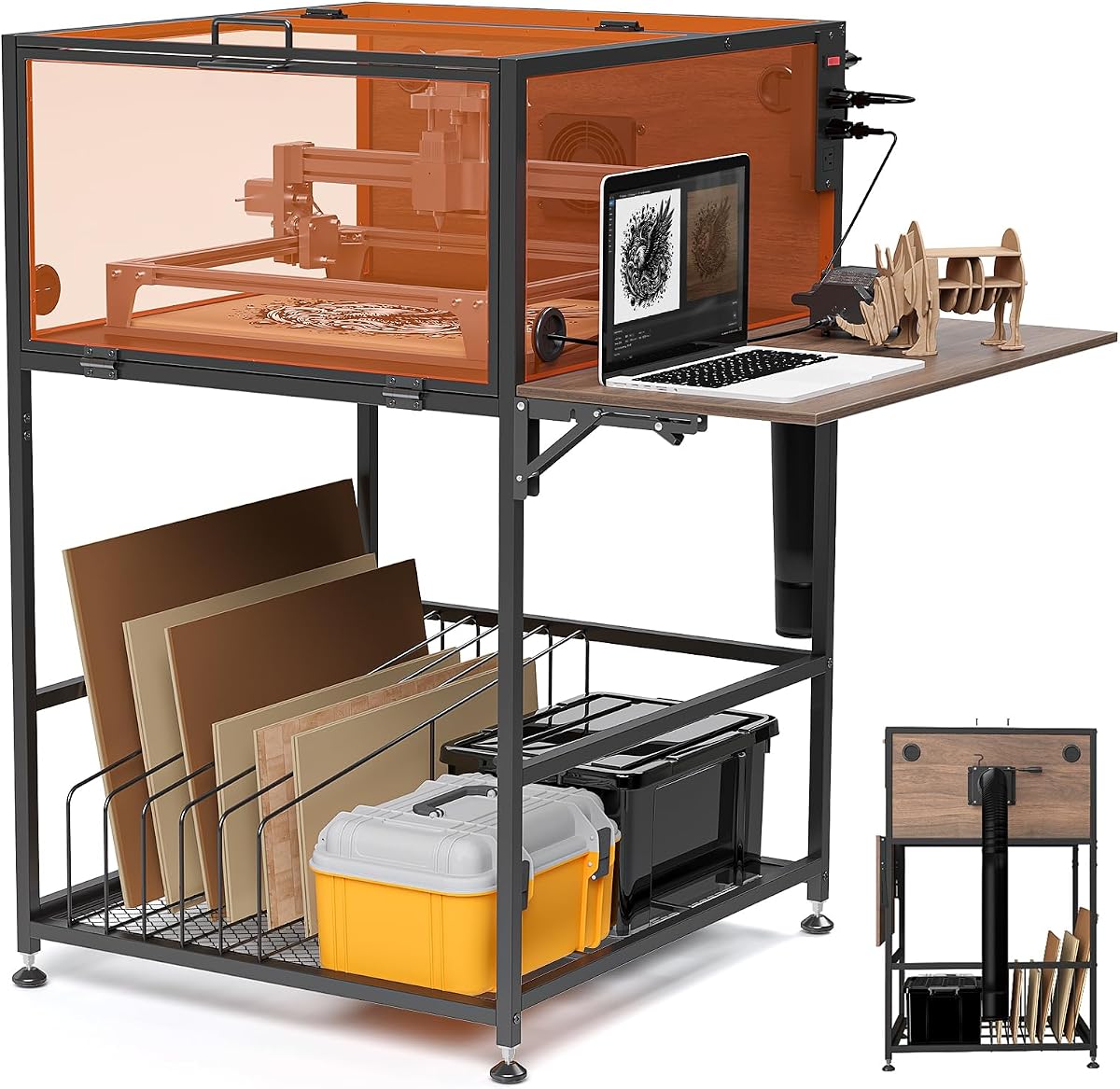
Crafit Laser Engraver Enclosure Cabinet
4.2Editor score
Full metal-frame cabinet design
Switch-controlled power strip
Integrated storage and cable management
A laser engraver enclosure creates a more controlled workspace by helping contain smoke, dust, odors, light, and machine noise. The right model should fit your engraver, support safe ventilation, provide a clear view of the work, and remain practical to assemble, clean, and store.
We compared ten enclosures using dimensions, material construction, viewing access, ventilation arrangements, storage features, and stated compatibility. The guide covers cabinet-style units, foldable fabric tents, and rigid acrylic enclosures for desktop laser engravers, cutters, and rotary accessories.
Each review explains the product's strongest benefits and practical compromises so you can choose for your machine and workspace. Ratings and specifications reflect the supplied listing information, while availability and prices change and should be confirmed before purchasing.
4.2Editor score

4.5Editor score

4.5Editor score
As an Amazon Associate we earn from qualifying purchases.
The comparison covers enclosure size, enclosure type, ventilation, and viewing design so you can quickly identify the model that best suits your engraver, materials, and available workspace.


The Crafit Laser Engraver Enclosure Cabinet is a substantial, furniture-style enclosure rated 4.2 by customers. It stands apart from lightweight tents with a rigid metal frame, thick heat-resistant wood, light-filtering panels, integrated power controls, storage, and a foldable side work area, making it the most workspace-oriented option in this guide.
We may earn a commission when you buy through this link, at no additional cost to you.
Its interior measures 24.8 by 27.1 by 12.6 inches, which is listed as suitable for most laser engravers and cutters. A 20W ventilation fan and included 2-meter flexible exhaust pipe support air circulation and help move smoke, particles, and odors away from the work area. The multi-sided semi-transparent panels allow observation from several angles while filtering part of the blue light produced during engraving.
The cabinet also incorporates practical workshop features. A switch-controlled power strip with three AC outlets can power the engraver, fan, laptop, and air-assist kit, while four cable-management holes help maintain a tidy installation. A divided bottom rack stores wood sheets and blanks upright, magnetic doors provide one-handed access, and adjustable feet help stabilize the cabinet on uneven floors.
The main compromise is size and height. Unlike a tent that can be folded into a narrow package, this is a substantial cabinet intended to remain set up as a dedicated workstation. Its stated 12.6-inch interior height will not suit every machine, particularly taller enclosed laser cutters. It is best for hobbyists and small workshops that want an integrated, organized engraving station and value furniture-like convenience over minimal storage footprint.
The foldable side panel creates space for a laptop or air-assist kit without permanently enlarging the enclosure. Below the machine, divided storage keeps sheets and blanks organized and easy to reach, reducing clutter around the active work area.
The integrated power strip, cable openings, magnetic doors, and adjustable feet address several everyday friction points at once. These details make the enclosure function more like a dedicated workstation than a temporary cover placed over the engraver.
We may earn a commission when you buy through this link, at no additional cost to you.
The Creality Laser Engraver Enclosure 2.0 carries a 4.4 customer rating and offers one of the strongest balances of capacity, portability, and visibility. Its 720 by 720 by 400 millimeter dimensions are compatible with the Creality Falcon series and, according to the listing, with 95% of laser engraving machines on the market.
We may earn a commission when you buy through this link, at no additional cost to you.
A 4000 RPM high-efficiency fan and closed enclosure work together to extract smoke, particles, and odors while also reducing the sound of the engraving machine. Dual windows use blue-light-blocking PVC material so you can observe the process without relying on direct, unobstructed viewing. The design is supported by high-strength steel pipes and flame-retardant fabric described as waterproof, fireproof, and resistant to deformation.
Some compromises come with the tent-style format. Fabric walls can wrinkle or shift during repeated setup, and the structure does not provide the rigid, furniture-like stability of the Crafit cabinet. Care is also needed when positioning the exhaust pipe so it does not create excessive pressure against the enclosure body. Nevertheless, the foldable design makes the unit much easier to carry and store between sessions.
This enclosure is a strong all-around recommendation for users who want proven compatibility without a fixed footprint. It suits common desktop engravers, temporary craft rooms, and users who need to relocate the enclosure frequently. Those with a rotary attachment or unusually tall machine should check the available clearance before buying, while buyers prioritizing the most durable rigid structure can consider the cabinet-style option.
The dual-window arrangement provides useful angles into the work area, while the blue-light-blocking PVC helps limit exposure to part of the visible light generated during operation. This makes progress monitoring more convenient without fully removing the enclosure.
The foldable frame and light construction allow the tent to collapse when it is not needed. That flexibility is especially valuable in shared rooms, small apartments, or workshops where a rigid cabinet would permanently occupy valuable floor space.
We may earn a commission when you buy through this link, at no additional cost to you.
The Integrated LED Enclosure has a 4.4 rating and is designed for engravers whose interior would otherwise be difficult to inspect. Its most distinctive feature is an integrated LED strip that illuminates the engraving area, complemented by a thickened PVC window that filters blue light.
We may earn a commission when you buy through this link, at no additional cost to you.
The enclosure measures 28.3 by 28.3 by 15.7 inches and is listed as compatible with xTool D1 and D1 Pro, Ortur, Sculpfun, Atomstack, and other common laser engravers. Its updated integrated bottom is intended to seal the base, helping reduce smoke escape and collect dust and debris more effectively than a design with a visibly open lower edge.
Airflow is handled by a 4000 RPM fan connected to a three-layer composite exhaust pipe. The listing says the upgraded pipe material makes it more difficult for smoke and dust to adhere to its inner wall, which may help limit residual odors over time. Aluminum-mold Oxford cloth and iron supports add structure, while metal rods help the enclosure remain stable during operation.
The integrated lighting is particularly helpful for detailed work, but buyers should consider whether wiring the LED strip and positioning the sealed base are convenient in their setup. It is a good fit for desktop users who want better internal visibility and a more complete lower seal without moving to a heavy rigid cabinet.
An integrated LED strip removes much of the guesswork from working through a filtered window. You can see the material and tool path more clearly, which is helpful when judging fine details, registration, or the progress of a small engraving.
The updated bottom is intended to limit smoke and debris escaping below the enclosure. While this improves containment, it also means the tent is less convenient to carry or reposition than one with a conventional open bottom.
We may earn a commission when you buy through this link, at no additional cost to you.
The Green Acrylic Enclosure takes a different approach from the common fabric tent by using a black aluminum alloy frame, bracket connectors, and thickened acrylic panels. No customer rating is supplied in the available listing information, so its appeal should be assessed primarily from its construction, dimensions, and access features.
We may earn a commission when you buy through this link, at no additional cost to you.
Its exterior dimensions are 29.9 by 16.9 by 26.7 inches, with the listing specifying suitability for particular desktop laser engraving machines. This makes fit the most important buying consideration: buyers should compare their machine's length, width, height, cable placement, and exhaust requirements with the enclosure's footprint before ordering.
The green acrylic is intended to reduce smoke diffusion, dust, debris, and material splashing. A front hinged door includes a handle and magnetic door stop for loading materials and accessing the machine. Cable threading holes help route cords more neatly, and the package includes acrylic panels, brackets, connectors, hinges, hardware, tools, and an instruction manual.
Unlike a foldable tent, this enclosure provides a more permanent structure and does not need to be collapsed after each session. It is well suited to users who want clean lines, stable access, and a dedicated desktop setup. Its narrower 16.9-inch depth may exclude larger or deeper machines, however, so careful measurement is essential.
Acrylic panels and an aluminum frame resist the repeated folding and unfolding associated with tent-style covers. The result is a more permanent enclosure that can remain around the engraver and support routine operation.
The hinged door opens for loading and unloading, while the magnetic stop keeps it positioned during use. Cable openings reduce awkward cord routing around the frame and help keep the working area orderly.
We may earn a commission when you buy through this link, at no additional cost to you.
The Creality Enclosure with Vent is a straightforward fabric enclosure rated 4.2 by customers. It focuses on the core jobs of an engraving tent: reducing cooling-fan noise, helping expel smoke and dust, shielding the workspace, and providing a filtered window through which the job can be observed.
We may earn a commission when you buy through this link, at no additional cost to you.
Its 28.3 by 28.3 by 15.7 inch dimensions are compatible with the Creality Falcon series and are listed for 95% of laser engraving machines. That broad claim makes it convenient for many common desktop systems, although users should still verify physical clearance for rotary attachments, taller frames, and exhaust connections.
The large transparent viewing area filters blue light and offers a broad view of the engraving process. A built-in smoke ventilation system moves air through the enclosure, while the outer construction is described as fireproof and dustproof. Installation takes only a few steps, and the enclosure folds for storage or transport.
This option is less elaborate than some competing tents because it does not provide a stated fan speed or upgraded LED lighting. It remains a practical selection for a new engraver owner who wants simple containment without spending time on a complex setup. Those needing more precise ventilation information or stronger structural details may prefer the newer V2.0 models.
The uncomplicated frame and few-step installation make this enclosure approachable for first-time users. It can move from storage to the engraver without requiring specialized tools or complicated permanent installation.
The enclosure's closed structure is intended to reduce the sound of cooling fans and other machine noise. That can make the workspace more comfortable during longer sessions, especially in a shared room.
We may earn a commission when you buy through this link, at no additional cost to you.
The LONGER Large Size Enclosure is rated 4.4 and stands out for its generous 31 by 28.7 by 20.8 inch interior. That extra height distinguishes it from many common 400-millimeter-tall tents and may make it easier to accommodate taller desktop machines, lift assemblies, or rotary equipment.
We may earn a commission when you buy through this link, at no additional cost to you.
The listing specifically notes compatibility with LONGER B1 series laser cutting machines, while the size also supports other desktop engraving systems that fit within the stated dimensions. A large transparent panel allows users to monitor the machine from the front and sides, helping them check operation without directly opening the enclosure.
An integrated smoking fan circulates air through the workspace and supports smoke and odor removal. The enclosure is constructed from fire-retardant materials that are described as easy to clean and durable. It is also intended to isolate fumes, burning odors, dust, debris, and noise, making it useful for indoor crafting sessions.
The trade-off is footprint: the larger structure takes up more room than a standard fabric tent and may be less convenient in a compact workspace. The listing does not provide a specific fan speed, so buyers seeking a quantified airflow figure should compare alternatives. Even so, the extra working clearance is a meaningful advantage for compatible machines.
The 20.8-inch interior height provides more room than typical compact tents. That additional space can reduce restrictions around compatible machines and makes the enclosure better suited to accessories that extend above the engraver bed.
The fire-retardant fabric is described as easy to clean, which is valuable after smoke- or dust-producing jobs. Combined with the enclosed design, it helps isolate residue from the surrounding workspace.
We may earn a commission when you buy through this link, at no additional cost to you.
The Creality Laser Engraver Cover V2.0 has a 4.5 rating, matching the highest listed customer score in this comparison. It combines a 4000 RPM exhaust fan, upgraded metal support rods, dual filtered windows, broad machine compatibility, and foldable construction in a well-balanced enclosure.
We may earn a commission when you buy through this link, at no additional cost to you.
The second-generation design focuses on stronger ventilation and a more reliable frame. Its square 720 by 720 by 400 millimeter interior is listed for xTool D1 and D1 Pro, Creality CR-Laser Falcon, Ortur, Sculpfun, Atomstack, and other common engravers. The additional height is also described as sufficient to accommodate a rotary roller.
Dual-view PVC windows allow the engraving process to be observed from more than one side, and the anti-blue-light material helps protect the eyes from part of the visible light involved in engraving. The 4000 RPM fan is designed to extract smoke, particles, and odors quickly, helping keep the surrounding indoor air fresher.
The enclosure still reflects the inherent compromises of a portable tent. It can flex or crease compared with an acrylic cabinet, and effective smoke control depends on routing the exhaust pipe appropriately. Even so, the balance of ventilation, visibility, compatibility, and folding convenience makes this a particularly persuasive choice for most desktop users.
The stated 4000 RPM fan rate gives buyers a clearer performance target than listings that mention only a fan. It supports rapid movement of smoke and particles, which is especially valuable when engraving materials that create strong odors.
Upgraded metal support rods improve rigidity and help the square frame maintain its shape. The enclosure can still collapse for storage, combining the stability benefits of reinforced framing with the convenience of a portable tent.
We may earn a commission when you buy through this link, at no additional cost to you.
The Creality Fireproof Enclosure combines a 4.5 rating with the core features buyers seek at an attainable tier: a sizeable interior, built-in ventilation, filtered viewing, and a foldable protective structure. It is one of the strongest choices for common desktop engravers that fit within 700 by 720 by 400 millimeters.
We may earn a commission when you buy through this link, at no additional cost to you.
Compatibility is listed for xTool D1, xTool D1 Pro, Creality CR-Laser Falcon, Ortur, Sculpfun, and Atomstack engravers. The extra vertical space can accommodate a rotary roller according to the listing, making the enclosure useful for projects that extend beyond the flat laser bed.
The closed structure is designed to isolate smoke, odors, dust, noise, fire, and water, while the built-in exhaust fan helps expel smoke and debris during a job. A large transparent viewing window uses light-filtered material to support observation and eye protection. The practical benefit is a cleaner, more comfortable room without giving up a live view of the work.
One installation detail deserves attention: the supplied note recommends pressing the two-way and three-way pipe tightly against the connecting rods to avoid excessive pressure on the cover body. Flexible fabric can also crease, but these are manageable issues for a value-oriented enclosure that provides essential containment and observation in a compact package.
This model delivers the fundamentals of a useful enclosure: ventilation, a filtered viewing area, broad machine compatibility, and flexible storage. It avoids adding lighting or elaborate workstation controls, helping keep the setup focused.
The listing notes that the enclosure's height can accommodate a rotary roller. That expands its usefulness beyond flat-bed engraving, provided the user's rotary attachment and machine configuration fit within the available space.
We may earn a commission when you buy through this link, at no additional cost to you.
The Creality Smoke-Isolation Enclosure has a 4.5 rating and emphasizes containment, heat resistance, and easy observation. Its 27.5 by 28.3 by 15.7 inch interior supports common Creality, xTool, and other laser engravers, including configurations that use a rotary roller.
We may earn a commission when you buy through this link, at no additional cost to you.
Its key material claim is substantial: the listing describes the enclosure as using flame-retardant material capable of withstanding temperatures up to 1000 degrees Celsius. While buyers should evaluate that specification in the context of the manufacturer's documentation and their own materials, it makes the enclosure's heat-focused construction especially relevant for users who regularly engrave more demanding stock.
The transparent viewing window filters blue light and offers a broad view of the cutting or engraving process. An exhaust fan and pipe move smoke and dust out during operation, while the enclosed structure helps isolate noise, odor, and splashing. Installation requires no additional tools, and the structure folds for storage and is described as lightweight and durable.
The lack of a stated fan speed makes direct airflow comparison difficult, and the heat-resistance figure should be treated as a manufacturer specification rather than a substitute for safe operating guidance. Even with those qualifications, this is a well-reviewed, versatile enclosure with the filtration, viewing, and compatibility features most users need.
Flame-retardant construction is especially useful around engraving and cutting operations where heat and combustion byproducts are present. The enclosure's closed shape and exhaust system work together to keep those byproducts away from the surrounding workspace.
The frame assembles in a few steps without requiring extra tools. Once the task is complete, it can fold down, making it convenient to store while preserving the full enclosure for the next session.
We may earn a commission when you buy through this link, at no additional cost to you.
The VEVOR Laser Engraver Enclosure is rated 4.1 and combines a large 31.5 by 31.5 by 19.6 inch interior with high-speed ventilation and built-in tool storage. It is aimed at users who need generous clearance and want engraving accessories organized within the enclosure.
We may earn a commission when you buy through this link, at no additional cost to you.
Its square footprint provides usable space in both directions, while the 19.6-inch height offers substantially more room than compact 400-millimeter tents. The listing states compatibility with most laser engravers, although buyers should still compare exact machine dimensions and account for material feed space, raised lids, cables, and any rotary attachment.
A 4000 RPM fan is included for smoke and dust extraction, and exhaust ports on both sides provide flexibility in where the pipe can be routed. Flame-retardant and fireproof materials are designed to isolate smoke, noise, and dust. The most unusual feature is a pair of 500 millimeter fastener strips, each adjustable to accommodate different tool shapes and easy-to-reach hanging storage.
The larger size means this enclosure may be inconvenient in compact rooms and less easy to carry than smaller tents. Its flexible construction also needs proper support to remain stable. Even so, it is a feature-rich option for small studios, families, and dedicated hobbyists who value extra space, flexible exhaust positioning, and organized tool access.
Adjustable fastener strips on both sides let users hang frequently used tools in locations that suit their workflow. The system can accommodate different shapes and keeps useful items close without adding separate shelving to the room.
Exhaust ports on both sides give users more freedom to direct the pipe toward a suitable window, wall port, or other extraction point. That flexibility is useful when the machine's position is constrained by the room.
We may earn a commission when you buy through this link, at no additional cost to you.
Choosing an enclosure involves balancing machine fit, containment, visibility, airflow, construction, and the amount of space you can dedicate to your setup. Measure before shopping and consider how you will use the engraver rather than choosing solely by the advertised material type.
Measure the machine and available workspace, then verify clearance for every accessory you plan to use.
Choose the enclosure that fits the entire configuration rather than only the engraver's advertised footprint.
Favor a defined exhaust arrangement with a sufficiently long pipe and practical connection points.
Plan the hose route before assembly so the fan can move air without creating leaks or damaged panels.
Choose a window or lighting arrangement that reveals the work clearly without requiring the cover to be opened.
Verify the stated light-filtering feature and keep the enclosure closed during operation.
Select a rigid cabinet for a permanent, organized station and a foldable tent for portability.
Base the choice on where and how often you expect to use the enclosure.
Favor flame-retardant materials and a frame that remains stable during long jobs.
Choose washable fabric or wipeable panels according to the mess and cleaning frequency in your workshop.
Use the enclosure to soften routine machine noise, especially in shared indoor spaces.
Secure supports and position the unit away from reflective surfaces to reduce vibration and echo.
Match storage features to the accessories you use during every job.
Favor dedicated organization when the machine is a regular fixture and portability when it is occasional.
Before assembly, measure the machine and enclosure, identify the correct exhaust route, and inspect every panel, rod, hinge, and fastener. Assemble the frame in a clear area, then position the engraver so vents are not blocked and the exhaust pipe reaches its intended outlet without sharp bends or tension against the enclosure body.
During use, keep the enclosure closed while the laser is operating. Confirm that the fan is running, verify that the viewing window remains clear, and keep the exhaust pipe unobstructed. Do not treat the enclosure as professional laser safety equipment or as a substitute for the safety procedures, eyewear, ventilation, and material rules specified by the engraver manufacturer.
After the job, allow the machine and fan to stop as directed, open the enclosure carefully, and remove material according to the machine's instructions. Let residual heat and smoke dissipate, vacuum or wipe dust from accessible surfaces, clean the viewing panel with a suitable nonabrasive method, and inspect the pipe for residue. Fold a portable tent or secure a cabinet door before checking the frame for looseness before the next session.
Choose an enclosure whose interior dimensions exceed the complete footprint and height of your engraver, including its lid, feet, cables, and material feed path. If you use a rotary attachment, also verify that there is enough clearance for the roller and the material being rotated. Always compare actual dimensions rather than relying only on a broad compatibility claim.
No. An enclosure helps collect smoke, dust, and odors while operating, and its fan helps draw contaminated air toward the exhaust. Performance still depends on the fan, pipe route, material being engraved, and whether the enclosure is closed. The exhaust should lead toward suitable ventilation, and the machine manufacturer's safety guidance remains essential.
Filtered windows can reduce exposure to some blue light and allow you to monitor the work without opening the cover. They should not be assumed to provide complete laser protection. Follow the laser engraver's instructions, avoid direct eye exposure, and use any specified protective measures even when working behind a viewing panel.
Choose a rigid cabinet if the enclosure will remain in a dedicated location and you value storage, structural stability, and workstation features. Choose a foldable tent if floor space is limited, you move the engraver frequently, or you want to store the enclosure between uses. The rigid Crafit cabinet is the most workstation-oriented choice, while several Creality models emphasize portability.
Several listed models state that their height can accommodate a rotary roller, including the Creality V2.0, Creality Fireproof Enclosure, and Creality Smoke-Isolation Enclosure. Compatibility still depends on the exact machine and roller dimensions, so check clearance around the roller, material, side supports, and enclosure walls before operating.
Inspect the pipe and enclosure after jobs that generate heavy smoke or fine dust, and clean them whenever residue becomes visible or airflow seems restricted. Use the enclosure manufacturer's cleaning guidance and avoid abrasive tools on filtered windows. Regular attention helps preserve ventilation performance and prevents residue from creating unpleasant odors.
It depends on the style and available floor area. Foldable tents can be stored compactly but still need a clear footprint while in use, and rigid cabinets generally occupy more permanent space. Consider not only the machine and enclosure but also room to load material, route the exhaust pipe, and move around the setup.
It can help keep dust, debris, and material splashing away from the surrounding workspace, and some products also help shield the machine. Protection is not complete because seams, doors, cable openings, and exhaust ports can admit some dust or airborne residue. The enclosure should complement, not replace, regular machine maintenance and safe material handling.
The Creality Cover V2.0 is the strongest all-around recommendation for most desktop users because it combines a 4.5 rating, a stated 4000 RPM fan, reinforced supports, dual filtered windows, broad compatibility, and foldable storage. The Crafit cabinet offers a different kind of value by becoming a complete workstation with integrated power, storage, cable management, and a foldable side surface.
Prioritize accurate machine fit first, followed by effective ventilation and a practical exhaust route. Then choose between a portable tent and a rigid cabinet according to your available space, and consider visibility, lighting, cleaning, and storage needs. Models with more headroom and accessory support may be worthwhile if your workflow includes taller machines, rotary rollers, or frequent production work.
Ratings, product details, and prices can change over time, so confirm the current listing and specifications before buying. Taking measurements and comparing the enclosure with your exact machine configuration will prevent most fit-related disappointments and help you select an enclosure suited to both your engraver and your workspace.