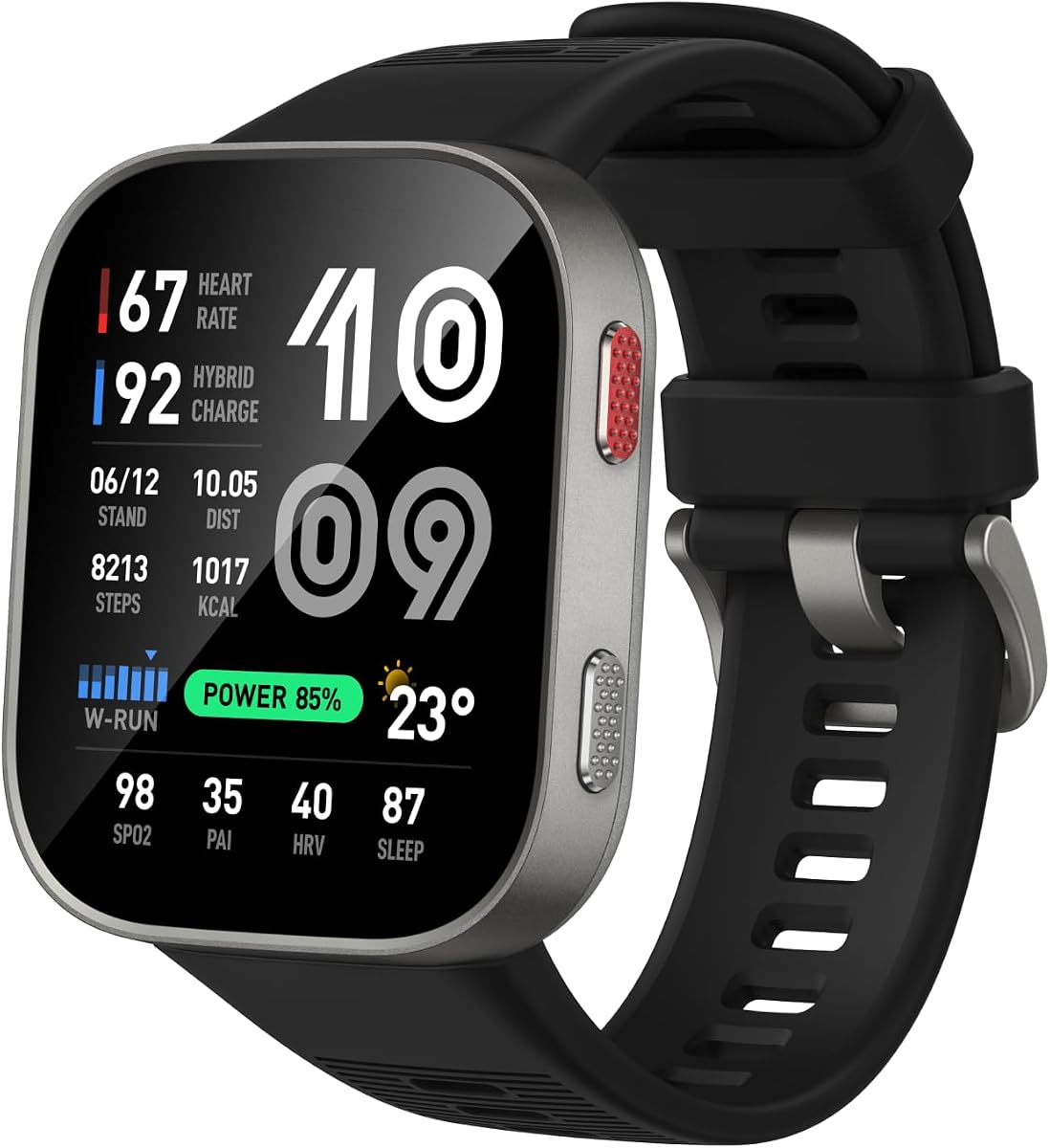
Amazfit Bip Max Smart Watch
4.4Editor score
Large bright AMOLED display
150-plus sports modes
Hybrid training and recovery metrics
A smartwatch for interval training must capture short, repeatable efforts accurately while remaining easy to operate between rounds. Beyond step counts, useful options provide heart-rate monitoring, dedicated workout profiles, recovery guidance, dependable battery life, and readable screens that remain visible during demanding sessions.
We compared all ten products using the supplied specifications, focusing on interval-relevant features such as HIIT modes, GPS, wrist-based heart rate, training load, workout guidance, display quality, water resistance, and connectivity. The guide includes running specialists, broader fitness trackers, and value-focused models for different training needs.
Each pick highlights a distinct approach, from simple interval tracking to advanced workout analysis and offline navigation. Ratings and feature information reflect the supplied product records, while availability and prices can change, so readers should confirm current listings and compatibility before purchasing.
4.4Editor score

4.6Editor score

4.9Editor score
As an Amazon Associate we earn from qualifying purchases.
The comparison below covers ten smartwatches suited to interval training, emphasizing workout modes, heart-rate monitoring, GPS, battery life, display size, water resistance, and connectivity. It reveals which models prioritize specialized training guidance, large displays, long battery life, or low-cost everyday functionality.


The Garmin Forerunner 165 combines a 4.6 rating with a focused feature set for runners and mixed training sessions. Its AMOLED touchscreen, traditional button controls, built-in GPS, and wrist-based heart rate make it a natural choice for people who alternate short intervals with longer aerobic efforts.
We may earn a commission when you buy through this link, at no additional cost to you.
Interval training benefits from more than simply timing repetitions. This model provides training effect and training-effect labels to show the primary benefit of a workout, while recovery time indicates how long the body may need before another high-effort session. More than 25 activity profiles, including HIIT and strength, also help keep workout records organized.
Battery life reaches up to 11 days in smartwatch mode and up to 19 hours in GPS mode, which is practical for regular training and outdoor running. Safety features, smart notifications, contactless payments, and Garmin Connect challenges add value, although incident detection is limited to select outdoor activities and requires a compatible smartphone and network coverage.
This is the strongest all-around recommendation for interval training because it balances purposeful workout analytics with approachable controls. Choose it if you want accurate pace and distance tracking, heart-rate monitoring, explicit HIIT support, and recovery guidance without moving to a more specialized multisport device.
Training effect and recovery time help explain what an interval session achieved and when another demanding workout may be appropriate. That context is more useful than simply confirming that several rounds were completed.
The combination of an AMOLED touchscreen and traditional buttons supports quick changes when the wearer is moving. It also preserves a lightweight 43mm form that is easier to manage during indoor or outdoor intervals.
We may earn a commission when you buy through this link, at no additional cost to you.
This 1.83-inch fitness smartwatch holds a 4.9 rating and offers an unusually broad collection of 130-plus sports modes for a budget-oriented option. It is suited to gym intervals, running, cycling, yoga, ball games, and general fitness routines where quick workout selection matters.
We may earn a commission when you buy through this link, at no additional cost to you.
The supplied specifications highlight 24/7 heart-rate monitoring, sleep tracking, step monitoring, and an IP68 waterproof rating that resists sweat, splashes, and rain. A bright HD touchscreen makes interval data easy to inspect, while Bluetooth calling adds practical value during commuting, work, and workouts.
The main limitation is the absence of listed interval-specific analytics such as training load, recovery time, or structured interval programs. It also has no stated built-in GPS, so outdoor runners should not treat it as a route-tracking watch without checking the app and current product details.
Despite those limitations, it is a convincing budget recommendation for gym-based interval training and users who want broad mode selection, health monitoring, and smart features in one device. Buyers wanting advanced coaching or independent route tracking should consider a more specialized model.
With more than 130 sports modes, users can move among running, cycling, gym training, yoga, and other activities without relying on one narrow profile. This makes the watch convenient for mixed fitness routines.
Bluetooth calling, notifications, timers, alarms, and sedentary reminders extend usefulness beyond training. The result is a general-purpose watch for people who want fitness tracking and phone convenience together.
We may earn a commission when you buy through this link, at no additional cost to you.
The Smart Watch Fitness Tracker earns a 4.9 rating by combining a 1.58-inch always-on color display with more than 120 exercise modes and all-day activity tracking. It is particularly relevant to interval training users who want heart rate, sleep, and recovery context alongside basic workout records.
We may earn a commission when you buy through this link, at no additional cost to you.
Its health features include 24/7 heart rate, blood oxygen, and blood pressure monitoring, plus tracking of light and deep sleep stages and wake time. The app records exercise information, distance, steps, and calories, giving users a broader view of workload than a simple interval timer would provide.
Full touch controls and a side button make menu navigation straightforward, although the 1.58-inch screen is smaller than several alternatives in this list. There is no stated advanced interval coach, detailed training-load model, built-in GPS, or high-end recovery estimate in the supplied information.
This model is best for indoor interval exercisers who value broad health monitoring and a high rating without needing specialized navigation. It also suits anyone who wants a compact tracker with an always-visible clock and extensive exercise choices.
Sleep stages, heart rate, blood oxygen, and blood pressure records can help users consider how recovery is progressing. These measurements provide context around hard training, though the watch should not replace medical equipment.
The always-on clock, daily step and distance tracking, and calorie records provide useful context outside the gym. Its smaller footprint may also appeal to wearers who prefer a less conspicuous watch.
We may earn a commission when you buy through this link, at no additional cost to you.
The Amazfit Bip Max stands out with a large 2.07-inch AMOLED display, built-in GPS, and a 4.4 rating. Its generous screen gives interval athletes room to read metrics without navigating a crowded tiny display, while the two-button layout keeps physical interaction straightforward.
We may earn a commission when you buy through this link, at no additional cost to you.
A major strength is the Zepp ecosystem. The app provides hybrid training that balances endurance, strength, and recovery; a Training Library; adaptive Zepp Coach routines; VO2 Max, Training Load, and Training Effect metrics; and more than 150 sports modes, including dedicated HYROX and strength options.
Five-satellite GPS support, downloadable maps, turn-by-turn directions, off-track alerts, and 4GB of onboard storage make it useful for outdoor intervals away from the phone. The stated 20-day typical-use battery further reduces charging interruptions. Its main trade-offs are the large case and the need to configure advanced training tools.
This is the top premium-style pick for users who want a big display, independent navigation, extensive workout analytics, and long battery life. It is particularly compelling for mixed training, outdoor runners, and athletes who appreciate detailed post-session performance information.
Training Load, Training Effect, and VO2 Max add context beyond individual intervals. These metrics can reveal whether a hard session meaningfully contributed to fitness and help guide the balance between intense and easier days.
Built-in GPS, five satellite systems, offline maps, and onboard storage reduce dependence on a phone. Turn-by-turn guidance and off-track alerts are useful additions for trail running and outdoor circuits.
We may earn a commission when you buy through this link, at no additional cost to you.
The Whitestone Garmin Forerunner 165 offers the same 4.6-rated running platform as the black version, distinguished here by its light colorway. Built-in GPS, wrist-based heart rate, an AMOLED display, and a lightweight 43mm case make it a practical option for road running and treadmill intervals.
We may earn a commission when you buy through this link, at no additional cost to you.
Garmin Coach and race-adaptive training plans can suggest workouts for specific events. More than 25 profiles cover running, cycling, HIIT, and strength, while personalized daily suggestions adapt to performance and recovery. Training-effect labels and recovery time add value when the goal is to understand the consequences of repeated hard efforts.
Its 11-day smartwatch battery and 19-hour GPS endurance support regular training without frequent charging. Safety and assistance capabilities require compatible smartphone setup and network availability, and the available profiles may still be simpler than those on dedicated multisport watches.
For runners who want structured guidance alongside interval tracking, this is an excellent choice. The primary decision between this and the black Forerunner 165 is color preference, since the supplied specifications describe the same core platform.
Garmin Coach and race-adaptive plans turn watch features into practical session ideas. Personalized daily workouts can account for recent performance and recovery rather than offering the same routine every day.
The morning report combines sleep, recovery, training outlook, weather, and HRV status. This gives interval athletes a useful snapshot before deciding whether to push the planned session.
We may earn a commission when you buy through this link, at no additional cost to you.
The Amazfit Bip 6 delivers a 4.2 rating with a vivid 1.97-inch AMOLED display, built-in GPS, and more than 140 workout modes. It balances visible workout data, navigation, and health monitoring in a relatively modern package for interval training.
We may earn a commission when you buy through this link, at no additional cost to you.
Dedicated HYROX Race and Strength Training modes sit alongside personalized AI coaching, while 24/7 heart-rate, sleep, blood-oxygen, and stress monitoring provide broader context. Free downloadable maps, turn-by-turn directions, and support for five satellite systems are valuable for outdoor intervals.
The stated 14-day battery life is a major convenience for regular users. However, the supplied details list 50-meter water resistance rather than a full IP rating, and the 4.2 rating is lower than several competing products. Advanced interval structures may also require checking what the current app supports.
This model is best for athletes who want a large, bright display and independent GPS without prioritizing the broadest recovery analytics. It suits mixed gym and outdoor routines and should appeal particularly to users who also care about health trends.
The 1.97-inch AMOLED display provides ample space for checking pace, heart rate, and interval information. Bright, colorful output also makes the watch useful across indoor gyms and sunny outdoor environments.
Up to 14 days of stated battery life means a busy training schedule can continue without nightly charging. This improves the likelihood that users will keep wearing the watch and maintain a consistent record.
We may earn a commission when you buy through this link, at no additional cost to you.
The CMF Watch 3 Pro combines a 4.2 rating with a compact 1.43-inch AMOLED display, GPS, Bluetooth calls, and more than 130 sport modes. Its connected features make it appealing to users who want a training watch that also functions as an everyday communication device.
We may earn a commission when you buy through this link, at no additional cost to you.
GOMORE-powered performance analysis, seven-type motion recognition, training-load monitoring, recovery insights, and an Active Score give the watch more depth than a basic sports tracker. Real-time heart rate, blood oxygen, stress, nap analysis, and sleep tracking add daily context.
Dual microphones, a built-in speaker, noise reduction, contact syncing, music controls, and quick replies support use during commuting and workouts. Synchronization with Apple Health, Google Fit, Google Health Connect, and Strava broadens its data ecosystem. The 13-day battery and 2.5-hour charging time are convenient.
The smaller AMOLED canvas may be less suitable for users who prefer large interval numbers, and some highly structured training functions may not offer the same focus as a dedicated running computer. It is nevertheless a balanced choice for connected fitness users who want calls, recovery tracking, and broad sport support.
Seven-type motion recognition and GOMORE analysis can help identify activities and interpret training performance. These features support users who rotate among interval formats instead of following one fixed sport.
A built-in speaker and microphones allow wrist calls, while contact syncing and quick replies improve convenience. The feature is especially useful during breaks between exercises when reaching for a phone is inconvenient.
We may earn a commission when you buy through this link, at no additional cost to you.
The 2026 Smart Watch has a 4.9 rating, a large 1.96-inch HD touchscreen, and more than 110 sports modes. It offers a straightforward way to record common interval workouts while adding communication functions that are often absent from basic fitness bands.
We may earn a commission when you buy through this link, at no additional cost to you.
Bluetooth 5.3 supports making and answering calls, storing contacts, viewing call history, and receiving social-media notifications through vibration. The display also supports more than 200 downloadable watch faces or personal photos, giving users considerable control over the daily appearance.
Health monitoring includes heart rate, blood oxygen, stress, sleep, steps, calories, and distance. IP68 water resistance is intended to handle sweat, rain, handwashing, and exercise. The stated battery life reaches seven days of use with about two hours of charging, which is less generous than several alternatives.
There is no listed built-in GPS, so independent outdoor route tracking is not a confirmed feature. The watch is best for indoor intervals and value-conscious users who prioritize a large screen, calling, health tracking, and customization over advanced performance analytics.
The 1.96-inch HD color touchscreen provides a clear view of heart rate, steps, calories, and workout records. Its larger canvas can reduce the need to squint between fast-paced rounds.
Calls, contact storage, vibration alerts, and social notifications keep the watch useful beyond exercise. This makes it an attractive option for buyers who want one device for fitness and daily organization.
We may earn a commission when you buy through this link, at no additional cost to you.
The ivory Garmin vívoactive 5 earns a 4.3 rating and emphasizes a broad approach to fitness, health, and interval workouts. More than 30 built-in indoor and GPS sports apps include HIIT, cardio, strength, yoga, swimming, walking, running, and cycling.
We may earn a commission when you buy through this link, at no additional cost to you.
Its strongest distinction is recovery-focused guidance. Body Battery uses sleep, naps, stress, and workouts to estimate energy status, while sleep coaching, HRV status, workout benefit, and recovery time add context. These features are particularly relevant when hard intervals are balanced with recovery days.
The bright AMOLED display and up to 11 days in smartwatch mode support continuous use, while built-in music adds phone-free entertainment during longer sessions. Wheelchair mode and dedicated push and handcycle activities offer inclusive options, although much of the health and recovery information is explicitly described as an estimation.
This is a strong recommendation for users who want interval training and comprehensive wellness tracking in one watch. It may be less focused than the Forerunner line for serious running analysis, but it is more versatile for strength, cardio, mobility, and general fitness users.
Body Battery, workout benefit, and recovery time help frame intensity decisions around sleep, stress, and recent sessions. This makes the watch useful for planning, not merely recording intervals.
Built-in HIIT, cardio, strength, Pilates, yoga, and mobility workouts reduce setup time. Users can also create workouts in Garmin Connect or explore adaptive Garmin Coach plans.
We may earn a commission when you buy through this link, at no additional cost to you.
The black Garmin vívoactive 5 shares the vívoactive 5 feature set and a 4.3 rating. Its 42mm AMOLED design, built-in GPS, and more than 30 sports apps give it a balanced profile for users who alternate gym intervals with outdoor cardio.
We may earn a commission when you buy through this link, at no additional cost to you.
HIIT is one of the explicit sports app categories, alongside swimming, walking, running, cycling, strength, and other activities. Workout benefit and recovery time show how a session may affect the body, while Body Battery and personalized sleep coaching encourage recovery-aware planning.
The watch also supports preloaded cardio, yoga, strength, HIIT, and Pilates workouts, custom workouts through Garmin Connect, and free adaptive Garmin Coach plans. Music can be downloaded from Spotify, Amazon Music, or Deezer and played through wireless headphones without carrying a phone.
For general fitness users, this watch offers more daily utility than a dedicated running device. Its trade-offs are a less running-specific feature emphasis and the use of estimated metrics for several health insights. It is well suited to mixed training and broad recovery tracking.
More than 30 sports apps cover both indoor and GPS activities. Preloaded strength, HIIT, Pilates, cardio, and yoga sessions make it convenient to change modalities without manually building every workout.
Downloaded playlists can support longer sessions without keeping the phone nearby. The same independent functionality works well with outdoor intervals, where carrying a phone may be inconvenient.
We may earn a commission when you buy through this link, at no additional cost to you.
The right interval-training watch should make intense sessions easy to record while providing enough recovery and workload context to improve future sessions. Compare workout support, measurement capabilities, controls, connectivity, battery life, and durability rather than relying on the number of sport modes alone.
A dedicated HIIT profile is more useful than a generic exercise list because it can organize short efforts and recovery periods within a single workout. The Garmin Forerunner 165 and vívoactive 5 explicitly include HIIT, while the Amazfit models offer dedicated high-intensity and strength options. Preloaded workouts are also valuable because they reduce the need to configure repeated rounds manually.
Choose a model with a profile matching how you train. Running intervals, stationary cycling, strength circuits, and mixed circuits may not all require the same fields or controls.
Wrist-based heart-rate tracking helps measure effort across repeated efforts, while recovery time, training effect, HRV status, sleep, and stress can explain how hard a session was. The Forerunner 165 offers training-effect labels and recovery time, the Amazfit Bip Max adds Training Load and Training Effect, and the vívoactive 5 emphasizes Body Battery and workout benefit.
Look for metrics that help plan future sessions, but remember that many health readings are estimates. None of these watches should be treated as a replacement for medical testing or professional advice.
Built-in GPS is essential for runners and cyclists who want distance, pace, route, or map support without carrying a phone. The Garmin Forerunner 165 and vívoactive 5 include GPS, while the Amazfit Bip Max and Bip 6 support five satellite systems, downloadable maps, and turn-by-turn guidance. Several budget-oriented alternatives do not list built-in GPS.
If your intervals happen primarily on a treadmill or stationary bike, GPS may matter less. Outdoor athletes should prioritize independent location tracking, satellite performance, and usable offline maps.
A large AMOLED screen can make effort time, heart rate, and remaining intervals easier to read at a glance. The Amazfit Bip Max has the largest listed display at 2.07 inches, followed by the Amazfit Bip 6 at 1.97 inches and the 2026 Smart Watch at 1.96 inches. Button controls are valuable when sweat or movement makes touch interaction less precise.
Balance screen size against comfort. A large watch can be easier to read but may be less suitable for smaller wrists or sleep tracking.
Long battery life reduces the chance that a missed charge becomes a missed training record. The Amazfit Bip Max lists up to 20 days of typical use, the Amazfit Bip 6 up to 14 days, the CMF Watch 3 Pro 13 days, and the Garmin watches up to 11 days in smartwatch mode. The Forerunner 165 also provides up to 19 hours in GPS mode.
Typical-use figures are not the same as continuous GPS or full display performance. Heavy interval training and frequent screen use can shorten practical endurance, so consider the manufacturer's stated mode-specific figures.
Sweat, rain, and pool exposure make water resistance relevant to interval training. Several options carry an IP68 rating, while the Amazfit Bip 6 lists 50-meter water resistance. Water resistance helps protect against routine exposure, but it does not mean every watch is suitable for every sport or prolonged submersion.
Check the specific product instructions before swimming, showering, or exposing the watch to salt water. Straps and sensors also require proper care to maintain accuracy.
The best interval watch is one you will wear consistently, so everyday convenience matters. Bluetooth calling, notifications, music control, alarms, and timers can improve usability between sessions. Garmin Connect, Zepp, and Nothing X provide training, health, challenges, layouts, and synchronization options, with some models supporting Apple Health, Google Health Connect, and Strava.
Confirm smartphone compatibility and decide whether independent operation matters. A watch that can work without the phone is often more convenient during outdoor intervals.
A high sport-mode count can look impressive while contributing little to interval analysis. Compare mode quality, built-in workouts, data fields, recovery guidance, navigation, and battery life. The value of a model comes from how easily it supports a complete training routine, not just the largest number attached to the product listing.
Set a budget based on the features you will actually use. Paying more for advanced analytics can be worthwhile for committed athletes, while occasional gym users may find broad mode selection and dependable heart-rate tracking sufficient.
Before the first session, install the companion app, complete the setup process, and set your preferred units and notification preferences. Choose the closest workout profile, enter your relevant personal details if requested, and confirm that heart-rate and activity data sync correctly. A short outdoor walk or easy indoor workout can verify basic tracking before high-intensity use.
For interval sessions, select a HIIT, running, cycling, strength, or general fitness profile based on the activity. Set reminders or warm-up prompts where available, wear the watch snugly above the wrist bone, and avoid shifting it during repeated efforts. Begin with easy rounds, check the live heart-rate and elapsed-time displays, then allow the watch to save the completed workout before removing the device.
Clean the watch and band after sweaty workouts using a soft, damp cloth, and dry the charging area before connecting a charger. Keep the sensor clear of dirt and residue, avoid exposing the watch to extreme heat or chemicals, and follow its water-resistance guidance. Review recovery and training summaries periodically rather than reacting to every short-term fluctuation, and update the app and watch firmware when updates become available.
A dedicated timer remains useful for precise work-rest periods, while a smartwatch can add heart rate, calories, distance, recovery guidance, and a workout record. Many watches also include HIIT profiles or preloaded interval workouts. If exact interval timing is the priority, compare the watch's timer controls and notifications with a dedicated interval timer before training.
The Garmin Forerunner 165 and vívoactive 5 are strong options because their supplied features explicitly include HIIT profiles and preloaded workouts. The CMF Watch 3 Pro and Amazfit models also offer extensive sports modes and performance analysis. Indoor users who do not need GPS may prioritize screen readability, heart-rate tracking, and simple workout controls over navigation.
GPS is unnecessary for stationary-bike and many treadmill sessions, but it is valuable for outdoor running, cycling, and trail intervals. It enables route and distance tracking without a phone. The Forerunner 165, vívoactive 5, Amazfit Bip Max, and Amazfit Bip 6 list GPS support, while several other models do not state built-in GPS.
Recovery data can reveal whether recent training, poor sleep, or elevated stress may influence your next session. Features such as recovery time, Body Battery, sleep coaching, HRV status, and BioCharge all add context, although their reliability depends on the algorithm and consistent wear. Use the trends as one input rather than a medical diagnosis or absolute prescription.
Swimming support varies by model and the supplied specifications do not treat every watch equally. The Garmin vívoactive 5 explicitly lists swimming among its sports apps, while water-resistance details differ across the lineup. Check the current manufacturer instructions for swimming support and rinse the watch with fresh water after pool sessions.
Advanced metrics are generally more useful when you train regularly and want to understand workload, recovery, and progress. Many sport modes are convenient for variety, but a long list does not guarantee accurate interval fields or coaching. Prioritize heart-rate tracking, a suitable workout profile, readable controls, and analytics that influence your training plan.
The degree of independence varies. Models with built-in GPS, onboard storage, offline maps, and downloadable music can collect and display more information away from a phone. Calls, notifications, detailed history, and some analytics may still depend on a paired smartphone and its app, so check the listed functions for your preferred workout environment.
Ratings are useful for gauging broad customer sentiment, but they do not measure every aspect of interval performance. Pair rating information with verified features, display readability, workout support, recovery metrics, battery life, and compatibility. A highly rated basic tracker may serve casual users better than a lower-rated specialist with advanced training tools.
The Garmin Forerunner 165 is the strongest overall choice because it combines dedicated HIIT support, built-in GPS, heart-rate tracking, training-effect feedback, recovery guidance, and accessible controls. The Amazfit Bip Max stands out for its large display, advanced training load tools, offline maps, and long battery life, while the budget-focused 1.83-inch fitness smartwatch offers broad sport support and useful everyday features.
Prioritize according to your training environment. Indoor athletes may focus on heart rate, interval profiles, screen readability, and charging convenience, while outdoor users should consider GPS and offline navigation. Recovery-oriented athletes should examine training effect, sleep context, HRV, and recovery time rather than relying only on the number of sport modes.
Current prices, availability, app features, and configurations can change, so verify the latest listing and compatibility before ordering. The provided ratings and specifications offer a strong starting point, but the best choice is ultimately the watch that supports your preferred interval format and the metrics you will consistently use.